

Wine Aromas Explained: The Science with Sietze Wijma
Sietze Wijma of The Art of Tasting explains the chemistry behind wine aromas, from Sauvignon Blanc's green bell pepper to aged Riesling's petrol character.
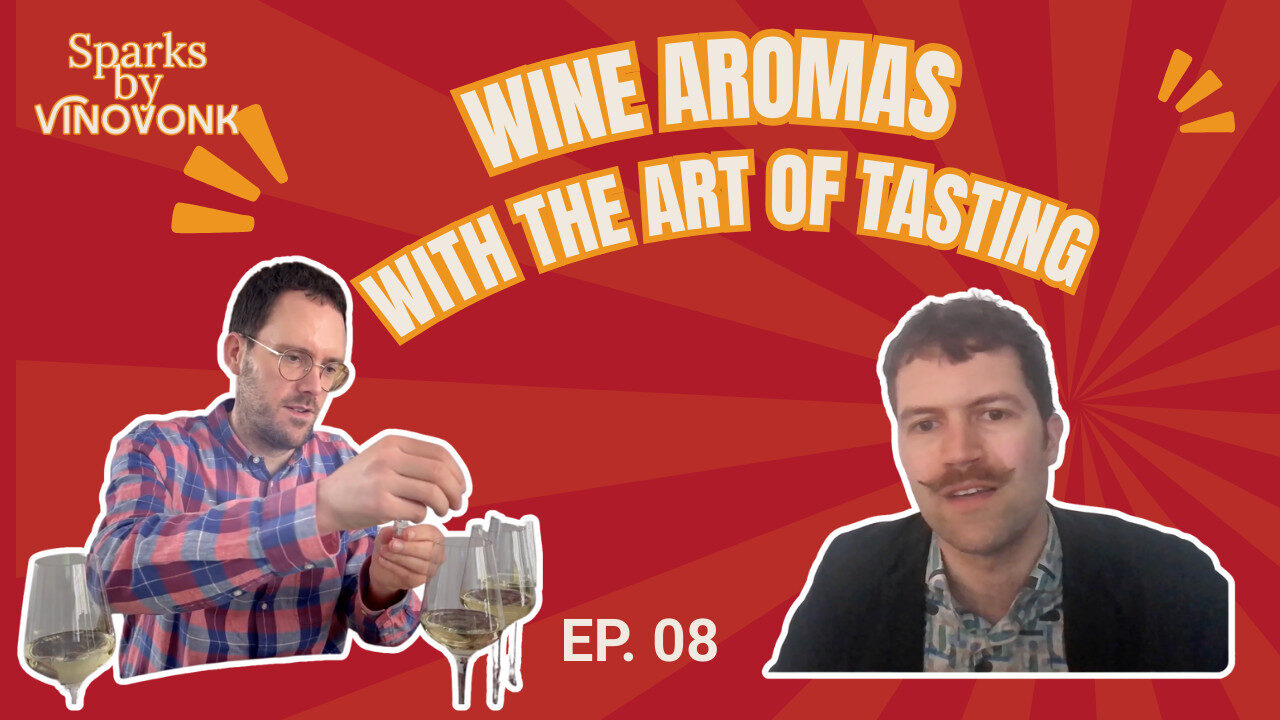
The green bell pepper in Sauvignon Blanc and the petrol note in aged Riesling both have a source, and it starts in the vineyard. In this episode of Sparks by VinoVonk, Sietze Wijma of The Art of Tasting explains where wine aromas come from. I tasted along at home: he had me buy a neutral white wine, and we dropped single aromas into separate glasses.
The Aromatic Trinity: Three Sources of Wine Aroma
Wine aromas are usually sorted into three groups. Primary aromas come from the grape itself and are already in the fruit before fermentation, such as the green bell pepper in Sauvignon Blanc. Secondary aromas form during fermentation, when yeasts turn sugar into alcohol and produce fruity esters along the way. Tertiary aromas, the bouquet, only develop as the wine ages. According to Sietze, Riesling’s petrol note belongs in that last group.
Green Bell Pepper: Already in the Grape
The green bell pepper in Sauvignon Blanc comes from pyrazines, compounds the grape makes itself. As Sietze puts it: “If you would be tasting Sauvignon Blanc grapes in the vineyard, then that green bell pepper flavour can already be noticed.” With many other aromas, he says, you have to wait until later in fermentation.
Climate decides how much of it survives. In a cool climate with shady vineyards, the grapes hold on to a lot of that green pepper; the warmer it gets, the more it ripens out. Sietze points to the Loire and New Zealand as places where you will find it. Give the grapes plenty of sun and Sauvignon Blanc moves towards elderflower, gooseberry, passion fruit and guava. That was our second glass. Sietze added that the compound in that second glass is also behind the cat’s pee note Sauvignon Blanc sometimes shows, and that it comes through more at a higher dose.
Petrol in Riesling: A Sunburn Story
The petrol note in older Riesling comes from TDN (trimethyldihydronaphthalene). It develops in bottle, typically after around five years as a rule of thumb, according to Sietze. How much you get is already shaped in the vineyard: “The greater the sunlight exposure of Riesling grapes during ripening, the more petrol flavour you’re later going to get during that bottle ageing.” The grape makes pigments to protect itself against the sun. They have no smell of their own, but in bottle they break down into that petrol note. In extreme cases the grapes get sunburnt, turning shrivelled and brown on the sunny side, and wine from those grapes will carry a lot of petrol, Sietze says.
The glass made me think of Riesling straight away: a touch of petrol, a lot of thickness, peach and nectarine.
Learning to Smell with Wine Instead of Vials
Sietze picked up the method during an internship in England, at a company that makes aroma standards, mostly for the beer industry. He only uses compounds that occur naturally in wine, at concentrations you could reasonably expect to find there. That means you can taste the glass as well, which you cannot do with a classic smelling kit. What people smell depends on their background, he says. A South African taster described the green pepper glass as blackjack, a plant common there, and a Chinese participant called it ginseng. “What could be your green bell pepper could be someone else’s ginseng.”
Caveats
- A base wine with one added aroma is only an approximation of Riesling or Sauvignon Blanc. Sietze added no acidity and points this out himself: everything about the glass says Riesling except the structure.
- Not everyone picks up every aroma. According to Sietze, finding out where your blind spots are is part of the point.
- He sees his classes as an addition to WSET or the Wine Scholar Guild, not as something better.
- The kits with ready-made wines cannot be shipped everywhere, the US being one example. Prices did not come up in the conversation.
- I tasted three aromas and one blend, with an organic Pinot Grigio as the base. That is an introduction, not a full course.
Introduction
Jeroen Vonk: Hi and welcome to a new episode of Sparks by VinoVonk. My name is Jeroen Vonk. I will be your host today, of course. Today I have a very special guest. He’s also from the Netherlands, but we’re going to talk English. His name is Sietze Wijma from The Art of Tasting. Hi Sietze.
Sietze Wijma: I’m very good. How are you yourself?
Jeroen: Yes, I’m very well indeed. Thank you for having me. Today we’re going to talk about how aromas get into wine, maybe a little bit about wine faults in wine. But can you tell me, for people that don’t know and don’t already follow you on Instagram or other channels, who are you and what do you do?
Background & The Art of Tasting
Sietze: Yeah, certainly. So my name is Sietze, I’m from the Netherlands. I have a master’s in sensory science, which is the academic study of flavor perception. So it’s where you learn about the senses of smell and taste. A couple of years ago, I founded my company, The Art of Tasting, because I felt there was a desire for a more systematic approach for learning to identify wine aromas.
I give in-person classes, but I also create tasting kits, which I send to people’s homes. I’m using a method of presenting wines with added aromatic compounds - these are basically wine samples or examples that you can use to train yourself in common wine aromas such as green bell pepper or butter or cloves. It’s also a method of training yourself in detecting faults, so picking up cork taint or reductive or oxidized wines. That’s in a nutshell what I do.
Jeroen: Is it only suitable for wine professionals, wine experts, and also for consumers?
Sietze: So I get a mix of people that are interested in my classes. Often they are people that face tasting exams, such as those from the Wine and Spirit Education Trust or Master of Wine exams, Master Sommelier exams, et cetera. They are just trying to get extra practice in identifying aromas, and they’re also there to explore their sensitivity to wine aromas. This is a method where you can identify your potential weaknesses as well as your strengths. Not everyone is able to pick up every wine aroma that exists.
The wine faults classes are a bit more technical, very popular with sommeliers that rely on being able to identify faults on the restaurant floor. And just wine geeks in general that are really interested in the technical and scientific details of wine aroma and flavor.
Origin of the Method
Jeroen: I love your approach a lot, but how did you come up with the idea?
Sietze: This was shown to me when I was doing an internship in England. I was still doing my masters at the time and I was working for a company that produces these aroma standards or aroma chemicals. They mostly apply it in the beer industry. I thought this is an incredible method - I was just immediately mind-blown by its effectiveness. And I had the desire of introducing it in the world of wine where it’s a bit less common than in the beer world, and decided to found my own company.
Jeroen: Because you’re, I don’t know for sure, but you’re the only one who’s doing this.
Sietze: There are some, so yeah, to the scale that I’m doing it, that is true. I’m the only one that makes it, say, accessible. There are for sure some academic programs, as well as some research institutions that offer some classes like this. But as far as I know, they have no intention of expanding or offering it on a larger scale. My idea is to have it accessible everywhere so that hopefully in a few years from now in most places in the world you can sign up for these classes.
Practical Experience
Jeroen: Yeah, because during WSET Level 3, I had some experience with the Amsterdam Wine Academy. Our teacher, Wouter, is also doing the Master of Wine program now. He also gave us some samples and we thought, what is this? During my last champagne specialist course, our teacher, Anja Von Nof, also put in some aromas that she got from you to find out how a champagne that is very oxidized smells and tastes. And it was like, is this? Well, this is a very extreme example. But later in the course, she had an example of an oxidized champagne. And we immediately smelled, oh, this is oxidized.
Sietze: Yeah. So that would have been an example of, say, where the flavor develops naturally. But not in a very good way. It could be a style, but it wasn’t.
Jeroen: But I mean, very happy to hear that the method seems to be working according to your stories.
The Tasting Method
Jeroen: It’s like expanding, you have the little aroma flavors of smelling kit, where you can smell the different kind of aromas, but you can’t taste them because it’s not suitable for taking it in. But you have the aroma that you can smell in the wine and taste it also.
Sietze: Yeah, exactly. And that is possible because I’m specifically looking for the aroma compounds or molecules - another way to call them - that are found to exist naturally in wine. And I’m also adding them at a concentration that you can reasonably expect to find in wine. So that is a bit different with some alternative kits that might have these aromas in very high concentrations and then it wouldn’t be suitable for consumption.
Jeroen: But you use it for educational purposes. But the company that makes these aromas, why do they make them? Do they make them for wine and, okay, we want a typical green bell pepper flavor in it. Okay, let’s put it in.
Sietze: Yeah, I see where you’re coming from. So that company that I used to work with, they produce them for educational purposes actually. And you might ask yourself, are there winemakers that just add a little bit of those flavors to make their wine taste better? That is typically not allowed. It might happen, it would be quite difficult to prove because once you’ve added your aroma to a wine there’s no way to tell by chemical analysis whether that flavor was added or whether it was developed naturally by the grape. And also by smelling or tasting it would be impossible to tell.
Jeroen: But you could think like, how do you know how much to add? How do you know if your wine will taste better and sell better? Usually those are questions that you don’t have an answer for before you start adding those aromas.
Sietze: I think there’s limited application in trying to make your wines taste better with just aroma additions.
Jeroen: Yeah, because you said, okay, it’s not possible to do a chemical analysis, but that is because the molecules that are in the aromas are exactly the same as they are naturally in the wine.
Sietze: Yes, 100%. So by chemical analysis, you would find that green bell pepper compound, but you can’t tell whether that was produced by the grape or whether it was artificially added.
Practical Demonstration
Jeroen: Very interesting. And I got a grocery shopping list from you. I had to buy a Pinot Grigio.
Sietze: Perfect, yeah I have the same thing, well I’m using an inexpensive Chardonnay here but the principle is the same because it’s just a neutral, inoffensive entry-level wine and that’s perfect indeed as a base wine for using those compounds. So I’ve done the same as you did I think, I’ve poured four glasses of that same wine and I think this is probably a good time to start adding some of those aromas.
Jeroen: Yeah, what are we going to do?
Sietze: So let’s keep one glass unchanged. So let’s move one to the side. We’re not going to do any additions to that. And then let’s pick up the vial, which is number one.
Jeroen: Yeah, perfect. Yeah, that’s the number one. And then you just gently squeeze the top?
Sietze: You can unscrew the cap. And then above the glass, yeah, you just press onto the pipette and it will make the liquid fall inside the wine.
Jeroen: It’s like you’re spiking your own glass.
Sietze: Precisely, then you just put the closure back on the vial and then give it a swirl so that the flavor mixes in nicely. And this doesn’t take too long, it’s like one or two minutes and it’s completely dissolved. Let’s go ahead with numbers two and ten as well. So I’ve just made a selection of three aromas that I’m using by default in my classes and in my tasting kits.
Available Products
Jeroen: So you have tasting kits that you can send and do you send them worldwide?
Sietze: I have two types of tasting kits. One where you receive wines with the aromas pre-added. Then there’s the other type where you receive the aromas on their own, like I’ve sent to you. And the first one, I’m shipping to most countries except where I cannot ship wine, such as the USA. You can’t ship wine directly to consumers. But the flavoring vials I ship worldwide, so these ones.
Tasting the Base Wine
Sietze: So why don’t we go to the reference wine? We’ll call it the reference wine because there’s no aroma addition there. And just give it a smell. There shouldn’t be too much going on. I think we can just call that wine and then move on to the next one.
Jeroen: Yeah, it’s a typical little bit flat Pinot Grigio. I chose to buy an organic one, so it’s more pure, but it’s not very aromatic. Just some apple, some lime, lemon, nothing special.
Sietze: Yeah, not too expressive, just some fruity notes. Why don’t we go to glass number one?
Aroma #1: Green Bell Pepper
Jeroen: Woo. I’ll give this one away. That’s the green bell pepper.
Sietze: Yeah, it’s precisely that. It feels like you’re chopping some vegetables and you have the green bell pepper and yeah, very typical.
Jeroen: Vivid description indeed. That’s one way of looking at it.
Sietze: The other descriptor I really like is green beans. So it’s the same thing. If you’re chopping green beans, like you’re removing the ends of the beans, so before boiling them, that releases the same smell. So like raw green beans. And also a little bit like green chili pepper.
Jeroen: I think that’s a really good call.
Sietze: So there’s different ways that you could be looking at this. And that is of course also reflecting what your background is or what you’re used to in terms of what you’re consuming, what you’re cooking with. So I run these classes in different places in the world and I get some very interesting descriptors. For example, this South African taster described to me, “Hey, that smells like blackjack.” And blackjack is apparently a type of plant that’s common there. Similarly, I had a Chinese participant and they told me this smells like ginseng - also something that I didn’t know existed, but it’s apparently this type of root that’s very common in their kitchen, but they also use it for medicinal purposes. So I like this approach because it also identifies like what could be your green bell pepper could be someone else’s ginseng.
Jeroen: Very interesting that you do these kind of classes, in-person classes, over the whole world and teaching the whole world about aromas, how they become in wine, but you’re also learning about the flavors and aromas of other sides of the world.
Sietze: Yes, precisely. And then maybe one day I can make a dictionary, you know, like if you’re smelling this, then the other person is smelling this.
Jeroen: I heard it one time from a winemaker from Priorat. She did a tasting in Japan and they also gave different kinds of descriptors like, okay, we have a citrus fruit. But there they have different kinds of citrus fruit. We have lemon, lime, maybe a bergamot and that’s it. But there they have lots of citrus fruits. And they say, this kind. Don’t you know it? The next day, they bought a big bowl of all different citrus fruits. And so you can smell the differences.
Sietze: Yeah, wow, okay. Yeah, that makes so much sense. There’s so much more diversity there. I guess it would be like saying a wine smells of vegetables here and you’re like, well, what type of vegetable?
Sietze: Anyway, I think you would have smelled this aroma in a wine before. Can you tell me what grape varieties this reminds you of?
Jeroen: This grape, a little bit of Sauvignon Blanc.
Sietze: Perfect! That is exactly the white grape variety that produces this aroma. There’s a couple of red varieties that do it too.
Jeroen: Cabernet Sauvignon as well, and Cabernet Franc.
Sietze: But just in terms of white wines, Sauvignon Blanc is indeed the grape variety that produces this, specifically if they are grown in somewhat cooler climates. So the warmer the climate, the more of the green bell pepper flavor sort of disappears and ripens out, but if the climate is very cool and the conditions in the vineyard are shady, so there’s not that much sunlight reception by the grapes, then you’re retaining a lot of that green bell pepper flavor and then it becomes very prominent in a finished wine as well.
And it’s synthesized by the grape, which is interesting, so if you would be tasting Sauvignon Blanc grapes in the vineyard, then that green bell pepper flavor can already be noticed. That is unlike many other wine aromas where you have to wait until later in fermentation before they become apparent.
Jeroen: Yeah, very interesting.
Sietze: Yeah, so next time you’re trying a wine from the Loire Valley or from New Zealand, for example, like the cooler regions, you will most certainly notice some green bell pepper like this.
Jeroen: And in this way you build up your muscle memories, your wine memory also.
Sietze: Yeah, I like that term.
Aroma #2: Tropical/Gooseberry
Sietze: Would you like to explore the second smell?
Jeroen: Good!
Sietze: And here we are still in the Sauvignon Blanc territory. But this is a completely different side of Sauvignon Blanc. This is more of a riper style. The first one, the green bell pepper, is a sign of less ripe grapes. But here, if you are growing your grapes in very sun-rich conditions, then you’re getting more of this aroma. And there’s multiple ways that you could look at this. Elderflower being a very common descriptor as well as gooseberry, but there’s also some tropical nuances to it so passion fruits and guava - those are also descriptors for this particular smell.
Jeroen: I mean, they had a lot of flowers and a lot of like the Sauvignon Blanc from New Zealand that comes right up in your nose, but not the grapefruit kind of thing, but more the gooseberry and the white flowers. And a little bit tropical also. Peach.
Jeroen: And so it’s the same wine, but you just add some drops and it’s completely different.
Sietze: Exactly, it changes the whole style, right? Even though just a single aroma.
Jeroen: Yeah, just one single aroma, but could you also mix or blend different kinds of aromas?
Sietze: Yeah, absolutely, we can do that in a little bit. And the other thing you could do is, what could be worth doing, I think you still have that Vial 2 on hand, you could increase the concentration a little bit. So what you could do is pull up another dose and then add it to the wine. And that will also slightly change the perception of this smell. It’s still safe to smell and to taste. Because this is the same aroma that’s also responsible for the cat pee character in Sauvignon Blanc. And sometimes that comes across a bit more when the concentration is increased.
Jeroen: Yeah, it’s more direct in your nose. It’s obvious.
Sietze: That’s very interesting. Good, but we can also, what you just suggested, blend these. I think we can do it just using the wine. So if you pick up one or two and you just pour one glass into the other, like that. And maybe pour a little bit back because the glass is a bit full.
Jeroen: Yeah, that will do.
Sietze: So if you smell this, it is precisely those two Sauvignon Blanc aromas together and all you’re smelling basically here is Sauvignon Blanc.
Jeroen: Yeah, and it’s like green bell pepper with peach, white blossom, a little bit like pineapple also.
Sietze: Yeah, the tropical aspects are true too.
Jeroen: I think when you do a blind tasting and you don’t see what it is, you could also think this is a red wine.
Sietze: Go ahead, explain.
Jeroen: Because of the green bell peppers, you could also think, okay, this is a red wine, but a little bit on the floral side. But yeah, if you don’t see it, you could think, okay, this is a red wine.
Sietze: I could be convinced, yeah, I hear what you’re saying.
Aroma #3: Petrol/TDN (Riesling)
Sietze: Would you like to explore the last aroma?
Jeroen: Yeah, also the taste is very interesting to taste also.
Sietze: Right? Yeah, it’s very different. You probably tasted the reference wine already, but yeah, the flavor is different. Of course the acidity, mouthfeel, sweetness, it’s all unchanged. But those aromas are coming through. They access your nose via this route that exists between your mouth and your nose. So definitely everything you’re smelling will also be noticeable when putting the wine in your mouth.
Jeroen: Yeah, in this way you don’t see it as a wine fault because what you smell is what you taste also and it’s just typical what you find in different kind of wines.
Sietze: Yeah, absolutely. Yeah, the faults are something else. They’re unpleasant, but this is just, these are normal flavors. Are we going to wine flavor number 10?
Jeroen: Yeah, let’s do it. Immediately I think, oh Riesling. It’s like little petrol, a lot of thickness, peach, nectarine.
Sietze: Bang on, yeah, this is a chemical that’s called TDN. It’s an abbreviation for a very long chemical name I’m not gonna bother you with. But indeed, this is causing the petrol notes in Riesling. And that’s a super interesting aroma for a couple of reasons.
And if you classify the aromas in like primary, secondary, and tertiary, this is an aroma that would belong in a tertiary category because it develops during bottle aging. So as a rule of thumb, if you’re bottle aging your Riesling after, say, five years, this aroma typically becomes apparent. But the interesting thing is that what happens in the vineyard, during ripening of Riesling grapes, already has an effect on how much of the petrol aroma you’re later going to get during bottle aging.
The specific effect that has been found is that of sunlight. So the greater the sunlight exposure of Riesling grapes during ripening, the more petrol flavor you’re later going to get during that bottle aging. So I think that’s a really interesting effect.
Jeroen: The grapes, they produce a kind of component that protects them against sunlight. So it’s almost like a sun tan lotion, if you like.
Sietze: So it generates certain colour pigments, and they don’t have any flavor by themselves but during bottle aging they break down to form the petrol flavor.
Jeroen: So you could say that the grapes had too much sun during ripening and that way you get the petrol flavors.
Sietze: Absolutely, yeah. In extreme examples, grapes can actually get sunburned and that will show, it will manifest itself. It’s visible on the grapes. You will see sort of a shriveled, slightly brownish, dark side on the grapes where they’ve been exposed to the sun. If you use those grapes to make wine, definitely they’re going to get a lot of petrol flavor.
Jeroen: And I tasted this wine now and my brain is saying Riesling, it’s Riesling, it’s Riesling and I know, it’s really good, really good and it’s like…
Sietze: Yeah, and also the acidity is lacking. I didn’t add any acidity - that’s also something that can confuse your brain. Like everything about it is Riesling except that the structure is not at all Riesling.
Educational Offerings
Jeroen: If people want to learn about this kind of thing, they could order tasting kits, but then they don’t get you or do you provide videos with it?
Sietze: I do have video recordings, I also have written material, I have PowerPoint slides that they could follow. So indeed, I have an online store where people can buy these aroma kits. And I give in-person classes as well. So that’s where you get to try all of the samples that we’ve tried together today. I’m hosting some classes in Amsterdam soon in collaboration with Amsterdam Wine Academy.
Jeroen: When will that be?
Sietze: That is in June. It is on the 13th and the 14th of June. So I have two days dedicated to this.
Jeroen: And what kind of classes are you doing then?
Sietze: I’ve separated those into three different themes. So there are three classes of two hours each available. One is dedicated to wine faults and one is dedicated to the positive flavors that you find in white wine. So some of the varietal characters like we’ve discussed today. And then the third session is dedicated to aromas found in red wines.
Jeroen: How many wines will you be tasting then? Are you going to do all the 10 aromas?
Sietze: Exactly, yeah, so it’s actually a total of 11 glasses. One glass is kept unchanged as a reference, then the other 10 glasses each have a single aroma added and it looks like what we’re trying today. So we’re talking about what it smells like, what it tastes like and what the origins are, how they form in wine.
Jeroen: It’s very interesting because you’re learning a lot and you’re expanding your brain, you’re challenging yourself. If you want to find out if there are any free spaces during the class, I put a link in the show notes. And also a link to your website. I think it’s artoftaste.com.
Sietze: Yes, artoftasting.nl actually. It’s a Dutch domain.
Wine Faults
Jeroen: And these were the aromas. Very interesting. Thank you very much for this opportunity. I learned a lot from this. But could you tell something just a little bit about wine faults?
Sietze: Yeah of course. In my kit I present some of the most common wine faults. Arguably the most famous one is cork taint. It’s a wine fault that develops in one in every hundred bottles that are fitted with a natural cork. And if you’re unlucky that cork is tainted with molds, and molds produce a component called TCA. That’s short for trichloroanisole.
So it’s the aroma that gives cork taint its characteristic musty smell. The TCA then moves from the cork into the wine and then your wine is just ruined basically. Common descriptors are wet cardboard. So it smells like something wet, something moldy. It has kind of a damp basement or attic smell.
Jeroen: It’s like an old smell to it.
Sietze: I hear descriptors like leather jackets for example as well or secondhand store kind of clothes. Anyway, this is an aroma that also has caused a lot of producers to move away from natural corks and use screw caps or cork alternatives. So there are some technical alternatives available these days that have been routinely cleaned and produced in such a way that the risk is very low of TCA.
So there’s a lot of improvements been made, but it still remains a big problem in the wine industry. Even though in the past, rates or incidences used to be much higher. So like in the 80s and 90s, cork production was different. You’d be looking at like 5-7 bottles in every hundred that were cork tainted, so a lot more than what you see these days, but it still remains a problem.
Jeroen: Nowadays you see a lot of cork that is like little pieces of cork glued together, like they call agglomerated, I think.
Sietze: Yes, perfect. You could even call it a granulated cork. So they’re like really small cork particles that have been individually cleaned and then put together using an adhesive. And indeed that type of cork can then be used to fit a bottle, and cork taint rates are dramatically reduced.
The technique has advanced to such a way that they can even clean whole cork pieces. So even the complete natural corks consisting of one piece of cork, they can be cleaned using that method these days. So definitely a lot of improvements.
Jeroen: What kind of wine faults are others like? Do you have like reductive or oxidative aromas?
Sietze: So oxidation is the exposure of too much air basically to wine, which can happen in very different scenarios. It can happen in the winery where there is, for example, too much air space in a fermentation tank, but it can also happen when you’ve opened a bottle and you’ve left it open for too long and it becomes oxidized.
And reduction is a bit of a different problem. It usually arises during fermentation when yeast is stressed. As a result of lack of certain nutrients or lack of oxygen, it starts to produce smells that belong to the category of sulfur compounds and those smells include almost like boiled eggs, rotten eggs, drains, camembert - so very unpleasant indeed.
And then another fault that’s receiving more attention today is that of smoke taint. Smoke taint happens when, during grape ripening, there has been a wildfire nearby. When you’re unlucky, the smoke from that wildfire can travel into your vineyard and then it can affect the aroma and flavor of grapes.
Especially in the face of climate change we’re seeing more wildfires - you see it all over the news. Indeed during grape ripening it can have an effect on wine flavor and the wine starts to smell of an ashtray and like smoky salmon. It’s not very pleasant.
Jeroen: A funny thing was that I did a masterclass about ice wine and they produce ice wine in Canada, but in Canada they also have a lot of fires. And they have a lot of Riesling there. They said, okay, we have a lot of fire, so we can’t make any wine, so just leave it. And then it starts to freeze. Oh, let’s make an ice wine with it. And because of the concentration of the juice, the smoke flavors and aromas don’t appear in ice wine.
Sietze: Ah, a very interesting technique. I hadn’t seen it like that.
Jeroen: The funny thing is, with climate change, more fires, okay, then you think, okay, let’s, when you get a fire, make an ice wine. But because of climate change, it freezes less and less hard. So you can’t make ice wine every year.
Sietze: Yeah, so that’s a solution with some limitations.
Future Outlook
Jeroen: During your visit in Amsterdam you will also cover wine faults. What do you think about the future? You have 10 aromas in white wine, red wine, 10 wine faults. What do you think the future will bring?
Sietze: In terms of what the future holds for my classes or my company?
Jeroen: Or do you think new aromas will be detected, new wine faults, or maybe, okay, these wine faults aren’t so bad? Like reductive wines - a lot of people like reductive wines.
Sietze: Right, okay, so I think there’s a lot to that question. We do see indeed wine faults evolving, so some of them becoming maybe more of a problem and others become less of a problem as a result of climate change but also improvements in wine production technology.
There will always be a market for people that are after somewhat more funky wines. So those wines that maybe show certain faults at a particular level where it could contribute some complexity and provide a wine character that is different from conventional wines. So that is always a very interesting point of discussion I think. For some people one fault might be completely ruining the wine whereas for other people it could provide some extra dimension to the wine.
In terms of what my company holds, maybe at some point people will realize this is an alternative to more traditional smelling kits such as Le Nez du Vin and they will see what the pros and the cons are of my method versus the existing methods. And I would love that wine schools, next to their Wine Spirit Education Trust Program or their Wine Scholar Guild Program for example, they would consider offering some Art of Tasting classes as well. Not because it’s better than the existing programs, but I feel like it’s a very valuable addition and you learn something that is maybe not covered by the other programs.
Conclusion
Jeroen: That sounds very interesting. The future looks very promising. I learned a lot. So, Sietze, thank you very much for your time. If you want to learn more, go to the website, theartoftasting.nl. Visit also the link for in-person classes. I’m sure you will learn lots more. We only had three aromas which we mixed so we had four aromas. Thank you very much for your time and looking forward to seeing more videos of you on Instagram.
Sietze: Pleasure. Nice chatting with you. Take care.
Watch or listen to the episode
Sources
- WSET, wine aroma chemistry: wsetglobal.com
- AWRI (Australian Wine Research Institute), methoxypyrazines, TDN: awri.com.au
- Jamie Goode, The Science of Wine: wineanorak.com
More on Sparks
1979 Wines: Eleni Kechri's Science-Driven Retsina
Eleni Kechri of 1979 Wines makes retsina with sustainably tapped resin from different forests. Three bottles, one vineyard, and what the resin changes.
Read on →
Enrico Rivetto: Barolo, Biodiversity, DOC Rules
Enrico Rivetto planted over a thousand trees among his Barolo vines. I tasted his Langhe Nascetta and we talked Demeter, daughter-drawn labels and doubt.
Read on →
Stamatis Mylonas: Savatiano That Ages Well
Stamatis Mylonas on Savatiano from Attica: old bush vines, mineral soils and a 2016 Gran Reserva that still tasted fresh and taut when I opened it.
Read on →