

Rutger Siersma on Wine Trends and the Robust Podcast
Rutger Siersma of Robust podcast on wine trends in 2025, his vineyard experiment in Twente, and why the story behind the bottle matters more than ever.
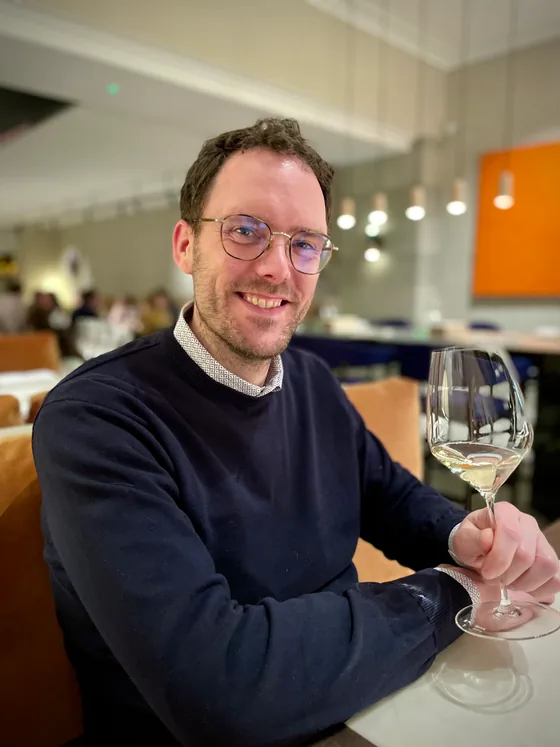

Rutger Siersma has worked in wine since he was fifteen, starting out at a traditional wine shop. At twenty-six he went it alone with Wijnadvies.nl. He also hosts the Robust podcast, which he and I both like to call the wine podcast of the Netherlands, and these days he can be found pruning Sauvignon Gris in Twente. On Sparks by VinoVonk he talked me through what he sees in his shops and at the trade fairs.
A Multimedia Wine Business
Rutger pitches his company as “the most multimedia wine business in the Netherlands.” You can buy wine on every street corner and all over the internet, he says, so he wants to tell the story behind the bottle. “Why is that wine so special? What makes the person who makes it so special?”
He does that in a few ways. Robust is a weekly thirty-minute podcast, recently moved from Friday to Thursday mornings, which he records with his colleagues Jorgen and Arjan. The Wijnadvies YouTube channel carries documentaries, including trips through France. And there is a running series on whether they could start a vineyard of their own in the Netherlands.
Perswijn once named Wijnadvies.nl the second-best online wine shop in the country, he mentions.
The Vineyard Experiment
Season 1 of that series is on YouTube in full. It asked whether a vineyard of their own in het Gooi, the leafy area south-east of Amsterdam, was realistic. The answer was no. They probably could have done it, Rutger says, but a vineyard means walking the rows every week, and common sense told them not to take it on.
For season 2 they struck a deal with Twente Wijnhof and now lease two small plots there. One gets a young planting in May; the soil survey has just been done. The other is a five-year-old block of Sauvignon Gris that needed pruning straight away.
When I saw the footage they were frozen stiff, but Rutger found it a real education. “Pruning is more work than the picking at the end.” You count how many buds to keep, and later you train the canes along the wire, almost massaging them, nearly breaking them as you fold them through. He loves it, though it is a lot of work.
Wine Trends in 2025
Wijnadvies has two shops, in Baarn and Huizen, plus a webshop that mostly serves the same region. Rutger finds it hard to name a single trend, because every customer wants something different. What he does notice is that people increasingly want to know where a wine comes from. He admits that sounds a bit like preaching to the choir.
He sees the pandemic as a turning point. Sales and consumption shot up, then came a backlash. People are more careful about how much they drink, but also more curious about what they drink, and they are happy for it to be a bit adventurous.
His customers in het Gooi still stick to familiar ground, though. American Chardonnay continues to sell very well. Orange wine has not taken off, and he sells hardly any alcohol-free wine. Organic and biodynamic wines do fine, as long as they are not too experimental.
Non-Alcoholic Options: An Honest Assessment
Rutger is upfront that his business does not focus on alcohol-free drinks. He keeps an eye on the market, and the trade press says the category is booming. December brought a small uptick for his limited range, but during Dry January he barely sold any alcohol-free wine.
When he takes a break from wine himself, he reaches for good alcohol-free beer, where he thinks the quality is there. With alcohol-free wine he is still looking for something to hold on to, and when it lets him down he puts the kettle on instead.
So het Gooi was not exactly dry in January. Rutger says it was his best January ever, business-wise, which he would not have dared predict.
Emerging Wine Regions
At Horecava and Wine Professional, Rutger noticed a lot of promotion for lesser-known, up-and-coming corners of Europe. Eastern Europe drew most of the attention, along with regions you rarely see in the Dutch trade, such as Alto Adige, which had a handsome stand. In his view there is still plenty to discover there, including good value.
Germany brought a strong line-up, with Rheinhessen to the fore. Rutger has been calling it a rising star of Europe for a few years now. “Keep an eye on those lads,” he says, because he thinks they are pulling off something special compared with France’s famous regions.
From Eastern Europe he names three. Anyone in the trade knows Calusari from Romania, a dirt-cheap bulk wine that often came up on Robust. For quality he points to Slovenia, the subject of his latest podcast episode. And he is watching Georgia, where wine began and where Western know-how is now helping producers make better and better wine.
All of this is one merchant’s view from two shops in het Gooi. What sells or sits on the shelf there does not necessarily say much about the rest of the Netherlands.
More about Wijnadvies: www.wijnadvies.nl
Watch or listen to the episode
Sources
- Robust Podcast (official): robustpodcast.nl
More on Sparks
1979 Wines: Eleni Kechri's Science-Driven Retsina
Eleni Kechri of 1979 Wines makes retsina with sustainably tapped resin from different forests. Three bottles, one vineyard, and what the resin changes.
Read on →
Enrico Rivetto: Barolo, Biodiversity, DOC Rules
Enrico Rivetto planted over a thousand trees among his Barolo vines. I tasted his Langhe Nascetta and we talked Demeter, daughter-drawn labels and doubt.
Read on →
Stamatis Mylonas: Savatiano That Ages Well
Stamatis Mylonas on Savatiano from Attica: old bush vines, mineral soils and a 2016 Gran Reserva that still tasted fresh and taut when I opened it.
Read on →