

Enrico Rivetto: Barolo, Biodiversity, DOC Rules
Enrico Rivetto planted over a thousand trees among his Barolo vines. I tasted his Langhe Nascetta and we talked Demeter, daughter-drawn labels and doubt.
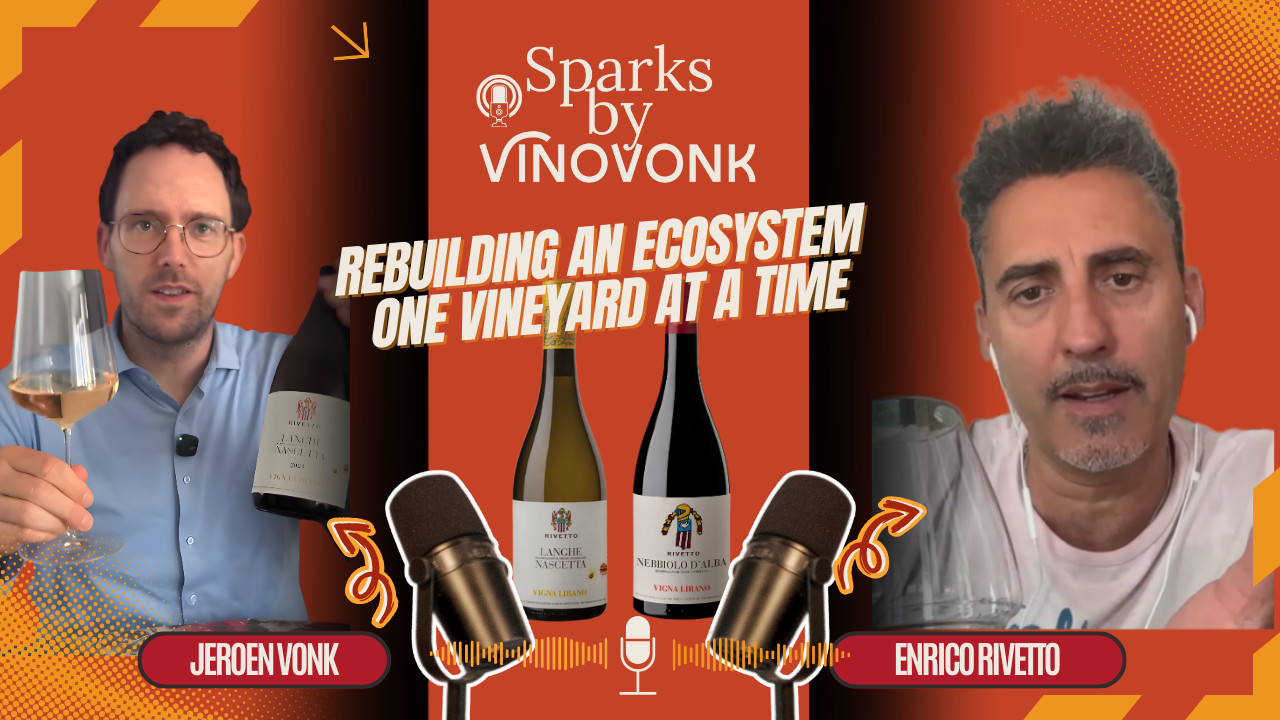
On the hill of Lirano, between Serralunga d’Alba and Sinio, Enrico Rivetto has planted more than a thousand large trees in twelve years. In a district where you see little but vines, he keeps bees, donkeys, old cereal varieties and seven hectares of woodland. He is the fourth generation of a family that has made wine since 1902, and since he turned thirty he has been doing it differently.
I spoke with him for an episode of Sparks by VinoVonk. He sent me two bottles from that hill: the Langhe Nascetta “Borea” and the Nebbiolo d’Alba Vigna Lirano. The conversation was at least as much about farming, biodiversity and labels as it was about wine.
From Winemaker to “Caretaker of an Agricultural Organism”
“Since we started a more open biodiversity project seventeen years ago, I cannot be considered only a wine producer,” Enrico says. “More like a caretaker of an agricultural organism. I can define myself in this way.”
His winery sits in the middle of the Barolo zone, in southern Piedmont, on a hill called Lirano. The name is on both bottles. “Seventeen years ago, when I was thirty, I started a different approach in the vineyard, and of course also in the cellar and in my life,” he says. “We decided to recreate one complex ecosystem.”
Why Biodiversity Matters in Barolo
The Langhe is monoculture country. “You see vineyards everywhere. But it was never like this,” Enrico says. “Before, there was much more differentiation of the cultures.”
He thinks that is harder to break in Barolo than elsewhere in Italy. In Sicily, Umbria or Lazio the vineyards are less densely packed, so some natural variety is already there. In Barolo the area is small, the land is expensive and the wine is famous. Biodiversity costs more there, and it is a bigger step mentally too.
What he has done: more than a thousand trees in twelve years (“big trees”, he stresses) and five kilometres of biological corridors planted with rosemary, sage, lavender, mixed shrubs and fruit trees. There are six beehives. Seven hectares of woodland form a buffer around the winery. There is a field of wheat, old cereals and an old variety of maize, a spot for making compost, and donkeys. At four hundred metres sits a pond that waters the other crops (not the vines) and supplies the biodynamic preparations, because tap water contains chlorine.
“Everything is on my hill,” he says. Around 85 percent of the estate is in one place, “and that’s a big advantage.”
Demeter, and Three or Four Hard Years
All of his vineyards, fields and the cellar are Demeter certified. Enrico committed to biodynamic farming in 2006 and gained certification in 2014. “If you do it, you have to do it for 100% of what you produce.”
Converting from conventional farming was tough. “The first three, four years were terrible,” he says. He lost yield, the soil was full of pesticide residues, and it took about five years before a vintage where he felt he had found his balance. When his vines struggled he doubted the whole project, until he realised the doubt came from comparing them with his neighbours’ tidy conventional vineyards. “I had to change the benchmark.”
After that he saw more birds and insects, and more fragrant grapes with more flavour. He accepts lower yields and higher investment as the price. He is also candid that he experiments a lot and that not everything works. He is just as direct about his wines: they vary from vintage to vintage. “If you like this type of authenticity, you will love us. If you like more standardisation, perfect execution, international style, you will not like us.”
Terroir and Technology in the Cellar
Enrico is not against technology in the cellar, only against the idea that technology is everything. New tank materials or temperature control are fine by him. He uses sulphites and filters, “but these are the maximum things that I do”. If the soil is sick or full of chemical residues, he argues, the wine cannot express its place, and no amount of cellar work fixes that.
“A Barolo has to be like Barolo,” he says. “In this sense I’m a conservative. But to be a conservative sometimes is also to be a revolutionary.”
Langhe Nascetta “Borea”: A Grape That Nearly Vanished
Nascetta is an indigenous white grape from Piedmont. The name, Enrico says, means something like “small, just born”. The variety is old but almost disappeared: it yielded little and the vines were fragile, so many growers pulled it out for other grapes. Over the last twenty years a handful of producers brought it back, “crazy people, including me”. Enrico planted his Nascetta in 2006. It is his only white; the rest of the range is red.
The vineyard faces east. It gets the morning sun and falls into shade around three in the afternoon, so the grape does not lose too much acidity, something Nascetta is prone to. Harvest is in early September. The name Borea came from his wife, who studied classics: Boreas is the Greek god of the north wind.
What I Tasted
Enrico promised white flowers, citrus and herbal notes. I got flowers and citrus, mostly grapefruit, and something herbal along the lines of rosemary. Intense and aromatic, but also slightly creamy, with some body. I found minerality and a touch of saltiness; Enrico links that to magnesium and manganese in his soil. Enrico says the acidity is high, which not every vineyard nearby can claim.
The green side, the rosemary and sage, keeps it fresh. It is not a fruit bomb; there is depth to it. I thought it was a beautiful wine.
Enrico also suggested drawing air through the wine while it is in your mouth. With biodynamic wines, he says, more aromas come through that way. That is his experience; on one bottle I cannot confirm it.
Nebbiolo d’Alba Vigna Lirano
The second bottle comes from a single vineyard: the first Nebbiolo vineyard Enrico farmed biodynamically from the start, planted in 2009. He prepared the soil beforehand with biodynamic preparations, which he calls “homeopathic medicines for the soil”. In his view the wine has been good since the first vintage he bottled.
We did not taste this one together in the episode, so there is no tasting note from me here.
The Label That Was Not Allowed
His daughter drew both labels: the Nascetta when she was six or seven, the Nebbiolo when she was eight. The producers’ organisation turned them down at first. The label covered most of the bottle and, they said, was not a serious label. “You can tell me that the wine is not good, but not the label,” Enrico replied. With the Nebbiolo he went further: if you don’t approve it, I won’t make the wine. Approval came after two or three years. Today the label covers half the bottle.
His daughter is now a bit embarrassed by them, since she could do much better now. I loved the labels from the start. Enrico calls them light, fresh and simple, the way a child draws.
What Comes Next
Enrico had just planted a vineyard with several indigenous varieties from north-west Italy growing together, a mixed planting. He wants more data: numbers of bees and butterflies, polyphenol extraction. And he dreams of a network around the winery, with farming courses and an exchange of knowledge and produce. He avoids the word community; it reminds him too much of the sixties.
“It’s a quantum physics rule,” he says. “If I do something, even in a small place, on a small scale, the energy that it develops, somebody in some other part of the world can receive it and can do the same thing.” And: “We don’t have to expect that somebody does something for us. You have to do it yourself.”
People who don’t share his way of thinking tend to drift away, he finds. He compares it to music: if you don’t like it, you stand still. If you do, you start dancing, in your own way.
Caveats
I only tasted the Nascetta during the episode; for the Nebbiolo I have Enrico’s account, not my own impression. Vintages did not come up in the conversation. Whether the wines were available in the Netherlands, I did not know at the time of recording. And Enrico himself says his wines change from vintage to vintage: if you want a polished international style, look elsewhere. The conversation was recorded around 2021; ‘seventeen years ago’ and the newly planted mixed vineyard date from then.
If you are ever in Piedmont, you are welcome at Lirano, Enrico said at the end. Salute!
Watch or listen to the episode
Sources
- Rivetto Dal 1902 (official, Sinio, Barolo): rivetto.it
- Consorzio di Tutela Barolo Barbaresco Alba Langhe: langhevini.it
- Demeter Italia: biodynamic certification: demeter.it
More on Sparks
1979 Wines: Eleni Kechri's Science-Driven Retsina
Eleni Kechri of 1979 Wines makes retsina with sustainably tapped resin from different forests. Three bottles, one vineyard, and what the resin changes.
Read on →
Stamatis Mylonas: Savatiano That Ages Well
Stamatis Mylonas on Savatiano from Attica: old bush vines, mineral soils and a 2016 Gran Reserva that still tasted fresh and taut when I opened it.
Read on →
Bodegas Viuda de Manjón: Sherry's Renaissance
Pablo García de León on Bodegas Viuda de Manjón: 175 years of sherry from Sanlúcar and Jerez, four Leaena sherries tasted, a vino de pasto on the way.
Read on →