

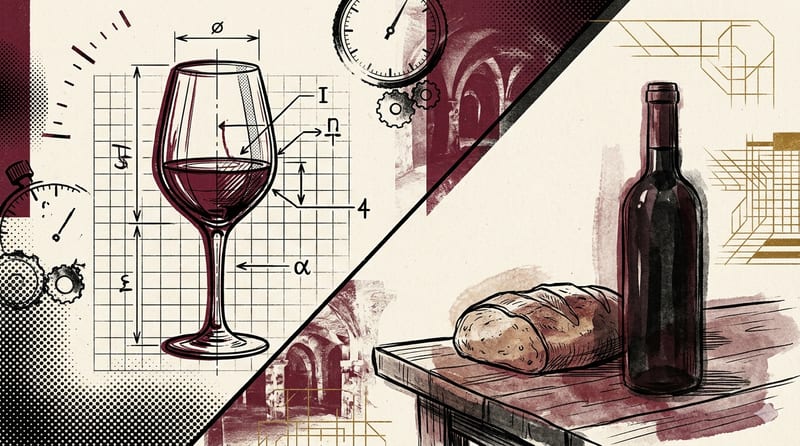
What tasting wine is
Tasting wine is not the same as drinking wine. Drinking is pleasure, tasting is paying attention. You pour a small measure, you look, you smell, you take a sip you walk across your tongue, and only then do you swallow. Or not, if there are twenty more wines waiting.
The goal: capture what the wine is, not whether you like it. Liking comes later. Observe first, judge second.
Anyone can learn this. You don't need a freak nose or years of practice before you can say something useful. You do need a quiet moment, a neutral glass, and the willingness not to talk your first impression away.
Before we get to the basics, the conditions need to be right. A quiet moment, a neutral glass, a wine at the right temperature, and a day on which the wine lets itself be read. What you taste depends as much on when and how you taste as on what's in the bottle. The next two sections cover both.
The basics: look, smell, taste
The order never changes. Three senses, one glass. Three steps, five minutes of work. Not judging the label, but what's actually in the glass.
Look
Tilt the glass against a white background. What colour? Lemon, gold, amber for whites. Purple, ruby, garnet, tawny for reds. How intense, how clear? On sparkling: are the bubbles fine and persistent, or quickly gone? A white drifting toward gold is usually older or oak-aged. A red with a brick rim has years on the bottle.
Smell
Smell still first, then swirl. A still glass releases subtler aromas that swirling blows off. One calm inhalation. What comes first? Fruit, and which fruit exactly? Flowers, earth, yeast, oak? Note that first impression before you start rationalising. It's almost always the most honest one.
Then a second pass for what sits underneath, and a third for faults: cork, vinegar, wet cardboard.
Taste
A small sip, draw a little air through your lips, and walk the wine across your whole tongue. Dry or sweet? Acidity, does it tingle on the sides? Tannin, that drying feel on your gums in red wine? How long does the flavour linger after you've swallowed? A wine gone after fifteen seconds is not a great wine. A wine still talking after a minute: pay attention.
One question to ask yourself: what's the dominant impression? That is the heart of the note.
The biodynamic calendar
Maria Thun was a German farmer who started an experiment in 1952 that ran for decades. She planted potatoes on different days and tracked what it did to the taste. Her findings became the biodynamic calendar: four kinds of days, each tied to the moon's position relative to a constellation.
Fruit days fall when the moon stands before Aries, Leo or Sagittarius. Flower days before Gemini, Libra or Aquarius. Leaf days before Cancer, Scorpio, Pisces. Root days before Taurus, Virgo, Capricorn.
Whether you can make this scientifically airtight is a different conversation. I only know that the same bottle reads more open on a fruit day than on a root day, and that producers like Nicolas Joly time their bottling around it.
In practice I work like this
- Fruit days: wines whose signature is fruit. Burgundy Pinot Noir, Riesling, Beaujolais, young Champagne. Anything that lives on clarity.
- Flower days: aromatic and floral. Gewürztraminer, Muscat, Albariño, older Champagnes where fruit has shifted into something more perfumed.
- Leaf days: mildly unfavourable for tasting. The wine flattens, structure is there but fruit sits behind glass. Useful for analytical work, not for pleasure.
- Root days: avoid serious tastings. The wine reads closed, sometimes even faintly musty. Good day for cellar work, filing notes, reading about wine instead of drinking it.
I plan blind tastings on fruit or flower days. Importer samples I open whenever they arrive, but I save the proper note for a second session if the timing was bad. Writing off a wine once because I drank it on a root day: I've done that too often to laugh about it now.
Fourteen days ahead
Calendar generated on 14 May 2026. Refreshes automatically on every site update. Source: Maria Thun's Aussaattage, with astronomical computation per Jean Meeus.
Levels: from beginner to Master of Wine
You can learn to taste wine at the level that fits you. Dutch and international wine schools run in parallel tracks. Here's how they line up, and what each level gets you in practice.
Beginner: SDEN 1, WSET Level 1
This is where you learn the words. What is acidity, what is tannin, what does oak do to a wine. A handful of grapes, a handful of classic regions. Enough to make a sensible restaurant choice that fits both dish and wallet.
SDEN (Stichting Dranken Examens Nederland) is a Dutch entry-level programme widely used in hospitality. WSET Level 1 is international, shorter, completable in a single day.
Intermediate: SDEN 2 & 3, WSET Level 2
At this level it's about how a wine is made. Grape, climate, soil, cellar work. You taste systematically using a fixed framework. You learn to describe the same wine the way a colleague in London or Hong Kong would, so notes become reusable instead of personal.
SDEN 3 takes you deeper into specific regions. WSET Level 2 does the same on a global grid and introduces the core logic of the SAT.
Expert: WSET Level 3, SDEN Vinoloog (4)
Here tasting shifts from skill into profession. The Level 3 exam means writing a blind tasting note that is internationally comparable. SDEN Vinoloog is the Dutch equivalent and goes deep on production and trade.
At this level the SAT (Systematic Approach to Tasting) becomes a second language. You don't just recognise what a wine is, you also argue why it is what it is.
Highest tier: WSET Level 4 (Diploma), Master of Wine
WSET Level 4, better known as the Diploma, is a two- to three-year programme of exams, papers and blind tastings under time pressure. It's the standard for wine professionals aiming higher.
Above that sits the Master of Wine, run by the Institute of Masters of Wine. Four years or more, three exam days of blind tasting, a research paper. There are fewer than four hundred MWs worldwide. There's also the Master Sommelier route via the Court of Master Sommeliers, focused on service and the restaurant floor.
At this level tasting turns from skill into dialect. You don't just identify Riesling, you place a Mosel Riesling from a producer you've never tasted before, on structure and style alone. That takes years.
I built my own foundation through WSET, and extended it with CIVC Champagne masterclasses, importer tastings, and visits in producers' cellars. What I learned in those programmes doesn't sit in my head as a checklist, but as vocabulary and reference points I fall back on without thinking.
The WSET SAT: four steps
The Systematic Approach to Tasting is the skeleton under the entire WSET curriculum. Not a checklist you tick off, but a shared language you use with colleagues anywhere in the world. Four steps, in this order.
Appearance
Clarity, intensity, colour. Tears and viscosity. For sparkling, the mousse: fine or coarse, persistent or quickly gone.
Nose
Condition first: clean, or is something off? Then intensity (light, medium, pronounced) and development (youthful, developing, complex, mature). Only then the aromas themselves, in three families. Primary from the grape (fruit, flowers, herbs). Secondary from fermentation (yeast, butter, bread). Tertiary from ageing (nuts, leather, mushrooms, caramel).
Palate
Sweetness, acidity, tannin in red, alcohol, body, flavour intensity, flavour character, finish. For sparkling also how the mousse feels: fine or coarse.
Conclusion
Quality, drinkability, ageing potential. And for those ready: which grape, which region, which year. The SAT takes time to become automatic. Once it is, you taste faster and write more precisely.
Deductive tasting and working blind
Blind tasting is the most honest instrument you have. You don't see the label. You don't know the price. What's left is what's in the glass.
Deductive reasoning is building a conclusion from what you taste. Colour speaks to age and grape. Acidity to climate and region. Tannin texture to variety and vinification. Aromas to terroir and ageing. WSET Level 3 introduces this thinking; at Diploma it's second nature.
At my CIVC Champagne masterclasses in Reims it went one step further: reading autolytic character (brioche, biscuit, yeast), gauging dosage on mouthfeel, identifying style from Brut Nature to Demi-Sec. Champagne has its own vocabulary alongside the SAT.
You only learn blind tasting by doing it. Start with a grape you know well. Have someone else pour. Write everything down before you guess. The guess is less interesting than the reasoning that came before it.
How I taste when I'm working
This is my working method. I use it when I'm writing tasting notes, working an assignment for a client, or prepping a bottle for the podcast. For a midweek bottle with dinner I skip all of it, I just pour and drink along.
Before I open it, the bottle sits on the table for an hour. I pick a neutral glass and check the temperature. Then I let the wine rest for half an hour. Not out of ritual, but because a freshly opened wine tells a different story than the same wine five minutes later.
Tasting is comparing. While I'm working, other wines run in the background of my head: same grape, comparable region, similar age. Whether a wine does what it should for its origin and price, I only know once I know what I'm measuring it against.
Price and quality belong together in that judgment. A fifty-euro Burgundy premier cru I measure against other premier crus at that level. An eight-euro Cava too, but against the best Cavas I know. The reference shifts, the sharpness doesn't.
I do give scores. For myself, to track where a wine sits: this style, this money, this moment. Sometimes a client asks for a number, I deliver it with the context attached. An 87 without a frame of reference says nothing.
After that I follow the standard order and taste the same wine again after five minutes. That second pass is usually where the note lives.
Keeping your notes
Tasting without writing it down is almost a waste. Today's bottle you'll compare to a new vintage two years from now, and without a note you won't remember why you liked it back then.
I built an app for it myself. Based on what I learned through WSET, CIVC masterclasses, importer tastings and time spent in producers' cellars. Knowledge as the skeleton, but for me it's really about the experience: the moment, the smell that reminds you of something, the image that stays. A form that leaves room for what a wine does to you, not just what's in it.
Open source, runs in your browser, stores everything locally. No account, no server, no tracking. You can export your notes as a Markdown file, email them to yourself, or print them for the binder.
Prefer pen and paper? Print a blank SAT-style sheet and fill it in by hand. Just as serious, and notes you wrote on paper are notes you actually remember. Four categories (wine, Champagne, spirits, alcohol-free) at three levels.
- Winebeginnerintermediateexpert
- Champagnebeginnerintermediateexpert
- Spiritsbeginnerintermediateexpert
- Alcohol-freebeginnerintermediateexpert
Prefer guided tasting? See the workshops →
Tips & tools
The glass changes what you taste
No Bordeaux out of a tulip flute. No Champagne out of something cylindrical. A neutral Zalto Universal or an ISO tasting glass covers ninety percent of what you need for serious work. The rest is trophy.
Cool sooner than warm
White wine at 8°C becomes 11°C on its own in a few minutes. White wine at 12°C never goes back to 9°C without another ice bucket. Champagne at 7°C is right for a serious bottle. For party-drinking, lower.
Water and unsalted bread
Not to rinse your palate, that's a myth. To slow down the physical experience so you actually taste instead of swallow. Bread absorbs fat, water resets temperature in your mouth.
Write the first impression down within fifteen seconds
After that you start rationalising and you lose the essence. One word. One image. One connection. Structure, acidity, finish, tannin: all of that comes second.
No perfume, no candles, no fried fish
A wine's nose is more fragile than most people realise. The room you taste in is the instrument you taste with. Treat it that way.
Taste blind, regularly
Not to win quizzes. To find out how often label bias is doing your work. One blind bottle a week, twenty euros maximum, with someone who'll also be honest. You learn more in a month than in a year of seeing what you're drinking.
Keep one bottle you know well
An anchor wine. Something you drink every month and whose shape you know cold. You measure everything else against that bottle, not against a point scale. My anchor right now: Egly-Ouriet Brut Tradition. Next year maybe something else.