

Harold Hamersma and 40 Years of Dutch Wine Ratings
Harold Hamersma has written about wine for 40 years. A conversation on how an 8.5 gets made, why he won't slate a wine and the wine trends he sees now.
An “8.5” or a “9” on a shelf label in a Dutch supermarket, and the bottle goes in the basket. Who puts those numbers there?
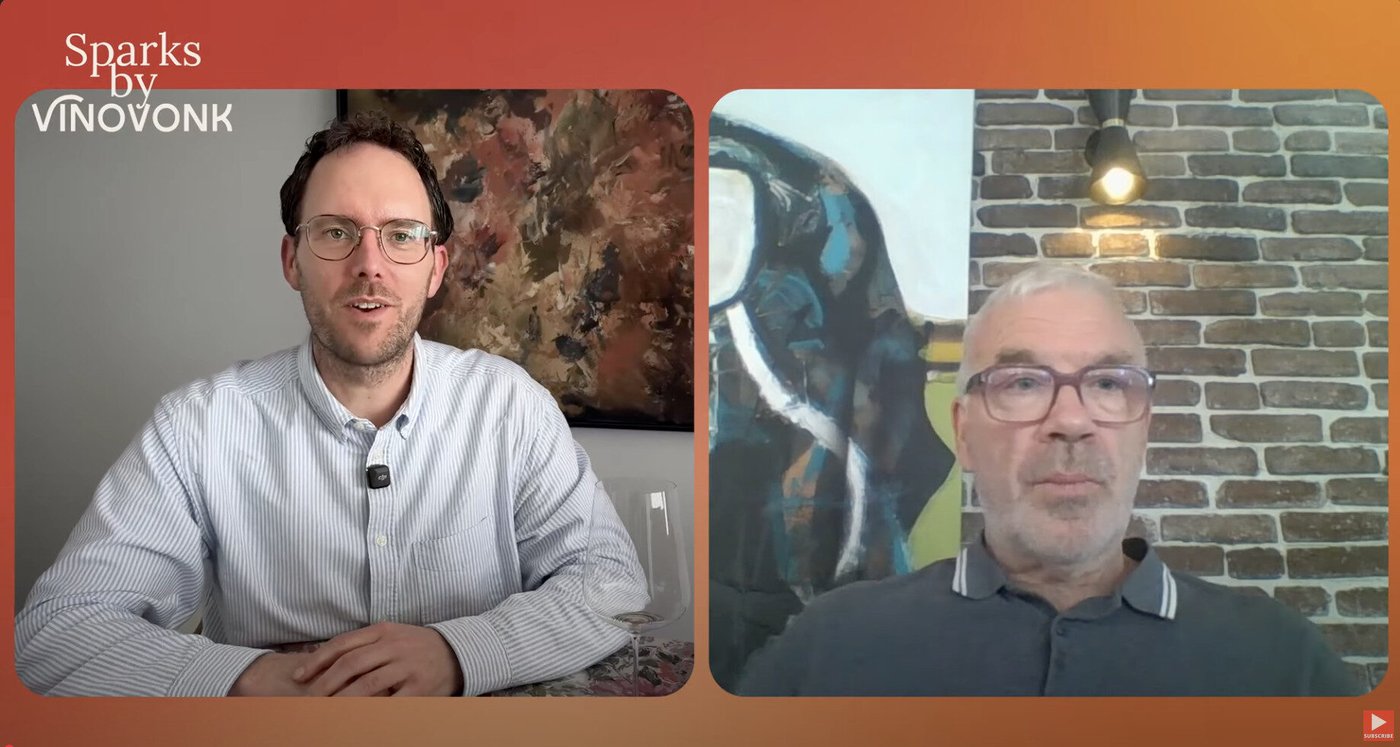
Harold Hamersma, the man behind De Grote Hamersma. He grew up in De Pijp in Amsterdam, taught himself the trade and has been writing about wine since 1985. In Sparks by VinoVonk episode 26 I talked to him about his rating system, why he won’t slate a wine and which trends he sees coming.
From cartons to a guide
Hamersma bought his first wine around 1973 at Albert Heijn. He grew up in the shadow of the Heineken brewery, where the men in the family sat on beer crates at birthday parties, and at school parties the drinks were whisky and jenever of dubious origin. Neither was for him. The supermarket had just started selling wine, cheap and in cartons: Pinar.
“Now the whole world is chasing them,” he says of those cartons, fifty years on.
Writing came first. At thirteen he bought his first typewriter with money from collecting old newspapers. It weighed 65 kilos and cost 65 guilders. At eighteen or nineteen he read De Complete Wijnliefhebber by Hubrecht Duijker, and the wine bug had him. In 1985, not yet thirty, he wrote his first wine pieces for the Haagse Post.
He never took the year-long Dutch vinology course. “I’ve been doing this for forty years, self-taught, and I taste so much,” he says. By his count his database holds 50,000 to 60,000 wines.
How an 8.5 gets made
Hamersma explains it with a €15 Albariño. It is scored on colour, nose, palate and finish, then set against every Albariño at around €15 that his panel has tasted in recent years. If it matches a rival’s score but costs two euros less, it earns a star for value. A €30 Albariño is measured against other €30 Albariños. As a sense check he looks at what international critics such as Tim Atkin, Decanter and Jancis Robinson say about the same wine.
He doesn’t hand out low scores. People sometimes ask him to give something a three for once. “I’ve got my hands full writing about good wine. So why would you go and buy a wine I gave a 3?” Anyone who wants to read that kind of review, he calls a disaster tourist.
There’s a catch. A wine that doesn’t clear the bar simply stays out of the guide, so it won’t tell you which bottles to avoid.
Hamersma adds his own caveat about the number. Two wines can both score 8.5 while one is rich and full, “Dolly Parton-style” as he puts it, and the other taut and bone dry. His advice: check your own taste and read the tasting note.
He knows who he writes for. According to a study from a few years back, only 3 per cent of Dutch wine buyers ever spend €10 or more on a bottle. In supermarkets, he says, the action is still just under €5 and just under €6.
Drinking less, drinking better
“In the Netherlands we’ve started drinking less wine, but better,” Hamersma says. People who drink better want to know more, in his view, and the number taking a WSET or vinology course has shot up. De Grote Hamersma now runs its own online course, which people at WSET, he says, recommend as a first step.
He also sees Dutch drinkers buying closer to home again: wine from Germany, Spain and Italy rather than Chile, Argentina or Australia. He links it to protectionism, which he thinks got an extra push from Trump’s election, and to restaurants, where chefs now buy local for the sake of carbon emissions and out of pride in their own produce. Those who spend a bit more are turning down Chardonnay more often, are tiring of Merlot and are trying an unfamiliar grape or region.
On alcohol-free wine he picks his words. “I’m critical of bad alcohol-free wine,” he says. The technology keeps improving, and for now he rates white, rosé and above all sparkling as the best of it. He still isn’t jumping for joy, and he puts the buzz in perspective: alcohol-free wine is under 1 per cent of the market. He is keener on drinks that don’t try to be wine, such as those from the Sparkling Tea Company, set up by a well-known Scandinavian sommelier. “Is that wine? No, that’s sparkling tea.” On his dry days he drinks alcohol-free beer and Nona’s drinks, which he rates well above Seedlip.
He and his wife drink in moderation: three days a week without alcohol, and no more than three glasses on the others. “You need more time to process it, physically. You sleep worse, you sweat, I don’t fancy any of that.”
Watch or listen to the episode
The full conversation also covers the handwritten note Hubrecht Duijker once sent him about his tasting notes, the chat group in his apartment block (one message, and fifteen minutes later every opened sample bottle has gone), the Bocksbeutel that fits neither a bottle bank nor a wine rack, and the bottles he sends back with advice to the buyer to check the whole batch.
The Hamersma effect
Whether a guide that only recommends counts as wine criticism is a fair question. Hamersma settled his answer long ago. When he went full-time as a wine writer, he chose to get as many people as possible drinking good wine, in a positive way and in plain language. He respects the trade press, but as an audience he finds it far too small and stuffy a circle.
The system runs on bottles that supermarkets, importers and specialist shops send in themselves. To Hamersma that proves it works: if a Hamersma rating did them no good, they would stop sending wine. In the early years anything turned up, down to sangria in three-litre cartons. These days the senders know what makes the cut, and in his view the first round of selection already happens at their end. Which means they partly decide what gets tasted.
One thing has changed since this conversation: since September 2026 I have been one of the tasters for De Grote Hamersma. The interview predates that.
Prices in this article date from October 2025. Check the current price with the seller.
Sources
- Harold Hamersma: De Grote Hamersma Wine Guide: grotehamersma.nl
More on Sparks
1979 Wines: Eleni Kechri's Science-Driven Retsina
Eleni Kechri of 1979 Wines makes retsina with sustainably tapped resin from different forests. Three bottles, one vineyard, and what the resin changes.
Read on →
Enrico Rivetto: Barolo, Biodiversity, DOC Rules
Enrico Rivetto planted over a thousand trees among his Barolo vines. I tasted his Langhe Nascetta and we talked Demeter, daughter-drawn labels and doubt.
Read on →
Stamatis Mylonas: Savatiano That Ages Well
Stamatis Mylonas on Savatiano from Attica: old bush vines, mineral soils and a 2016 Gran Reserva that still tasted fresh and taut when I opened it.
Read on →