

Joni Sloesen of Zavel: Pfalz Grapes, Dutch Wine
Joni Sloesen drives three hours to the Pfalz for grapes and makes Kerner, Pinot Gris and Pinot Noir in Tegelen. Minimal intervention, old oak, amphora.
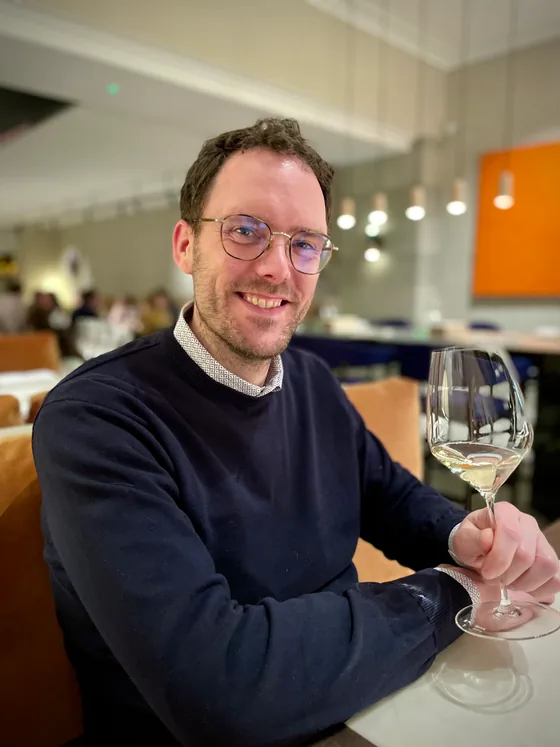
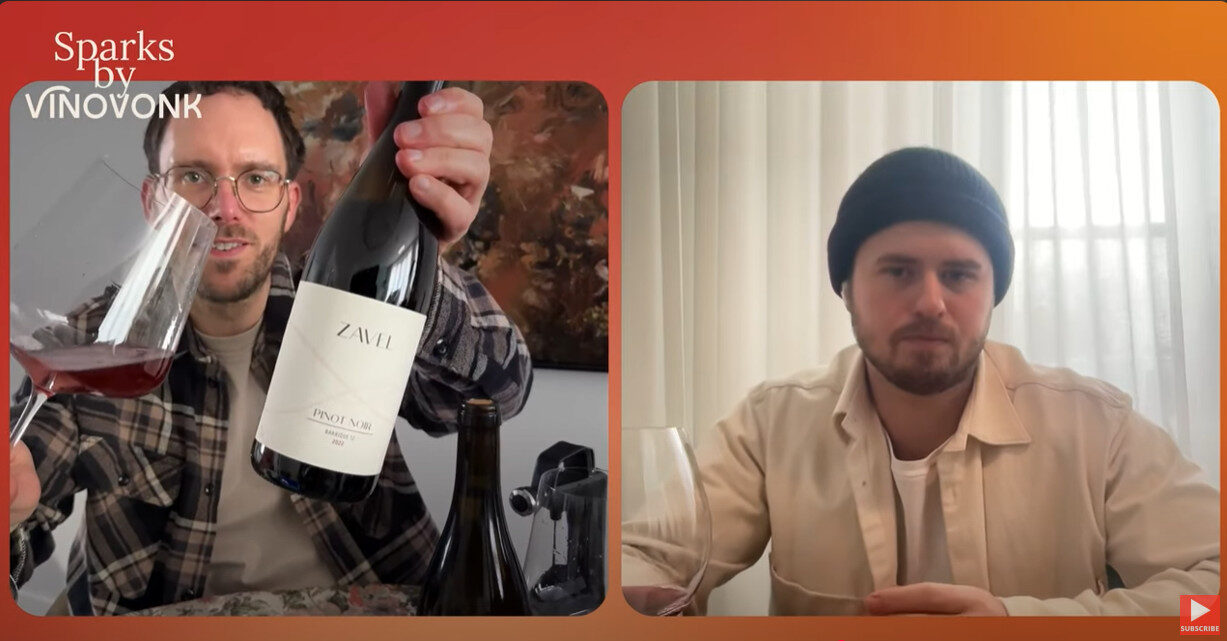
Grapes picked in the Pfalz reach Tegelen within three hours, says Joni Sloesen. He collects them himself in September and October in his own van. In a building where ceramics used to be made, he is building Zavel, a Dutch wine brand with deliberately plain labels, because he wants the attention on what is in the bottle.
In Sparks by VinoVonk episode 24 I sat down with Joni Sloesen of Zavel. I already knew the name from restaurant De Kas in Amsterdam, where I once had one of his wines. We tasted three bottles: Kerner 2023, Pinot Gris Barrique 11 (2023) and Pinot Noir 2022.
From a hotel internship in South Africa to his own winery
Joni developed a serious interest in wine while studying. After an internship at a hotel in South Africa he fell, as he puts it, in love with wine. Back in the Netherlands he asked his WSET teacher, Jaap Heijmeijer of NHL Stenden Hotel School, how he could work with wine every day. WSET Level 2 was part of the curriculum; he took Level 3 on the side with the same teacher.
He then worked for a company in Amsterdam. He considered making wine somewhere in southern Europe, but felt the Dutch market lacked a certain style and saw potential at home. The building in Tegelen had always housed family businesses, and ceramics were made there. Nobody was queuing up to start something new in it, so during the pandemic Joni set up a winery. The first harvest was 2021. He now has seven vintages behind him, four of them for Zavel. On the same site he runs restaurant Soberg, where much of the cooking starts with vegetables from the garden.
Pfalz grapes, with a Dutch plan
South Limburg has a real cluster of winemakers; elsewhere in Limburg, Joni says, they are scattered. He had interned in the Pfalz, at Weingut Eiermann and with Dennis Wolf, a good friend. The idea was to start close to home with German grapes as a stepping stone to his own vineyard. He has worked with Wolf since 2021 and with Hannes Bergdoll since 2022. All the German fruit is Demeter-certified and biodynamically farmed.
Zavel is also planting its own vines:
- 1 hectare in central Limburg, planted in 2024
- around 300 Riesling vines at the estate in Tegelen, since 2021
Having his own vineyard was always the plan. In Limburg nearly all the work is done by hand, with as few machines as possible.
Spontaneous fermentation, old barrels, two amphorae
The approach is the same for every wine: spontaneous fermentation and as little intervention as possible, though Joni rules nothing out if a wine needs it. Minimal sulphites, no filtration, no fining. The Kerner is the exception, the only wine fermented with cultured yeast, although he wants to move that one to wild yeast too.
The stylistic split is in the ageing. The wines with colourful labels (Kerner, Dornfelder, Gewürztraminer pét-nat) are aged in stainless steel. The wines with the plain white label have been made entirely in wood or amphora since 2023. In 2022 a third still went into steel, because the number of barrels had to grow gradually.
Most of the oak is old: 350 to 500 litre barrels, fourth fill or older. Only the Pinot Blanc and Chardonnay get a share of new oak. When I asked whether the ceramics background would find its way into the cellar, it turned out it already had. Two wines age in amphora, a deliberate choice from the start. Like wood, amphora lets oxygen through, and it gives a different texture. Joni wants to see whether he can use it more widely.
Three bottles tasted
I tasted all three through a Coravin, one bottle of each.
Kerner 2023: around €15
Aged in steel. The label shows a lemon or a bergamot, depending on how you look at it.
On the nose I found bergamot peel, the kind you sometimes get in a restaurant, and lime zest. Underneath, a touch of something tropical and some stone fruit: peach, nectarine. Very fresh, and more complex than I expected from such a bright wine. The palate has lovely acidity, a crisp, crunchy feel, deep lemon, ripe apple and a bitter edge that reminded me of grapefruit, with more nectarine, apricot and peach.
Kerner is a cross of Riesling and Trollinger (Schiava). Joni explains that the grape often disappears into bulk wine, but at low yields gives more concentration and expression, with slightly more tropical notes than Riesling and the same freshness. He is candid about its limits in his cellar: with this cultured yeast he has to ferment at 19 to 20 degrees or fermentation stops, which costs some of the typical aromatics. Because he does not filter and uses little sulphite, he cannot always prevent malolactic conversion. In 2023 the pH and acidity held it off, which is why the wine stayed so taut.
Pinot Gris Barrique 11 (2023): around €17
Eleven months in used oak, then bottled. The label gives only Zavel, the grape and how long it spent in barrique. 13 percent alcohol.
I got butter-fried apple straight away, with pear, lemon, almond paste, almond and hazelnut. The palate is round and rich, with tight acidity and good balance, a long finish and a hint of rock candy.
Joni corrected my butter. In his view, buttery notes come mainly from new oak (diacetyl); here it is creaminess and extract from lees ageing and old wood, with no vanilla. The malolactic character is clearly present. He calls the 2023 the best Pinot Gris they have made.
What surprised me is that Joni does not find Pinot Gris a particularly interesting grape. Acidity drops quickly, alcohol shoots up, and elsewhere it is often made either overly aromatic or overly heavy. Earlier vintages were more reductive. He likes that style himself, but it did not always sell.
Pinot Noir 2022: €23
Twelve months in oak. Joni gives his Pinot Noir at least a year in bottle before release; this one had already had eighteen months.
A beautiful colour. I found the nose soft, with raspberries, ripe strawberries and a little farmyard, a stable note in the best sense. Joni puts that down to slight reduction from topping up the barrels, which gives the wine the backbone to age. With some air the red fruit comes through clearly. On the palate there is tight acidity, tannin that is present without being high, good structure, decent body and above all a lot of juiciness.
That juiciness is what Joni is after. He keeps the fermentation cool so the wine can stay on its skins longer, then warms it at the end to pull out some tannin. At his restaurant he serves it with celeriac and hazelnut, and with wild goose ravioli, beurre blanc, sauerkraut, dried carrots and a purée of wild pears.
What I do not know yet
These are three wines, tasted during one recording, with the maker’s story alongside them. The prices are the figures Joni gave in the conversation, and he was briefly unsure about the Pinot Gris. Zavel’s own cellar is not certified biodynamic. Joni does not think his customers need that label, though he admits it would make things clearer for buyers as volumes grow.
Watch or listen to the episode
Where to buy
Zavel sells through its own webshop across the Netherlands. At the time of recording, parcels went out once a week, with daily dispatch planned from April. Partners include:
- Designer Wijn (Amsterdam)
- Beneluxwines
- Wynspot (Amsterdam West)
- Henk (Rotterdam)
- Boots Albij (Dordrecht)
Most of the wine goes to restaurants. It turns up in Belgium now and then, and according to Joni a restaurant in Italy pours it too. Visit zavelwijn.nl for the full range. Restaurant Soberg is on the same site in Tegelen.
Sources
- Wijndomein Zavel (official, Tegelen, NL): zavel.eu
- Vereniging Nederlandse Wijnproducenten: nederlandsewijnproducenten.nl
More on Sparks

1979 Wines: Eleni Kechri's Science-Driven Retsina
Eleni Kechri of 1979 Wines makes retsina with sustainably tapped resin from different forests. Three bottles, one vineyard, and what the resin changes.
Read on →
Enrico Rivetto: Barolo, Biodiversity, DOC Rules
Enrico Rivetto planted over a thousand trees among his Barolo vines. I tasted his Langhe Nascetta and we talked Demeter, daughter-drawn labels and doubt.
Read on →
Stamatis Mylonas: Savatiano That Ages Well
Stamatis Mylonas on Savatiano from Attica: old bush vines, mineral soils and a 2016 Gran Reserva that still tasted fresh and taut when I opened it.
Read on →