

De Boe Rosé Brut 2024: Eleven Months Change It
The second Zeeland sparkler from Wijndomein De Boe spent eleven months on the lees instead of nine. What that changes, and what the label still overstates.


The mousse gives it away first. Last year the bubbles sat next to the wine, as if they had been added at the last minute. In this glass they are part of it: creamy, fine, and they hold on the palate instead of collapsing straight away.
This is the De Boe Rosé Brut 2024, the second sparkling wine from Wijndomein De Boe on Walcheren. Bruno Suter sent the bottle. I bought the first vintage myself at the estate and wrote that it was lively but still short on depth. That sentence can go.
Two months you can taste
The 2023 spent nine months on the lees. This 2024 spent eleven. It sounds like a footnote and it is the most important thing that changed about this bottle.
Lees ageing, sur lie, means the wine rests on the spent yeast cells after its second fermentation. Those cells break down slowly and hand over texture: the bready note of brioche and toast, and above all a finer mousse that belongs to the wine. Short on the lees and the bubbles stand apart. Longer and they merge.
The blend moved too, from 70/30 to 75 percent pinot noir against 25 percent pinot noir précoce. Précoce is an early-ripening mutation of pinot noir, useful in a climate where autumn does not always cooperate. Its share went down, which suggests the ordinary pinot noir ripened well enough in 2024 to carry the wine on its own.
Tasting note
Appearance
Copper-pink, with a powerful mousse that behaves finely and holds.
Nose
Ripe cherry leads, with raspberry and strawberry alongside it. Underneath sits a clear savoury streak that runs towards rosemary and thyme. Then butter, a dairy note somewhere between cream and yoghurt, and a small touch of brioche and toast. Never heavy-handed, just enough to register that this wine has been lying somewhere.
Palate
Creamy, and the mousse is creamy with it. Red fruit and citrus hold each other in balance, with a light bitter edge that keeps things sharp. The lees ageing shows more clearly than last year without the bread taking over the fruit.
Finish
Fresh and decent in length, that bitter edge lingering.
Quality
Where the 2023 was enjoyable, this one holds together. The integration of the mousse makes the difference, and you owe that to those two extra months.
A rotten season you cannot taste
2024 was a worse growing season than 2023. Very little of that reaches the glass.
The autumn of 2023 was already wet, nearly 140 millimetres above average, and through 2024 the rain kept coming, another 200 millimetres or so on top of the annual mean. A mild winter and an even milder spring pushed the buds out far too early, and on 23 April a light frost crossed the vineyard. Fire pots kept most of it off. Cold, windy weather in June caused poor fruit set, and from July onwards the constant rain pushed disease pressure above normal. Picking happened on 7 September and 5 October, and the rain stretched the harvest to nearly the end of October.
So the fact that this wine turns out better than its predecessor says little about the vintage. It says something about what you do afterwards with a healthy batch of fruit.
Still a German cellar
What did not change: the second fermentation again did not happen in Zeeland. As with the first vintage the wine travelled to Schaufelberger Sekt in Brauneberg on the Mosel, a Sektmanufaktur that runs the méthode traditionnelle for small growers.
The label reads “bottled in salty Zeeland”. That remains a generous line for a wine that took its bubbles some three hundred kilometres inland. For a second vintage it is still defensible, because building your own sparkling cellar costs a fortune and most Dutch producers do exactly the same. But anyone buying this bottle for Zeeland craftsmanship is buying Zeeland fruit and German craft.
Twenty-eight euros, for the second time
The price held at €28 while the wine got better. That is the whole verdict in one line. For the same money as last year you get a bottle whose mousse works, which makes the fight against Domein Holset or an entry-level crémant far less lopsided than it was for the 2023. It still does not win on complexity. The vines are too young for that, and full production is not expected until around 2027 or 2028.
That €28 is also more than one and a half times the estate’s cheapest still whites, which start at €17.50. Anyone wanting to get to know De Boe can start cheaper.
Two reservations. Residual sugar sits at 10 grams per litre, near the upper limit of what brut allows. The wine reads fresh and that sugar never registers as sweet, but it is working: it fills in acidity that is still young. Put a brut nature next to it, with no dosage, and you taste where the roundness comes from.
Then the volume. 241 cases. This is not a wine you build a habit around. If you want it, order now: the Blanc de blancs Brut 2024 that briefly sat beside it at €30 has already sold out.
Eleven months did this, so I want to know what fourteen months do.
Wine details
- Producer
- Wijndomein De Boe
- Wine
- Rosé Brut 2024
- Region
- Walcheren, Zeeland
- Grapes
- 75% Pinot Noir, 25% Pinot Noir Précoce
- Method
- Traditional method, 11 months on the lees
- Alcohol
- 12.4%
- Residual sugar
- 10 g/l
- Production
- 241 cases
- Price
- €28
Frequently asked questions
How does De Boe Rosé Brut 2024 differ from the 2023?
The 2024 spent eleven months on the lees, the 2023 nine. You hear that difference mostly in the mousse, which is creamier and folded into the wine rather than sitting beside it. The blend also shifted, from 70/30 to 75 percent pinot noir and 25 percent pinot noir précoce.
Where is De Boe Rosé Brut made?
The grapes come from Walcheren in Zeeland, the Netherlands. The second fermentation still happens at Schaufelberger Sekt in Brauneberg on the Mosel, exactly as it did for the first vintage. Zeeland fruit, German cellar.
What does De Boe Rosé Brut 2024 cost?
Twenty-eight euros through the estate webshop and at the estate itself, the same price as the 2023. Production is 241 cases.
Sources
- Primary source: Fiche technique Rosé Brut 2024, Wijndomein De Boe (July 2026)
- Additional: Wijndomein De Boe webshop (prices checked 1 August 2026)
- Additional: own tasting notes, and Sparks episodes 16 (Bruno Suter) and 17 (Jochen Schaufelberger)
More on Wine Review
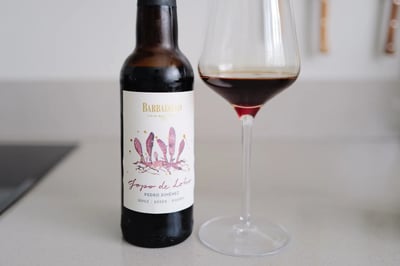
Barbadillo Jopo de Lobo: Organic Pedro Ximénez
Jopo de Lobo from Barbadillo: organic Pedro Ximénez from sun-dried grapes. Coffee, dark fruit, blossom. €15.95 for a half bottle of 0.375 litres.
Read on →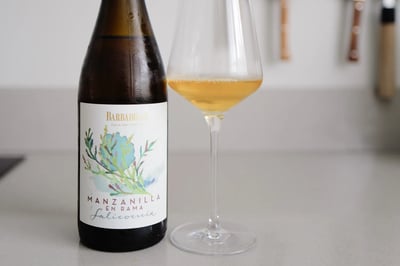
Barbadillo Salicornia: Organic Manzanilla en Rama
Salicornia, Barbadillo's organic manzanilla en rama: flor, baked apple, salt and a brand-new solera. €25.95 at Granada Wijnen, with discount code.
Read on →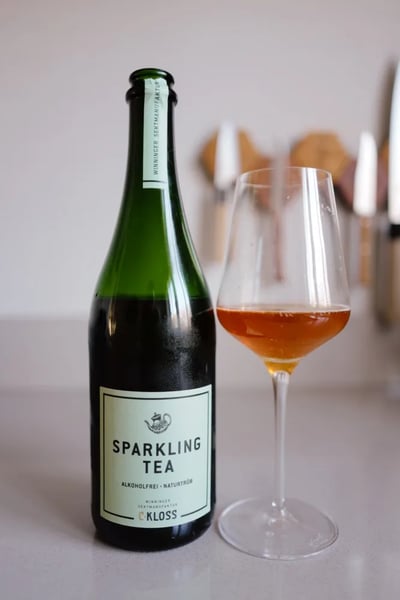
C. Kloss Sparkling Tea Weiss: Fermented Celery
Non-alcoholic sparkling tea Weiss from C. Kloss: linden blossom, nettle and fermented celery. Dry, 2.7 g sugar per 100 ml, €14.99 at Amavine.
Read on →