

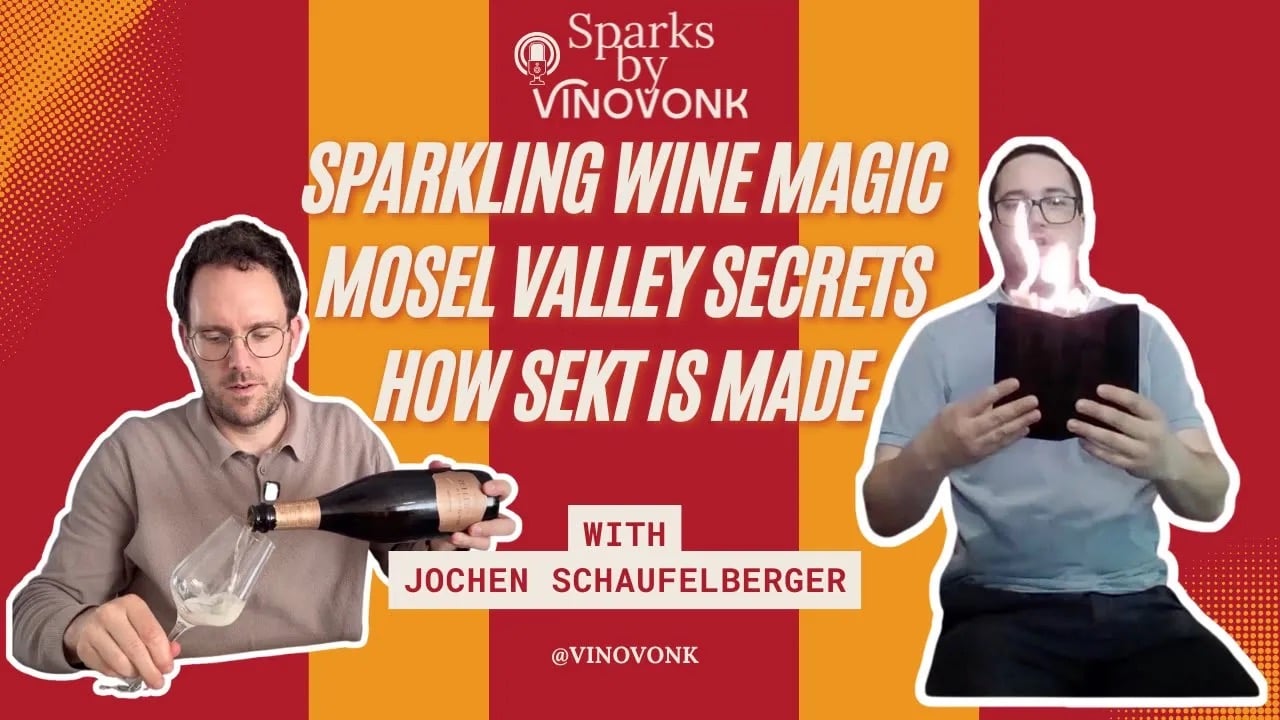
Bruno of Wijn de Boe makes wine in Zeeland, sparkling included. When I asked him how, he said he sends his wine to Schaufelberger and they put the bubbles in. That company sits in Brauneberg on the Mosel and does the same job for around 250 wineries.
For Sparks episode 17 I asked its owner, Jochen Schaufelberger, how traditional-method Sekt is made, why Dutch and Belgian wineries have him make their sparkling wine, and what German Sektsteuer does to the price of a bottle. He also makes wine under his own name and sent three of them: a Cuvée Magic, a Grauburgunder and the Brauneberger Juffer Cremant.
Jochen Schaufelberger sent me the bottles; I received no payment and the opinions are my own.
Who is Jochen Schaufelberger
Jochen is 31 and lives in Brauneberg, in the middle of the Mosel valley. He grew up in southern Germany and first made sparkling wine as a hobby in 2021, from cherries. He has also been a magician since the age of nine, and he brings the two together: the logo on his own Sekt is a rabbit in a top hat.
The company dates from the 1980s. His predecessors started small, with machines from Champagne, and were pleased to manage 150 bottles a day. Today the line runs at 600 to 700 bottles an hour. Jochen took the company over in 2022.
What Schaufelberger does
The company makes Sekt under its own label and sparkling wine for other wineries. Doing it yourself takes dedicated machines, space, bonded storage, time and staff, and Schaufelberger provides all of that. According to Jochen that means about 250 customers and, each year:
- roughly 125,000 bottles of sparkling wine (second fermentation in bottle)
- roughly 150,000 bottles of Secco or Frizzante (direct CO2 impregnation)
Most customers are on the Mosel, with others in the Pfalz, Nahe and Ahr, plus Belgium and the Netherlands. There is also one Greek customer, who sent Assyrtiko from Nemea.
Jochen owns no vineyards. He buys juice from growers he knows, at what he calls fair prices, and makes the base wine himself.
In 2016 he spent seven months in the Netherlands, in Leeuwarden and Winschoten, and helped with the harvest at Friese Wijn. Later he wrote to Dutch wineries with a letter in Dutch. He now has about ten customers from the Netherlands and Belgium. Their wine travels to Brauneberg under an EAD, the electronic excise document, and goes home as sparkling wine.
How the process works
Most wineries deliver a finished base wine, and it has to meet a few conditions:
- alcohol between 10.5 and 11 per cent, or 85 to 87 grams per litre; the second fermentation adds about 1.5 per cent, and if you start higher it can stall
- not too much sulphur
- an analysis sent in advance
At Schaufelberger the wine is first chilled to minus 3 degrees. Tartrate crystals drop out and are filtered off. In still wine they do no harm, but in a sparkling wine, Jochen says, an opened bottle would empty itself. Then comes sugar, up to 24 grams per litre, and yeast that was prepared a day earlier so it can get used to the wine. The bottles are filled, closed with a crown cap and packed into crates that can be riddled by machine.
The wine normally rests for 9 months, sometimes less, sometimes more. Riddling earlier keeps more fruit; leaving it longer brings brioche and yeast. Some wineries take their bottles home straight after filling, keep them for 5, 6 or 7 years, riddle them by hand and then bring them back to Brauneberg for disgorging. Others leave everything with Schaufelberger.
The last step is disgorging: freeze the necks, remove the yeast plug, add cork and wire cage, then label and capsule. It is all done by machine. For a winery with a thousand bottles such a machine is too expensive, and doing it by hand is heavy work, which is one reason small producers outsource it.
Cuvée Magic
A blend of three grapes. Jochen won’t say which; he calls it their secret. The three change every year; the wine is always extra brut. This bottle is from the 2022 harvest, disgorged in September 2024, with 3.5 grams of sugar and 18 months of ageing in total.
The nose gives plenty of apple, some tropical fruit, peach and pineapple, along with bread and yeast. With 3.5 grams of sugar there is nowhere to hide. It is balanced, the acidity is not too high and the bubbles are well integrated.
We tasted it more than eight months after disgorging. Jochen finds sparkling wine rough and sharp shortly after; he prefers it at least two months on, and says six months or a year is better still. That matched my experience. I tasted Bruno’s first sparkling wine soon after it was finished, and the bubbles were sharp and the wine out of balance. A few weeks ago I tried it again and it had come together.
Cuvée Magic costs €14 from Schaufelberger. My caveat: because the grapes are secret and change every year, a buyer cannot know exactly what is in the bottle.
Grauburgunder
Pinot Gris, also from 2022, disgorged in April 2024, so more than a year before we tasted it.
Fresh and crisp, lots of apple and lime, textbook Pinot Gris. The yeast is the same as in the Cuvée Magic, but this wine spent almost the whole time on its lees. That gives more structure on the palate and more toast. The mousse is foamy without being harsh; the bubbles pop like tiny balloons. Price: €16.
At €15 to €16 you get a second fermentation in bottle, the Champagne method. I don’t think that is expensive for what you get.
Brauneberger Juffer Cremant
The Brauneberger Juffer is a Grosse Lage and one of the well-known vineyards of the Mosel. He joins the harvest: by hand, into buckets, with whole bunches going onto the company’s very old wooden press. This Cremant spent 24 months on the lees and was disgorged in March 2025.
For such a recent disgorgement it neither smells nor feels freshly disgorged. It is lively but also warm, full and round, with a long finish. The Juffer is known for elegant, subtle wines.
Jochen himself said this wine needs a bit more time in the glass. And because the disgorging was so recent, the bubbles faded from the glass fairly quickly. Price: €39.
Sekt and German tax
In Germany, sparkling wine at 3 bar or more pays Sektsteuer: €1.02 a bottle. A Secco or Frizzante at 2.5 bar is exempt. VAT then comes on top of everything, the tax included.
Jochen quoted the wine communicator Konstantin Baum, who worked through a €4 German Sekt: take off the €1.02 tax, allow about a euro for the bottle and filling, and roughly two euros remain for the wine. An empty bottle alone costs 60 to 70 cents, Jochen says.
In the supermarket, tank-made Sekt sells for €2.49. More than half of that is tax, according to Jochen, which leaves about a euro for bottle, cork, wire cage and wine together. At €14 a bottle the tax takes a smaller share and more of the money goes into the product.
A magnum pays double: €2.04.
Formats, Secco and PIWIs
Besides the standard 0.75 litre bottle, Schaufelberger fills small bottles, magnums and a slender flute-shaped bottle that Dutch customers use too.
Secco or Frizzante is made by impregnating finished wine with CO2 as it is filled, up to 2.5 bar. Sparkling wine from a second fermentation in bottle reaches 6 bar. A Secco can be drunk as soon as it is filled. I called it a giant SodaStream; Jochen’s advice is never to try it at home, unless you fancy a new kitchen.
For Dutch customers he has already filled Frizzante and sparkling wine from PIWI grapes. He has one such variety himself but uses PIWIs very little so far.
Where it is heading
Jochen expects sparkling wine to become more individual, with more new grape varieties, especially at the higher end. He also sees less cheerful trends: on the Mosel and across Germany, wine consumption is falling and wineries are disappearing. He expects that to continue for the next ten years, leaving larger wineries and, in his view, higher quality. About the Netherlands he is optimistic.
For Dutch growers, outsourcing mostly means waiting. A wine finished now goes to Brauneberg, rests for around nine months and may come back as sparkling wine a year or eighteen months later. After that the advice is to wait at least another two months. Jochen only gives that advice when asked; some winemakers like their wine freshly disgorged.
What I tasted, and what I didn’t
I tasted one bottle of each wine, the Juffer shortly after disgorging. The figures about the business, such as customer numbers and volumes, come from Jochen’s own account.
Frequently asked questions
What is the difference between Sekt and Secco? Traditional-method Sekt gets a second fermentation in bottle and reaches about 6 bar. Secco or Frizzante is finished wine with CO2 pressed into it, up to 2.5 bar. In Germany, Sektsteuer only applies from 3 bar.
Who are Schaufelberger’s customers? Around 250 wineries, mostly from the Mosel, Pfalz, Nahe and Ahr. On top of that about ten wineries from the Netherlands and Belgium, and one Greek customer with Assyrtiko from Nemea.
How long does it take from base wine to sparkling wine? The wine normally rests 9 months in bottle, sometimes less, sometimes more. Disgorging, corking and labelling follow. According to Jochen it only shows its best a couple of months after disgorging.
Can I make Secco at home with a SodaStream? Jochen advises against it, unless you want to renovate your kitchen.
Contacting Schaufelberger as a winery
Jochen speaks a little Dutch. Dutch and Belgian wineries that want sparkling wine made can call, email or get in touch through schaufelberger-sekt.de; he can also help with questions about customs. You can visit to see how they work, or join the Magische Sektprobe, a tasting he runs once or twice a month.
The bottles in this episode
Cuvée Magic. Blend of three undisclosed grapes. Extra brut, 3.5 grams of sugar. 2022 harvest, disgorged September 2024. €14.
Grauburgunder. Pinot Gris, 2022 harvest, disgorged April 2024, long on the lees. €16.
Brauneberger Juffer Cremant. Grapes from a Grosse Lage, hand-picked, pressed on an old wooden press, 24 months on the lees, disgorged March 2025. €39.
More about Schaufelberger Sekt
Visit schaufelberger-sekt.de. The conversation with Bruno of Wijn de Boe that led me to Jochen is also on Sparks.
Transcript
The full conversation transcript.
Show full transcript
This transcript is generated automatically from the audio and has not been edited. Speech recognition makes mistakes, so treat wording as an approximation rather than a verbatim quote. It is here for accessibility and search.
So let me open it up. I like the sound. I like the smell very much. It’s very lots of apple, a little bit tropical fruit, peach, pineapple, but also a little bread and yeast flavors. Let’s talk about Dutch wineries.
I think this is very interesting topic. Hi and welcome to a new episode of Sparks by VinoVonk. My name is Jeroen, and today we’re going to talk about sparkling wines. Sparkling wines from Germany. And I have a special guest, Jochen Schaufelberger.
Welcome Jochen. And I got in contact with Jochen because I did a chat with Bruno from Dijn de Boe. He also makes wine in Zeeland and he also makes sparkling wine. And I asked, okay, how do you make it? Well, I sent my wines to Schaufelberger and they make it sparkling for me.
I thought, okay, but how do they do it? And then I got in contact with Jochen and he told me, yeah, but I also make my own wine. So he sent me these three wonderful bottles we’re going to taste and we’re going to talk about. How do you make sparkling wines? Why for other people?
Do you do collaboration? Do you go to the vineyards? And this is the subject of this video podcast. So welcome Jochen. Again, could you, for people who don’t know you, introduce yourself?
Thank you for this nice introduction, Jeroen. My name is Jochen Schaufelberger. I’m 31 years old at the moment. I live now in the beautiful Mosel Valley. So directly in the center, the village is called Brauneberg and I’m very happy to make sparkling wine.
I can tell you something about how this started. The company started in the 80s. This was the time when I wasn’t on this earth yet. But my predecessors started it very small and they bought some machines, used machines from Champagne. And yeah, they started and they were happy when they made 150 bottles per day, this was great.
And now we are doing between 600 and 700 bottles per hour. So this is quite a bit more but it’s still not small and it’s not big so it’s in between. And they started doing sparkling wine for other wineries because it’s very… Yeah, special to do it, you need special machines, need the room, the place, you need also the customs, warehouses and so on, and you need the time and the manpower and so we offer this to the winemakers. Yeah, this grew constantly.
Yeah, and I am happy that I could take over the company in 2022. I’m not from the Mosel Valley originally, so I’m from southern Germany. Yeah, this is where I come from and this was a hobby and I made sparkling wines for the first time in 2021 from cherries. And so this is also the new 2023 harvest, which I’m now riddling down 121 bottles. So this is very little, but it’s very special.
So this is why I came in contact here and could take over the company. Yeah, great story and a great introduction. Well, let’s start with you also make your own wines. Do you have your own vineyards or do you buy grapes? I don’t have own vineyards.
To be honest, I’m happy about it because we have a lot of work. I can work for three persons, but we have great winemakers here and we know who has good grapes, good vineyards and we pay fair prices so we get good quality and we get the grape juice after the harvest so we can produce our base wines. for the sparkling wine how we like. So you do the vinification yourself with your colleague, a winemaker. But here we have three different kinds of wines.
Could you tell me something about it? Yeah, so before we start to taste… I have a hobby which is magic and since I’m nine years old I’m a magician. And I love doing magic and so I thought why not combine these two. And so it’s sparkling wine and magic and so this is also you can see the logo on top so this is a rabbit in the cylinder.
I like this. And I can show you also magic trick before we get to the first tasting. So I show you something very nice. So this is something about money and as magicians we have always a little bit of money so this comes from America, American dollar but we can also go to other countries like 100 Australian dollars or 20 euros or let’s say This is, I think, Chinese yuan. This is 50 Mexican pesos, but we are here in Europe.
This is why we pay in euros. And this is 100 real euros. So this is what I do as a hobby. Amazing, but making sparkling wines is also a little bit like magic. I like magic tricks.
So, let’s go to the first one. It’s a cuvée. Magic. Magic. Cuvée Magic.
Yeah, right. So it’s a magical cuvée. And cuvée, of course, is made from different grapes. And in this case, we have three different grapes. Which grapes?
I am not telling. In this case, because this is our secret and every time it’s three different grapes. It’s always extra brut and it differs each year. So this is the harvest of 2022 and our thought is the philosophy of this sparkling wine is something for the nose and also something for the… Yeah, so it’s three different.
Yeah, and a good magician never tells his trick, so that’s why Cuvée Magic don’t tell your magic. In this case, Yeah. Prost. Cheers. Cheers!
I like the smell very much. It’s very lots of apple, a little bit tropical fruit, peach, pineapple, but also a little bread and yeast flavors. And I like it because it’s only 3.5 grams of sugar so you cannot hide anything behind it. But it’s great in balance and it’s not too high in acidity. It’s very soft.
The bubbles are very good integrated. And it was from the year 2022. The disgorgement was in September of 2024. Yeah. So this is only 73 calories.
Yup. Lovely. Also now we have more than eight months after the disgorgement and I think this… gives more balance to sparkling wine because shortly after disgorgement mostly they are very rough, they are a little bit sharp and so I like sparkling wines which are at least two months after disgorgement and even more half a year or a year is even better. This sparkling wine needs time.
Yeah, that was my experience with wine from Bruno, from Wijn de Boe. The bubbles were very harsh and it was very bubbly, it wasn’t in balance yet, but he told me the wine was just finished and it was the first time I made this wine. And couple of weeks ago I tasted the wine again when I was there. It was perfectly balanced. It was amazing.
It got more roundness, more structure. And it was the first time he made wine from his wines and the first time he made together with you his sparkling wine. Yeah, I think it’s a completely different sparkling wine after some months. So it will improve. Yeah, and now we’re talking about magic.
In my imagination is making sparkling wine, you have to have your own wines, the grapes, you make your wine, then you bottle it in a thick bottle. Then you put in some extra yeast, put in a cork, lay it down for a couple of months so the bubbles can integrate. And after a couple of months, let’s say between 9, 12, 15, you make the bottles open, you freeze it a little bit so the yeast can go out, put in maybe a little bit of sugar, put in the cork, and then your sparkling wine is finished. But that’s, in my imagination, it’s a very simple process, but it’s very… Yeah, lots of labor.
That’s why a lot of winemakers don’t do it themselves because they have special machines. But how do you work? Like, you have this process, but how do people get their wines with you and do you bottle them? Can you tell me something about this magic? So most winemakers they bring the finished base wine to us.
This wine needs to have not too much alcohol and also not too much sulfur. Alcohol of 85 to 87 grams per liter. So this is how it is perfect. Because if it’s too high, you get a problem with the second fermentation in the bottle. It may stop in between.
So we make sure also the values are right. So first of all, people make an analysis for us and bring the wine to us and we stabilize it for the tartrate. Do you have the English word for this? Tartrate? When you have, for example, white wine and you get some crystals down.
Yeah, I only know the Dutch word, tartaric acid. Yeah, yeah, yeah. And so these are the acidity and the base and they are combining and neutralizing. In the wine this is no problem, but for sparkling wine this would be a problem because if you open the bottle, the bottle will empty itself without drinking. You talked about the alcohol in grams, normally on the bottle it’s in percentages.
And how many degrees of alcohol do you have to have? Is it like 10 and a half, 11? Yep. Between 10.5 and 11, sometimes less, but for the second fermentation we have 1.5% of alcohol higher. So if we start with 11, it’s 12.5, so this is a perfect range.
So we cool it first to minus 3 degrees. Tartrate, this gets out, will filtrate it after and we will add sugar to it, so to 24 grams per liter. Yeah, and then we add the yeast. So yeast is also very important. Which kind of yeast do you use and you need to prepare it one day before and so the yeast gets used to the wine also.
And after we fill it so I can show you. We fill it into a bottle and we close it with crown cork. Crown cork? Yeah, you know what I mean. We have it in boxes so we can riddle the whole boxes automatically.
It lays down for normally 9 months, sometimes more, sometimes less, it depends. Also you can influence the taste also a little bit, so if you riddle the bottles a little bit earlier you get more the fruitiness and if you have it longer like this it’s more the brioche and the yeast taste. So you can play a lot, it’s very interesting. Yeah, so you get the base wine, you fill the bottles, you put in the crown cap, and then you lay it down. And then the wine stays with you or goes back to the winery.
It depends on the winery, so we have both. We can store it for the customers as well. We have also some wineries which we only fill the bottles and they store them at home for 5, 6, 7 years and are riddling them by hand. We are disgorging this for them so we can do everything. Especially for the let’s let’s talk a little bit about Dutch wineries.
I think this is very interesting topic. Yeah Bruno came to me by the Wijn de Boe and asked if we can do the sparkling wine for him and ah Yeah, sure, why not? This is our daily work. We have around 250 customers, which we’re doing sparkling wine and also Secco for them. I thought about…
The Dutch wine market could also be interesting for us because I think some Dutch wineries are searching for someone who doing such work and we can offer it and also we are not too far away and I was seven months in Holland so I was in in Leeuwarden and in Winschoten, so in the north of the Netherlands. And I went to the harvest also of Friese Wijn, maybe you know them. A great family and this was the first contact to Dutch winemaking. This was in 2016. So I wasn’t thinking I would be here in Brauneberg.
And then I thought, let’s see how many wineries are there. It’s 150 wineries, no, sorry. Yes, 150 wineries and 300 hectares of grapes in the Netherlands and still growing, of course. Yeah, it’s growing. I made a letter and I wrote it in Dutch language.
We have now around 10 customers from the Netherlands and from Belgium also. It works very good. We can do all the customs work. They send us the wine with an EAD and we send it back later. When it’s finished as sparkling wine.
So you have 250 customers, but how many bottles do you make then? Because in my imagination, when you have one box and you have like a thousand bottles, your storage must be humongous. Yeah, you need a lot of space for sparkling wine making. At the moment we are doing around 150,000 bottles of Secco and 125,000 bottles of sparkling wine but we are growing so we can do more and we also want to do more. You need to buy more boxes and yeah.
We also offering now different shapes of the bottles, so not only the standard bottle, not only the 0.75 liter bottle, we also do now the small bottles, so the Demi and also the Magnum. We can also make the flute shaped bottle, a special bottle, which is very elegant, also for a Dutch customer. So, yeah, we are slowly improving and, It’s very flexible also. You need to be flexible. If you make only standard, I think this is not the way it works.
Especially for high-end products like sparkling wine. I really think this is great that the Dutch wineries are really proud of their products and also the prices are very high of the sparkling wine. I think they start all for around 30 euros so this is good but needs also a lot of work and of course special bottles. Yeah, because making wine is a lot of work, but yeah, you don’t do it for free also. This is okay.
Yeah. And then you store it, then you riddle it, and then you also do the disgorgement, or do customers also do the disgorgement themselves? It depends, some do it themselves, but this is very few. I can show you the machines if you like. So I’m sitting here right in our production hall.
Here we can see… Here we cool down the bottles. So we freeze the necks. So we have here the disgorgement. Next one is corking and wire hood.
And the next one is we are turning the bottles four times. And we are washing the machines. And we can label it and we make the… Capsules and so this is and as you can see it needs to be clean because we are working with, yeah this is let’s say this is food or something which should need to be clean, sorry for my English. You have to have a lot of hygiene factors also.
But it’s all an automatic process. If you come by the machine, if you only have like a thousand bottles, then the machine is too expensive. Yeah, this is right. You can do it with some hand machines, but it’s very, very hard work. Shall we go to the next wine?
Yeah, sure. Sure. And that is the Grauburgunder. Yeah, next one is the Grauburgunder. In the grey color of course, I thought too.
And this is also from 2022 and the disgorgement was also in April of 24. It was longer than a year ago. Yep. It’s very fresh and it’s again, it’s very crispy. A lot of apple, lime and it’s typical like a Pinot Gris, like a Grauburgunder.
I see. Very fruity. Your mouth gets full and this is Grauburgunder. It is very fresh and very full. What is the difference between this one and the Cuvée Magic?
Other grapes, of course. But do you also have other yeast or other ripening on the lees? The yeast is the same but for the Grauburgunder we have it longer on the yeast. The Cuvée Magic we are riddling very early after four to five months and it stays on top for the next… months so it had 18 months in total and here we have it almost the full time on the yeast laying down yeah and so this is also for the more structure in the mouth.
And it’s also a lot of toastiness in it and more toast than the other one. But it’s logical because it’s more laying down instead of standing up. And what, because you told me Dutch wines are very pricey, it starts with 30 euros. But what is the price point of your wines? With the Cuvée Magic we started with 14 euros.
So this is our flagship. So this is which shows us, our presenter. This is priced at 16 euros and later we have the Braunenberger Juffer Cremant which is with 39 euros. Yeah, but between like 15, 16 euros you have a high quality wine with the second fermentation in the bottle. It’s not like a Prosecco with like a big soda stream.
It’s very integrated. It’s the traditional method like they use in champagne. So it’s not too expensive for what you get, the quality and the quality price ratio. It’s very good, I think. Thank you.
Yeah, I love the smell and the bubbles are very nice, very foamy, very bubbly, but not too harsh. They pop like little balloons in your mouth. This is also the longer time after the disgorgement. A lot of Dutch winemakers, make their wines. And like now in May, June, they release it.
Then nowadays, they only can release it to you to make it sparkling. And then they have to wait like nine months for release. Then maybe a year, maybe a year and a half later, they get the sparkling wine. And when they got it back from you, they say, okay. Let’s open it up.
Now you have to wait a little bit longer, you don’t want to wait because you’re impatient. You want to drink it, you want to sell it. Yeah, I understand it. I think this also takes time. I think after four or five years you build up a little bit of buffer and you can ensure a longer…
better sparkling wine. Yeah. And do you advise to people also, okay, you can get the bottles, but please wait like six months before opening it before selling it. Usually we don’t advise it to the people. Some winemakers also like it when it’s very fresh.
For example, a Riesling, it’s freshly disgorged. But I think this is also a kind of thinking. Everyone is allowed to do as he pleases. If someone asks us, we tell our advice. And this is to wait at least two months.
Yeah. And do you only have customers from Germany and from the Netherlands or do you also have customers from like Italy, Spain, France? We have one Greek customer. So this is special. So we got wine from Nemea.
And this was Assyrtiko, which is, they tell it’s the Riesling of Greece. And I never worked with this kind of grape before, but it’s a very interesting product. Yeah, and also interesting project because, but how do you work with it and what is the outcome of it? Yeah. And mostly our customers are from Germany, of course, mostly from the Mosel Valley, because it’s not too far away, but we also have customers from Pfalz, from Nahe, from Ahr, and from Belgium and the Netherlands.
And you told me you make sparkling wine, but you also make a Secco? Or Secco? And that is with a tank method. No, not exactly, but this is made you take wine you add CO2 and after it’s finished in a short way. So we add a maximum of 2.5 bars and in the sparkling wine you have 6 bars of pressure.
And this is with the second fermentation in the bottle. So this is a huge difference. But the Secco or Frizzante is very good for an easy summer drink. Not too much bubbles, but a little bit. This year we made a lot of Secco, lot of Frizzante.
So this is also what we offer. Yeah, and it’s like a big soda stream. Some people have it in their kitchen for making sparkling water. But when you make it like that, you can drink it immediately. And you don’t have to wait.
Exactly. But never try to make a Secco at home in the soda stream. If you want to renovate your kitchen, you can do it. But it’s not a good way. No, you can try it.
And make a video and send it to me, please. Yeah, we have a… direct impregnation so during the flow we impregnate the wine with the CO2 and it’s very interesting because of as you told it’s drinkable immediately after the filling And also in Germany it’s very interesting for the winemakers because we don’t need to pay sparkling wine tax. So the sparkling wine tax starts from 3 bars and more. And if you have 2.5 bars you don’t need to pay.
So in Germany this is 1 Euro and 2 cents on each bottle and this money is not on the cycle. So in the price of every bottle is one euro and two cents of sparkling wine tax in Germany. When you buy like I heard a famous wine communicator Konstantin Baum talking about sparkling wine from Germany and he said, yeah, this bottle was four euros. But imagine, one euro and two cents is in the taxes. So the bottle was only three euros.
But you know the price of an empty bottle is like one euro fifty? Empty bottle, it’s like between 60 and 70 cents, it depends. Of course if it’s a different shape, special bottle, it’s like… Yeah, I think you have to label and so you have four euros, one euro is for the taxes. Now, let’s say one euro for the bottle and filling it up.
So the wine only costs two euros. I have a great example. So in Germany we are the world champions in drinking sparkling wine. More than 200 million bottles. I don’t know the exact number now.
A lot of this is very, very cheap. So in the supermarket, and this is made not with a traditional method like we do, this is done with big tanks. And with some are with 2.49€ so this is very little and as you can see the tax of the sparkling wine is this big and afterwards you get the value added tax which also goes on this tax so you have more than half you have taxes and then you have 1€ left for the bottle, the cork, the wire hood and the wine so this is crazy somehow it works but not with us Sparkling wine is a little bit more expensive with 14 euros here for example the tax is smaller and we can add more into the product. Yeah, but if you make like a Magnum bottle, is the tax price also one euro? Because the amount is double as much.
Oh, it’s also double. So it’s two euro four cents yeah Otherwise, I thought, okay, let’s only make magnums. 15 liter bottles Yes. And shall we go to the last wine? Because this was a very interesting wine for me.
It says on the label, Braunenberger Juffer Cremant. I’m very proud of this product and it took me a very long time until the release and I’m very happy. Also I made special capsules for this, short capsules. So let me open it up. I like the sound Yeah.
Yeah. This wine takes a little bit more time in the glass. And this is a Braunenberger Juffer. This is here in Grosse Lage area. Very famous also.
In 1976 Spätlese was presented at the wedding of Prince Charles and Lady Diana. So this is very, very special. And I’m happy to be able to present the Braunenberger Juffer Cremant now after 24 months on the yeast. And I’m happy that I got some grapes from this mountain. So it’s a very famous area, long time on the lees.
It was disgorged in March 2025, so it’s very fresh. Yeah. But it doesn’t feel like and it doesn’t smell like, it’s just being disgorged. It’s very lively, but it’s also very warm, full, round. And the Braunenberger Juffer is also known for very elegant wines which are not too loud.
They are quite subtle but straight. And I think this Cremant also has this… This is a great example of what longer aging on the lees does with the wine. When you have a grape from a very famous and high quality area, you get a high quality wine. Because the disgorgement was very fresh, the bubbles evaporated a little bit quickly, but they’re still in the wine.
They pop in your mouth. And the aftertaste is very long also. And thank you and I’m also every time I join the harvest so I’m very happy this is my… And during the harvest, you picked all the grapes for yourself. We cut it into buckets and we put it up and it’s all done by hand and all with full grapes.
Full grapes are pressed and I have a very old press, a wooden press down and I also do the Braunenberger Juffer on this press. This is a lot of work but a little bit of adventure. Yeah, yeah, adventure. But yeah, that is how magic also works. Sometimes a little bit more labor, a lot of work.
But well, then you get a more and higher quality product. And of course, it’s a little bit more expensive, but you get a lot more. And because I love this chat, but we have to wrap it up. Mm. What do you think will the future will be for sparkling wines?
Well, I think it will be more individualistic. I think there will be lot more of the new grape varieties, the future grapes. And I think also from the bottles it will be individual. Especially for the high price range. Also, I think here at the Mosel, we have also in whole Germany, have a decrease of the wine drinking and also the wineries are getting less also on the vineyards.
I think this process will go on with the next 10 years. And the wineries are getting a little bit bigger and I think the quality will also increase. So let’s see how this will be. I’m very optimistic and I think also in the Netherlands it will be maybe double than now. Let’s see.
Yeah, that sounds good. And also about the new grape varieties, the modern grape varieties, the hybrids, the PiWis. Do you also make wines from like hybrids or PiWis? We filled it for Dutch customers also, so Frizzante and also Sparkling Wine. For ourselves we have one of these varieties, I don’t tell which is here, but we are slowly…
We’re not in the big use of the PiWis at the moment. But let’s see how it will be. Yeah, let’s see what the future will bring. More magic, I think. And you’re expanding from like 150,000 bottles of sparkling wine, or 120,000 bottles of sparkling wine, or 150,000 of Frizzante.
You’re expanding. But if a Dutch winemaker is listening, but how can they come in contact with you? Just send you an email, go to your website. Yeah. Call me, you can write me an email, you can go to the website www.schaufelberger-sekt.de and you can contact me, no problem.
Also if you have some questions or advice about the customs, this is not a problem. We have all numbers and can help you there. Okay, I leave your contact details in the description of this show. Jochen, thank you very much for your time, especially because it’s during harvest time now, or harvest after the wine is ready. So you are very busy.
Thank you very much for your time. Thank you very much for explaining a little bit about sparkling magic. It was more complicated than I thought. And thank you again for sending me these wonderful wines. And hope to see you again.
Thank you. And I want to show you also something, a magic trick for the finish, for the end. It’s really one of my favorite magic tricks. You need a handkerchief, you need a hand. Now I will tell you a number between one and five.
Three. Four? Do you want to change your mind? No? Okay.
And if you believe it or not, it’s 4. It’s crazy, but this is not the magic. This is the magic. So, yeah. It’s another Cuvée Magic.
It’s the Blanc de Noir. And if you want to see more magic, I do events here, the magic sparkling wine tasting, Magische Sektprobe once or twice a month. And you can join it. Also you can visit the company and see how we are working. Also, if you’re a Dutch winemaker, you can contact me.
Call me, visit us. I speak a little Dutch, which is very good. Always handy, very handy. Thank you very much for your time. If you are in the neighborhood, go visit Jochen at Schaufelberger.
Thank you very much for your time. And I’m going to enjoy these wines. Thank you very much. See you next time. Thank you everyone.
See you.
Listen
Watch