

De Boe Rosé Brut 2023: Zeeland's First Bubble
Wijndomein De Boe releases its first sparkling: Rosé Brut 2023, pinot noir from Zeeland, matured on the Mosel. What the bottle shows, and what it doesn't.

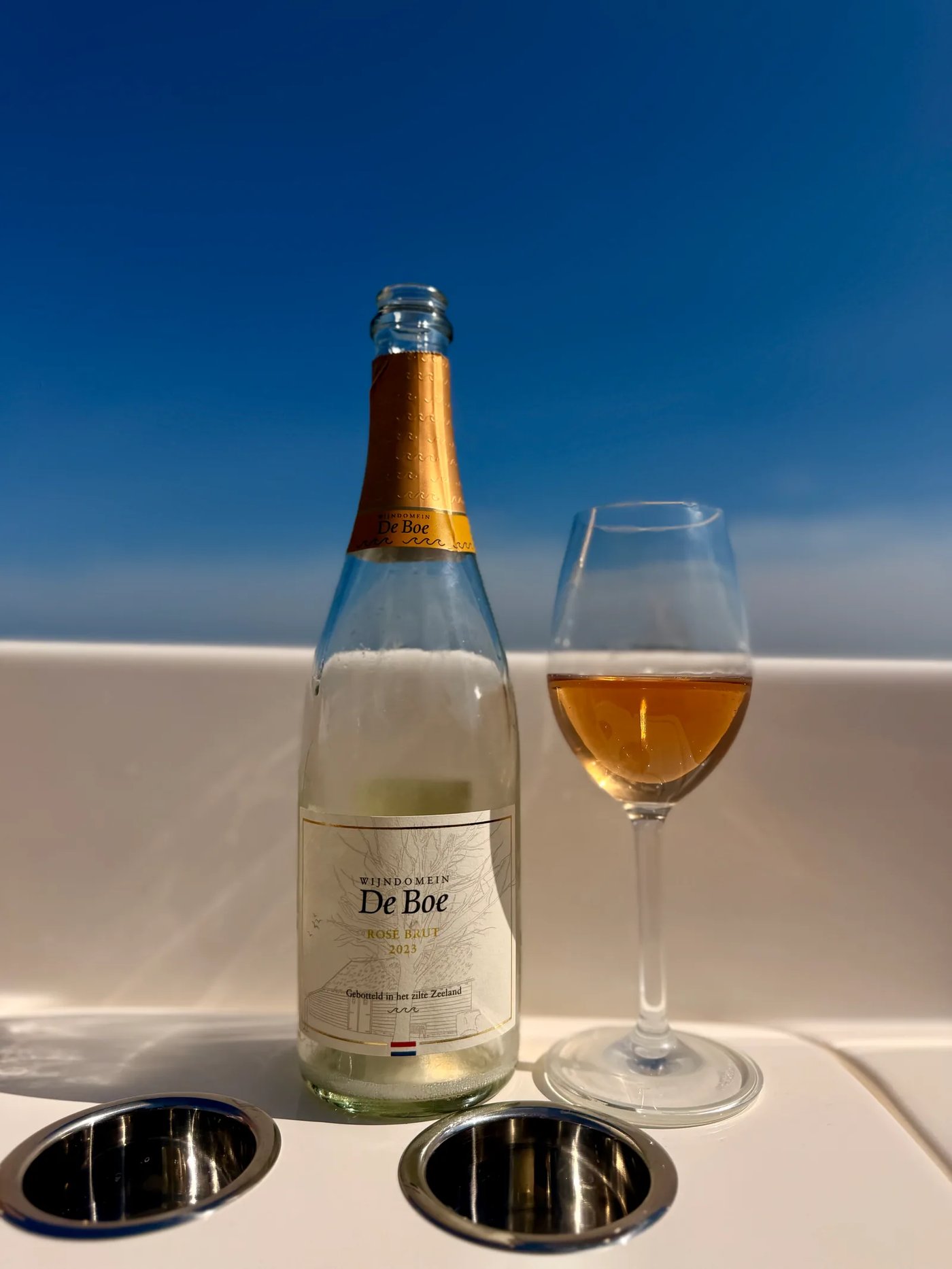
The colour is the first thing you notice. Not the pale salmon of most rosé brut, but deep copper, almost onion-skin, as if the pinot noir had spent a little longer on its skins. I poured it on a boat somewhere above the Oosterschelde, and against the low evening sun the glass turned the colour of old bronze.
This is the first sparkling wine Bruno Suter ever made. The 2023 vintage, bought at the estate, from Bruno himself. That makes it more interesting than the average debut bubble: you are tasting where a very young Zeeland estate stands the first time it attempts the hardest wine style there is.
A Zeeland grape, a Mosel cellar
Suter has been planting vines on Walcheren since 2021, five hectares around an old orchard between Middelburg and Vlissingen. The vines are young, and full production is not expected until around 2027 or 2028. For his first sparkling he chose pinot noir and pinot noir précoce, in a 70/30 blend, the classic red grapes for a bottle-fermented rosé.
What the label does not tell you: these bubbles were not made in Zeeland. The vinification ran through Schaufelberger Sekt in Brauneberg on the Mosel, a Sektmanufaktur that handles the méthode traditionnelle for small growers. So “bottled in salty Zeeland” sits on a wine that got its second fermentation some three hundred kilometres inland. No shame in that, plenty of young estates start this way, but it helps to know what you hold: Zeeland fruit, German craft.
The wine spent nine months on the lees, by the traditional method. That is short for a sparkling wine, and you can taste it.
Tasting note
Appearance
Deep copper-pink, far darker than you expect from a rosé brut. Fine, persistent bubbles that keep rising cleanly.
Nose
Fresh and creamy at once. Plenty of red fruit, a spicy note underneath, and citrus pulling towards grapefruit.
Palate
Approachable and fresh, with red fruit and cherry, that same spice, and a light touch of toast from the lees. No more than a touch, medium intensity. The mousse tingles nicely on the tongue and palate, though it is not fully integrated yet. After nine months on the lees you would not expect that marriage to be complete.
Finish
Medium in length, with acids in fine balance and a bitter edge that I actually like a lot.
Quality
Approachable and lively, a pleasure to sip, but still short on depth. For a young estate’s first sparkling that stands to reason, and the bitter edge with that balance already make it easy to enjoy.
What to pair it with
That saline swipe and the red fruit almost demand the local coast. Zeeland oysters, especially the fuller creuses, or a plate of Oosterschelde lobster. It also works with smoked trout, or simply as an aperitif on a warm evening by the water, exactly where I drank it.
Serve it around 8 degrees. Colder and the nose shuts down, warmer and the acidity turns sharp.
Twenty-eight euros for a first effort
At €28 De Boe is not playing in the entry tier. You compare it with Domein Holset from Limburg, with the Amsteltuin Johannes I, and with entry Crémant or a simple grower Champagne around the same money. In that company this rosé is not yet a winner on depth. What you buy is something else: a first vintage from an estate you can follow from the very start, with a colour and a saline twist you will not find anywhere else.
I have since tasted the second version of this sparkling. It spent eleven months on the lees instead of nine, and that gains exactly what this first vintage lacked.
Wine facts
- Producer
- Wijndomein De Boe
- Wine
- Rosé Brut 2023
- Region
- Walcheren, Zeeland (PGI Zeeland)
- Grapes
- 70% Pinot Noir, 30% Pinot Noir Précoce
- Method
- Traditional method, 9 months on the lees
- Alcohol
- 12%
- Price
- €28
Frequently asked questions
What is De Boe Rosé Brut 2023?
The first sparkling wine from Wijndomein De Boe on Walcheren in Zeeland, the Netherlands. A dry rosé of pinot noir and pinot noir précoce made by the traditional method, aged nine months on the lees. Alcohol 12 percent, carrying the protected geographical indication Zeeland.
Where was the wine made?
The grapes come from five hectares on Walcheren that Bruno Suter planted from 2021. The sparkling vinification of this first vintage happened at Schaufelberger Sekt in Brauneberg on the Mosel, a Sektmanufaktur that runs the méthode traditionnelle for dozens of small houses.
Where can you buy De Boe Rosé Brut?
Through the Wijndomein De Boe webshop and at the estate itself, which runs Saturday tours with tastings. The bottle costs around 28 euros.
Sources
- Primary source: bottle label Wijndomein De Boe Rosé Brut 2023 (front and back)
- Additional: Wijndomein De Boe, webshop
- Additional: own tasting notes, Sparks episodes 16 (Bruno Suter) and 17 (Jochen Schaufelberger)
- Additional: Savor the Harvest on Wijndomein De Boe (confirms the 70/30 blend and Schaufelberger vinification)
More on Wine Review
C. Kloss Sparkling Tea Weiss: Fermented Celery
Non-alcoholic sparkling tea Weiss from C. Kloss: linden blossom, nettle and fermented celery. Dry, 2.7 g sugar per 100 ml, €14.99 at Amavine.
Read on →
Barbadillo Sábalo: Organic Palomino Without Flor
Organic Palomino Sábalo from Barbadillo: no flor, salt from albariza soil. Chamomile, apple, sea. €17.95 at Granada Wijnen, with discount code.
Read on →
Tua Rita Lodano Rosso 2024: Petit Verdot Leads
A €50.95 Super Tuscan built on 60 percent Petit Verdot and 18 months of barrique. Why I chill it, decant it and never drink it without food.
Read on →