

Rouge en Voiture: Redefining Alcohol-Free Red
Cul Sec's Rouge en Voiture: an alcohol-free red built on Sangiovese juice, with smoked peat and pepper for throat feel. Tasted with maker Fleur on Sparks.

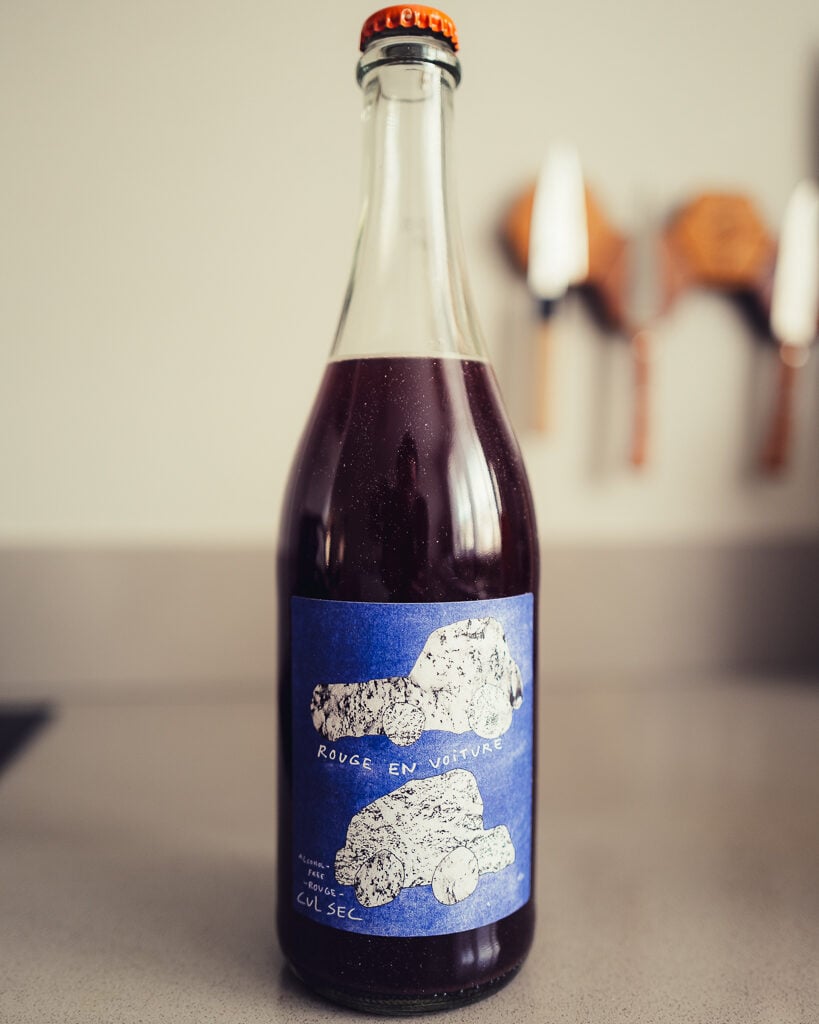
There is pepper in Cul Sec’s Rouge en Voiture. The makers add it for throat feel, to mimic a little of what alcohol does. Fleur from de Fruitslagers told me so when we opened the bottle together in episode 8 of Sparks. I had just said I tasted some heat in it.
I spotted a car on the label. Test passed, I said.
How it’s built
The base is juice from Sangiovese grapes. Fleur told me they use organic grapes for all their drinks and choose not to dealcoholise wine because, in her view, too much flavour is lost that way. Water infusions, a slow ferment and tinctures join the juice. Those tinctures are infusions on alcohol, and they bring back volatile aromas. They are added drop by drop, up to a maximum of 0.5 percent alcohol; Fleur said the drinks now sit at 0.4 percent or lower.
Two ingredients never came up with the orange L’étable Fumé. The first is smoked peat, which Fleur says the makers gather themselves. The second is the pepper. The light fizz is added CO2, as in the orange.
In the glass
Tasting Note
Appearance
A lovely red colour, with a light fizz.
Palate
Lots of ripe red fruit and very spicy. Complex, a little smoky. A heat like red chilli, minus the sharp edge.
Fleur adds fruit and floral notes, hibiscus for one, and redcurrant. She calls it full of flavour and full of character, and says this is not a bottle that makes you think you are about to drink juice. That is the maker’s reading, though I recognised it.
At first I put the smokiness down to Sangiovese, which often has a smoky side. Fleur agreed about the smoke and pointed to the smoked peat.
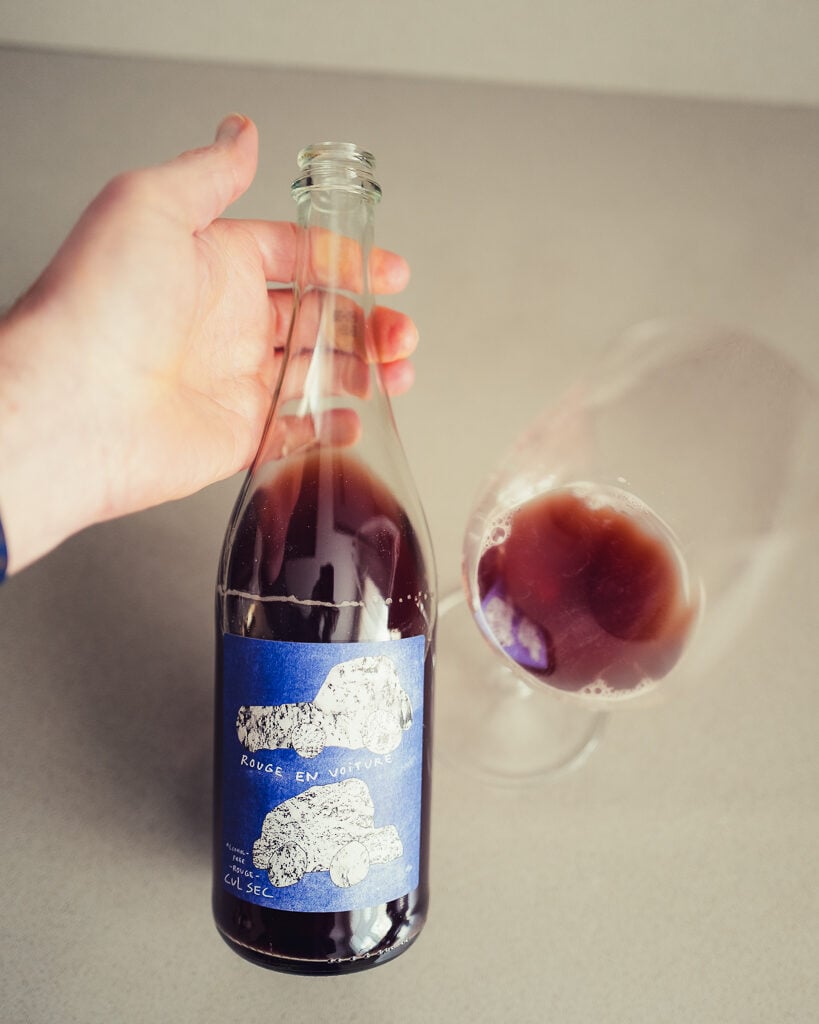
What to watch for
Start with the pepper. It is there to imitate alcohol, and if you don’t miss that feeling in your throat you may find it a trick. I didn’t find it sharp, but it is there. Fleur wasn’t sure which pepper it is.
That ties in with the second point. Fleur didn’t create the drinks; she helped with production. What I write here about how the drink is built is her explanation, and I had no way of checking it.
Check which bottle you are buying, too. I tasted the earlier version, made on Sangiovese. The 2025 cuvée is a different drink. That label lists Pinot Noir, Kékfrankos and Dornfelder, with lacto-fermented blackcurrant, blackberry, beetroot and peach, and the colour is much darker. What’s on sale now will probably taste different from what I describe here.
The grapes are organic, the bottle as a whole is not. Cul Sec carries no organic certification, because not every ingredient is organic.
I tasted a single bottle, once.
- Maker
- Cul Sec, de Fruitslagers
- Drink
- Rouge en Voiture, red
- Base
- Juice from Sangiovese grapes
- Method
- Water infusions, slow ferment, tinctures
- Signature
- Smoked peat, pepper for throat feel
- Alcohol
- Maximum 0.5%; now 0.4% or lower, according to Fleur
- Fizz
- Added CO2
- Certification
- No organic certification; the grapes are organic
The price didn’t come up in the recording.
More information: fruitslagers.nl/culsec
Sources
- My own tasting note and conversation with Fleur from de Fruitslagers, Sparks ep. 8
- Cul Sec at de Fruitslagers: fruitslagers.nl/bedrijven/culsec
More on Non-Alcoholic
Ron Gastrobar's alcohol-free wine list, minus the wine
The Ron Gastrobar alcohol-free wine list runs on tea and fermented drinks. Sommelier Jacob van Benthem explains why that beats dealcoholised wine.
Read on →
Non-Alcoholic Sparkling Tea, Rewritten by Kloss
Non-alcoholic sparkling tea from the Mosel: fermented celery, wild orchard apples, 0.0%. Five bottles from C. Kloss tasted, with pricing and where to buy.
Read on →
Drink Less, Drink Better: The No/Low Shift of 2026
Drinking less but better is a taste decision, not a diet. What the 2026 no/low numbers mean, and when alcohol-free actually holds up in the glass.
Read on →