

Jörg Geiger Champagner Bratbirne: a Pear from 1797
Champagner Bratbirne: a pear variety first described in 1797. Jörg Geiger turns it into an alcohol-free sparkler with three years on the lees.

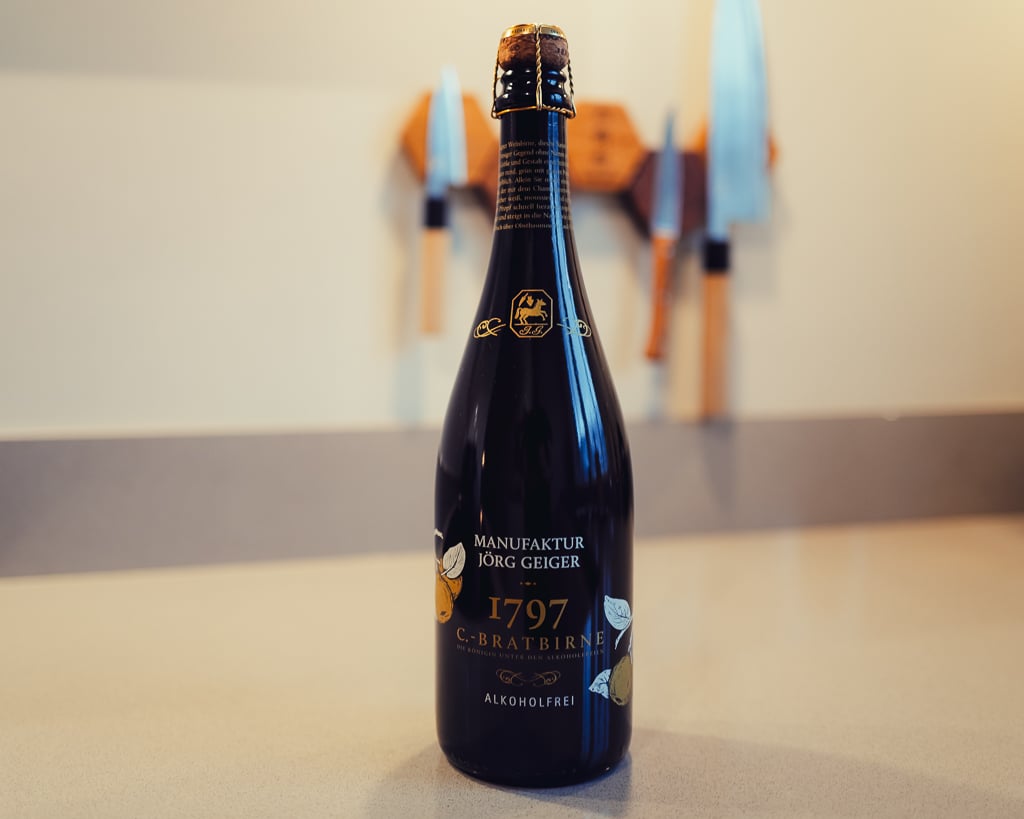
A pear variety that was already on paper in 1797. Jörg Geiger’s Champagner Bratbirne comes from that pear. It’s an alcohol-free sparkler that sits somewhere between champagne and cider, and it has no business on the standard non-alcoholic shelf.
The pear and the name
The Champagner Bratbirne is first mentioned in 1797, in the fruit-growing handbook of the pastor Johann Ludwig Christ. Since 2005 the variety has been on Slow Food’s Ark of Taste, the list of endangered regional foods.
That name got Geiger into court. The Champagne producers argued that “Champagner” on a German bottle infringed their protected name.
The Federal Court of Justice agreed in 2005, even though the variety name was more than 150 years old. That’s why the front label now reads “C. Bratbirne”, with the full variety name only on the back.
How it’s made
Jörg Geiger took over the family business in Schlat, Gasthof Lamm, in 1993. In 2003 he started his Manufaktur, and his first alcohol-free drinks the same year.
The Bratbirne first gets a normal fermentation, then a second fermentation in bottle, as with champagne. It then spends at least three years on the lees.
Only then does the alcohol come out, by vacuum distillation. Under vacuum, alcohol boils at around 37°C, so the wine never has to get hot. About 0.2% alcohol remains.
Tasting notes
Tasting Note
Appearance
Pale yellow, with a fine mousse that holds.
Nose
Dried pear, with a brioche layer from lees ageing that immediately recalls classic champagne.
Palate
Just enough sweetness to carry the pear without masking it. Fine, festive mousse, pear and subtle skin tannins.
Finish
Long.
What I watch for
One: alcohol-free here doesn’t mean 0.0. There’s about 0.2% in it. That’s very little, but if you need exactly zero for medical or religious reasons, pick something else.
Two: the bubbles don’t come from the bottle. The second fermentation gives the brioche, but the fizz is lost in distillation and added back afterwards. The method tells you about the flavour, less about the mousse.
Three: the champagne comparison only goes so far. This is pear wine, with the skin tannins of pear. If you’re after an alcohol-free champagne, you’ll taste something different.
At the table
Aperitif, brunch, or with dishes where champagne works but the alcohol must stay out. Foie gras, Reblochon on bread, grilled white fish. Also fine with cake or not-too-sweet desserts.
Verdict
One of the sharpest alcohol-free sparklers I know, and you don’t need to judge it as a stand-in for something else. Three years on the lees and an old pear variety make it a product in its own right.
Thanks to Jan Rutten at Het Proefstation. Order via proefstationdirect.nl.
Sources
- My own tasting note
- Manufaktur Jörg Geiger (official, Champagner Bratbirne alkoholfrei): manufaktur-joerg-geiger.de
- Slow Food Deutschland, Ark of Taste: Champagner Bratbirne
- Federal Court of Justice (BGH), ruling I ZR 262/02 of 19 May 2005: kostenlose-urteile.de
- Het Proefstation, product information: proefstationdirect.nl
More on Non-Alcoholic
Ron Gastrobar's alcohol-free wine list, minus the wine
The Ron Gastrobar alcohol-free wine list runs on tea and fermented drinks. Sommelier Jacob van Benthem explains why that beats dealcoholised wine.
Read on →
Non-Alcoholic Sparkling Tea, Rewritten by Kloss
Non-alcoholic sparkling tea from the Mosel: fermented celery, wild orchard apples, 0.0%. Five bottles from C. Kloss tasted, with pricing and where to buy.
Read on →
Drink Less, Drink Better: The No/Low Shift of 2026
Drinking less but better is a taste decision, not a diet. What the 2026 no/low numbers mean, and when alcohol-free actually holds up in the glass.
Read on →