

Cul Sec Rouge en Voiture: A Wine Proxy Done Right
Cul Sec Rouge en Voiture, the 2025 cuvée: an alcohol-free red on Pinot Noir, Kékfrankos and Dornfelder. What the label says is in it and how it tastes.

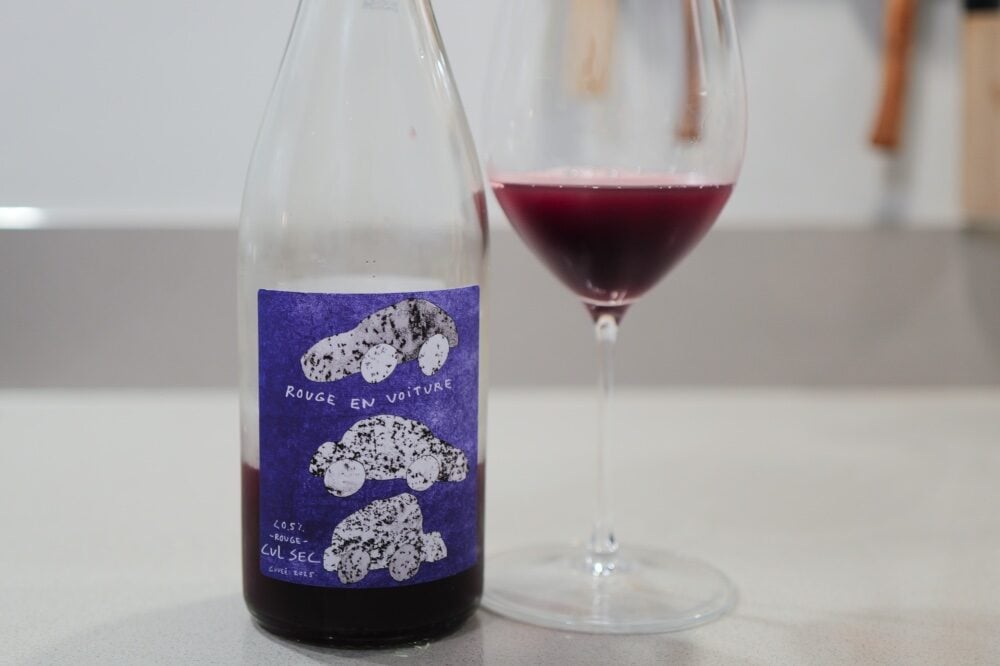
Cul Sec Rouge en Voiture isn’t trying to be wine. De Fruitslagers, based in Culemborg in the Netherlands, borrow techniques from the wine cellar and use them for an alcohol-free drink that goes its own way. When I poured the bottle and stopped looking for Pinot Noir, the drink started to work for me. This piece is about the 2025 cuvée.
What is a wine proxy
A wine proxy takes the place of wine at the table without being wine. De Fruitslagers describe Cul Sec as an alcohol-free alternative to wine, a maceration of wild herbs, wine grapes and ferments. The label puts Rouge en Voiture under 0.5 percent alcohol.
Dealcoholised wine it is not. In Sparks episode 8, Fleur from de Fruitslagers explained that they start from grape juice, because in her view dealcoholising loses too much flavour.
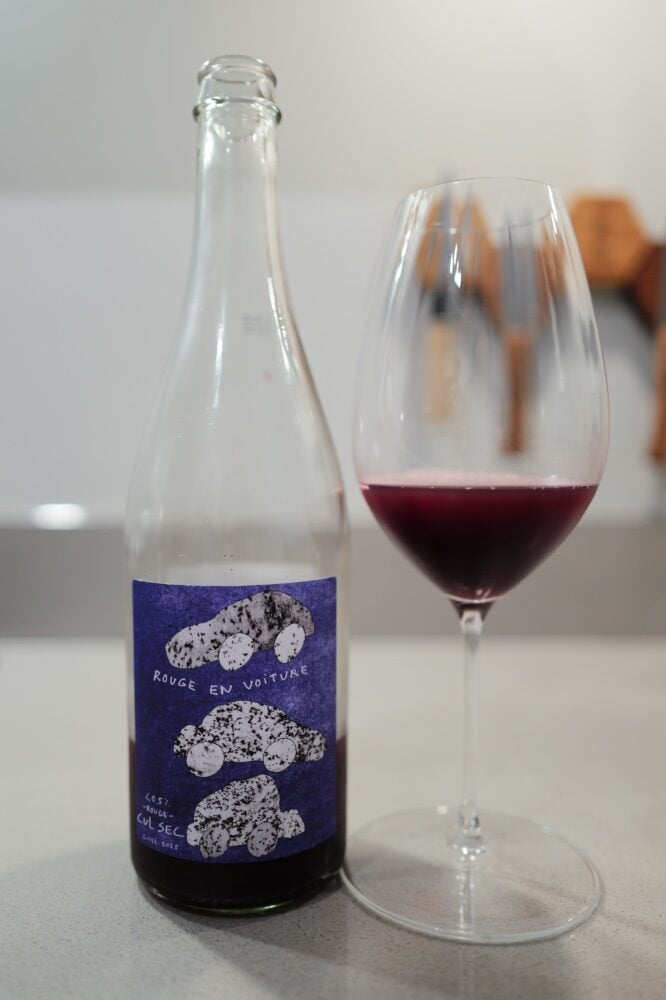
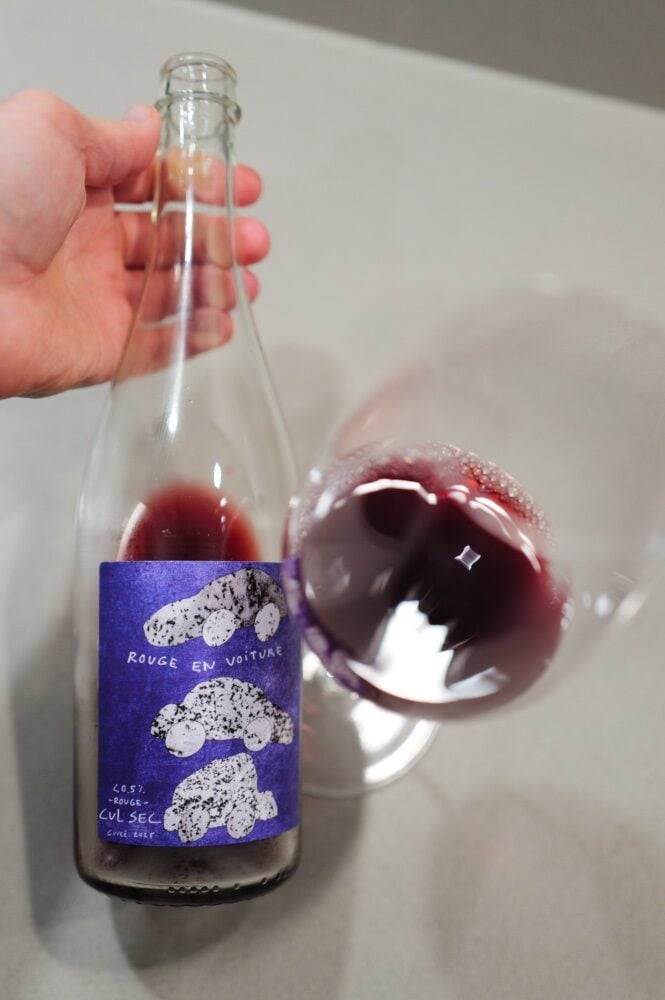
The makers write that with this palette of flavours they are building “Domaine Cul Sec”, an estate full of wilderness and regeneration. Their website mentions oyster shell for mineral notes and several kinds of wood for tannin. The name translates as “red in the car”, and that car is on the label.
Borrowed technique, original vision
According to the label, the juice comes from Pinot Noir and Kékfrankos grown in Nemesgulács in Hungary and Dornfelder from Kitzingen in Germany. The Pinot Noir and Dornfelder are organic. For the 2025 cuvée the makers work with ripe, oxidised grapes and with verjus, the sour juice of unripe grapes. That brings acidity and tannin into the drink without alcohol. Emile of the Fruitslagers wrote on Substack in September 2025 that they had spent a full year working with the farmers.
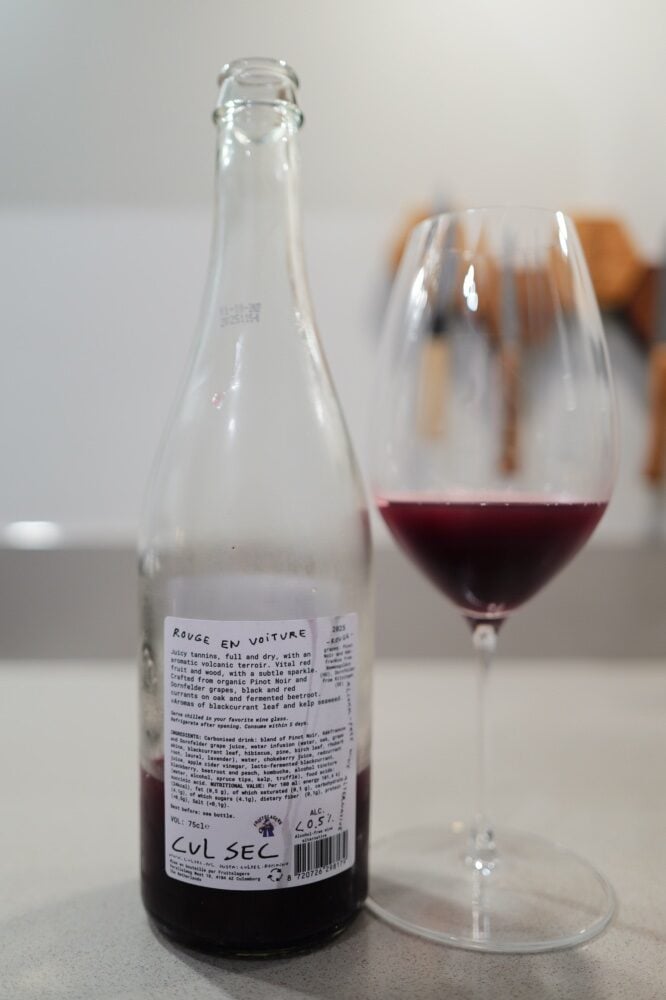
The ingredient list on the back is long. There is a water infusion with oak, grape skins, blackcurrant leaf, hibiscus, pine, birch leaf, rhubarb root, laurel and lavender. Chokeberry juice, redcurrant juice, apple cider vinegar and kombucha are on it as well. Blackcurrant, blackberry, beetroot and peach are lacto-fermented, the process you know from sauerkraut and kimchi. The alcohol tincture is made with spruce tips, kelp and truffle. The fizz is added CO2.
In the same post Emile describes a trial with an ultrasonic bath, which he calls hydrosonic. High sound frequencies pull flavour out of an ingredient in a short time, where it would otherwise take a week or two. Blackcurrant leaf went in. He added that they were still testing. I found no confirmation that the technique made it into the bottle I tasted.
Tasting notes
Once poured, the colour comes first: intense, almost impenetrable garnet with a gentle fizz. It is darker than the earlier version I tasted with Fleur on Sparks. She told me that one was made on Sangiovese, a grape that no longer appears on this label.
The nose jumps out of the glass. I get beetroot and dark cherry, with chestnut and hazelnut underneath. Fresh herbs such as basil, oregano and stinging nettle push it towards savoury, and below that there is something of forest floor and bramble leaf. The fruit is wild and has none of the sweetness of fruit juice. The wine aromas you know are not in here.
On the palate, the structure surprised me. The tannins have grip and the acidity is bright and mouth-filling. The beetroot returns and makes it earthy. The finish has a pleasant bitterness, with fruit and herbs. The gentle fizz gives it lift. I found the aromas more open when it was slightly warmer than fridge temperature.
When and how to drink it
The label advises serving it chilled in a wine glass, keeping the bottle in the fridge once opened and finishing it within five days.
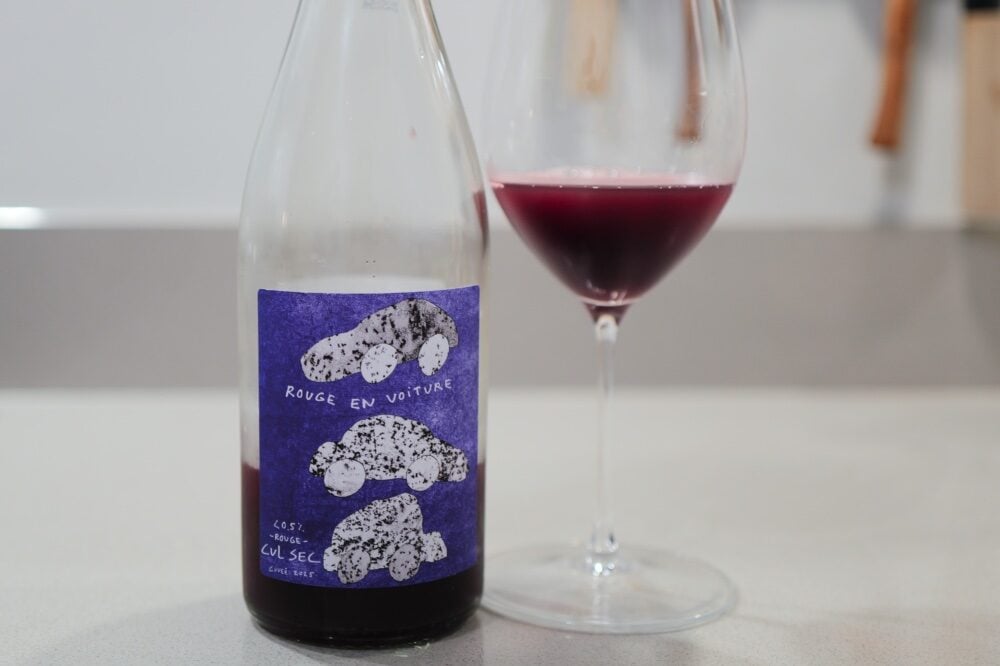
I would pour it at lunch, when you want something serious in the glass and need to stay sharp for the afternoon. It also suits anyone who avoids alcohol and misses a drink with depth.
With food, I end up in autumn: a wild mushroom risotto with fresh truffle. The earthy, savoury side of that dish matches the drink. I would also put it next to roasted root vegetables, aged cheese and dark chocolate.
Don’t pour it when someone asks for “something like a nice Chianti”. That ends in disappointment, because it doesn’t resemble wine. Pour it for someone who is curious about fermentation.
Honest assessment
Rouge en Voiture is complex, with tannin and acidity, and it lacks the sweetness many alcohol-free drinks lean on. I think it is a superb drink.
There are limits too. The funky, earthy character won’t suit everyone. This is a bottle for natural wine drinkers and people who like fermentation. Anyone after something familiar will drop out.
Price is the second. In October 2026 the Fruitslagers webshop listed it at €17.50 for a 75 cl bottle. For the work that goes into it I think that is fair, but it is no supermarket price.
The third concerns this piece itself. Origin, ingredients and technique come from the label and the makers’ website, and I had no way of checking them. I tasted a single bottle.
Worth seeking out
If you want a bottle that tastes like Côtes du Rhône, look elsewhere. If you are curious what wine technique delivers without alcohol, put it on your list. Santé.
Sources
- My own tasting note and the bottle’s label, 2025 cuvée
- Cul Sec at de Fruitslagers: fruitslagers.nl/bedrijven/culsec
- Emile of the Fruitslagers, Shaping the 2025 Cuvée, Substack, 8 September 2025 (a year with the farmers, ultrasonic bath)
- De Fruitslagers webshop, price: fruitslagers.shop/webshop
- Conversation with Fleur from de Fruitslagers about the earlier version, Sparks ep. 8
More on Non-Alcoholic
Ron Gastrobar's alcohol-free wine list, minus the wine
The Ron Gastrobar alcohol-free wine list runs on tea and fermented drinks. Sommelier Jacob van Benthem explains why that beats dealcoholised wine.
Read on →
Non-Alcoholic Sparkling Tea, Rewritten by Kloss
Non-alcoholic sparkling tea from the Mosel: fermented celery, wild orchard apples, 0.0%. Five bottles from C. Kloss tasted, with pricing and where to buy.
Read on →
Drink Less, Drink Better: The No/Low Shift of 2026
Drinking less but better is a taste decision, not a diet. What the 2026 no/low numbers mean, and when alcohol-free actually holds up in the glass.
Read on →