

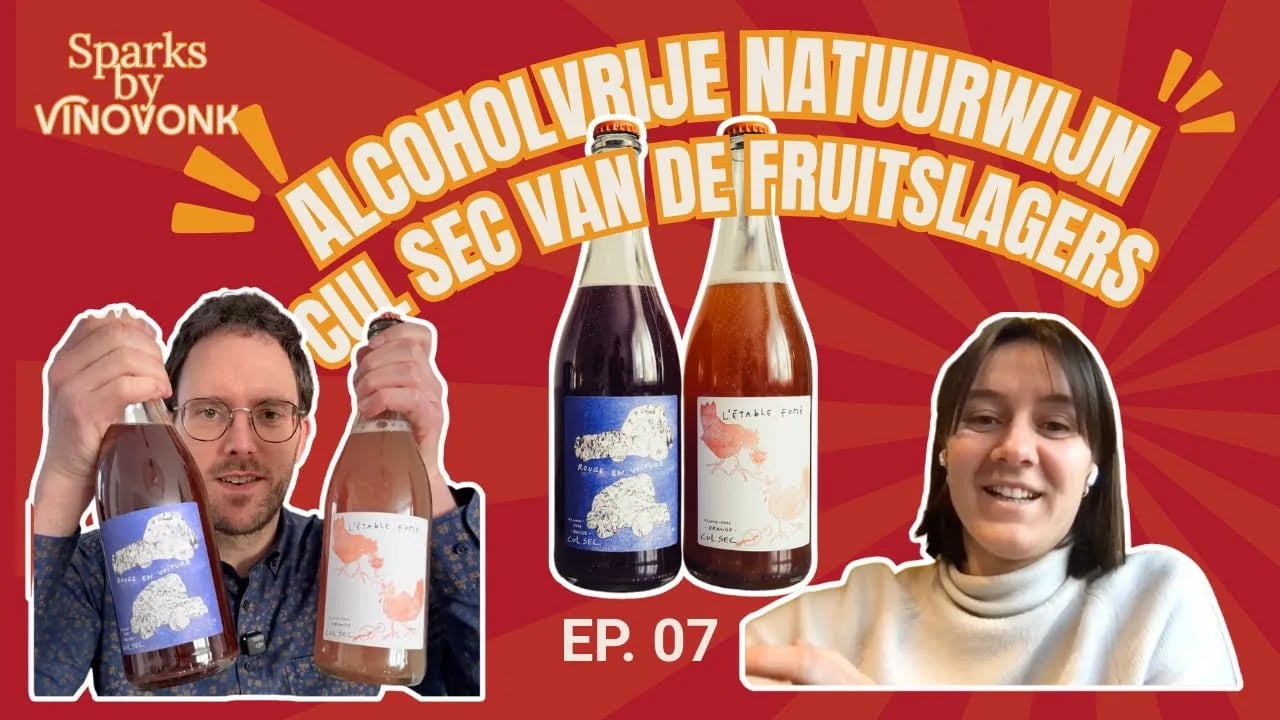
For this Sparks I sit down with Fleur of de Fruitslagers, the company behind Cul Sec, a range of alcohol-free drinks for people who like natural wine. We open two bottles, L’étable Fumé and Rouge en Voiture, and Fleur walks me through how they are put together. She is clear that it isn’t natural wine, since the process is different. What they went after are the flavours natural wine drinkers recognise.
De Fruitslagers sent me the two bottles; I received no payment and the opinions are my own.
From syrups to alcohol-free wine
De Fruitslagers is the umbrella name. Roze Bunker, where they started some nine or ten years ago, is one of their brands: syrups, by now twelve or thirteen flavours. Over the past year they added two drinks lines, Cul Sec and the alcohol-free spirits of Fieldkite. From their own leftover streams they make condiments, such as a hot sauce and a tempeh chilli oil using tempeh from Boonzaak, their brand that turns forgotten Dutch beans into tempeh.
Fleur says the point of all this is to restore the landscape, improve the soil and make the food system better. Herbs and other ingredients come from regenerative farmers and growers.
How Cul Sec is built
Development started a year or two ago. They wanted a drink with layers and body, something grown-up. So they took a technical look at what wine does on your tongue and in your throat, and how to recreate that without alcohol.
Each bottle has four components. The base is juice from organic grapes: Pecorino for the orange, Sangiovese for the red. They deliberately don’t dealcoholise wine, because in Fleur’s view too much flavour is lost along the way. Next come water-based infusions, from tea to cold infusions, and a slow fermentation. For L’étable Fumé the skins and must go onto kombucha to draw out the tannins.
Last, they add tinctures drop by drop. These are infusions in alcohol, which carries flavour differently from water. The ceiling is half a percent; Fleur thinks the current level is 0.4 percent or lower, enough to bring back the volatile aromas. The light sparkle is added carbon dioxide rather than a product of fermentation, and it stops the drink from feeling flat.
In the glass
L’étable Fumé is first. Bits float in the bottle, and as with natural wine, I rather like that. I get something floral, white tea and jasmine. Fleur points to dried herbs such as alfalfa and verbena, pear, the kind you get from oak ageing, and a funky undertone. The bitterness comes from gentian root, and the Pecorino adds a touch of sweetness, though she wouldn’t call it sweet.
It has that natural-wine edge, a bit earthy and funky. It doesn’t taste like wine, nor like fruit juice. It is its own thing, and you can feel the complexity. I find the finish long and pleasant. On a terrace in summer I wouldn’t miss the alcohol.
Rouge en Voiture is Sangiovese-based, and Fleur describes fruit and floral notes such as hibiscus, plus redcurrant. I taste plenty of ripe red fruit, spice and some smoke, plus a heat that reminds me of red chilli minus the burn. That matches what goes in. They add pepper to mimic the throat feel of alcohol, and for the smoky side Fleur says they use smoked peat.
As an aperitif
Fleur likes L’étable Fumé as an aperitif, and she sees plenty of restaurants serving it that way because of its bold flavour.
Caveats
The grapes are organic, but the bottle is not certified organic. Not every ingredient is: regenerative farmers often have no certification, and sometimes de Fruitslagers choose a leftover stream over an organic product.
Fleur didn’t create the drinks. She helped with production, and she couldn’t say exactly what the floating particles are beyond leftovers from filtered herb infusions. I tasted two bottles the producer sent me, so this is a first impression; I haven’t compared them with other alcohol-free wines.
Frequently asked questions
What exactly is Cul Sec? Cul Sec is a range of alcohol-free drinks from the Dutch company de Fruitslagers, aimed at natural wine lovers. The flavour is built from organic grape juice, water-based infusions, a slow fermentation and a small amount of tincture.
Is Cul Sec the same as dealcoholised wine? No. Dealcoholised wine starts as finished wine and has the alcohol removed. Cul Sec starts from grape juice and builds its own profile, with tinctures up to 0.5 percent alcohol to bring back volatile aromas.
Which drinks feature in this episode? L’étable Fumé, an orange based on Pecorino grape juice, and Rouge en Voiture, a red based on Sangiovese.
Is Cul Sec organic? The grapes are, the bottle isn’t. There is no organic certification, because not all ingredients are organic or their origin is hard to trace.
Where can I find out more about Cul Sec? Price didn’t come up in the recording. More information is at fruitslagers.nl/culsec
Listen on your own podcast platform
Prefer Apple Podcasts, Pocket Casts, Overcast or another app? Search for Sparks by VinoVonk in your podcast app and you will find this episode with Fleur on Cul Sec.
More about de Fruitslagers
Cul Sec and the full range from de Fruitslagers: fruitslagers.nl/culsec
Transcript
An English translation of the Dutch conversation, up to about 12:30. The final part, covering a third drink and where to buy, has no transcript yet.
Show full transcript
This transcript is generated automatically from the audio and has not been edited. Speech recognition makes mistakes, so treat wording as an approximation rather than a verbatim quote. It is here for accessibility and search.
Hi, I’m Jeroen Vonk and welcome to Sparks by VinoVonk. The series in which I take you into the world of wines, spirits and innovative drinks. And today we’re going to talk about innovative drinks. And from Cul Sec of the Fruit Butchers. And I have a nice guest and that is Fleur from the Fruitslagers.
Fleur, welcome. Can you tell us something about, yes I saw it, the Fruit Butchers. You are in the Pink Bunker. I’m going… Really hard on these kinds of names, I love them.
But could you tell us something about it? Yes, that’s good. Our umbrella name is the Fruit Butchers. You already said it in the Roze Bunker, now it seems like a lot, but Roze Bunker is actually the name of one of our brands. We have various brands and we make non-alcoholic drinks, but also with our own residual flows, condiments and other products.
We started Roze Bunker about nine or ten years ago. Those are syrups. If I remember correctly, we already have a tasty offering, 12, 13, on the shelves. And over the past year we have been very busy launching two non-alcoholic beverage lines. So we indeed have Cul Sec, the non-alcoholic alternatives to natural wine.
And then we have Fieldkite, alcohol-free spirits. And they are great to mix with Roze Bunker or Cul Sec to make a mocktail. And then we also have a number of condiments that we make from our own residual flows. So for example a hot sauce and a tempeh chili oil. The tempeh chili oil is made with tempeh from another brand that we also carry, namely Boonzaak.
There we make tempeh from forgotten Dutch beans. Well, then we have dessert syrups, vinegars, well, everything actually. And we do all this to restore the landscape. Start making better and improving the food landscape. Yes, it’s a bit of a regenerative approach.
Certainly, yes, we also work with many regenerative farmers and growers to purchase products from them, herbs, things like that that we then process in our drinks. Yes. I received these two nice bottles from you to try. Yes, indeed what you say, it is a bit of an alternative to natural wine. Wine with low intervention and what you also see is that there are all these nice bits floating in it.
And yes, I always find that useful. Because then you just know that something is happening. I remember Niels van Laatum when he wrote the book Natural Wine. It always says shake before use, yes if preferred. But that’s where the pressure is, so of course we’re not going to shake this hard.
There are indeed bubbles in it. But can you tell us something about these two? Yes, It is an alternative for natural wine lovers. That is indeed how we sell it. And we started developing it a year or two ago.
And actually our goal was to make a tasty product that has layers, that is mature, that has a lot of body. And so we used all kinds of techniques to make this. And we started looking very technically at what exactly wine is and what it does in your mouth, what it does on your tongue, in your throat. Why does that happen and how can we imitate that without using alcohol or that alcohol has that effect, but. Shall I tell you something about the structure and the techniques behind it?
I think that says a lot. Would you like to pour it into a glass first and then taste it together? Good idea, what should we start with? What do you think? You are an expert.
Orange this one? Yes. Can be opened completely. I don’t have to worry that if my cap is wet it will spray out completely. No, there is some fizz in it, but that’s all fine.
Yes. Yes! So this is the orange one, yay, cheers! What a special scent. Very nice, floral.
Yes, this is the… A bit of white tea and jasmine. Yes, it has quite a few dried herbs that I think you can smell as well. And some pear notes, but also pears ripened in oak, for example. And alfalfa, verveine, so those kinds of dried herbs.
So that’s also a bit of the funky undertone that you can taste in it. And this one also has quite a bit of bitterness, so that’s why I thought it would be nice to start with this one. I really enjoy drinking this as an aperitif, for example. I also see that many restaurants enjoy doing that. Because it has quite a strong taste.
Quite a bit bitter. That comes from gentian, which is a root. And it just gives off quite a bit of bitterness. So this one is full of flavor. Quite spicy.
And this one contains pecorino as a grape. It still gives a little sweetness, I wanted to say. Anyway, I like this one… Wouldn’t describe it as sweet per se. Yes, yes, exactly.
Yes. And so what we actually do with all our drinks is we have a structure that you may not have seen before. So we have some grape juice. We use organic grapes for this. In this case it is pecorino.
Then we have some infusions. So an extraction of taste from water. So the simplest form can be thought of as tea. But it can also be a cold infusion that is present in our white, for example. Then we have some slow fermentation.
We use kombucha for the orange, the L’étable Fumé. So we put the grape skins, the must, on fermentation to get the tannins out. And then we have some tinctures. So that’s actually something like an infusion, but with alcohol. Because alcohol, yes, has a different ability to transmit flavor than water does.
And we add that to a maximum of half a percent. Now there is even less in it, max I think 0.4 or maybe even less. And we really do that to get those volatile flavors back in. So that very little bit of alcohol actually does quite a lot for the layering in taste. Yeah, so that’s basically the structure of our drinks.
Roughly speaking. And each has different ingredients. Yes, and a little bit of carbon dioxide. For that mouthfeel too. And how do you get that carbon dioxide in?
Should I see that as some kind of big soda stream? Yes, we will inject that in. So that is not due to fermentation, but that is applied, so to speak. Yes. Can come through the kombucha.
Yes, no, we added that ourselves. Yes, and it is a very light sparkle, but it still packs quite a punch in the mouth, I think. It ensures that it does not remain very soft. It literally makes it fizz in your mouth. And you said you’re starting with grape juice.
Do you really start with the grape or do you start with dealcoholized wine? No, we really start with the juice of the pure grape, so we don’t dealcoholize. And that is actually a conscious choice because we want to keep that taste alive. And when you dealcoholize it, in our opinion, quite a lot of flavor is lost. So that’s why we chose not to do that and instead use those other techniques and use the pure grape in it.
So that pecorino that I tasted was really… Something I had never tasted before, because you only tasted it in wine form, so to speak. And this had simply not happened yet, so that is quite special to taste and very tasty. So that was also a nice discovery when making these drinks. Yes, and what do you think when you taste it like this?
Very tasty, but I also think it is very special, because it is what you said yourself, it is an alternative to natural wine. So wine that hasn’t had much intervention, so you always have something of an edge, a bit earthy, a bit funky, that makes you think, what’s going on here? And you have that here too. But it’s not like you’re like, I’m not drinking wine or, I’m having a fruit juice. No.
It is really something completely different, but you do feel that it has complexity. Well, nice, because that was indeed the goal, to really make something mature. It is not natural wine of course, because it has a different production process, but what we have done is actually for natural wine lovers, so basically what you say, those flavors that you recognize, to bring them back and also to indeed make a drink that will stand up if you choose an alcohol-free alternative. It is indeed an adult drink. I think the finishing process is quite long, because I can still taste it.
And in a very pleasant way. It’s very pleasant. I think if you have this on a terrace in the summer, you just don’t miss the alcohol. I often hear that from people, I want to have fun, but I miss alcohol so much. It’s missing something and you just don’t get that with this.
No, well, I think you say it. Thank you. Yes, that is also, we share that. That was also the goal. Certainly.
Yes. All those bits that are still floating in there are some kind of residue from the infusions. Well like I said, I’m not the producer, so to speak, the creator or creator of this. I did help with the productions, but I dare not say what exactly that residue is. Yes, we do use it, so it is indeed an infusion that sits in water for a very long time and we filter it, but there is still some left behind.
Yes, but they are, they are pure things that are in it. So alfalfa and verveine, I’m just really thinking about. Dried herbs that we have withdrawn, so no addition in that sense. So they are remains. It is all of organic origin, but the bottle is not certified organic.
No, well it’s not all of biological origin. The grape does, so the grape is a very large part of what is in it. But not everything is of biological origin. That is also because we work with farmers who work regeneratively, so you do not have an organic quality mark. Roze Bunker also works with residual flows, for example, so we make very conscious choices.
And then sometimes biological is not the most obvious choice and there is another choice that we can make better. Yes, so that is why it is not a quality mark, because it is not all organic, or not easy to determine, or yes, exactly organic. Yes, clear. Shall we taste the second then? It’s called Rouge en voiture-voiture.
Auto-oto, right? It’s also a nice picture that makes you think, what do you see in it? I see a car in it. I’m very happy that I passed the test. This one also has that effervescence.
Very nice color. Yes, a really nice red one… Yes. That is very special. And this is based on…
Sangiovese. Interesting. Another grape. So this one is really full of flavor. It also has some fruit and floral notes, for example hibiscus.
You could certainly taste that again. Very spicy, but really very complex. It’s not like you’re thinking, we’re going to have a juice now. Also really full of character. Yes.
Yes. But you will notice that this one is really different from the orange one. And that is very different, but also lots of ripe red fruit, very spicy. Complex, a bit smoky. Sangiovese always has a bit of a smoky feel to it.
Also a little spiciness. I would describe it as red chili peppers, but not very spicy. Yes, no, there is indeed a pepper in it and then I have to take a look, I sometimes forget which pepper it is, but we really add that pepper for that throat feeling, but to imitate the feeling of the alcohol a bit. But there is certainly pepper in it and you were also right about the smokiness, but we use smoked peat, which we collect ourselves, and indeed those fruit notes. So I always say it in English, save currants.
Read also
Related article on this topic →Listen
Watch