

Removing the alcohol without losing the wine
At a NoLo congress in Logroño, tech, science and sommellerie collided. Why removing alcohol from wine is far harder than brewing a 0.0 beer.

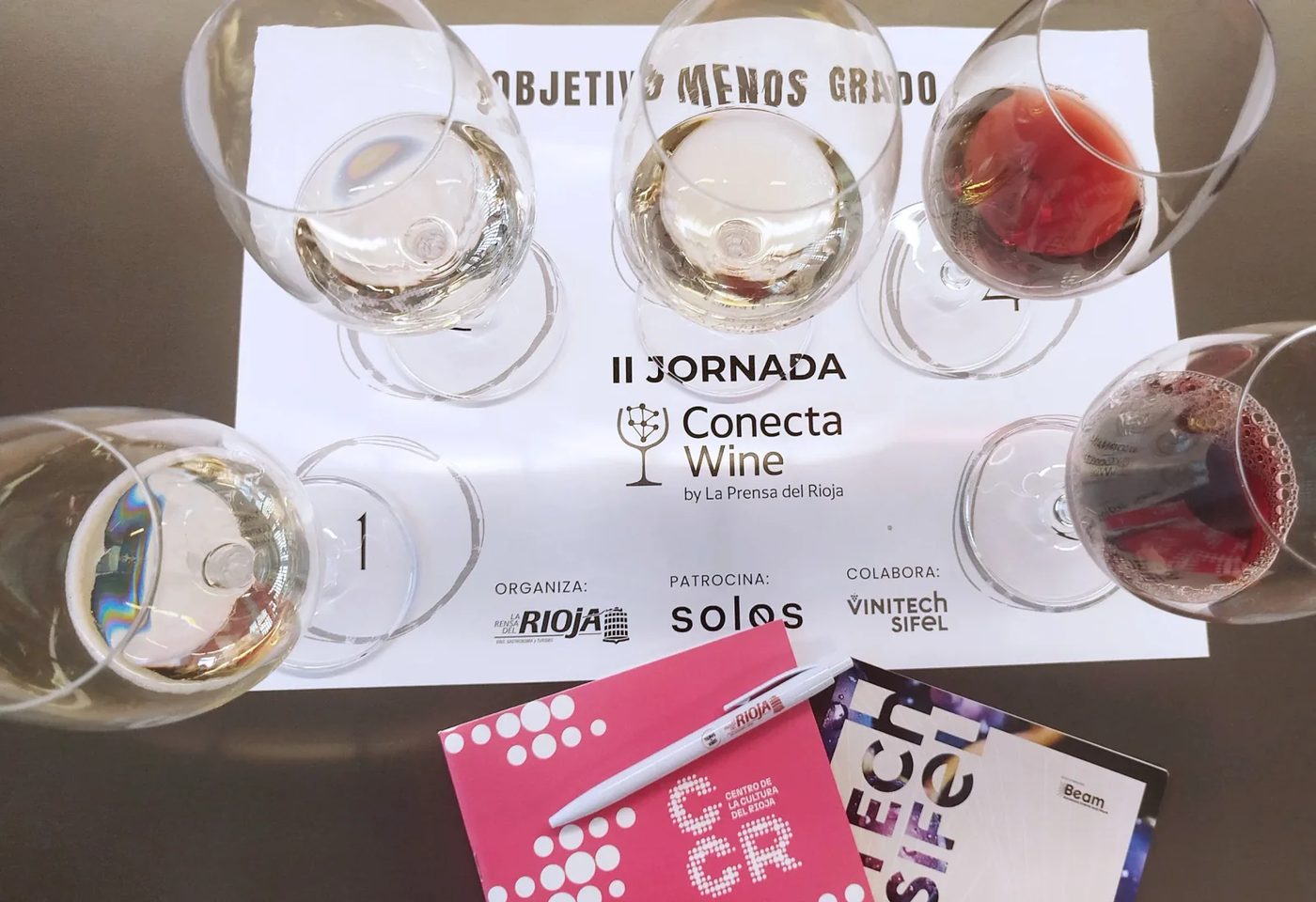
Removing alcohol from wine sounds like a technical footnote, until you hear what actually disappears the moment the alcohol leaves. At the Centro de la Cultura del Rioja in Logroño yesterday, an aroma specialist, a microbiologist and a sommelier sat at the same table, and all three arrived, in their own way, at the same question: how do you keep wine recognisable when you strip out the one ingredient that holds the rest together?
The congress, “Objetivo Menos Grado”, was part of Conecta Wine. It was not about whether no/low is here to stay. That argument is over. It was about how to do it well. And that is a different conversation from the slick product launches scrolling past on your feed.
Alcohol is not just alcohol
Irem Eren, global brand ambassador for SOLOS, exposed the core of it. Take out the alcohol and you also take out part of the aromatic compounds and disturb the wine’s structure. The mouthfeel collapses, the nose thins out. What you are left with technically holds no alcohol, but it is no longer wine either.
That is why SOLOS works with vacuum distillation plus its own system that captures the volatile, fragile aromas and puts them back afterwards. The aim is not a new product, but staying as close as possible to the original sensory profile.
Eren made two points I am keeping. First: low-alcohol wines at five to seven percent currently sit closer to ordinary wine than the fully dealcoholised versions do. Zero percent is technically impressive, but the middle road often tastes better. Second: alcohol-free wine is not a drain for Europe’s production surplus. You need top-quality fruit as your base, because first you make a good wine, then you remove the alcohol, then you have to stabilise it. Three rounds of work, three rounds of cost.
The science is still catching up
Lucía González-Arenzana, a researcher at the ICVV, added the side that almost never makes the marketing story. Alcohol is a natural barrier against micro-organisms. Remove it and you get a more vulnerable product that demands stricter hygiene and safety protocols.
How does such a wine behave after a year in bottle? How well does it keep, how stable is it microbiologically, what does it do physically and chemically over time? There is simply too little research on this. González-Arenzana argued for more science and for government support to share that knowledge, with organic production as an extra headache because of the regulations. That is a sober caveat for a category that likes to run ahead of its own evidence base.
The competitor is not wine
The sharpest shift in perspective came from Iván Sánchez, sommelier at the acclaimed Venta Moncalvillo. In his view no/low does not compete with ordinary wine at all. It competes with soft drinks, water, kombucha and 0.0 beer.
That matches what I see myself. People switch back and forth depending on the moment, the evening, whether they still have to drive. One night a glass of Rioja, the next an alcohol-free alternative, without it feeling like a defeat. So Sánchez simply puts it on his list. The glass of wine is a social ritual, and that ritual does not vanish when the alcohol does. He expects hospitality to become one of the big engines of the category’s growth.
What I tasted in the glasses
The afternoon closed with a SOLOS tasting: a Verdejo at 0.5 percent in still and sparkling form, a Reverse Pinot Bianco, a Breakaway Pinot Noir, a Breakaway Merlot and a Moscatel orange wine with skin contact, all around 0.2 percent. The last one interests me most. Skin contact in an alcohol-free wine is exactly the kind of experiment that shows this segment is growing up: not imitating the taste of wine, but chasing its own texture and a touch of bitterness.
For me the thread was clear. No/low is no longer a marketing fad and no longer a second-rate choice. It is a serious technical and scientific challenge that the best makers are still very much learning. And that is precisely what makes it worth following.
Source: El reto de quitar alcohol sin perder el vino – La Prensa del Rioja
More on Non-Alcoholic
Drink Less, Drink Better: The No/Low Shift of 2026
Drinking less but better is a taste decision, not a diet. What the 2026 no/low numbers mean, and when alcohol-free actually holds up in the glass.
Read on →
Zeno Tempranillo Cabernet: alcohol-free red
Zeno Tempranillo Cabernet is an alcohol-free red wine from Spain. Tasting notes, why alcohol-free red is the hardest category, and when it still works.
Read on →
Zeno Sparkling Rosé: alcohol-free bubbles
Zeno Sparkling Rosé is an alcohol-free sparkling rosé from Spain. Tasting notes, how it compares to the Sparkling White, and when to pour it.
Read on →