

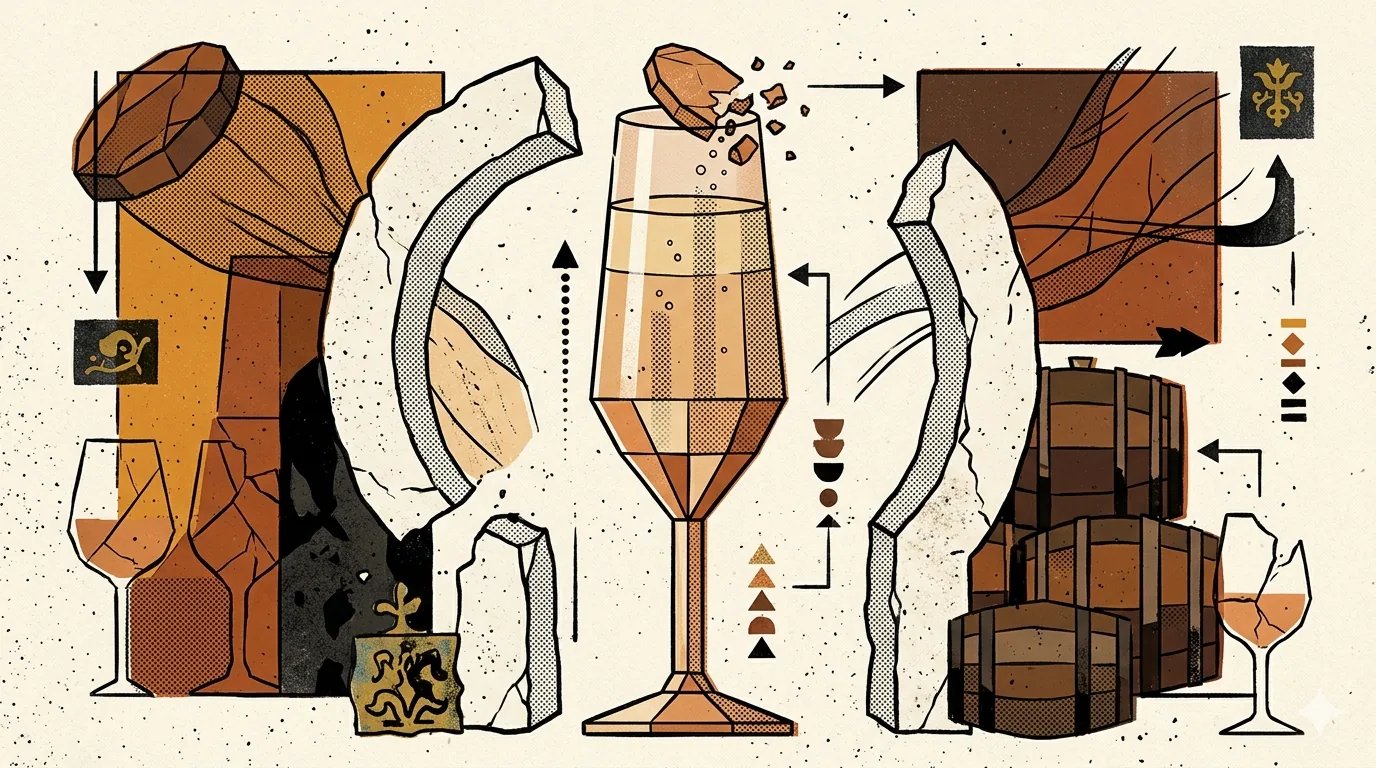
In a cool bodega in El Puerto de Santa María, a cork pops. Not fino, not manzanilla, but a sparkling wine made of one hundred percent palomino. The label does not say DOP Jerez, and that is exactly the story of sparkling sherry: an emerging category that formally does not exist.
The three routes to bubbles from Jerez
| Route | How the wine is made | What you taste in the glass |
|---|---|---|
| Traditional method, clean base | Early-picked palomino, tirage with sugar and yeast, months to years on the lees, then riddling and disgorging | Apple, pear, a touch of citrus and a saline mineral edge from the albariza; close in profile to a lean cava or a blanc de blancs from a cool harvest |
| Traditional method, with flor | The base wine ages briefly under the velo de flor before tirage, or flor yeasts and biologically aged fine lees go into the second fermentation | Fresh bread, yeast dough, almond and chamomile, with a salinity the bubbles sharpen and a drier finish than you expect |
| Ancestral method, pét-nat | The first fermentation is finished in the bottle, with no second dosage | Rougher, less effervescent, often cloudy; at home in the natural-wine movement that has gained ground in Andalusia too |
None of these wines may carry the word sherry on the front label. They appear as Vino Espumoso de Calidad or under the Cádiz or Tierra de Cádiz indication.
What is sparkling sherry?
Sparkling sherry is not an official term. It is a working label for sparkling wines made inside the Marco de Jerez, usually from palomino, often through the traditional method with secondary fermentation in bottle. Some producers use briefly biologically aged base wine with flor influence, others stick to a cleaner, more neutral base.
What the wines share is geography and philosophy. The grapes grow on the same white albariza chalk that nurtures fino and manzanilla. The makers usually come out of the sherry establishment or work closely with it. And yet these bottles never appear under the DOP Jerez-Xérès-Sherry seal.
The category is small and experimental. For the drinker that is precisely the appeal: you taste a Jerez that is reinventing itself outside the rigid categories the rulebook has imposed for nearly a century.
Legal status: why sparkling sherry does not exist in the DOP
The Consejo Regulador of DOP Jerez-Xérès-Sherry / Manzanilla recognises no sparkling category. The official styles remain fino, manzanilla, amontillado, palo cortado, oloroso and the sweetened versions, plus later additions such as manzanilla pasada and fino antiguo. There is simply no slot for bubbles.
This is not an oversight. It is a deliberate choice. The DOP defines sherry through oxidative or biological aging in an open solera system. A bottle with trapped carbon dioxide does not fit that ageing protocol by definition. Sparkling wines made in Jerez are therefore bottled outside the DOP, usually as Vino Espumoso de Calidad or under the broader geographic indication Cádiz / Tierra de Cádiz.
The result is a category without protected labelling. Producers cannot put the word sherry on the front label. Abroad, the wines tend to be presented as sparkling palomino, méthode champenoise from Jerez, or simply by the bodega name. Anyone holding the bottle has to know the back-story to understand what is inside.
In 2022 a revision of the DOP rules came into force. That round focused on the boundaries between Jerez and Sanlúcar and on ageing criteria. Bubbles were not on the agenda. For anyone hoping for a formal opening, the wait continues.
How is sparkling sherry made?
The technical foundation is familiar from Champagne and Cava. A still palomino base wine receives a second fermentation in bottle through tirage with sugar and yeast. The wine then rests on its lees for months or years, followed by riddling and disgorgement. Only at that point does the clear, sparkling wine we know emerge.
What sets the Jerez version apart is the base wine itself. Palomino is naturally low in acidity and neutral in aroma. A handicap for still wine, exactly the reason sherry producers love it for flor ageing and long oxidation. For sparkling production it requires early picking, sometimes from cooler-soil parcels, to build enough freshness in the base.
A handful of producers go further and bring flor yeast actively into the process. The base wine ages briefly under the velo de flor before tirage, or flor yeasts and biologically aged fine lees are used during the secondary fermentation. The result is a sparkling wine carrying the salty, bready, even faintly bitter notes of fino, but with bubbles.
Another route is the ancestral method, sometimes called pét-nat, where the first fermentation is finished in the bottle without a second dosage. The result is rougher, less effervescent, often cloudy, and fits well with the natural-wine movement that has gained ground in Andalusia too.
Flavour profile: bubbles with flor
What do you taste? First the bubbles, fine or coarse depending on the method and time on lees. Second the palomino signature: a neutral fruit base of apple, pear, sometimes a touch of citrus, plus a striking mineral and saline note from the albariza.
Wines that have had flor contact add another dimension. Think fresh bread, yeast dough, almond, chamomile and that distinctive umami saltiness fino can carry. In a sparkling context this works surprisingly well, because the bubbles seem to amplify the salinity and dry the finish further than expected.
Wines without flor contact resemble a lean, mineral Cava or even a blanc de blancs Champagne from a cool vintage. The difference lies in the soil and the grape, not in the technique.
Compared to Champagne the acidity is usually lower and the palate rounder. Compared to Cava the minerality and salinity are more pronounced. Compared to pét-nat the style, at least in the traditional-method versions, is more precise and more focused.
Who makes sparkling sherry?
A note of caution on names: the scene is small and shifting. A few references that recur in the trade press:
Familia Pérez (Luis and Willy Pérez) has been working on unfortified wines from the sherry region since 2002 and later launched the Viña El Corregidor project, with sparkling palomino from old vines on albariza in Pago de Carrascal. The project is one of the better-documented examples of contemporary Jerez bubbles.
Equipo Navazos, known for its La Bota bottlings, collaborated with Catalan sparkling-wine producer Sergi Colet on Colet Navazos. Those wines are bottle-fermented in Penedès, but use flor yeasts and biologically aged lees from Jerez as an experimental cross-pollination between two traditions.
Bodegas Forlong in El Puerto de Santa María has produced unfortified wines from palomino and other regional varieties for years, and is regularly cited as part of the broader new-Jerez movement, including sparkling experiments.
Bodegas Barbadillo in Sanlúcar has dipped into sparkling palomino with several projects, and producers such as Bodegas Cota 45 (Ramiro Ibáñez) and Alba Viticultores appear in the trade press for ancestral and pét-nat styles from the area.
Historically the story is older than the current wave. As early as the 1880s, Hijos de Jiménez Varela in El Puerto de Santa María made a sparkling palomino. Domecq followed around 1904. Both projects faded across the twentieth century. The current movement is therefore more of a revival than a rupture.
Pairing: sea, shellfish, fritura
Sparkling sherry is built for the Andalusian table. The combination of bubbles, salinity and possible flor notes plays sharply with:
- Oysters, mussels, cockles and other raw shellfish
- Fried fish (pescaíto frito, calamares, boquerones)
- Jamón ibérico and salted almonds
- Tortilla, croquettes and other tapas with egg and starch
- Sushi and sashimi, especially with white fish
With flor styles it also works on aged hard cheeses, mature manchego or comté. Wines closer to pét-nat fit better with looser, vegetarian dishes or raw fish.
Avoid heavy sauces or intensely sweet dishes. The wine has too little fruit volume and too much salt to carry them.
Sparkling sherry: a category under construction
Whether sparkling sherry will ever earn its own slot inside the DOP remains to be seen. Commercial volumes are still tiny, the legal lobby weak, and the identity of Jerez has historically been built on ageing rather than carbon dioxide. For now it remains a niche within a niche.
For the drinker that is precisely the attraction. Anyone who finds these wines is drinking something that formally should not exist: bubbles from the heart of the sherry region, carrying the taste of albariza and flor, on a label that is not allowed to say so out loud.
Sources
- Jerez-Xérès-Sherry blog (Lucas Payá): “Bodegas Hijos de Jiménez Varela” and “The table wines of Cádiz”, historical overview of sparkling palomino in Jerez. https://jerez-xeres-sherry.blogspot.com
- Spanish Wine Lover: “Jerez redefines itself: end of compulsory fortification and new DO” (on the 2022 DOP revision). https://spanishwinelover.com
- Spanish Wine Lover: “Alba Viticultores sparkling: a rebellion in Sanlúcar” and related articles on experimental bottlings.
- Sherrynotes (Ruben Luyten): tasting notes on Colet Navazos and other experimental Jerez bottlings. https://www.sherrynotes.com
- Demain les Vins: interview with Ramiro Ibáñez (Bodegas Cota 45) on palomino and terroir. https://www.demainlesvins.com
- Consejo Regulador DOP Jerez-Xérès-Sherry y Manzanilla-Sanlúcar de Barrameda: official regulations and style categories. https://www.sherry.wine