

Champagne Glass: Flute, Coupe, or White Wine Glass?
Flute, coupe, or tulip-shaped white wine glass for Champagne? An honest comparison and clear advice for every occasion.

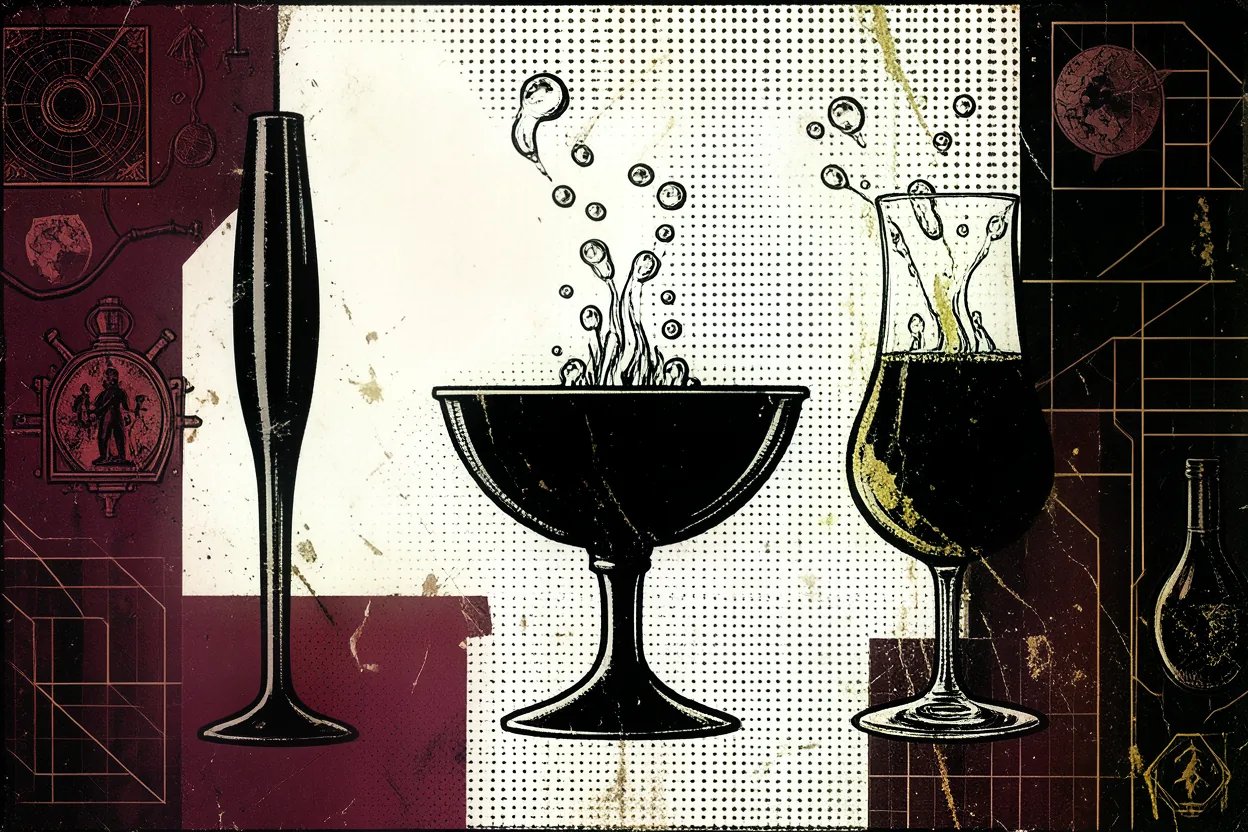
Pour grower Champagne into a flute and you leave half the wine in the glass. Harsh, but that’s how it works. The flute was the default for decades: tall, slim, never questioned. Then the coupe came back. And now most sommeliers and the CIVC point you somewhere else. A tulip-shaped glass you probably already own.
The right Champagne glass, flute, coupe or something else, depends on what you care about. Here I put flute, coupe, and white wine glass side by side.
The Champagne Flute
The flute became synonymous with Champagne in the 20th century, partly for practical reasons and partly for aesthetic ones. The tall, narrow bowl keeps the wine cold longer and preserves the bubbles, because the surface area is so small. On top of that you get the rising stream that photographers wait for.
Holding temperature is what the flute does best. The narrow column means CO₂ escapes slowly and the small surface slows warming. Visually, the ascending bead beats everything else on the table.
But the same narrow shape that traps the bubbles also traps the smell. CO₂ concentrates right under your nose, prickles, and masks the aromas. With aged or grower Champagne carrying developed tertiary notes, you smell almost none of what’s in the glass.
Verdict: Good for entry-level NV Champagne where visual appeal matters more than aromatic complexity. Not suitable for serious tasting.
The Coupe
The coupe, wide and shallow like a saucer, was the original Champagne glass. Popular from the 17th through mid-20th century, until it fell out of favour because it loses bubbles too fast. Its current revival is largely aesthetic. Coupes look wonderful in photography, on a bar, in a cocktail.
The wide surface lets aromas open up fully, so in principle you can smell the wine. For Champagne towers and cocktails like the Kir Royale or French 75, where bubbles aren’t the priority, it works well and looks the part.
For straight Champagne, that same wide surface is fatal. CO₂ escapes fast, the wine warms in the open bowl, and in a crowded room you slosh it everywhere. Within five minutes you’re holding a flat, lukewarm glass.
Verdict: Ideal for cocktails and aesthetics. Not recommended for fine Champagne you want to actually taste properly.
The Tulip or White Wine Glass
This is what the CIVC (Comité Champagne), most professional sommeliers, and leading Champagne houses now recommend. A tulip-shaped glass, or a standard white wine glass with a rim that narrows slightly towards the top. Enough bowl width for the aromas to develop, with a narrowing that funnels them to the nose.
The wider bowl gives primary, secondary, and tertiary aromas space to collect, and the narrower rim directs them to your nose without CO₂ getting in the way. The bubbles hold up reasonably well. Better than in a coupe, slightly less than in a flute. For serious tasting that’s the right trade-off.
What you give up is mostly visual. You lose the iconic endless bead, the bubbles are still there but less dramatic, and the glass is less distinctive on a table. If you want to taste the wine rather than photograph it, you lose nothing.
Verdict: The correct choice for tasting fine Champagne seriously. If you’re opening something good, use this.
Specific Glasses Worth Knowing
Several glass manufacturers produce Champagne-specific designs that take the tulip concept further:
Riedel Veritas Champagne Wine Glass: specifically designed for aged and complex Champagne; wide bowl, tulip shape.
Zalto Champagne Glass: very fine crystal, excellent for grower and vintage Champagne.
Lehmann Jamesse Grand Champagne: developed with Champagne producers, favoured by many houses.
INAO tasting glass: the standard professional tasting glass, not glamorous but technically correct.
You don’t need to buy any of these specifically. A standard white Burgundy glass (Riedel Vinum Burgundy, for example) works excellently for Champagne.
Does the Glass Make a Difference?
Yes, noticeably. The best-supported part is the CO₂: work at Reims measured gas concentrations just above the rim running two to three times higher over a flute than over a coupe in the first quarter of an hour after pouring. No equivalent measurement compares flute and tulip on aroma, so treat that as tasting experience rather than laboratory fact: the flute pushes CO₂ at your nose and the fruit and floral notes struggle past it, while a tulip gives them room.
For non-vintage Champagne at a party, this distinction is largely academic. But for a Krug, a Salon, a Selosse, or any grower Champagne you’ve paid serious money for, the glass matters. Serve it in a flute and you leave half the experience in the glass.
Practical Recommendation
Ideally, own three types of glass. A white wine or tulip glass for serious tasting and fine bottles. A flute for parties and entry-level NV service. A coupe for cocktails and aesthetics. Each has its moment.
Buying one set and want to do everything with it? Get a good tulip-shaped white wine glass and use it for everything. Your Champagne will thank you.
Frequently asked questions
Flute or coupe: which is better for Champagne?
The flute, for the bubbles. Its narrow shape holds the carbonation longer and sends the mousse upward. The coupe looks festive but lets bubbles and aroma escape fast. For the best of both, use a tulip-shaped wine glass: wide enough for aroma, narrow enough to keep the bubbles.
What glass should you use for Champagne?
Ideally a tulip-shaped white-wine glass rather than the classic narrow flute. The flute shows off bubbles but chokes the aromas. A slightly wider glass that tapers at the top gives the nose room while holding the mousse. The coupe is mostly decorative and lets Champagne go flat too quickly.
Sources
- Comité Champagne (CIVC): champagne.fr
- INAO, Cahier des charges Champagne: inao.gouv.fr
- Liger-Belair et al., PLoS ONE 7(2) e30628 (2012), on CO₂ and ethanol in the headspace above a flute and a coupe
- Hummel et al., Appetite (2003), on untrained tasters rating the same wine’s odour differently depending on glass shape
More on Wine Guide

How to Spot Real Champagne: What Fakes It on the Shelf
Aviva at 9.29 euros, Piper-Heidsieck at 45.99, side by side on the shelf. Why only one may call itself champagne, and how to tell them apart.
Read on →
Is Austria really the top organic wine country?
Austria leads on organic wine by share, not by claims. Not 35 percent but 25.0 percent of its vineyards are certified organic. Here is what the figures say.
Read on →
The solera method in Champagne, explained
The solera method in Champagne: how a perpetual reserve works, why it is rare, and how Monmarthe ages 100% Meunier in one. Borrowed from sherry in Jerez.
Read on →