

Is Austria really the top organic wine country?
Austria leads on organic wine by share, not by claims. Not 35 percent but 25.0 percent of its vineyards are certified organic. Here is what the figures say.


A quarter of Austria’s vineyards are organic. Not 35 percent, the figure that keeps doing the rounds. The real number sits in black and white in the Austrian Wine Statistics Report 2024: 10,524 hectares certified organic, out of 44,210 hectares under vine. That is 25.0 percent.
A good number. One that needs no inflation. And still everyone tacks ten points on top.
Where does that 35 percent come from?
Two things get tangled. The first is a different label. Alongside organic, Austria runs “Sustainable Austria”, a sustainability certificate covering water, energy, soil and CO2. In 2024 it covered 12,324 hectares, 28 percent of the vineyard area. Sustainable is not the same as organic. Sustainable Austria looks at the whole operation, but it does not guarantee a vineyard works without the synthetic inputs that organic farming bans.
Add the two labels together, or confuse one for the other, and you drift toward thirty and start rounding up to 35. The second mistake is an arithmetic one that shows up in almost every wine country: confusing vineyard area with production.
25 percent in the vineyard is not 25 percent in your glass
An organic plot yields less than a conventional one. In a cool climate like Austria’s, with fungal pressure and uneven ripening, that yield drops 15 to 25 percent fast. No copper shortcuts, no synthetic fertiliser, more loss to mildew in a wet year.
So that 25 percent of organic vineyard translates into a smaller share of organic bottles. Österreich Wein does not publish the exact figure, but the direction is mathematical. Read “25 percent of the vineyard is organic” as “a quarter of Austrian wine on the shelf is organic” and you have rounded up. Some of those organically grown grapes also vanish into cooperative blends where the organic label dies, or come from growers still in conversion who cannot certify yet.
The number that holds, 25.0 percent of area, is not the number most people think they are hearing. It describes land, not what you buy. That is the first caveat, and it matters.
And the “number one” claim?
Here it gets interesting, because part of it is true. With a quarter of its vineyard organic, Austria sits among the leaders by share among established wine countries.
In absolute hectares, it plays in a different league. Austria has just over 10,000 hectares of organic vineyard. Spain, France and Italy together account for more than three-quarters of the world’s organic vineyard area, and each of the three holds far more vineyard land in total than Austria. Spain, with the largest vineyard area in the world, almost certainly has the biggest absolute organic area.
That is the second caveat. “Number one organic country” only survives if you drop the word “percentage”. For a small wine country with premium positioning, it is a flattering story. It sells better than “we are small but tidy”. Understandable, but not a claim to let slide unmarked.
Why Austria genuinely leads
The percentage comes from somewhere real. Austrian viticulture is built mostly on small family estates, not industrial holdings. After the 1985 wine scandal the sector swung hard toward quality over volume, and organic farming fit that turn. Research from the FiBL institute produced region-specific knowledge on chemical-free disease control in a difficult climate. Niederösterreich, with sub-regions like Wagram and Kamptal, was early to it.
That is a real achievement. Getting a quarter of your vineyard organic in a cool, disease-prone climate is harder than hitting the same 25 percent in the dry south of Italy or Spain, where fungal pressure is low and organic almost happens by itself. On bare percentage, the comparison actually sells Austria short.
What this means when you pick a bottle
Read the label, not the hype. Three certifications to keep apart.
Organic (EU leaf or Austria Bio Garantie). Certified, no synthetic pesticides, three-year conversion. This is the 25 percent.
Biodynamic (Demeter). Stricter and smaller: 1,431 hectares in Austria, just over 3 percent of the area. Organic plus lunar calendar, preparations, closed-loop farming.
Sustainable Austria. Sustainability, not organic. A good scheme, a different thing. Do not read it as a green light for “no chemicals”.
Pro tip: to be sure you have an organic wine from Austria in your glass, look for the EU organic leaf plus, if you can, Demeter. “Sustainable” on its own says something else.
The truth is less spectacular than 35 percent, and stronger. A quarter of Austria’s vineyard is organic, in a climate that makes that hard. No need to inflate it.
Sources
- Primary source: Österreich Wein, Austrian Wine Statistics Report 2024 (IACS 2023/24): vineyard area, organic, Sustainable Austria, biodynamic.
- Additional: Österreich Wein, statistics overview.
- International context: FiBL/IFOAM, The World of Organic Agriculture 2024 (data year 2022): Spain, France and Italy together hold over 75% of the world’s organic vineyard area; Spain has the largest absolute area. Exact per-country hectares sit in the paid FiBL tables and are not verified here.
More on Wine Guide
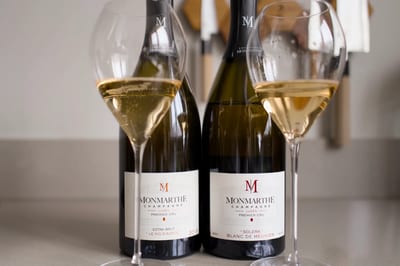
The solera method in Champagne, explained
The solera method in Champagne: how a perpetual reserve works, why it is rare, and how Monmarthe ages 100% Meunier in one. Borrowed from sherry in Jerez.
Read on →
How to Read a Champagne Label: Everything That Matters
A Champagne label hides more useful information than almost any other wine label in the world. Two letters and a number tell you who actually made the wine.
Read on →
What Is Grüner Veltliner? Austria's Signature White
Grüner Veltliner is Austria's signature white. Crisp, peppery, food-friendly. Here's what makes it distinctive and how to drink it well.
Read on →