

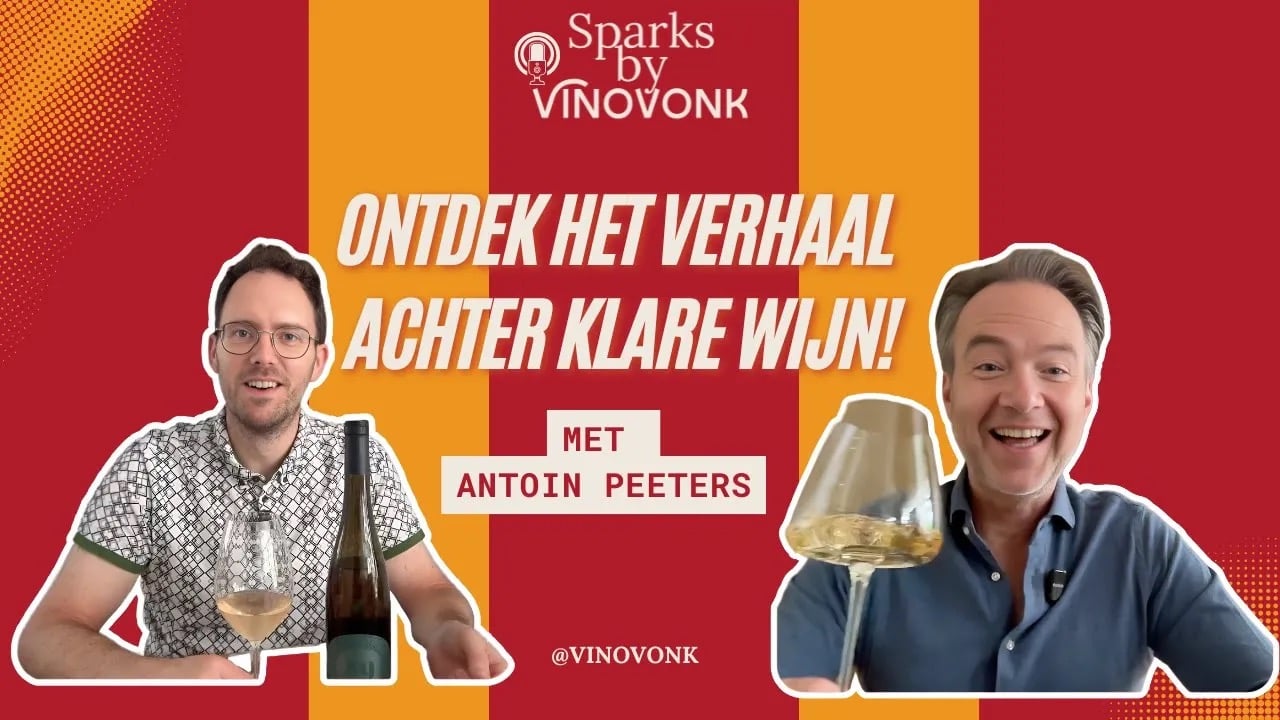
Antoin Peeters has worked at RTL Nieuws since 2001 and has anchored its 7.30pm bulletin since 2015 or 2016. In the summer of 2019 he started Klare Wijn, an Instagram account given over entirely to wine. About two years later came the Klare Wijn podcast with his friend Ernst-Jan Overduin, which is now close to 60 episodes old.
In Sparks episode 18 we talked about six years of making wine content, how he set up Dikke Donderdag, and how to stay honest when bottles keep arriving in the post. We finished by tasting Ayleen Charlotte’s AY Unfiltered Riesling, and Ayleen herself joined me afterwards for episode 19.
This episode was recorded in Dutch. YouTube can auto-translate the subtitles on the video below.
Who is Antoin Peeters
Antoin trained at the School of Journalism in Tilburg and worked for regional broadcasters before joining RTL Nieuws in 2001. He spent years as a domestic reporter, travelled widely abroad, and covered the royal family during the period when Willem-Alexander took over from Beatrix. Since 2015 or 2016, as he puts it himself, he has been the regular anchor of the 7.30pm news, the newsroom’s main bulletin of the day. He also chairs the occasional conference. Last year one of those overlapped with wine: after the sessions he ran a small tasting of five wines at the drinks.
He has been into wine for thirty years and calls it a hobby that got completely out of hand. His knowledge comes from practice: tasting, travelling and visiting a great many growers. Ernst-Jan is the theorist of the pair. According to Antoin, seven or eight years ago Ernst-Jan was not interested in wine at all, until he found himself unable to join in at a party full of wine lovers and caught up at speed through books, courses and tastings.
How Klare Wijn started
Antoin already had an Instagram account through RTL, complete with the blue tick you still had to apply for back then. The idea was that newsreaders should show a bit more of themselves, and for Antoin that soon meant wine. Every wine post brought in new followers and warm replies, but it also lost him people who have no interest in wine. So one summer evening in July 2019 he decided to start a separate account that was only about wine.
The name comes from a Dutch saying, klare wijn schenken, “pouring clear wine”, which means speaking plainly. In his words:
“Pouring clear wine means speaking plainly. That suits me and my work quite well, and I think it matters a lot with wine too.” (Antoin Peeters)
Growth was slow at first. Over the past year, he says, it has picked up sharply.
The Klare Wijn podcast
The podcast came out of the pandemic. Antoin and Ernst-Jan, a friend from Dordrecht, were running online tastings for a wine merchant, with little sample bottles at home and a video call. Participants enjoyed their rapport so much that they suggested the pair do more with it.
The division of labour is easy to hear:
- Antoin: the practical side, the tasting, and thirty years of visits and travel
- Ernst-Jan: history and theory, drawn according to Antoin from “500 books and essays and articles” and written out in full
Each episode takes a lot of preparation. Antoin finds a guest and does a pre-interview, together they choose the wines and decide whether to offer a tasting kit, Ernst-Jan writes up his research, and then they still have to find a date that works for everyone. They have tried simply sitting down and chatting, but it is not how they work. Without structure, Antoin thinks, a listener gets nothing out of it. If an episode feels long, pause it halfway, as he does on the drive to Hilversum.
At first it was just the two of them, but the research piled up. Antoin kept phoning people to check things and realised he might as well invite them. A specialist guest is now almost standard, and some come back every year.
Topics come from their own curiosity and from listeners. An episode on the US led to one on Oregon alone, and that sparked the idea of an episode on Pinot Noir alone. The Portugal episode happened after listeners pointed out that 55 episodes in, Portugal had never come up apart from port. There is a shortlist of around thirty topics, Greece among them, and they plan to reach at least episode 100.
Some episodes come with a tasting kit put together by a merchant or importer. That is also the only money the podcast makes: Antoin and Ernst-Jan earn a small commission on the kits, against the cost of subscriptions and equipment. Kits with lesser-known wines, such as the Jura or Portugal, sell well. One built around Verdejo did not, because you can buy Verdejo on every street corner.
Dikke Donderdag
At the start of 2025 Antoin asked himself what he wanted from the account. More followers means more reach, and reach helps with everything. He spoke to a few professional influencers, whose advice was specific. Put the effort into reels, because photos alone no longer work. Build a recurring feature, and give it a catchy, ideally alliterative name.
At the same time he and Ernst-Jan were working on a podcast about cult and iconic wines. Antoin feels those expensive bottles get little attention on Instagram, where the focus is on supermarket wine and bottles at ten or fifteen euros, and many followers have never heard of the world’s great wines. He wrote to importers asking for help, and Dikke Donderdag, roughly “Big Thursday”, was born.
The response, he says, has been almost entirely positive. Some viewers find it decadent. He does not have a cellar full of these wines, though. They are sample and promotional bottles from importers, and some of them also went into the podcast.
He notices the effect in the street. People used to call out about RTL Nieuws; now it is mostly younger people shouting “Klare Wijn” or “Dikke Donderdag”. At a festival in Dordrecht he was stopped by young people who use the account and the podcast alongside their wine courses.
Honest reviews in a world where everyone knows everyone
Antoin is sent a lot of wine. His arrangement with everyone is that he tastes a bottle when it suits him and does what he likes with it, because he has no commercial stake. A rosé that had to be covered the following week, because it was about to go on promotion, did not get that treatment.
He does not trash wines. People put real effort into every bottle, and with a growing audience he does not think it is fair to tear a wine apart. If he dislikes a wine, you probably will not see it on the account. That is an understandable choice, but it does mean Klare Wijn mostly shows what he enjoyed, and you will rarely read a negative verdict on a wine there.
With a restaurant he once took a different line. He posted a review he considered honest and fair, then switched off comments for the first time ever when followers started fighting among themselves underneath. In wine and food, he says, everyone knows each other and everyone has interests, so criticism always offends some importer, seller or sommelier. He is also aware that a single restaurant visit is a snapshot.
Where news and wine meet
Antoin prefers to keep news and wine apart. After a day of disasters and wars, he likes to retreat to his small wine cellar to switch off. Sometimes the two worlds touch: climate change, wine fraud, and the festive season, when RTL wants a piece on which champagne to buy. And under his made-to-measure suit there is always a lining printed with champagne bottles, corkscrews or oysters, which you only see when he opens his jacket.
Plans for the future
There will be no vineyard of his own. Antoin has visited enough growers to know how hard they work and how fickle the market is. He is 50 and wants to stay on as anchor for a long time yet, with wine alongside.
A wine programme on television does appeal. The catch is that RTL serves a broad audience and wine remains a niche. In his view only two people have pulled it off on Dutch TV: Hubrecht Duijker, long ago and first, and Ilja Gort, whose programmes became more travel show than wine show. Videoland or YouTube might work, but it is a lot of work, and a production with a Hilversum-style crew costs a lot of money.
At the time of recording, in the summer of 2025, he had a week in South Africa planned for early September around Cape Wine, the trade fair held every three years. He was going by invitation, with a group of serious wine lovers, and with an obligation to produce some content. The programme runs from early morning to late evening, and he expected his phone to be flat by ten. He has no camera crew, and thinks that is part of the appeal: he does it his own way. He also spits a lot, because if you swallow everything you are finished by ten in the morning.
Tasting the AY Unfiltered Riesling
Antoin and I had both been sent this bottle, which is why I opened it during our conversation. Dutch audiences know Ayleen Charlotte from RTL Nieuws and from the Netflix documentary The Tinder Swindler. Antoin admires how she turned being a victim into running a business. He is wary of famous people with their own wine, since it is often little more than a name on a label, but he thought her earlier orange wine was superb.
It is an unfiltered, biodynamic Riesling from Alsace, vintage 2022, made at Charles Frey. Ayleen developed it with Design & Wine in Amsterdam. How exactly she came to the wine I did not know at the time of recording; she explains it in episode 19.
Between us we picked out apricot, rich ripe apple, some citrus and even orange. There seemed to be a touch of oak too, though we found that hard to believe. With three years in bottle it is rich on the palate, with lovely acidity and everything in balance. The ripeness brings hazelnut and almond, and at the end a little hazelnut, something salty, a smoky note and a slight bitterness. It stays fruity and fresh. One of us thought it would work well with dinner.
Someone remarked that Alsace wines are often too sweet, though the region is getting drier.
We tasted a single bottle shortly after opening, so treat this as a first impression. Neither of us knew at the time of recording where to buy it or what it costs.
AY Wines sent Antoin and me the bottle; I received no payment and the verdict is my own.
Frequently asked questions
Who is Antoin Peeters? A journalist and newsreader at RTL Nieuws since 2001, and regular anchor of the 7.30pm news since 2015 or 2016. He started the Instagram account Klare Wijn in 2019 and makes the Klare Wijn podcast with Ernst-Jan.
What is Dikke Donderdag? A recurring Instagram feature in which Antoin shows a special or iconic wine, the kind of bottle you will not find in a supermarket. The bottles are samples and promotional bottles from importers.
How often does the Klare Wijn podcast come out? Antoin did not mention a fixed schedule. Each episode needs preparation: finding a guest, a pre-interview, choosing the wines, sometimes a tasting kit, and a running order. There are close to 60 episodes, and they plan to reach at least 100.
Where can I listen to the Klare Wijn podcast? In your podcast app. The Instagram account @klarewijn carries the links.
More about Klare Wijn
Follow @klarewijn on Instagram and find the Klare Wijn podcast in your podcast app of choice (it is in Dutch).
For the story behind the AY Unfiltered Riesling we tasted in this episode, see Sparks episode 19 with Ayleen Charlotte.
Transcript
The full conversation transcript.
Show full transcript
This transcript is generated automatically from the audio and has not been edited. Speech recognition makes mistakes, so treat wording as an approximation rather than a verbatim quote. It is here for accessibility and search.
Hello everyone, and welcome to a new episode of Sparks at VinoVonk. The series where I share beautiful, inspiring wine stories. And today, I have someone with me who has also inspired me greatly with wine and other things. That’s Antoin Peeters. Antoin, welcome.
Well, thank you so much for taking the time. For those who don’t know you, you’re known from RTL News, of course, but perhaps even more so from Klare Wijn. Your Instagram account and Klare Wijn the podcast. Do you have anything else to add? Anything else you’d like to share?
Well, this is the list. I’ve been working at RTL News since 2001. I’m a journalist. I also studied journalism in Tilburg. Back then, it was called the School of Journalism.
And after some wanderings at regional broadcasters, I ended up at RTL. I ‘ve been a frequent domestic reporter, and I’ve also seen a lot of international news. I was a Royal Family reporter when Willem-Alexander took over from Beatrix. So that was quite a special time. And since 2015, 2016 I think, I’ve been the regular anchor, as they say, of the 7:30 news.
That’s basically the most important RTL News bulletin. It’s every evening at 7:30. And of course, besides that, there’s the 6 o’clock news and the late news. And indeed, what you said, the wine. And I also chair conferences occasionally.
So then I get asked to speak at a large conference on any topic. If I find the topic interesting, I get hired and then I’m the master of ceremonies, so to speak. Yeah, super cool. And is it ever about wine or not? Well, rarely actually.
Coincidentally, I attended a conference last year where the NAAS were present. So after the conference, there was a reception. And then it seemed so fun that I also did a small tasting with five wines. So that’s when it all came together, yeah. So that was fun.
Super cool. When did you start your Instagram account? The summer of 2019, so exactly six years ago. A year before corona, so to speak. I already had an Instagram account through RTL, actually.
I got that blue check mark right away; everything was taken care of for me. Back then, you had to apply for it, now you can buy it. And then the idea was, as a newsreader and journalist, you should also show more of yourself. I really wanted that. But of course, if I’m going to show anything of myself, it’s usually wine, of course.
And I noticed every time I posted something about wine, I gained a lot of followers. Very nice. Nice, enthusiastic reactions too. But people who aren’t into it also dropped out. I understand that, if you’re not into wine.
Yeah, why would you sit around looking at all the bottles? That’s useless. So then, on a beautiful summer evening sometime in July, I spontaneously thought… Why don’t I just start an account solely about wine? So, another one in addition to my own account.
Well, I was looking for a catchy name. He came up with a proverb or a saying. Pouring clear wine means speaking clearly. That kind of suits me and my work. And I find that very important with wine too.
So that’s how I came up with the name “klare wijn” (clear wine). Well, I’ve been doing it for six years now. And in those six years, it’s changed a lot. I’ve gained a lot of followers, of course. It grew slowly at first, and then suddenly, in the last year, it’s taken off.
A year or two later, we also started a podcast with Ernst-Jan, a friend of mine. He lives nearby, and I know him from Dordrecht, where I live. And then we actually realized that during the coronavirus pandemic, we were giving online tastings for a wine merchant. We probably all remember that; we all did that. We’d get those little bottles at home, and then…
Yeah, that was awful, with all that Teams stuff. But anyway, we thought it was really cool at the time, and that it was all possible. And then we heard that you have such a nice chemistry and contact with each other and that it’s going well. Can’t you do something with that? So we started a podcast, also called the Klarenwijn Podcast.
And we’re almost 60 episodes in now. I find that very inspiring too, especially because it sometimes goes on a bit longer. Anyway, you pause it and listen to it next time. What’s especially interesting, the dynamic, is that you’re very practical about wine. And Ernst-Jan then dives into the history.
And that sometimes becomes a bit of a gimmick, like, “How many pages are there today?” And the letters get bigger too. Well, what almost nobody knows is that Ernst-Jan wasn’t a wine lover at all until 7 or 8 years ago. He knew nothing about it. Then he showed up at a party or something, I don’t know where. There were all these wine lovers there, and he couldn’t talk about the wine.
You don’t want to do that to Ernst-Jan. He wants to know everything. So then he started delving into wine. He’s been absorbing every wine book in existence at breakneck speed , taking courses, and tasting, of course. So he’s kind of caught up, while I’ve been working with wine for 30 years.
So he’s more of a theoretical person, indeed. I’m more into the practical side and tasting, but also into everything I’ve experienced and visited in those 30 years. And yes, we complement each other really well. Well, I definitely recommend it. If you’re listening or watching now, check the show notes; there’s a link to the Klare Wijn Podcast.
What I also find interesting is that you occasionally offer a tasting package. Then people can, for example, listen to the last episode I listened to about Portugal, and then you can say, “I’m curious about those wines.” Then you can order them, which I’ve done in the past. And what’s nice is that you then taste and then listen again. Then you actually taste together. It’s a bit like going back to the coronavirus pandemic.
Yes, exactly. No, we try to offer that regularly. Not always. For us, yes, it’s usually not a commercial podcast. It only costs money with all the subscriptions and equipment and who knows what else.
But through those podcast packages, we still get a small commission. We don’t sell it ourselves. We do that through wine merchants or importers. And they select truly special bottles. And what we’ve noticed is that especially the packages that include lesser-known wines sell very well.
We once had a podcast about Verdejo. Well, that didn’t go so well, because you can buy Verdejo on every street corner. But we’ve also done a podcast package about the Jura, or in this case, about special wines from Portugal. Or America. That’s going very well.
And people are really excited about being able to taste along. But for us, the most important thing is sharing information in a lighthearted way. It’s certainly quite heavy stuff sometimes, but we try to keep it light with a joke and a bit of banter, and the occasional jingle or something. And what’s really important is that we started with just the two of us. But it was quite a lot of work figuring everything out.
And yes, then you had to call people. What’s the deal? And at some point I thought, yeah, I might as well invite those people I’m calling. Because they know a lot more about it than we do. So, it’s almost standard practice for us now to actually invite a guest.
And a really good guest. Someone who really understands the topic we’re going to talk about. So that, yes, we now have some regular guests who come back every year. Yes, so we really have a fan base. I was just saying it to my wife the other day.
I get recognized on the street quite often. And that used to be like, “Hey, RTL news, or is it still news?”, yeah, those kinds of comments. And now when people come up to me, I think, “Here we go again.” I always enjoy it, that’s fine. But now it’s also very often, especially for young people, like, “Hey, clear wine” or “Hey, Fat Thursday,” yeah. So suddenly, I’m being recognized for the wine.
So that’s a bit of an adjustment for me too. But it’s really funny. Last week there was a festival in Dordrecht. I’ve been approached so often by so many young people who are all also involved with wine. They use, if they also have a course, the podcast or the Instagram account as a kind of source of inspiration to further their wine journey.
So that’s really funny. Yes, and you already mentioned Fat Thursday. That’s also something new you’ve started. Yes, Fat Thursday is actually a bit… At the beginning of the year, I thought, what do I actually want with this Instagram account?
You always want to keep climbing, and the more followers you have, the greater your reach. And that helps with everything, of course. So I thought, how can I expand that? I’ve spoken to some people who are doing really well. Real professional influencers, but that’s definitely not me.
But they did, so they gave me some tips on how best to do that. Reels, which we’re all working on, videos—very important. And photos—just posting photos is a bit out of fashion. If you want to expand your reach, you really need to start with videos. Especially engaging videos, of course.
And then someone also told me, columns are really effective. People like them. Where you just do something every week, every month, or every day that keeps recurring. And at the time, we were also working on a podcast about cult wines and iconic wines. I actually think those very special and expensive wines don’t get much attention on Instagram.
They’re always a bit like supermarket wines, or they always have to be around ten or fifteen euros, and even then we consider it a lot. While there are such fantastic wines being made worldwide that are certainly popular with true enthusiasts… but not with people who look at Instagram. They often don’t even know about those wines. So I think they deserve to be put in the spotlight.
So that’s what I started doing. So I contacted some importers, would you mind helping me with that? They also said you need a catchy title, a bit alliterative. Well, Dikke Donderdag (Fat Thursday) was born. That’s how I got started.
Yes, it’s been a huge success. I get so many, so incredibly many reactions. Almost all positive. Of course, there are also some people who find it all a bit… decadent.
But it’s not like I have my whole cellar full of those wines. They’re all sample bottles, they’re promotional bottles. And then you get to taste them. We’ve also used some for the podcast, so we really do all sorts of things with them. But we do put them in the spotlight.
Or as I say in this case, Dikke Donderdag (Fat Thursday). Yes, very fun to do. Yes, look, you always get comments. A while ago, we made a video together about champagne for 15 euros. You think, how bad.
But for me, it was inspiration to see, what does it consist of? So I took a champagne specialist course. And do you know why it’s so bad? But I also received truly hateful messages back then. Yes, you get those too, of course.
But honestly, I think, like, well, things I don’t even dare repeat now, that’s how bad it was. Yes, I recognize that. I don’t really want to pay too much attention to it, because 95% of it is just fun and positive. But there is… At one point, I made a video review of a restaurant.
I didn’t think the restaurant was that good, so I made a video about it, honestly and fairly, in my opinion. At some point, I turned off the comments. That’s the first time I’ve done that. Because people were getting into conflict with each other. Yes, I understand that.
Well, then I really thought, “This is getting out of hand if people start arguing among themselves under my post. ” That’s not the intention of my clear wine account. But you ‘re honest. And honesty means you sometimes don’t like something. Yes, and then it’s not good.
No, that’s certainly difficult in the wine world, and perhaps in the culinary world as well. Everyone knows each other, everyone has vested interests. We all want to be honest, but if you do get critical… …there are always certain parties, whether it’s the importer… …or the seller, or the sommelier, or whoever, who feel offended.
Or disagree, and that’s possible too; I don’t have a monopoly on wisdom. But hey, everyone has their own opinion, and we live in a free country, and I just think that, to a certain extent, you can say whatever you want. Yes, definitely. I think it’s only right that you can say what you think. And there are also wines you don’t particularly like.
And then you also say, I was actually disappointed. Yes, I get sent a lot of wines, you probably do too. That’s really great, of course, and also quite an honor. In the beginning, I often thought, wow, how cool that I get to taste that now. I’ve made arrangements with everyone.
I have absolutely no commercial interest in it. So I taste it when it suits me. And I do with it what I want. I’ve also had some stress with a rosé once. Would you mind reviewing it before next week?
Because then the weather will be nice and we’ll put it on sale. That’s not how it works for me. Then I taste a wine like that. And I always add, if I really don’t like it, you probably won’t find it again. So, in principle, I’m not one to really criticize wine.
Because I also know that a lot of people are involved who, after all, put a lot of effort into making that bottle of wine. So I always find it a bit sad to completely trash a wine. And if your reach increases, it reaches more and more people, and I just don’t think that’s fair. So I just don’t do anything with it. I think, “Well, that’s not my wine,” and I leave it.
You also get those restaurant reviews sometimes, and it’s just really bad for once. And then they get a four or a five in another magazine. And then the cancellations come pouring in, because, well, it’s not good there. It can also be a snapshot. Of course, it’s always a snapshot, so I’m aware of that, and I really try to be careful not to just…
But most of what you get is also delicious, and most of the places I eat are always good. But yes, sometimes it’s just disappointing. Yes. Yes. What I also like about the podcast is that I…
I often learn things that make me think, “I don’t know this at all.” Do you also choose your topics based on that? If you say, for example, we want to learn something about Portugal last time, you choose your topic based on that. We still have a shortlist of about 30 topics. So we can still go, we’ve said we’ll at least go to 100. And then we’ll see.
Well, it’s a lot of personal interest. And one topic often leads to another. For example, you start with America in general. And then you think, yeah, but America is really general. Well, then I made a podcast just about Oregon.
Well, that’s super cool, of course. And then you talk only about the Pinot Noir grape that comes from there. Then you delve even deeper and say, “We should do a podcast just about the Pinot Noir grape sometime.” And how did that happen? How does that work? That’s how you delve deeper and deeper.
But we also get a lot of tips from listeners. For example, that Portugal tip, or that Portugal podcast, which emerged from a few tips from people who said, “Yeah, you’ve been doing 55 podcasts and Portugal hasn’t been mentioned yet. ” Yes, port sometime. Well, then we say, “We’ll put that on the list.” And that’s how we often do it, combining listener tips and our own interests to come up with all those topics. Yeah, super cool.
I hope there will be a podcast about Greek wine sometime. We’ll definitely do that. We’ve mentioned it before, though. We once did a podcast about island wines. I think we included Crete.
But not just Greece yet, although that’s on the shortlist. But what people often forget is that we don’t just sit down and chat for an hour and a half. Of course, I have to look for a good guest beforehand. Often I know that, but sometimes I don’t. So then I have to put out a call, I have to talk to people beforehand.
Then we start discussing the wines. How are we going to approach that? Will there be a package deal or not? Then Ernst-Jan starts preparing. So he reads 500 books, essays, articles, and who knows what else.
Then he really starts writing it all out. That’s incredible. Well, then I get to work on those wines. Because where do we place each wine? I have a preliminary conversation with the guest so I know what questions to ask.
Well, that’s basically how we create a whole script. And then we have to find a date that we can all meet. And then we sit down, and the really fun part begins. Then we taste and record the podcast. So it’s actually quite a lot of work before it’s ready.
It’s not like you just say, “Someone rings the doorbell and you start.” No, we’ve tried it, but that’s not how we’re wired. There are a lot of those popular podcasts where we just sit down spontaneously and chat. Just sit down with wines, have a chat. At some point, you have to have a certain structure, you have to be able to ask each other certain questions. Otherwise, as a listener, it’s useless, in my opinion.
So you do need some regular sections or themes. Some people think it’s too long, well, fine, then you don’t listen. In my experience, most people just pause it halfway through. If you’re going to run 10 or 15 kilometers, you’ll do it in an hour, so you’re already well on your way. When I drive to Hilversum, I listen to a lot of podcasts.
One is half an hour long, another two hours long. When I get there, I stop and just pause it. That’s the nice thing about podcasts. You’re not tied to it; it’s not live. What I also found interesting was that our worlds often intersect in the world of wine, but at some point I came across a wine.
Then I thought, yes, that’s actually quite a coincidence for you, that your worlds intersect. Because we both received this wine. That was the real impetus. You’ve already opened it, I have to open it. And that’s a wine made by Ayleen.
And Ayleen is famous, among other things, through RTL News because she was a victim of the Tinder Swindler. And if I’m not mistaken, there’s even a Netflix series about it. But she also started making wine. She became famous because she fell victim to a scammer who ripped her off. There was a documentary about it.
But she actually turned that whole victim role, which I think is quite impressive, into entrepreneurship. She started doing all sorts of things, was also a wine lover, or is still a wine lover, and thought, “I want to make my own wines.” Well , there are a lot of people like that, and then… I’m always a bit suspicious. Yes, a lot of footballers make their own wine too, but it’s often just a label with their name on it, and they’ve tasted something once, and that’s it. But she also made another wine a few years ago, that orange wine.
I thought it was absolutely amazing. So she knows what she’s talking about, and this wine too. But I haven’t opened it yet, because this is a different one. Jeroen, what can you tell me about it? It’s a Riesling from Alsace.
It was developed in collaboration with Design & Wine from Amsterdam. Roos and Lidrik from Design & Wine designed it. I don’t know exactly how she sourced the wine. But this one is from Alsace. It’s unfiltered from 2022.
So she collaborates with Charles Frey from a winery. Yes, biodynamic. You can look up even more things with a QR code. But I thought it was fitting, because this is another wine that touches on both your worlds. Definitely.
Well, indeed, that doesn’t happen very often. I hear that a lot too. How does that work with your journalistic job on the one hand and the wine on the other? I actually like that they’re often very separate. The news is often very bad and upsetting, with disasters and wars and so on.
A lot of suffering. So it’s also nice sometimes when you come home in the evening to really switch off and not think about that for a while. And then you dive into your wine cellar and start thinking about things about wine that aren’t important at all, but that do help you unwind, that just lets you relax. Those are very separate things, but sometimes those worlds do collide with something like this. But also, for example, climate change, which is definitely a topic that’s very relevant in the wine world.
And around the holidays, RTL always wants to feature items about which champagne to choose and… That kind of thing. So sometimes it comes up with some kind of… …wine fraudsters, which I always find very exciting. Those are also topics we definitely address sometimes.
Yes, no one sees that. Of course, I always wear a suit, because that’s how we do it. A suit for men? It’s not all that exciting, of course. It’s just dark blue or gray, but they are nice suits, you know.
Tailor-made. But that allows me to choose my own lining, and I always choose one that has something to do with wine. So champagne bottles, wine bottles, corkscrews, oysters with bubbles, that sort of thing. But of course, no one sees that, because, well, I always keep my jacket buttoned up. But every now and then I do that, and then you see it.
Yeah, that’s what Instagram is for, behind the scenes. Shall we taste this? Cheers! A little cheers. A little aged again.
What’s this vintage? ‘22. So three years. It’s got quite a bit of bottle aging because of that, I think. Yes, it also seems like it has a bit of oak, but I can’t really imagine that, but maybe it does.
Apricots, I’m right. Rich, ripe apple, those kinds of notes. Smells really great. Also beautifully fresh, some citrus comes through. A bit of orange, even.
And a very rich taste. Yes, that acidity is really nice too. Well, everything is nicely balanced. Riesling from Alsace, that usually sets off a few bells for me. I’m not a huge Alsace fan because it’s often too sweet for me.
But that style there is also becoming increasingly dry. And Alsace in general is definitely getting drier. And of course, fantastic wines come from there. And what I also love is that hazelnuts and almonds are now suddenly added. Really because of that ripeness.
Super cool. And unskinned, because she also tells unskinned stories. A truly excellent wine. Delicious. Rich, complex, and exciting.
Indeed, a hint of a little hazelnut at the end. But it remains wonderfully fruity and fresh, and a bit salty too. A bit smoky, a bit bitter, but still just a little bit. Lovely with a dinner party or something. Yes, fantastic, she’s done well again.
Right? I’ll find out where you can buy it. Then we’ll put it in the show notes. I don’t actually know that either. But it’s in the text below.
Yes, it must be quite a bit. I have no idea, because it’s quite a beautiful wine. Delicious. Just like that. Yes.
We’ve talked a bit about what you’re doing now. Tasting wine. Do you have any plans for the future? You say, well, in the future, I’d like to make my own wine. Just like Rutger from Wijnadvies.
I do spend a lot of time in Spain. I do spend a lot of time in Spain, but that’s not exactly the area with many vineyards. I’m way down south near Málaga. Yes, there are some there in the mountains, but not a whole lot. No, I’ve visited too many winemakers in my life to realize that I never want to be a winemaker myself.
It’s always romantic when you’re there, but I know how hard those people have to work and how fickle the market is. Ideally, you want a château that’s world-famous and has already sold everything. But that’s hard to come by. Unless you have a lot of money. No, really not.
The combination I’m currently doing, I’m 50 now, is the role of reliable news anchor for a prominent news program, and I really want to keep it going for a long time. Along with that wine hobby, which has, of course, gotten completely out of hand, but it fits nicely alongside it. Yes, what I still think would be fun, of course—and I often hear, “When are you going to do that?”—is to create a truly great wine program simply by visiting winegrowers. That’s certainly not very unique, exciting, or original, but well, you should really think about how to make it… original, maybe with a few people or something, combined with food or whatever.
The only problem is that I work for RTL, and RTL is a channel that focuses on a broad audience, and wine will always remain a niche market. All sorts of things have been tried on television regarding wine. And really, only two have succeeded. That was Hubert Duiker, but that was a long time ago. He was the first, and back then TV was still a magical medium, and everyone was watching…
and he did some really great things. And Ildegard Ort, of course, that’s really true, I think he’s a big man when it comes to the programs he’s made. But that’s also become more than just a wine program. It’s almost become a travel show. It’s really great, and the way he does it is really good.
But there are also a lot of programs in the field, TV programs about wine that have failed. But maybe you should think of Videoland or YouTube or something. And there are now… I do have some access, but it’s always a lot of work. Yeah, I don’t know.
It would be nice, but for now, what I’m doing now is perfectly fine. Yes, and I’m just going to keep running the Instagram account. I’m getting tons of great invitations, of course. For collaborations too; I’m going to South Africa for a week at the beginning of September. I think that’s absolutely fantastic.
Yeah, annoying, isn’t it? Cape Wine is here, that triennial fair. And there’s a whole program built around it. I go there with some serious wine lovers, so I think that’s fantastic. Those kinds of things come up all the time.
But I always have to find a balance between work, my private family life, and the wine. That can be a bit of a struggle sometimes, but I do try to find it. You’d almost say, well, you’re going to Cape Wine. Someone should really just give a report, go with you and film everything you experience. But I’ve seen Rutger from Wijnadvies tell me how much work goes into making documentaries about wine regions.
And then you think, oh yeah. And they have a small team that works quite quickly and effectively. Truly fantastic. But if you really want a professional—that’s already very professional, of course—but if you really want a team like they have in Hilversum, that’s completely out of the question. That costs a lot of money, and you’re on the road with about ten people, handling production, assistance, post-production, and who knows what else.
But of course, it all has to look good. So those are big productions that also cost a lot of money. But maybe it can be done differently. Who knows. But it costs a lot of money and, above all, a lot of time.
Yes, so soon Cape Wine will be on Klare Wijn, perhaps on the Klare Wijn Podcast. Well, I do have some obligations to do things there. But of course, I used to be a reporter, and I was abroad. And then you had to film a lot, create a lot of content, interview a lot of people, and so on. And that just happened on a moving train.
Then you had to go there, there, there, there. And you barely had time to process it, edit it, narrate it, make it better, and then upload it to all your followers or all your viewers. I think it’ll be pretty much the same with Klare Wijn. I’ve seen the program. It’s visiting wineries from early morning until late at night.
I think my phone will be dead by 10 a.m. So I have to think carefully about how I’m going to get all that material out. Maybe I’ll only do it at the end, when I actually make one beautiful video. But it would be a real luxury if I had someone with me to do everything for me. But I don’t have that luxury.
And maybe… I shouldn’t want that either, because it’s also kind of charming that I just do it my own way. Yes, but that also makes it authentic that you do it yourself. It’s nice when there are others and they film you and you film them. That you can help each other with content that way.
But indeed, it’s a kind of real-life soap opera. Real-life soap opera about wine. That gives you the impression, because I sometimes hear that from people too: yes, you shout, you only drink wine. Then I say, yes, someone who paints, only posts things that they’re painting; they wouldn’t be painting all day either. No, of course, I hear that a lot too.
And then I always say, “I have a spittoon now, so I just happened to drink this sip.” Yes, you’ll definitely taste a lot of Cape Wine later, too. Yes, that’s from having us taste it together early in the morning. Because if you drink it all, you’ll be out of breath by ten in the morning. That’s just not possible. So, yeah.
So no, I do have to keep an eye on it, of course, but no, generally I still spit a lot out, yes. You also have to combine it with your work, of course. I assume you’re also on standby in case something breaks out that requires you. Yes, that’s right. I do work shifts.
So I know exactly when I’m working and when I’m free. But with really big news, they can certainly call on me. Yes, and then it depends, of course. Look, if you have a party, and then that’s a different story. Then it just stops.
But yes, that’s certainly possible. That I might have had one too many. But generally, when I’m free, I’m free. Yeah, that’s a good thing, right? Luckily, it is.
I want to thank you very much for your time, for the lovely chat. You’re certainly welcome, Jeroen, it was fantastic. Well, that wine was great too. Thank you. First, a quick trip to Spain, of course, because it’s summer, so we’re going back to our usual spot in the south of Spain.
And are you also going back to that special wine bar in Málaga where they write with chalk? Yes, Antigua, a very long name. I’ve been going there for 25 years. There are stick-like waiters. And you stand at a wooden bar, where they do indeed write with chalk…
But it’s only Málaga dulce, so only sweet wine. Not really drinkable, but it’s part of the experience. I’ll add an ice cube, then it’s okay. And then quickly on to a really good wine bar. But no, we always have to go there.
It’s always packed, always very cozy. It’s a bit of a dirty, smelly place. But it’s truly a landmark in Malaga. The oldest wine bar in Málaga. We’ll definitely go back then.
I’m going back to see my friends. I have to, not for the wine, but for the good company. Absolutely, that’s true. And also drink sherry or… Always, but I’m not going this time…
The last time I was in Sherry was during that outage. With that power outage in April. That was a shame, because it meant a few visits were cancelled. So I could go there now. But you know, August, southern Spain, you really only need to do a few things then.
And that’s just lying around, swimming, and not much else. And maybe go into town in the evening. But don’t do too much because it’s too scorching hot. So that’s what we all do in spring and autumn. Absolutely, yes.
Are you going away? Are you going on vacation? No, I’m staying here. And discover a nice Dutch wine. Yes, the weather is nice.
We’ve had a good summer, so we’ve got it again. Yeah, great, man. You’re doing well. Okay, Jeroen, thanks. This was another episode of Sparks by VinoVonk.
Want to know more about Antoin and what he does? All his links to where you can find him, his podcast, and Instagram account are in the show notes, including all the wine descriptions. And subscribe on your favorite channel, and we’ll see you next time. Cheers. Ciao.
Listen
Watch