

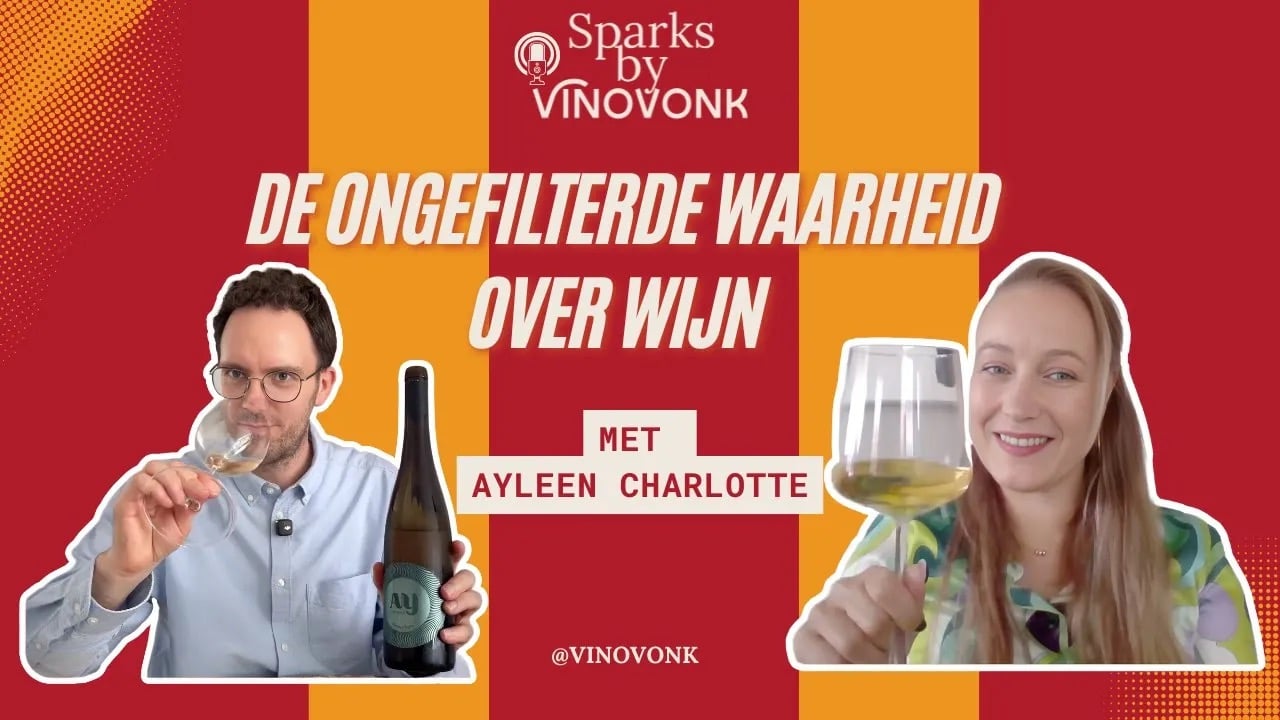
In an earlier Sparks episode I tasted AY’s unfiltered Riesling with Antoin Peeters of Klare Wijn, knowing very little about it. Ayleen Charlotte saw that clip and messaged me to say she would happily tell the story herself. So here she is.
For Sparks episode 19 we tasted the Riesling together, and Ayleen explained how her label came about. It started as a plan for an easy-drinking wine at around €10 and ended up as an unfiltered Alsace Riesling, plus an orange wine whose entire stock she bought up.
Ayleen sent me the bottle; I received no payment and the opinions are my own.
This episode was recorded in Dutch. Watch on YouTube with auto-translated subtitles via the link above.
Who is Ayleen Charlotte
Ayleen spent her career in luxury goods, at Louis Vuitton and Hugo Boss among others, and ended up in a management role at Hermès. She became known worldwide through the Netflix documentary The Tinder Swindler, about her relationship with the fraudster Shimon Hayut. After the documentary came out she had to choose between staying in her job and making fraud prevention her work. She chose the latter.
For about three and a half years she has been speaking about her story and about fraud, from India to Chile and from New York to Stockholm. She has also developed a training course for first responders, the people who deal with fraud victims first, on handling them with empathy and in a trauma-informed way.
After everything she had been through, she wanted something on the side that was simply enjoyable. Making wine appealed to her less than tasting and drinking it, so she set up her own label.
How AY started
She built the label with two friends at Design en Wijn, who had already released wines under their own name: Roos Groot, the designer, and Diederik, the oenologist. Roos handled the branding; Diederik helped her find wines that suited her. Ayleen’s first idea was a commercial, easy-drinking wine at around €10. Along the way she realised that did not fit. After years around Hermès and Louis Vuitton products, she wanted something exclusive or distinctive.
Riesling is her favourite grape. Diederik set up a blind tasting for her, and each time the unfiltered wine came out on top for her, with the most flavour and the best finish.
“My story is unfiltered and I am unfiltered, so my wines have to be unfiltered too.” (Ayleen Charlotte)
From there they looked for producers working unfiltered and also organically or biodynamically, which mattered to Ayleen. That search led them to Charles Frey in Alsace.
The name AY
AY is short for Ayleen; wherever she turns up, people greet her with “AY, wine!”. In Turkish, ay means “moon”, which is why the label is built on curves. Roos designed it. Ayleen admits she was fussy about it, with notes on the curve of the letters, their weight and their alignment.
The orange wine carries an amber sheen. The Riesling got yellow, a colour she associates with the grape’s acidity. The label changes as the light catches it. Each wine has its own back label with a short story and a QR code to her web shop, so someone who drinks it in a restaurant can order a bottle straight away.
The two wines
AY Orange Wine (special edition)
While the Riesling was still being made, Ayleen went to an event with Roos and Diederik. Diederik had brought her an orange wine from a Dutch winemaker who had read the article about her in de Volkskrant and felt his wine suited her story. As the stand was being packed up, she poured some into a plastic cup and was won over after one sip.
Only 650 bottles had been made. Ayleen bought the lot and released it as the first AY wine, with a gift box and a short note on why she started the label. It costs €39.50; at the time of recording a few bottles were left.
AY Unfiltered Riesling 2022
Charles Frey was the last appointment on a trip around Alsace producers. The estate sells this Riesling itself too, filtered. For Ayleen, one batch was left unfiltered, and that version is only available through AY. According to Ayleen, the estate had rarely done this before, and both sides saw it as a bit of a gamble. A new vintage follows only once this one sells out, and the unfiltered version stays exclusive to her. The bottle costs €19.50.
Charles Frey is certified biodynamic. When Ayleen visited, the estate had just bought a plot from its neighbours. Grapes from that plot cannot yet be called biodynamic. Ayleen says it takes roughly eight years for pesticides to leave the soil completely, after which everything is tested twice.
The Riesling in the glass
It is unfiltered but not cloudy; Ayleen’s bottle was fairly clear. Ayleen points out that it is a natural product, so some bottles show more haze than others. The colour is deeper than a young Riesling’s, which fits a wine with a few years behind it.
I found it rich. I put that partly down to it being unfiltered and spending longer on its lees, and partly to the attention biodynamic growing pays to the grapes. I picked up something smoky, a hint of tropical fruit and plenty of stone fruit, peach and apricot. There is a lot of wine here without it becoming heavy or hard work. It kept developing in the glass and stayed soft and pleasant.
Ayleen had worried about the sharp acidity she had met in other Rieslings. She describes this one as having a long finish that keeps softening, with flavours that shift in the mouth. She regularly tries it at different temperatures, straight from the fridge, at room temperature and in between, to make sure the wine under her name still holds up. In her view it has grown more golden and richer over time. She likes it with Asian food.
For a biodynamic Alsace Riesling with a few years of age, I do not think €19.50 is expensive. Most of what is on the shelves is 2023 or 2024; if you want something more mature, you usually pay more or cellar it yourself for years.
Caveats
Ayleen raises the scepticism around celebrity wine labels herself. She recalls Antoin writing in his review of the orange wine that he is always in two minds about them. Her aim is for people to come back for a second bottle, rather than lending her name to a wine nobody buys twice.
She also says the prices sit a little higher because this is a niche market, and that many drinkers still think of Riesling as sweet German wine.
I tasted one bottle, which Ayleen sent me. According to her, bottles can differ in clarity. The orange wine was not on the table for this episode; I had already finished mine.
What comes next
Ayleen would like to add a red, ideally an unfiltered Pinot Noir. She often drinks Pinot Noir chilled, from the fridge or on ice. She is not looking yet. First she wants to build a name with these two wines.
Wine and fraud prevention
At the time of recording Ayleen was organising a Women Fight Fraud event in Amsterdam, to bring together women working in fraud prevention in the Netherlands. She plans to pour her wines there.
She also mentioned an investigation by the Dutch consumer programme Keuringsdienst van Waarde. From memory, and hedged with an “I think”, she said supermarket wines between roughly €3 and €12 contained 24 different pesticides on average. I have not checked that figure. For her it is a reason to buy organic at minimum; she says her own wine sits better with her than supermarket or pub wine.
Frequently asked questions
What does unfiltered mean? The wine goes into bottle without filtration, so fine particles such as yeast remain in it. That can make a wine hazy, though it does not have to; according to Ayleen this Riesling was fairly clear.
Where can I buy AY Wines? Through Ayleen’s own web shop, aylcharlotte.com, and at Design en Wijn. The unfiltered Riesling is sold only through AY.
Who is Charles Frey? A certified biodynamic estate in Alsace. It supplies the Riesling for AY and sells a filtered version under its own name.
Will more wines be added? Ayleen would like to add an unfiltered Pinot Noir, but is sticking with these two for now.
The bottles
AY Unfiltered Riesling 2022. Charles Frey, Alsace, certified biodynamic. I found smoke, peach and apricot; Ayleen describes the finish as long and softening. €19.50.
AY Orange Wine (special edition). From a Dutch winemaker; Ayleen bought all 650 bottles and releases them in a gift box. €39.50.
More about AY Wines
The web shop is at aylcharlotte.com. On Instagram Ayleen shares both her wine and her fraud-prevention work.
Transcript
The full conversation transcript.
Show full transcript
This transcript is generated automatically from the audio and has not been edited. Speech recognition makes mistakes, so treat wording as an approximation rather than a verbatim quote. It is here for accessibility and search.
Hi Ayleen, you saw a video of me and Antoine talking about your wine. And then I said, “Yeah, I don’t really know much about it.” Then you sent a message saying, “Well, I wanted to tell you something.” So here we are, Ayleen Charlotte. Thank you for your time. Yes, I’m really enjoying tasting my beautiful AY-unfiltered Riesling with you. And I’m very curious to hear what you think.
Of the entire label, in particular. I’m very excited to tell you something about it. Well, then I’d say: let’s get started right away. Welcome to a new episode of Sparks at VinoVonk. Following the conversation I had with Antoin Peeters of Klarewijn, where we tasted this wine together.
I didn’t really know much about it, but who better to tell you more than Ayleen herself? But Ayleen, for those who don’t know you yet, could you briefly introduce yourself? Yes, of course. For those who don’t know me: I worked on a documentary called “The Tinder Swindler.” It’s the story of a scammer from Israel named Shimon Yehuda Hayut. I met him six or seven years ago, fell in love, and started a relationship.
Unfortunately, that relationship ended in a huge fraud. A few years after the scam, after all the aftermath of filing reports, lawsuits, and trying to sue him, I collaborated on the documentary. It ‘s become a worldwide hit on Netflix, I dare say. Because of that, I unfortunately had to choose between staying at my job at the time or venturing out into the world and ultimately making fraud prevention my career. Because I realized there was a huge need for it.
Ultimately, I combined that with my biggest dream, which ultimately came true. After all that misery, I thought: I just want to do fun things. Well, what’s more fun than drinking wine? You tell me! Maybe making wine, but that process wasn’t quite my passion.
Tasting and drinking wine were a bit more so. And then I thought: I want my own wine label. And that’s how this whole journey began. Super cool. How did you even get started?
Because I can imagine: I want a wine label, I’m not going to make my own wine, but then how do you connect with winemakers? Can you tell me a bit about that process? Well, I’m very lucky because I have two fantastic friends. Their company is also called Design & Wine. And they had already released several wines under their own label.
And I knew they could also do that with companies or individuals. So the moment the idea came to me, I thought: I actually have it at my fingertips. The most fantastic people who can help me start a wine label. Diederik - a brief explanation - Diederik is the oenologist for the wine section of Design & Wine, and Roos Groot is the designer. And she helped me with the branding, with launching the entire brand.
And Diederik, as an oenologist, helped me choose the wines and which ones suited me best. Super cool. And it all started with an orange wine. I’d tasted that one before. I also understood from Antoine that we were both very enthusiastic about it.
I don’t have it handy because it’s gone. Yeah, good sign. I do have it handy here. I thought: I’ll grab it and actually tell you a little bit about how it all started. Ultimately, I contacted Roos and Diederik: “Hey, I really want to start my own wine label.
Would you like to help me with that?” Within a split second, I got a message back from Roos: “Great! Of course we do.” So that’s what happened. We quickly made an appointment and started brainstorming right away: what exactly do you want? And I started with the idea of an aperitif wine for around ten euros. I thought: nice, nice and commercial.
Only as the journey of building and establishing my brand progressed, I discovered that an aperitif and a more accessible wine didn’t really suit me. I’d always worked in the luxury industry for brands like Louis Vuitton and Hugo Boss, and eventually I was a manager at Hermès. And to be completely honest: when you encounter such beautiful products— yes, later in the journey of my own wine label—I also realized that I thought: it shouldn’t be too accessible for me. There has to be something exclusive, beautiful, or unique about it. Well, we continued with that idea.
We tasted a lot of wine. Very important, and very fun to share: my favorite grape is also Riesling. So we really went searching: which Riesling would suit me? And at one point, Diederik organized a blind tasting for me. And every time, unfiltered came out best.
Every time I said, “No, I really like this one the best. This one has the most flavors, the most beautiful finish.” Actually, it had already started with: okay, then we’ll look for unfiltered wines. So, very slowly, you naturally start to narrow it down a bit. And then we indeed arrived at unfiltered. Just like my story in the Netflix documentary: my story is unfiltered and I am unfiltered, so my wines must also be unfiltered.
That has to be right. Then we delved further and deeper into that, so to winemakers who make unfiltered wines, but also biodynamic and organic, because I thought it was very important to include that, because that’s essentially becoming the new winemaker. I really enjoyed applying that. And finally… we ended up with Charles Frey.
This beautiful Riesling is from them. Only at that moment, they still had to harvest and the Rieslings still had to be made. Those still had to be made. And then I went to an event with Roos and Diederik. And Diederik said, “I have a wine for you, because a winemaker from the Netherlands read your article in de Volkskrant.
And he says: he has such a beautiful orange wine, he thinks it fits your story perfectly. So try it.” They were cleaning up their booth, and I had poured the orange wine into a plastic cup. And I took a sip and immediately said, “Wow, this is truly so incredibly unique. This is a wine I’ve never tasted before.” And ultimately, I chose to release that wine first, also as a kind of special edition. I could tell you hundreds of things about it, but I’ll soon feel like I’m the only one talking.
I think it’s a fantastic story, because it’s also the story behind your journey to your own wine label. And that’s also unfiltered. Yes, yes, that’s right. Yes, this is me. That orange wine is still for sale.
It costs, if I’m not mistaken, at Design & Wine, and you can also buy it through your own website for, if I’m not mistaken, €39.90- €39.50. Not much difference. Yes, that’s right. There are still a few bottles left. Only 650 bottles were made.
And because I bought the entire stock, I’m the only one allowed to have this beautiful orange wine in my collection. It also comes with a beautiful gift box and a short story about my history and why I started it. So that’s really nice to offer that as a pairing. Meanwhile, the Riesling was ready, and Roos and Diederik and I went to Alsace. We visited many other vineyards and tasted a lot.
And finally, we settled on—our last appointment was Charles Frey. And there I tasted the unfiltered Riesling, and it was so beautiful. It’s so special. And then I immediately said—because they actually have quite a lot of this Riesling. They sell it themselves, too.
It’s been left unfiltered exclusively for me. My Riesling is also only available from me. They don’t sell it themselves. And they found the idea rather exciting. And so did I, because I thought: yes, Charles, as a winemaker, he hasn’t really done this very often.
How bizarre is it then that I just popped in to take a look and immediately decided to buy a batch of that wine? Suppose it doesn’t quite work out, then that would be a bit of a shame. But no, thankfully. I can proudly say that I’ve managed it very well. And what do the winemakers themselves think of it?
Fantastic! And they also keep checking in—because I still have some of this one—and keep checking in with me: “Do you still taste it yourself? Is it still good?” So I really appreciate that. They’re still really trying to get feedback on what they’ve delivered. Super cool.
And are they going to release unfiltered Riesling themselves? Or are they not brave enough yet? They are, but we’ve agreed on exclusivity for me. And will there also be—because I have a bottle from 2022—new vintages? When this one is gone, yes.
So that’s why we’ve also agreed that the unfiltered Riesling will remain exclusive to me. But yes, of course, let’s be honest, it’s quite a niche market. So people—I often notice, as Antoin already mentioned, for example—that ‘s where the sweetness inhibitors often come from. Or when you mention Riesling, it’s often said, “Aren’t those German wines?” There’s not a lot of knowledge about it yet. Only if you ask the oenologists, they all say, “Yes, Riesling is one of our favorite wines.
You can do so many things with Riesling.” And I think that’s really beautiful, because I experience that myself. And that’s certainly why it’s become my favorite grape, because I can drink it with both meat and fish. So that… Sorry, I’m going to… You’ll see, I don’t do this every day, but you’ll see that suddenly goes out the door.
What I also like is that it’s unfiltered, but it’s not like you’re saying: it’s very cloudy. I’ve had wines that should have been filtered, but they were just a lot cloudier. Sometimes—I have to be honest—it’s a truly natural product, of course. And in some bottles, you see it a bit more, and in others, not. So it can vary a bit, but this one is indeed—mine is also really, quite clear.
A lot of people find this dark. It’s a somewhat older Riesling. The older it gets, the darker it often gets. And that label, what I love about it, is that there’s so much going on. I’ll hear the story about that, but I’ll taste it together first.
Cheers! I’m looking forward to it. It’s Friday afternoon, it should be possible. Yes. I’ll tell you more about the label later.
What I love about this wine is its richness. That richness probably also comes from being unfiltered. It’s been on the lees a bit longer. But I also think that because it’s biodynamically produced, much more attention is paid to the grape. Do you know if they’re also biodynamically certified?
Yes, they are. This winemaker is in France, and France has some pretty strict regulations regarding biodynamics. They really explained a lot to us about how to become biodynamically certified. For example, they have a huge number of hectares of wine grapes. But when we were there, they had bought a new section from the neighbors.
Only the wines from there, or at least the grapes from there, weren’t allowed to be called biodynamic yet. Because it takes about eight years for all the pesticides to be completely removed from the soil. After that, everything has to be double-tested, and it does indeed have to be biodynamic… It has to be fully converted. Only then can they call it biodynamic.
And the regulations in France are really very strict about that. So they really monitor it very closely. You can actually taste a bit of it. And what I also like is that it’s smoky. It has a hint of tropical fruit, but not overwhelmingly so, but also a lot of stone fruit, a lot of peach and apricot.
And it’s just really a lot of wine without it becoming too boring and complex. That’s right. I’ve also had Rieslings where the acidity really popped, and you actually got this really strange aftertaste. And I was a bit worried about that. I thought, “Yeah, it’ll come out eventually.” But I just notice with this one too: it has such a beautiful finish.
It has a long finish, but it gradually softens. And what I really like is that it changes a little in your mouth. The flavors change, and every time I drink it, I think, “Oh, this is so delicious.” When was the last time you tasted this? Honestly? Do you want an honest answer or a…
“Yeah, sort of,” is the answer. Saturday… So I don’t think there was much difference between Saturday and today. But have you also—say, looking at how you tasted it initially and how you taste it now— what kinds of things do you notice? It does indeed become richer in flavor.
And I also notice a lot—it depends a lot on how cold it’s been. Because what I also regularly do is pull out a bottle every now and then. And then I just drink it at room temperature, for example, to see how it tastes. But I also drink it very cold sometimes to see how it changes. And I also drink it in between those times, because the flavor changes even then.
And I find that very special, but I just want to be sure that the wine I sell and label under my name is still truly good. But it has indeed become a bit more yellow with age and a bit richer in flavor. It costs 19.50 in your store. I thought 19.90, but I was wrong. Personally, I don’t think that’s expensive for a biodynamically made Riesling from Alsace .
Especially not when you look at it—it’s already a bit more mature. What you see these days is that a lot of wine you can buy is new. For example, from 2023, 2024. They still have a lot of freshness. But if you want a more mature wine, the price often goes up.
So if you want to make it yourself, you often have to buy it yourself. You try it now and then try it in a few years, if you have the patience. But that’s also what I like: that you can now buy a more mature Riesling without immediately thinking, “Oh, do I have to wait so many more years?” Yes, exactly. And can you tell us something about the label? Because the label is made up of waves, and it says AY-unfiltered.
We came up with the name at some point. Because that’s also—we had already conceived the type of wine. We had also conceived the branding around it. And as I said: I come from the luxury industry and I love the unboxing, so to speak… So it has to look beautiful, but of course, it’s also about the quality of the wine.
So I really wanted a combination of those. And eventually, we came up with the name AY, because it’s an abbreviation of my name. And everywhere I go or walk in, it’s: “AY, little wine!” “Little wine, AY, little wine.” So at some point, I thought: yeah, it’s actually really nice to just call my wine label AY. It’s easy on the tongue. AY means “moon” in Turkish.
And that’s also why I thought: yeah, maybe it would be nice to work with curves. And Roos has done a truly fantastic job. With that too, you start here and work your way up. What fonts, what shape, what should it look like? And what I find very important is that it stands out a bit, that people think: “Oh!” And that they think it’s nice etiquette, but also that they think: there’s something beautiful in it.
And I’m—which I really like—we started with the orange wine. As you can see, it’s really shiny. And there’s a slight rosé hue, an amber glow. Because I think that complements the wine in the bottle beautifully. And as we just discussed: Riesling often has slightly more acidic flavors.
That often refers to yellow or green. That’s why I really like this label. And it changes a bit in the light. So it really depends on where you place it, how you position it, and how the light falls on it. And I really love that.
So I kind of… I think she was really happy that we finally arrived at the final product. I’m a bit picky, so I also said, “Yeah, I actually don’t like the curvature of the AY. I like the thickness, and I don’t think it’s aligned well.” This is what it ultimately became. And at some point, the logo was finished.
And then we just had to choose the colors, but that was also a lot of hard work. And what I also like is creating a unique back label for each wine with a real story about the wine. And there’s a QR code on it that also goes directly to my website. So that if, for example, it’s being served in a restaurant and people think, “What a delicious wine,” you can immediately scan it to the website and order it without having to use Vivino or anything . Absolutely.
I’d really like to have another red wine with it, and my preference is Pinot Noir. Normally, they say: when you’re starting or launching a product, “don’t get high on your own supply.” But I have to be honest, I really do think it’s very important that I like it. I also said to Roos and Diederik or my friends, “Suppose it doesn’t sell well and it doesn’t catch on, I can always drink it from my own supply because I like it too.” But I would really like a Pinot Noir with it, and unfiltered. That’s also because—I personally think Pinot Noir goes really well with everything. And what I really like about it: I often drink it cold.
And that’s not possible with all red wines, but again, I want you to have different options for drinking it. I just love that you can drink a wine in so many different ways. But when you say “cold,” do you really mean cold, straight from the refrigerator? Yes, yes, yes. Sometimes just on ice, so we put it on ice.
But sometimes also just cold from the refrigerator. That’s a hit these days too: a red wine made a bit like a claret style. But of course, you can also just have a red wine, but it has to be really fruity. Are you scouting for one yet? Not yet.
In terms of wine labels, I’ll stick with these two for a while. I first want to make a name for myself and have people recognize it, but also know: “Hey, she makes really nice wines.” Because that’s often quite difficult when you’re just entering the market. And I remember Antoine also commented in his review of the orange wine: I’m always a bit ambivalent about it, always a bit apprehensive, because if a celebrity or a Dutch person launches their own wine label, what will it look like? And that’s of course what people think: “She has her own wine label, but is that even a good thing, or is it actually good?” Look, the prices—because it’s a niche market, these are very exclusive wines—are a bit higher. So I have less visibility in that respect.
I also once tasted a wine from a very famous football player. I wasn’t into football, but someone said: “This is fantastic.” It was three times more expensive than the wine I tasted before. I just didn’t find it special. I don’t want to say I didn’t like it, but it’s not that I value the price… No, and I think that’s a shame.
Because then you know people won’t come back. Then you know it’s really just one bottle. And I want people to think: “Hey, we tasted the Riesling, it really is a beautiful wine. Let’s order another one.” And oh, she’s coming out with a red wine now, or should we just order that orange wine? I think that’s much more important than attaching your name to something like, “Oh, that’s nice.” Because that’s not how I really wanted to launch it.
And people who know and follow you a little know that you also stand for honesty. You’re committed to combating fraud. I follow you on Instagram. I don’t want to say all over the world, but you go to a lot of places to tell that story. So I think that if people think, “Yes, but she has her own wine,” “Yes, that must be an honest wine.” Not wine fraud.
No, no, because there are those too. There’s a nice documentary about that on Netflix, indeed. Yes, no, and I think that’s very important. I just want that—look, I think wine is a truly fantastic product. If you’ve had a good day, you open a nice bottle.
If you’ve had a bad day, you might open a nice bottle. If you have something to celebrate, you open a nice bottle. Open. So I want it to be linked to that, and not just because people have something nice or beautiful to celebrate and they’ve bought my wine, and they take a sip and think, “Oh, damn it!” And then they move on to the next one. No, that’s just not how I want to be known.
And I’ve also developed a training for first responders, those who first encounter victims of fraud: But how are you known? Besides wine, you’re involved in so many other things. Yes, that’s right. I’m currently working on a lot of projects, especially in the fraud prevention industry. I developed my own training based on all my experience over the past three and a half years.
Three and a half years ago, I started speaking and giving lectures about my story and about fraud. Well, as you said: I really do fly all over the world, from India to Chile, from New York to Stockholm. And yes, that’s really my most important work right now. how they can be trauma-sensitive and empathetic. can work.
Because it can be true that when a victim of fraud isn’t treated properly, they can sometimes stray and—as much as I hate to tell the story—it can sometimes even lead to suicide. I simply believe we need a better response in our society. So I’m working very hard on that. And indeed, the wines—that’s also a bit of a hobby, as I mentioned, and a huge dream of mine. But I also really enjoy combining the two.
For example, I’m currently organizing a Women Fight Fraud event in the Netherlands, in Amsterdam. We’re bringing all the wonderful women who work in fraud prevention in the Netherlands together—I want to bring them together. And in that… Yes, I’m giving, for example… Let’s say I’m pouring my wines so that there’s more knowledge and interesting knowledge about that too…
Yes, so that I can also share more knowledge about that. And wine connects people. You mention that you’re going all over the world. The moment you say, “Well, I’m curious too.” I’ve heard that Chile also has great wine. You don’t just fly to Chile to go wine tasting, but if you happen to be there, you might as well ask: “Wow, is there anything to taste?” And that’s what I did.
Yes, I went to four or five wine tastings there. I took a tour because I stayed a bit longer in Chile because I’d heard, or rather, secretly already knew, that there are some really great wines there. So I also went to the Maipo Valley , where Undurraga is also sold, which is sold a lot at Albert Heijn. It’s really nice to see: “Hey, that brand is in our Albert Heijn, and it’s actually very accessible to all of us.” But then you’re in Chile, and suddenly you’re at the actual vineyard where it’s all happening. So that’s really great.
And then you often discover that, aside from the entry-level supermarket-style wines, they also make very special, very beautiful wines. And you wonder: “But why don’t we have that in the supermarket?” “Yes, consumers don’t want that.” Yes, it’s still strange. Yes, I think so too. And what I also find strange is that we keep repeating: “Wine makes me very ill. I get nauseous, acid reflux, or extreme headaches.” But I don’t think that was last year, but the year before, the Dutch Food and Consumer Product Safety Authority (Keuringsdienst van Waarde) launched an investigation.
They investigated supermarket wines between 3 and 12 euros, I think, and discovered that they contain an average of 24 different types of pesticides. And then I think: those pesticides are simply making us sick. Because I also notice: when I’ve drunk my own wine, I’m much… And let me tell you: if you drink large amounts, of course you get a headache, because that’s alcohol—it dehydrates your body. But I’m not sick, I’m not nauseous, I don’t have a strange stomach, I don’t have a strange taste in my mouth.
Not at all. But when I drink supermarket wine, or even worse, wine from the pub, I really notice it affects me much more. And that’s not because it plays well… It’s not very good or tasty wine, but it’s mainly because it contains a lot of pesticides. Personally, I make sure that a wine is at least organic.
Certain anti-fungal and anti-bacterial agents are allowed there, but to a much lesser extent. And with biodynamic wine, in particular, a lot of attention is paid to: what does nature give us and how can we combat it? And that it also happens more harmoniously. You notice that—you have to pay for it, but that’s a fair price. That’s not only for yourself, but also for nature.
And have you ever looked for fun wine accessories? Like crazy things? The reason I’m bringing that up is: I went to Undurraga in Chile and bought a home spray with the scent of Chardonnay. Yes, I was really happy with it. I was just standing there in the store.
I sprayed it like, “Oh, this is really nice!” Yes, I also think that these kinds of nice things should come to the Netherlands more often. Yes, you have a label—maybe they’re talking about it. Maybe they want to collaborate, who knows. Yeah, who knows. I also happened to be at the first tasting I went to in Chile, at a very small farm.
I really enjoyed that, because they actually started telling me they were an organic winemaker. So, of course, I was very curious. Then I tasted a red wine and I really liked it. Later, they told me it was unfiltered. I thought, “Yeah, sure, of course.” But I think I flew back from Chile with a total of eleven bottles in my suitcase.
Yes, I had sealed it completely, and I had all the wine bottles—because they have special packaging there for shipping. So I put them in there, and I’d even asked for extra bubble wrap everywhere, wrapped it in my clothes, and the whole suitcase was still sealed. And then I just hoped I’d arrive at Schiphol and not see everything gently dripping out, because I thought: I’d cry. But no, everything arrived safely, and I have some truly beautiful bottles here that aren’t for sale in the Netherlands. Fantastic story.
They make some really great wines, but a lot of it comes here in bulk in those huge plastic containers, to reduce emissions. But yes, there’s plenty of wine, but there’s always so much more to discover. And did you… I saw you just poured more. I might have poured a small sip, but…
What strikes me is that it continues to develop, as you mentioned. But it just remains very pleasant. It’s very smooth. You just have a very serious wine without thinking, “Oh, heavy, difficult.” It’s just incredibly drinkable. Yes, I’m really happy and proud of that.
You can drink it as is, but you can also serve it with a lovely dinner. So, it makes a great wine pairing. It goes especially well with Asian food. I personally think it’s really delicious. But yes, it can also just be drunk as is, and then you can really enjoy it.
Well, super cool. And we’re getting towards the end. Do you have anything else you’d like to share with people? No, I just hope that if people were hesitant about ordering or trying it, I can now—or we can now delve a little deeper into the wines, and give them a bit more explanation. People might also appreciate that they’re not thinking, “Again, will it be any good?
Never mind, I’ll go for something else I know.” But I would love it if more people were there and I got a lot of comments saying, “I ordered it, it’s super delicious.” I would love that. That’s so cool to hear! The way to order is in the link below. Otherwise, a message to me, a message to you. All the links are included.
Thank you so much. Thanks again, by the way, thanks so much for sending it, because I received this from you. Super cool. Thank you. Then I’d say: have a nice weekend.
Cheers, actually. It’s empty, but that won’t take long. Thank you for having me here and thank you for the invitation. You’re very welcome. This was an episode of Sparks at VinoVonk.
Subscribe on your favorite channel, app, Instagram, YouTube, Spotify, podcast, platforms—you name it. And I’ll see you next time. And don’t forget to buy this.
Listen
Watch