

Non-Alcoholic Sparkling Tea, Rewritten by Kloss
Non-alcoholic sparkling tea from the Mosel: fermented celery, wild orchard apples, 0.0%. Five bottles from C. Kloss tasted, with pricing and where to buy.
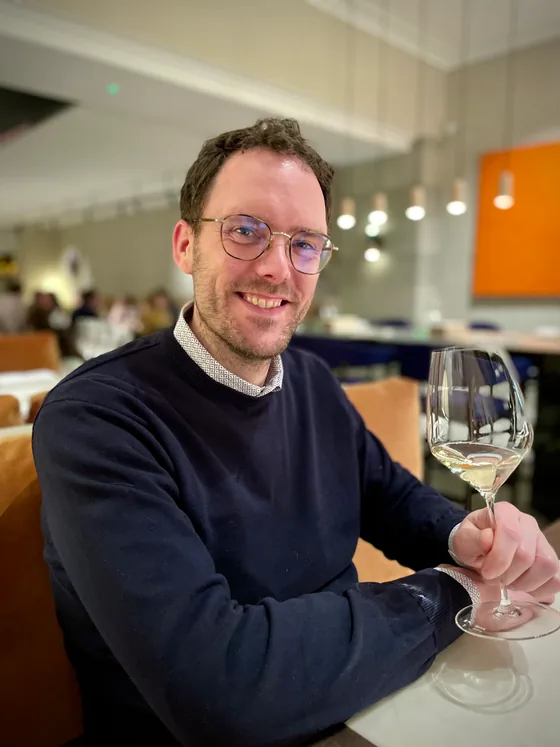
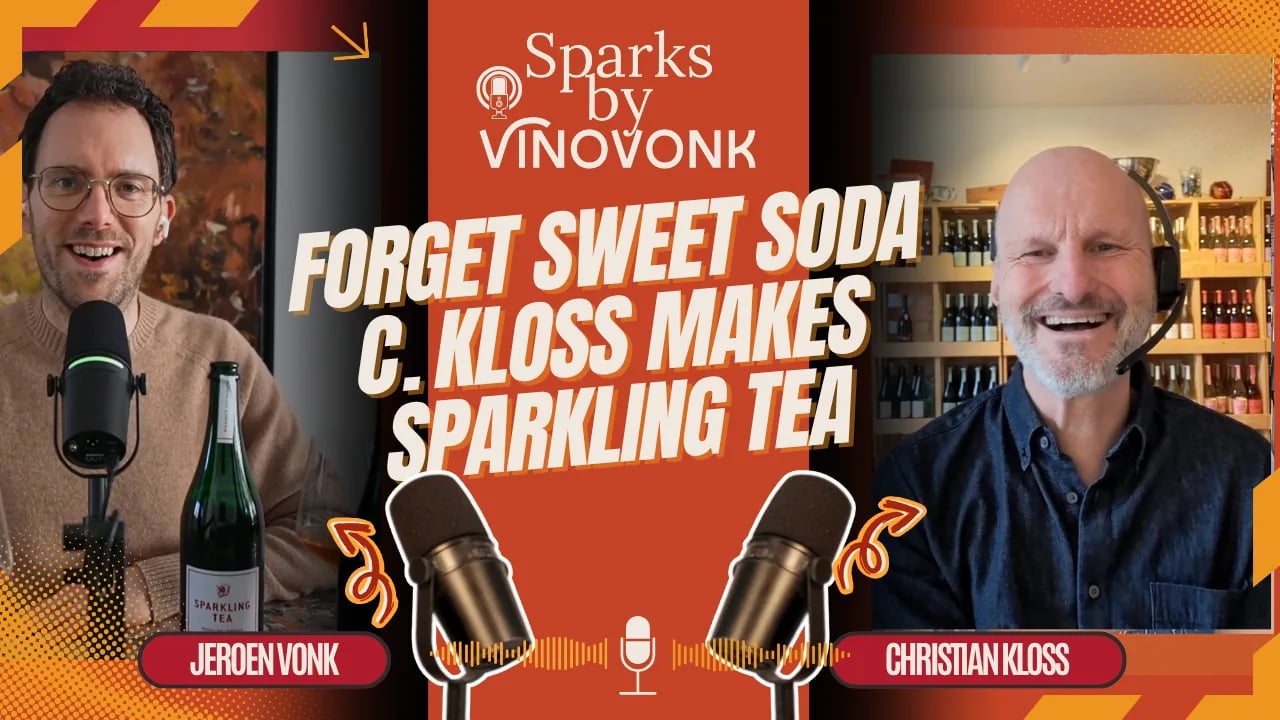
There is fermented celery in the bottle. It supplies the umami that lets this non-alcoholic sparkling tea stand up to a plate of roasted vegetables instead of vanishing underneath it. Christian Kloss mentions it in passing, somewhere between blackberry leaf and nettle, the way you would mention the weather.
The bank does not wait
Kloss makes Sekt in Winningen, the last village on the Mosel before the river meets the Rhine. He bought a historic cellar there three years ago and ran straight into the arithmetic every sparkling producer knows. A good bottle sits on its lees for one to five years before you can disgorge and sell it. The bank counts in months.
So he needed something for the years in between. Tea is what he found, and he is blunt that it happened by accident rather than by plan.
His great-great-grandfather Julius Kloss founded a sparkling wine house 170 years ago with his brother and his best friend. That company now carries the name of its biggest brand, Rotkäppchen, the second largest sparkling wine producer in the world. The family never left the business.
What sets Christian apart from the rest of this category is more mundane than the family tree, and more useful. He makes wine, he makes Sekt under contract for other houses along the river, and he makes tea. I have not found anyone else doing all three. It shows in the glass.
Blending, only with tea
Ask him how tea differs from wine and he starts talking about picking order. In a wet year you harvest the lower parcels first, because they sit in water, and the higher slopes later. In a warm year you reverse it, because the bottom holds shade and the top holds sun. Every year the blend lands somewhere new.
Same principle, different raw material. He assembles teas into a cuvée.
Two technical decisions do most of the work. The first is juice. Where most producers reach for supermarket apples, this is juice from wild orchard fruit: small, sharp apples carrying acid and very little sugar, the opposite of a Pink Lady. Every gram of sugar in these bottles comes from fruit. His line for it sticks: sucrose tastes sweet, fructose tastes fruity. Less sugar, the same amount of flavour.
The second is carbonation. Not one shot of pressure the way cola or a SodaStream does it, but CO2 introduced across a longer stretch of time. The bubbles get time to bind, so they come out smaller and sit on the tongue instead of breaking on it. That is what you chase in Champagne, and it is the first thing you notice pouring. This does not foam like mineral water. It foams like something that fermented.
It did not ferment, though. The bottle has the shape of a Champagne bottle and sits on the shelf beside Sekt and Champagne, but there is no second fermentation here. The bubble is added, carefully and slowly, and still added. Christian says so himself and calls bottle-fermented versions his eventual goal. The closure is more honest than the shape: a crown cap, exactly what a Sekt bottle wears during fermentation, rather than the cork and cage of a finished Champagne.
The three herbal bottles
Wild Herbs (2.7 g sugar per 100 ml, 11 kcal) is the one that holds you longest. Amber in the glass, linden blossom leading, and a dry bite from blackberry and nettle leaf that behaves the way tannin behaves: it gives the liquid something to grip. Underneath sits the fermented celery, which you never identify as celery but register as weight. Vegetarian and vegan kitchens buy this bottle specifically. Delicate vegetable cooking needs a drink that meets it rather than shouts over it. This is The Discovery.
Rosé (3.4 g, 14 kcal) smells like something warm you pull over your shoulders. Bramble, stewed pear, a dusting of baking spice, lavender at the centre and crushed fennel behind it. Pear juice instead of apple rounds the edges, though on paper it is barely sweeter. The mousse is at its finest here and the finish keeps stretching itself out. Falstaff, the largest wine magazine in the German-speaking world, gave it 96 points, and shortly before that Kloss was named the best non-alcoholic wine alternative in that market. At €14.99 this is The Value Play, and the bottle that gives the most for its money.
Bergkräuter (5.4 g, 21 kcal) is the outlier. Green oat tea underneath, sage on the nose, peppermint and elderflower around it, calendula for colour and mouthfeel, and homemade pine cone syrup closing it out. That syrup, made from cones harvested in July while they are still soft, carries resin and grip. Broad and full while it is in your mouth, then bone dry the second you swallow. This is The Specialist Pick for the table: cheese, savoury cooking, anything with butter in it.
Watch the number, though. At 5.4 grams this bottle carries double the sugar of the rest of the range. That is a deliberate choice and the drink is better for it, but anyone buying the line on a “basically water” promise will feel misled by this one. Buy it for what it is, not for the sugar story.
The two classic teas
For the second range Kloss worked with TeeGschwendner, Germany’s largest tea importer, based between Koblenz and Bonn, with two tea sommeliers who spend their year sourcing across Asia. The brief was to stay as close to real tea as possible, and to come out drier than the herbal line.
Green Tea (2.8 g) blends several green and white teas with a restrained hand of jasmine, quince juice for texture and a splash of Mosel Riesling grape juice. Smoky, white-fleshed fruit, and a dryness you do not expect from something with no alcohol in it. The flavours arrive in sequence rather than all at once. This is The Specialist Pick for the glass: restaurants pour it as a tea pairing in place of a wine pairing, which is exactly where it belongs. If you take lemon or sugar in your tea, this is not for you.
Fruit Tea (2.9 g) is the easiest of the five and therefore The Safe Bet. Real dried fruit rather than flavouring: blueberry, strawberry, cherry, with hibiscus supplying tartness and a thread of cinnamon over the top. Deep colour, fine bead, long finish. This is the bottle nobody turns down.
Read the label on your bottle
The sugar level moves from filling to filling. Christian thought he had 1.9 grams in his glass. The label said 2.8. Because every gram comes from juice, a warm year pushes it up and a cold year pulls it down.
If you are counting sugar, read the label on your bottle rather than the review. Including this one.
What it costs
In Germany these bottles are classified as food rather than wine, which puts them in a lower tax band. They sell for €13 to €15 there. I assumed Dutch sugar tax would push that up, since it does not care whether the sugar is fructose or sucrose.
It barely does. Amavine lists them at €14.99, effectively the German price.
Put that next to the rest of the shelf. Dutch sparkling teas usually run €20 to €35, and I have paid close to €50 for one. For the price of a single bottle at that end you get two of these. That is arithmetic rather than opinion, and it is the strongest argument this piece has.
Where to buy in the Netherlands: Amavine Price: €14.99 per 750 ml bottle. Small format from €5.50 German benchmark: €13 to €15
Those small bottles matter more than they sound. Four people at a table on a Tuesday, three share a bottle of wine, the fourth is driving. That is the format, and in the Netherlands you can actually buy it.
Cans are off the table. Apple acidity attacks the inner lining, so can manufacturers will only certify twelve months of shelf life. Wine shops do not work with best-before dates, and twelve months reads as nearly expired the moment it lands.
Listen to the episode
The full conversation with Christian Kloss is Sparks 40, with bottle photos, the tasting order and the complete transcript.
Where this is heading
Start with the Rosé. It gives back the most for the money and it is the easiest of the five to put on a table.
The interesting bottles are still in the cellar. There is one sparkling coffee, kombucha fermented on coffee instead of tea, which moves slowly because kombucha loves tea and hates coffee. Sold out. Water kefir is close and it is Christian’s own favourite. And then the bottle-fermented version, which would finally live up to the shape of the bottle.
Open a bottle and do not finish it, and an ordinary Champagne stopper is enough. Drink a third and it holds for days. Drink two thirds and you should finish it the next day, because the headroom wins. The finer bubble buys more time than mineral water does, but not unlimited time.
This article is based on press samples sent by Christian Kloss. No payment was made and the assessment is independent. I introduced Christian to Amavine and receive nothing for it.
More on Non-Alcoholic
Ron Gastrobar's alcohol-free wine list, minus the wine
The Ron Gastrobar alcohol-free wine list runs on tea and fermented drinks. Sommelier Jacob van Benthem explains why that beats dealcoholised wine.
Read on →
Drink Less, Drink Better: The No/Low Shift of 2026
Drinking less but better is a taste decision, not a diet. What the 2026 no/low numbers mean, and when alcohol-free actually holds up in the glass.
Read on →
Zeno Tempranillo Cabernet: alcohol-free red
Zeno Tempranillo Cabernet is an alcohol-free red wine from Spain. Tasting notes, why alcohol-free red is the hardest category, and when it still works.
Read on →