

Dutch Wine Harvest 2025 Doubles to 1.5 Million Bottles
The Dutch wine harvest 2025 doubled to 11,752 hectolitres, over 1.5 million bottles. RVO and VNWP report the second-highest yield on record.

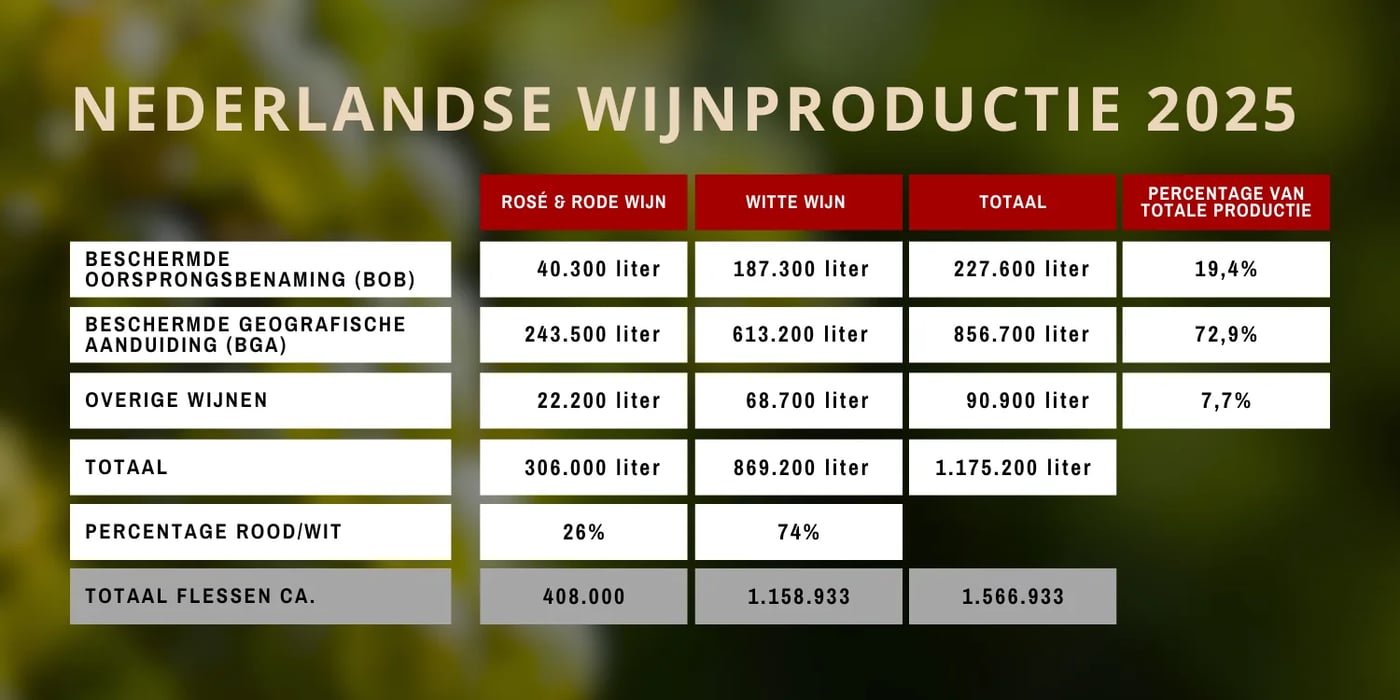
Dutch growers picked twice as many grapes in 2025 as the year before. The Dutch wine harvest 2025 lands at roughly 11,752 hectolitres, just over one and a half million bottles, according to figures the Netherlands Enterprise Agency (RVO) compiled with the Dutch Wine Producers Association (VNWP). That makes it the second-largest crop the country has ever recorded.
2024 went the other way. Night frost and weeks of rain wrecked the flowering, and the count stopped at barely half of this year’s. The whole gap comes down to weather. A cold, wet 2024 against a 2025 summer that handed the grape almost everything it wanted.
- Total production 2025
- 11,752 hl
- Estimated bottles
- approx. 1,566,933
- White vs rosé/red
- 74% / 26%
- Increase on 2024
- 5,684 hl → 11,752 hl
- Share of 5-year average
- 135% (5-yr avg 9,515 hl)
- Vineyards / area
- 220 vineyards / approx. 350 ha
A summer that did the work
The KNMI weather institute logged the summer of 2025 as one of the warmest in its records, averaging around 18.5 °C. On its own that figure means little to a drinker. To a grower it feeds straight into the Huglin index, which adds up the minimum and maximum temperatures across the growing season. Drop below about 1500 and quality fruit gets hard to ripen. The central Netherlands came in near 1700 last year, roughly eight hours of sun a day.
Plenty of light, plenty of warmth, and the grapes ripened all the way. The result is the second-largest Dutch grape crop ever measured. Three-quarters of it went to white wine. The rest is rosé or red.
Quality climbing, not just volume
The volume stopped just short of a record. The quality did not. You can read it in the share of wine carrying a Protected Designation of Origin (PDO): around 19% of the whole harvest, the highest that figure has ever been for Dutch wine.
A PDO is not a marketing badge. It means the wine meets rules written into a regional product file, with tighter limits on grape, yield and origin than a plain regional wine has to clear. One bottle in five reaching that bar tells you something about how seriously Dutch growers take themselves. For the person buying, it is a checkable promise rather than a hopeful one.
- PDO (Protected Designation of Origin)
- 227,600 L · 19.4%
- PGI (Protected Geographical Indication)
- 856,700 L · 72.9%
- Other wines
- 90,900 L · 7.7%
The weight still sits with the broader PGI tier, nearly three-quarters of production. The top end is growing. The base of Dutch wine stays in that wider middle.
White wins, rosé and red stay small
The colour split follows the usual Dutch shape. A cool, northern position suits white grapes with bright acidity, and white took 74% of production against 26% rosé and red. In bottles: over 1.1 million white, around 408,000 rosé and red between them.
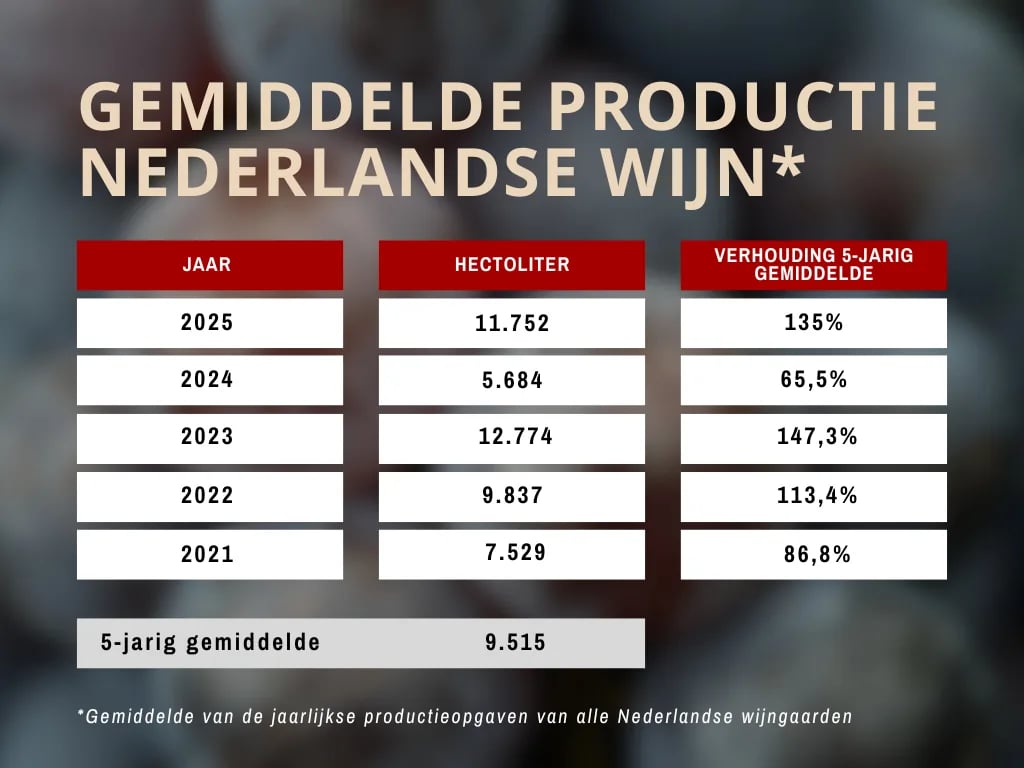
Set 2025 against the five-year average of 9,515 hectolitres and it sits well clear, at 135 percent. The same run of numbers carries a warning. 2024 stalled at 65.5 percent, 2022 spiked to 113 percent. One ruined flowering or a week of frost and half the crop is gone.
A few more vineyards, slowly
Beyond litres, the RVO counts the growers too. The 2025 crop came off 220 vineyards covering roughly 350 hectares, another small step up on a line that has climbed for years. Some of it is existing plots expanding, some of it new vineyards going in.
What strikes me is how much stays in-house. 79% of growers turned their own grapes into wine. Two percent sold the fruit on, the rest hired a winemaker. Dutch wine is not a hobby crop bottled somewhere else. It is, overwhelmingly, own work from grape to glass.
What the numbers leave out
Two things temper the headline. First, one and a half million bottles sounds like a lot until you set it beside what the Netherlands imports and drinks. This is a niche a single supermarket chain clears in a week. The growth is real. The scale stays small.
Second, “second-largest harvest ever” reads well, but it is still not a record, and one good summer is not a trend. The swings in that five-year run should keep anyone from getting carried away. 2025 was a gift from the sun, not evidence that Dutch viticulture has turned climate-proof.
This much is settled: the first whites and rosés of the 2025 vintage are in bottle, or nearly there. Part of the crop faces the judges this summer at the Wijnkeuring van de Lage Landen tasting competition. Anyone curious what a sun-soaked Dutch season tastes like can pour them side by side this year.
Sources
- Primary source: RVO & VNWP, press release “Nederlandse wijnboeren beleven succesvol wijnjaar” (Rhenen, 3 June 2026)
- Production figures from 2013: nederlandsewijninfo.nl/productiecijfers
- RVO wine registration: rvo.nl, register wine
- Summer 2025 weather data: KNMI seasonal overview summer 2025
More on News

Champagne Can Now Buy In 15 Percent. Or Can It?
The champagne purchase derogation of 7 August triples the buying ceiling. It governs excise law, though, not what the label is allowed to say.
Read on →
Fino can now go to 14 percent: what changed in Jerez
The new sherry rules drop the minimum for Fino and Pale Cream to 14 percent, tighten the yield threshold and add three pagos to the register.
Read on →
Champagne Harvest 2026: Less Wine, Better Acidity
The champagne harvest 2026 opened on 6 August, the earliest on record. Less wine than the quota allows, and acidity that held better than feared.
Read on →