

Champagne Gallimard: Six Generations in Les Riceys
Two Gallimard bottles from a July subscription box. A solera running 2009 to 2022, hand disgorgement, and a label code that says something the story doesn't.

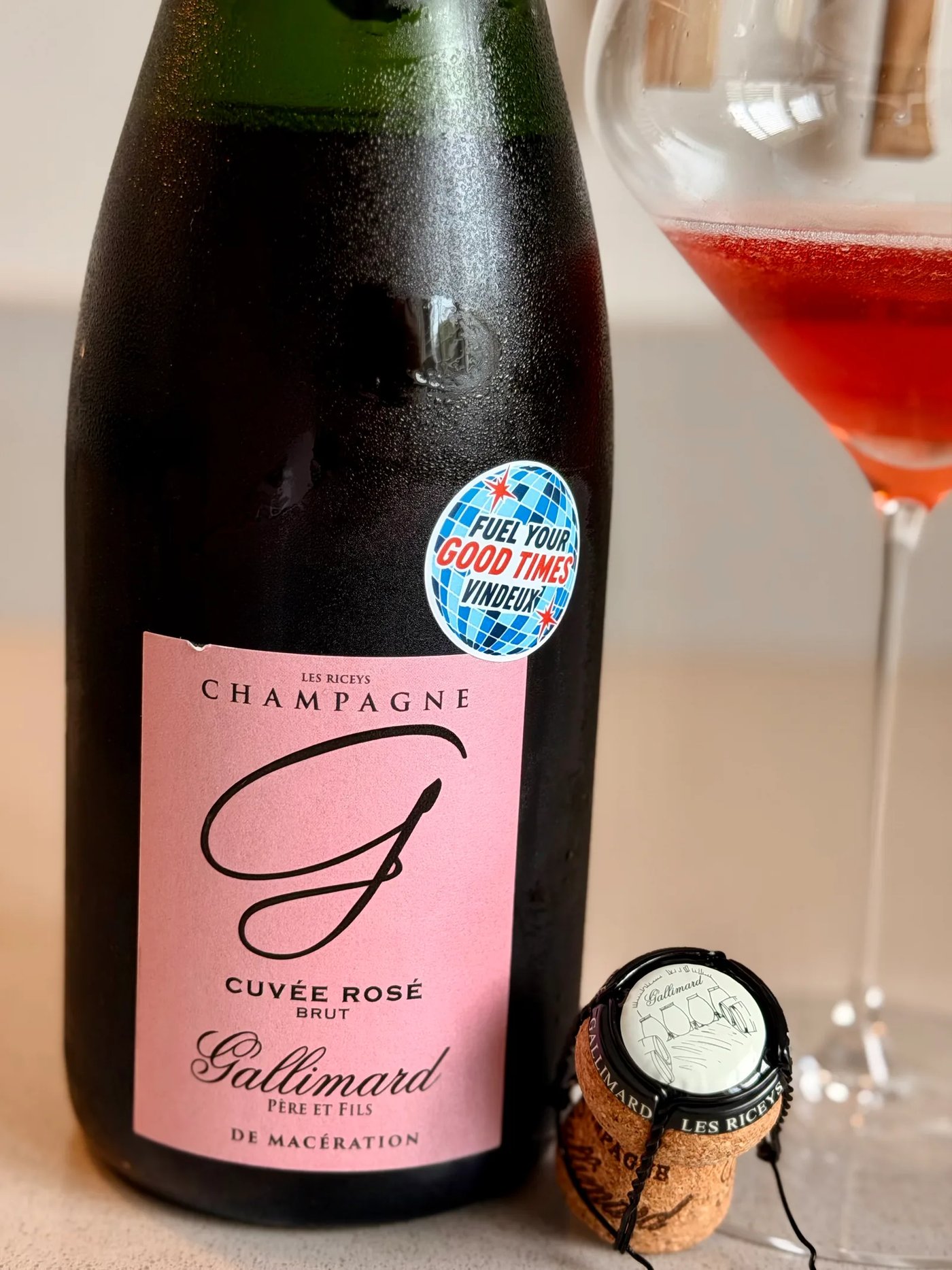
Arnaud Gallimard calls himself a lazy winemaker. “Do it well in the fields and you barely have to do anything in the cellar.” That line comes from the flyer packed with my July box. Turn the bottle around and the back label reads: solera 2009 à 2022. Fourteen vintages of reserve wine, drawn off and topped up year after year, each one a decision you cannot taste until a decade later.
Two bottles from this estate arrived in edition 34 of my Vindeux subscription: a Cuvée de Réserve Blanc de Noirs and a Cuvée Rosé made by maceration. Both come from Les Riceys, the southernmost corner of Champagne, and both share the same reserve wine.
What the back label gives away
Most champagne asks you to guess where it came from. Gallimard doesn’t. The blanc de noirs back label lists it all: 100% pinot noir, 2023 base, 30% reserve wines from a solera running 2009 to 2022. Soil argilo-calcaire kimméridgien. Terroir Les Riceys, Côte des Bar. Dégorgement à la volée. Domaine familial depuis 6 générations. Twelve percent alcohol.
A solera is a running barrel. You draw wine off for the blend and top it back up with the new harvest, year after year. Never empty, never entirely new. What ends up in the bottle is not a vintage but an average with a long tail: 2023 as the spine, carrying traces of every year since 2009.
Then there is the disgorgement. The standard method freezes the neck so the yeast deposit shoots out as an ice plug. À la volée skips the freezing and does it by hand, letting the pressure blow the deposit clear. More loss, more skill, more bottle variation. Gallimard disgorges every bottle this way.
In the bottom corner of that same label, in small type, sits the code NM-436-001. Most buyers never read it.
NM, not RM, and why that matters
NM means négociant-manipulant. The house is allowed to buy in grapes or must from other growers. RM, récoltant-manipulant, is the code that says everything came from the estate’s own vines. Those two letters are what separates grower champagne from everything else that looks like it.
Gallimard farms twelve hectares in Les Riceys, has been bottling since 1930, and goes back six generations. The family story holds up. But the bottles in front of me carry NM, and French reference works disagree with each other: Hachette lists the family as récoltants-manipulants, other sources and the label itself say NM.
This is not an accusation. It is the reason you read the code rather than the phrase “domaine familial” on the front. If you buy grower champagne on principle, buy on RM. If you want a family estate with a recognisable signature, this is one, whatever the two letters say.
Les Riceys does something no other village does
At more than 860 hectares, Les Riceys is the largest wine-producing commune in Champagne, and the only village holding three appellations at once: Champagne, Coteaux Champenois and Rosé des Riceys. That last one is a still rosé from 100% pinot noir, recognised on 8 December 1947, and the village is more famous for it than for its bubbles.
One correction to the flyer that came with the box: the village is indeed three hamlets, but they are Ricey-Haut, Ricey-Bas and Ricey-Haute-Rive. And the separate appellation is Rosé des Riceys, not “AOC Les Riceys”.
The bedrock is Kimmeridgian, the same limestone marl that runs under Chablis a hundred kilometres south. It is why pinot noir tastes different here than on the chalk of the Marne: rounder fruit, a saline edge on the finish. I went deeper into the village and its three appellations in my piece on Les Riceys.
The blanc de noirs
Making white wine from black grapes is an exercise in restraint. Too much contact between juice and skin and you have rosé. Gallimard lets it happen just barely: the glass holds no straw yellow but deep amber pink, copper against the light. The flyer calls it a rosé in the making, which is exactly what you see.
Blanc de noirs is the obvious style in the Côte des Bar, where pinot noir dominates plantings, while chardonnay owns the Côte des Blancs near Épernay. Brut, 7 g/L, two years on lees, and sold separately by Vindeux at release for 38 euros. Full tasting notes sit in the separate piece on this blanc de noirs.
The rosé de macération
The rosé is the louder of the two. Not pale salmon but clear raspberry red, closer to a light gamay. That comes from four days of skin contact on pinot noir, after which Gallimard tops it up with chardonnay to an 80/20 blend. Brut, 6 g/L, two and a half years of ageing, disgorged by hand as well. At release Vindeux sold it separately as Rosé de Saignée for 40 euros.
Most rosé champagne is made by assemblage: a splash of red wine into a white base until the colour is right. Saignée works the other way and leaves the juice on the skins until colour and fruit have moved across. You taste the difference immediately, and not everyone will want to. Anyone looking for the restrained Provence-style rosé champagne the big houses make will find this one too outspoken. My tasting notes on the Cuvée Rosé are separate.
The heatwave in the flyer, and the number from 22 July
The flyer opens cheerfully on the weather: low disease pressure, grapes ripening well, a harvest starting some three weeks early. That first part holds. Drought suppresses mildew, and Champagne is heading for the earliest picking date in its recorded history, around 15 August.
The flyer went out in July. On 22 July the Comité Champagne set the marketable yield at 8,800 kilos per hectare, the smallest appellation yield in twenty years and the fourth cut in a row. Trade press expects roughly ten percent less fruit than last year after frost, June heat and drought. Healthy grapes and a good harvest are not the same thing: there will be fewer of them. For a small estate, a solera like Gallimard’s is less romance than risk management. I wrote about what a shrinking harvest does to demand in my piece on heat and alcohol sales.
Douwe and Ellen did the legwork
Vindeux is the reason these bottles reached my table at all. Douwe and Ellen have been shipping champagne from a single producer every month since 2023, with a tasting guide that explains the maker rather than selling the wine. Since last month that guide also travels digitally in their newsletter.
Two subscriptions, and those names are not wine names: fête is one bottle a month at 33 euros plus a 5 euro joining fee, fête-deux is two bottles at 63 euros a month. Both can be paused or cancelled monthly. I am on fête-deux, so 31.50 euros a bottle.
Set that against buying singly. Their shop listed the blanc de noirs at 38 euros and the rosé at 40 at release, so 78 euros together. The subscription saved 15 euros a month, and at 31.50 a bottle it undercuts what entry-level grower champagne costs in a Dutch specialist shop. For a cuvée carrying fourteen vintages of reserve wine, that is sharp.
It is also more work than it looks. An estate like Gallimard has no importer building a market first. Without a curator driving to Les Riceys and tasting, this bottle does not arrive here. The real constraint is printed in the shop itself: when it is gone, it is gone. A new drop of two champagnes lands every month, and anyone who waits too long to reorder misses it.
I pay for that subscription myself. No press samples, no commercial relationship.
What I would do
Of the two, the rosé is the one that starts a conversation. Put it beside a big-house rosé champagne and the colour alone does the work. The blanc de noirs is the bottle for understanding what a solera actually does: pour it next to a straight brut with no reserve wine and pay attention to the texture.
And before you order, look at that code in the bottom corner. RM means every grape came from the estate. NM means some of it did not have to.
Sources
- Primary: back labels of Champagne Gallimard Cuvée de Réserve Blanc de Noirs and Cuvée Rosé; Vindeux information flyer, edition 34, July 2026
- Additional: Comité Champagne, 2026 yield press release (22 July 2026)
- Additional: Champagne Gallimard Père et Fils
- Additional: The Drinks Business on heat and 2026 yields
More on Winemaker
Fattoria La Valentina: Awards, No Dutch Importer
Fattoria La Valentina from Abruzzo won Tre Bicchieri again, plus high scores from Suckling and Vinous. I found no Dutch shop selling it. What I tasted.
Read on →
Michele Chiarlo at 70: From Barbera to Cerequio
Michele Chiarlo turns 70. What the house did for Barbera, Nizza and Barolo Cerequio, what a bottle costs, and what the anniversary press release leaves out.
Read on →
Vignamaggio Wine Estate: Wine as One Crop of Many
The Vignamaggio wine estate in Chianti Classico puts wine back among olives, grain, pigs and sheep. What the plan is, what a visit costs and where I doubt.
Read on →