

Champagne at 14% ABV: climate is reshaping the region
Vinous: Champagne now often harvests at 12-12.5% potential alcohol. Some bottles approach 14% ABV. What does that do to the wine, and to who makes it?

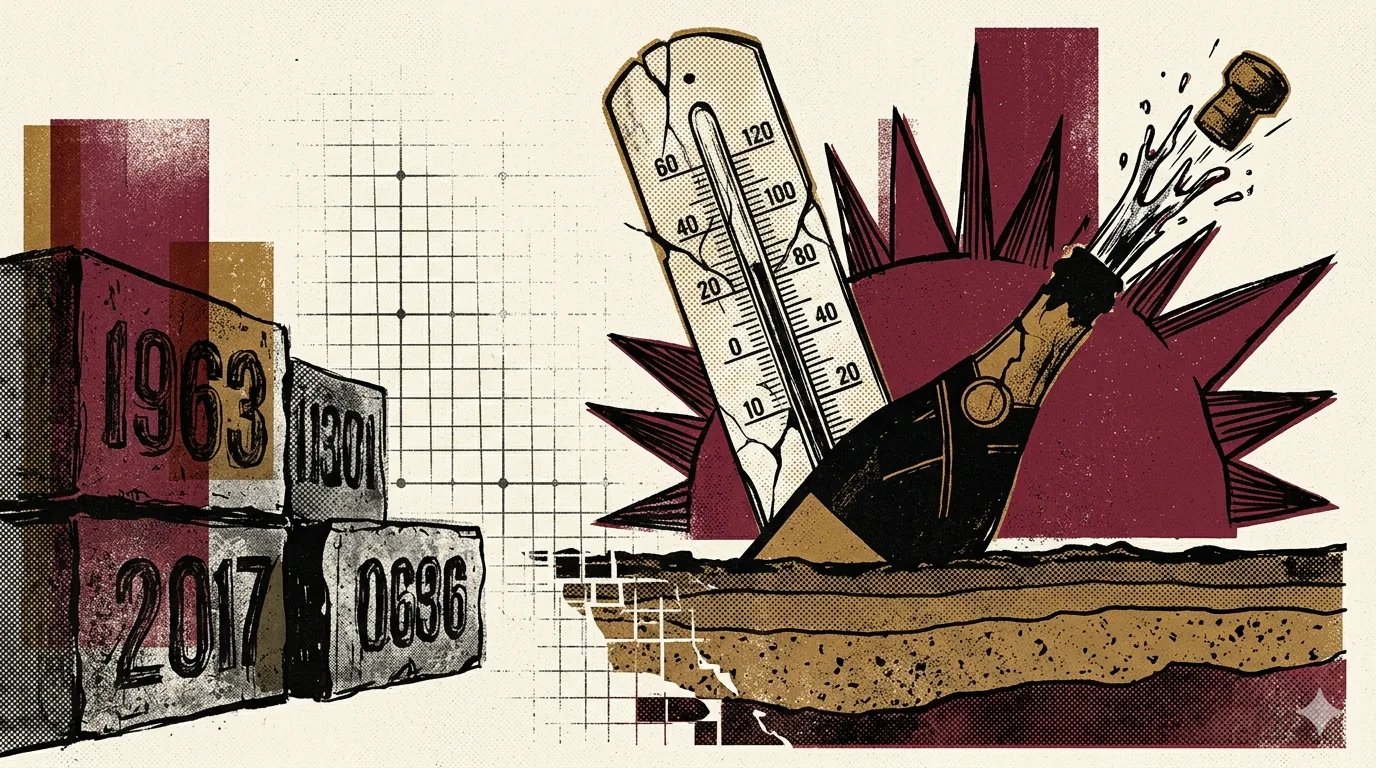
Fourteen percent alcohol. In Champagne.
Not as exception, not as labelling error. As fact. Vinous documented it in May 2026: harvests now often sit at 12 to 12.5 percent potential alcohol, “in some cases even higher”. Secondary fermentation adds roughly another percent, “which means that some bottled Champagnes will start approaching 14% alcohol.”
An appellation that stood for a century for finesse, acidity and freshness at moderate alcohol. Not for opulence, not for body, not for the bone-white heat of a summer Languedoc.
Not alarmism. Registration of what actually sits in the bottle. And the end of a definition.
The numbers: 2025 as a snapshot
For anyone thinking this is incidental, three producer reports from a single vintage. Bollinger announced that the 2025 harvest brought Pinot Noir in at 10.6 percent potential alcohol, Chardonnay at 11.1 percent, acidity 6 g/l, pH 3.1. Pol Roger logged 10.8 percent on average across the press hall, Chardonnay at 11.3 percent.
Add the roughly one percent alcohol pickup during fermentation. That bottles Bollinger’s Chardonnay component at 12.1% and Pol Roger’s at 12.3%. In prestige cuvées where selection is sharper, those figures climb further.
Thirty years ago the same wines sat at 8.5 to 10 percent potential. Gilles Descotes, for years chef de caves at Bollinger, summed it up in one line: “We have a rise of about 1% natural alcohol in the last 30 years. At the same time, we lost about 1g per litre of total acidity.”
And on the harvest calendar: “We pick 18 days earlier than we did 30 years ago. We picked in August in 2003, 2007, 2011, 2017, 2018. The last time before this was 1893!”
That last detail isn’t a marketing anecdote. That is the kind of historical comparison that marks a breakpoint.
“A fight for freshness”
Jean-Baptiste Lécaillon, chef de caves at Louis Roederer, frames the same reality the other way around. The fight used to be to pull ripeness out of a cool climate. Now, in his words: “Today, you get ripeness from the most recent harvest, so it is a fight for freshness.”
Read that sentence twice. A century of Champagne pedagogy was about pulling ripeness in. For fifteen years now it has been about restraining ripeness, preserving structure, defending acidity against the sun. The entire organisational paradigm of cool-climate winemaking has quietly been inverted.
Lécaillon is plain about what factually happened: “The facts were undeniable, climate change had been affecting the Champagne region over the past 30 years.” He doesn’t see that as crisis but as assignment, and what Roederer does is give that taste shape rather than hide it.
What they hold on to in the cellar
The response operates on two levels simultaneously: in the vineyard and in the cellar. Start with the second.
Dosage drops. The sugar addition after disgorgement, historically between 9 and 12 grams per litre for non-vintage Brut, has been reduced by 3 to 4 grams across the board at Louis Roederer. At Moët & Chandon, chef de cave Benoît Gouez says the dosage of Brut Impérial has been lowered and that this contributes to a more elegant wine. He gives no figures.
Jancis Robinson documented the breadth of the shift: across Champagne, acid levels averaged 8.18 g/l (expressed as sulphuric acid) in the 1990s. By the first decade of this century that had fallen to 7.52 g/l. A drop of nearly 8 percent. Without acid backbone, dosage can no longer rescue a wine, it just becomes sweet, flat, old.
Malolactic fermentation gets blocked. Several cooperatives and smaller houses now block MLF in part of the blend, depending on vintage character. That keeps some malic acid intact, the sharp apple acid that ferments away fast in a warm harvest.
Reserve wines become a climate buffer. Pierre Naviaux at the Comité Champagne states it explicitly: the reserve system “in fact functions as a climate buffer.” At Champagne Lenoble, Julien Lardy deliberately keeps reserve wines at 9.5 to 10 percent, low alcohol, high acidity, to blend later with 11-percent base wine. An upward alcohol stream at harvest is corrected with a downward alcohol stream from reserve.
And in the vineyard
Here the Champagne industry splits into two schools.
Louis Roederer goes for heritage. Pinot Blanc, Arbane, Petit Meslier, historic Champagne grapes that had vanished from commercial production, return in field blends. Roederer’s 2018 Brut Nature contains a massal-selected Pinot Blanc. Arbane and Petit Meslier have been in the pipeline since 2022. The logic: higher acidity, different ripening rhythm, more genetic diversity per field = more resilience.
Lécaillon’s broader argument: field blends used to bring complexity and resilience to the wine, and can fulfil that role again under contemporary conditions. Not a flight forward, a return to the era before monoculture.
Bollinger goes for precision viticulture. Vineyard director Gaël Vuille names three mechanisms: more targeted clone selection (no early-ripeners), canopy adjustments against sunburn, and research into Voltis as a future variety.
That’s where it gets interesting.
Voltis: Champagne’s new grape
Voltis is not a vine you find in a garden centre. It’s a deliberately crossed hybrid from a collaboration between INRAE (the French agricultural research institute) and the Julius Kühn Institute (Germany). The grape is 95 percent Vitis vinifera, through repeated backcrossing, but contains a resistant core from Vitis rotundifolia, an American species immune to downy mildew.
In late 2022 the French VIFA programme (Varieties of Interest for Adaptation) approved Voltis for use in Champagne. First plantings: 2023. Maximum 5 percent of a vineyard, maximum 10 percent in any blend.
By 2026 there are 170 plots of Voltis in Champagne. A blind tasting in 2023 with 700 experts judged blends containing 5 percent Voltis as “rounder, simpler and more ready to drink.” Two other mildew-resistant hybrids, Aurelis and Cérélis, are in the pipeline for possible approval in 2027.
Géraldine Uriel at the Comité Champagne calls Voltis explicitly “one element of the toolbox.” Not a replacement for traditional varieties, but specifically deployable, for example in plots adjacent to homes where phytosanitary treatments must be reduced.
Hugo Drappier captures the cultural tension well: Pinot Noir has been in the Aube for over 900 years and the house still learns every day, if you want to know how Voltis behaves, you have to start somewhere.
The yield trap
One complication on this whole climate story: yields are dropping. Not from climate, from policy. The CIVC has reduced the rendement commercialisable systematically over four years: 2022 at 12,000 kg/ha, 2023 at 11,400, 2024 at 10,000, and 2025 at 9,000 kg/ha, the lowest since Covid.
Lower yields per hectare reinforce ripeness pressure. Fewer grapes per vine = more concentration of sugar and aromatics = faster to 11-12 percent potential alcohol. So while climate adaptation runs in technical mode, the CIVC’s market-correction policy in the vineyard amplifies the very problem that adaptation is trying to manage.
The Vignérons Indépendants, independent growers, formally objected to the 9,000 kg/ha decision and want 10,500 kg/ha as a stable target.
Counter-argument
Not everything is gloomy. Vinous itself adds an important nuance: “It’s hard to know if this is the result of better farming and/or winemaking, the beneficial impact of climate change allowing better ripening in lesser-quality sites or some combination of factors. But it seems clear to me that the average level of quality in entry-level NV Champagnes has increased. This is a very positive trend since these are the wines most consumers will encounter.”
Climate change has lifted lesser-quality terroirs within Champagne to a higher baseline. For the average consumer who reaches for non-vintage Brut rather than prestige cuvées, that means: better wine on average than thirty years ago. Not a small detail.
What this means for you
Three things to keep in mind with every Champagne bottle you open this year.
- Read the label. Champagne has been required to declare ABV for a few years now. An NV Brut at 12.5% or higher is not a producer incident, it’s the new norm. A Cuvée at 13% is realistic. Above that still rare, but no longer unthinkable.
- Extra Brut and Brut Nature are not fashion items. The style is a direct response to this biochemistry. A producer who dares to bottle at 0-4 g/l dosage without making the wine bony delivers a serious signal about base wine quality.
- MLF-free batches, field blends, old clones, no longer marketing. Read them as producer responses to an appellation that can measure: temperature, acidity, sugar, and what those together produce in your glass.
Champagne in 2026 is a different product than Champagne in 1996. The techniques that keep it in balance, dosage discipline, MLF blocking, reserve-wine buffer, hybrid grapes at the margins, are also a different product than what happened in the cellar thirty years ago. The makers know that. Now you do too.
Sources
- Vinous 12-14% ABV claim + 2025 vintage analysis: Vinous, Champagne: The 2026 Spring Preview
- Bollinger 2025 harvest data (10.6% PN, 11.1% Chard): The Drinks Business, Bollinger hails the quality potential of the 2025 harvest
- Pol Roger 2025 harvest figures: Pol Roger: The 2025 harvest, a fine vintage on the cards (PDF)
- Gilles Descotes (Bollinger) 30-year trend: Secret Sommelier, Climate change leadership Porto: Gilles Descotes
- Lécaillon (Roederer) “fight for freshness” + field blends: The Drinks Business, Louis Roederer looks back to face future in Champagne · World of Fine Wine, Louis Roederer 2025
- Dosage trend Roederer + Moët, acid data 90s vs 00s: Jancis Robinson, Champagne now older and drier
- Climate data 1961-now, Huglin Index, reserve wines as buffer (Naviaux, Lardy): The Buyer, Warmer, riper, different Champagne
- Voltis facts + Uriel, Drappier quotes: Wine Spectator, Champagne experiments with new grape
- Yield 9,000 kg/ha 2025 + Vignérons Indépendants opposition: Wine Couture, 9000 kg/ha marketable yield for 2025 harvest
More on News
Sherry exports to the Netherlands fall 38 percent
Sherry exports to the Netherlands dropped from 2.55 to under 1.6 million litres in a year. Jerez blames private label. What the figures do and don't show.
Read on →
Arctic Barolo: Rivetto Ages Barolo Under the Sea
Arctic Barolo spent a year 34 metres down off northern Norway. What Rivetto and Hurtigruten did, what the taster found, and why I am not convinced yet.
Read on →
Champagne 2026: the same picking plan as 1959
Roederer put its 2026 picking plan beside 1959 and found only the date had moved. What the first vins clairs suggest, and what they cannot prove.
Read on →