

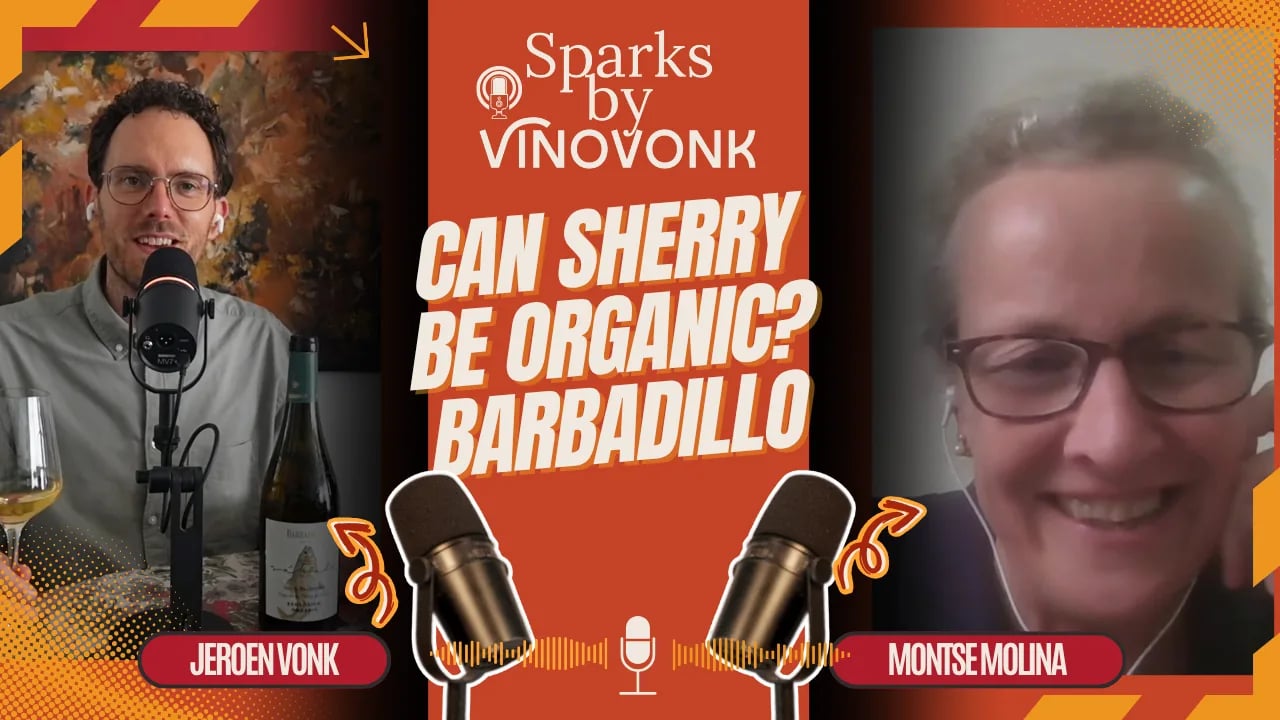
Montse Molina reageerde op een advertentie in de krant. Zo belandde een apotheker met een master in wijnbouw en oenologie eind jaren negentig in Sanlúcar de Barrameda, met bijna geen kennis van manzanilla of Jerez. Dertig jaar later maakt ze alle wijnen van Bodegas Barbadillo, ook drie biologische: een droge Palomino zonder versterking, een manzanilla en rama en een Pedro Ximénez.
Ik proefde ze alle drie met haar, ik in Amstelveen, zij in Sanlúcar, met een scherm ertussen.
Deze aflevering is in het Engels opgenomen. Bekijk op YouTube met automatische ondertiteling, of lees de Engelstalige versie van dit artikel.
Wie is Montse Molina
Ze kwam voor de witte en rode wijnen. Barbadillo wilde een afdeling onderzoek en ontwikkeling en zij moest die opzetten. “I knew almost nothing about Manzanilla or Jerez”, zegt ze, en dan: “I’ve been here for 30 years.”
Barbadillo is sinds 1821 een familiebedrijf en dat is het volgens haar nog steeds. In een eerder stuk noemde ik het de grootste manzanillaproducent van de Marco de Jerez. Op mijn vraag hoe het is om de wijnen te maken van een huis met zoveel geschiedenis, sprak ze over verantwoordelijkheid: heel oude solera’s, heel oude oloroso’s en amontillado’s, opgebouwd door veel mensen vóór haar. Ze noemt het huis “very, very traditional, but also very, very innovative” en wijst op een witte wijn uit de jaren zeventig. Biologisch hoort voor haar in dat rijtje.
Waarom biologische sherry een nieuwe solera nodig had
In de kelder werkt biologisch volgens Montse nauwelijks anders, met één uitzondering: de Salicornia en de Pedro Ximénez. Voor allebei was een nieuwe criadera nodig, een rij vaten binnen een solera-systeem. Een biologische wijn mag je niet bijvullen uit vaten met niet-gecertificeerde wijn, dus het systeem begon bij nul.
In een oude solera heeft de flor, de gistlaag op de wijn, zichzelf tientallen jaren lang geselecteerd. Een nieuwe criadera begint zonder die voorsprong. Soms lenen ze flor uit andere criadera’s om het op gang te helpen, en dan is het wachten: “It’s not the first month.” Ze begonnen rond 2020, denkt ze, “maybe 2022”. Hoe het systeem werkt staat in mijn gids over het solera- en criadera-systeem, die ik in de aflevering beloofde.
Biologisch in de wijngaard
Ik vroeg of de biologische lijn een boodschap over natuurbescherming draagt. Montse antwoordde als een technicus: in elke wijngaard werk je “in a logical way”, en met biologische druiven gebruik je minder middelen. Andere uitdagingen, dezelfde klus. Sommige jaren was er geen biologische wijn, of maar een klein volume. Een recent jaar was de voorjaarsregen zo hevig dat niet elke biologische wijngaard de lijn haalde. Barbadillo houdt biologisch en conventioneel in aparte lijnen en zet niet alles om.
Wat biologisch in het glas verandert, werd me niet duidelijk. Ik vroeg of flor zich anders gedraagt op biologische druiven. Dat kon ze niet zeggen. Barbadillo heeft DNA-gegevens van zijn gisten (“you can see the DNA of almost each one”), met een grote diversiteit, en verschillen komen volgens haar uit de druiven in het veld. Haar antwoord wijst dus naar de druiven en naar een solera die nog jong is. Dat kan genoeg reden zijn om deze wijnen te kopen, maar het is een andere reden dan “dit smaakt anders omdat het biologisch is”.
De proeverij: Sábalo, Salicornia, Jopo de Lobo
Montses volgorde is simpel: van links naar rechts, van jonge wijn naar manzanilla naar PX, omdat alcohol en zoetheid in die richting toenemen.
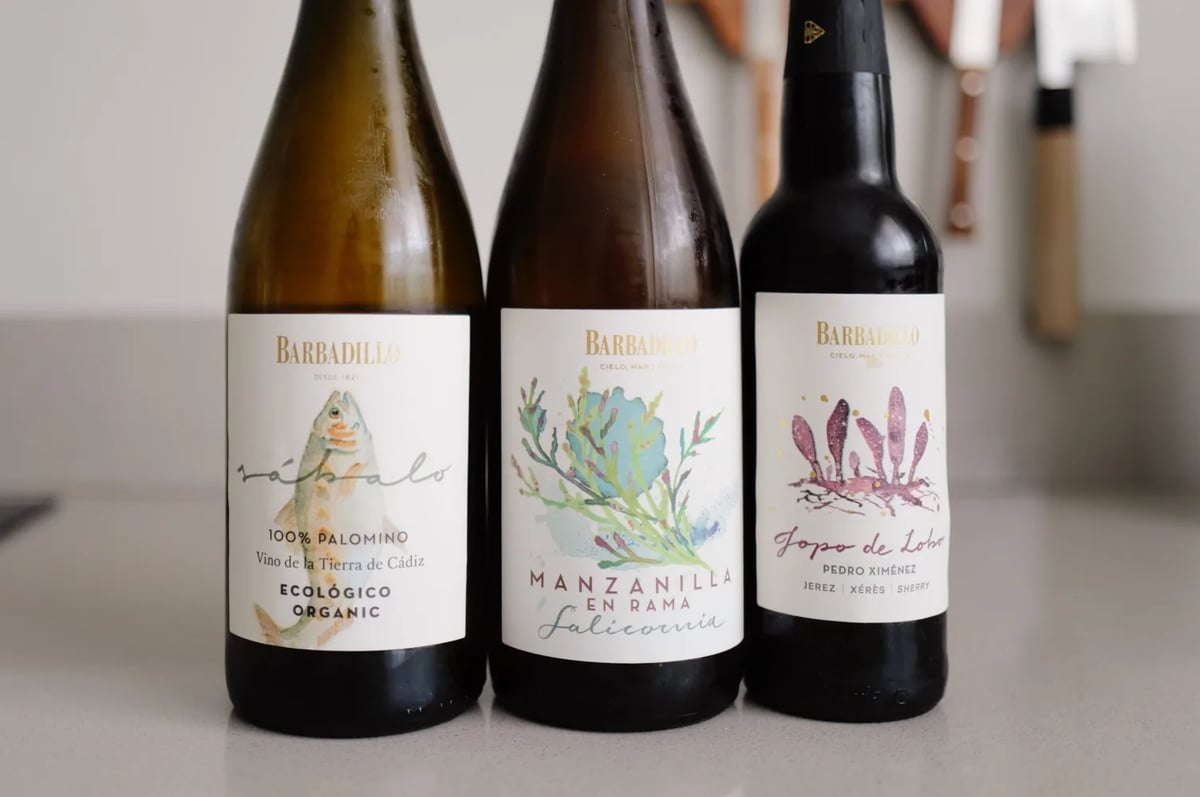
Sábalo: de instap
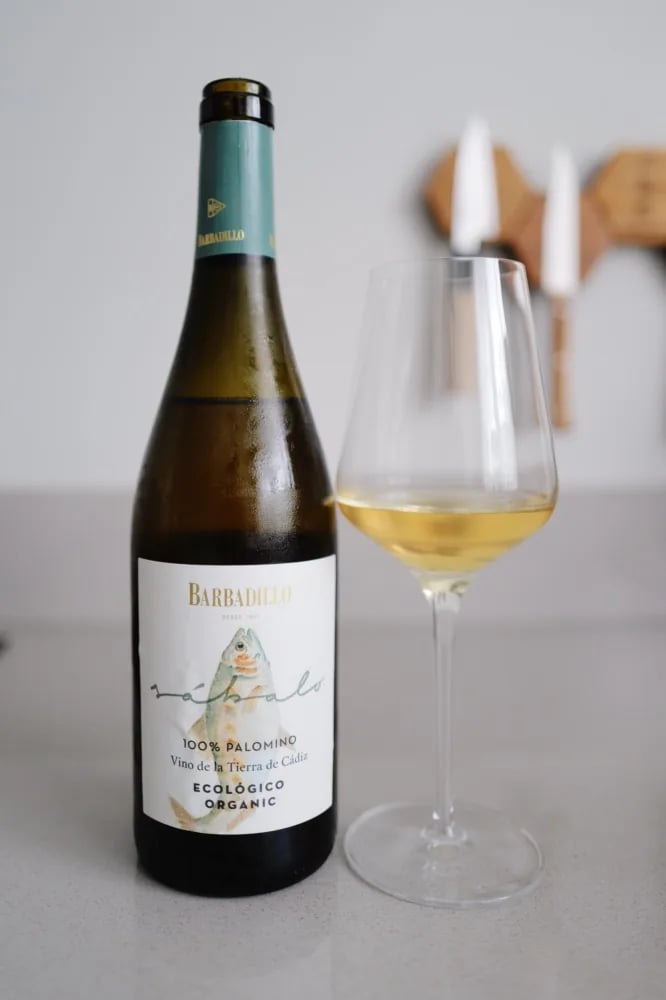
Biologisch, 100% Palomino, 13,5% alcohol, een vino de pasto. Wat die term precies betekent weet Montse zelf niet zeker, behalve dat het een jonge wijn is om te drinken. Hij gist in roestvrij staal, ziet nooit flor en wordt alleen gefilterd om helder op fles te gaan. De druiven komen uit biologische wijngaarden in Pago Burujena, tussen Sanlúcar en Trebujena bij de rivier, en uit een tweede wijngaard dichter bij zee.
Oogst 2023, dus bijna twee jaar op fles. Montse zegt dat hij verlegen begint, met appel en peer, en dat kamille en een jodiumzoute toon in de fles opkomen. Ik ruik kamille, appel, peer, wat steenfruit en de zee. Ze omschrijft de frisheid als zoutigheid, niet als zuur: lage zuurgraad, veel speekselvorming, wat ze sapidez noemt (Spaans voor hartigheid).
Deze wijn geef ik aan wie zegt: “sherry, dat vind ik niks”. Sommigen noemen hem “sherry light”, zegt ze. Ik hou niet van die term, want hij suggereert iets minders, maar ik snap waarom hij werkt als eerste stap. Met eten probeerde ze hem bij verschillende stukken tonijn, de vette en de droge, en volgens haar past de wijn zich telkens aan.
Salicornia: de vergelijking
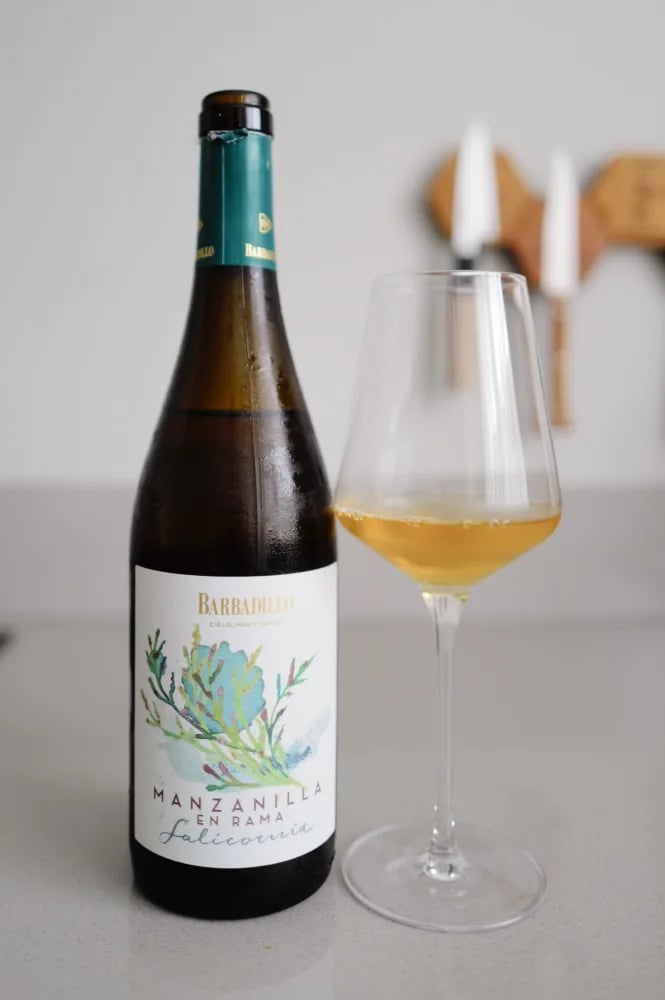
Salicornia neemt dezelfde basiswijn verder: twee tot drie jaar onder flor in een solera met drie criadera’s, versterkt tot 15% om andere micro-organismen van het oppervlak te houden en de gist te selecteren. Het is een manzanilla en rama, dus met minimale filtratie gebotteld. De naam is Spaans en Latijn voor zeekraal, een zoutminnende plant, volgens Barbadillo.
In het glas zit dezelfde identiteit met een extra laag. Montse wijst op gebakken appel, manzana asada. Die geur komt van acetaldehyde, dat de flor aanmaakt. Ik ruik hazelnoot, aardappel, brood en een beetje boter. Er zit geen suiker meer in. Hij is heel droog zonder je mond samen te trekken, en de afdronk blijft doorgaan: “long, long, long”.
In de aflevering vergeleek ik hem met muziek die “boem” doet, terwijl andere muziek op de achtergrond blijft. Daar sta ik nog steeds achter. Montse zegt zelf dat je aan deze wijnen moet wennen, en dat klopt. Vind je manzanilla met veel flor niets, dan is Sábalo de betere koop en gaat Salicornia je niet bekeren.
In de opening van de aflevering zei ik drie dingen die ik niet kan onderbouwen. Ik noemde Salicornia de tweede biologische wijn ooit in de sherryregio, en Montse de eerste met een biologische Pedro Ximénez. Toen ik het haar voorlegde, zei ze: “I don’t really know if we are the first.” De bronnen die ik vond, steunen geen van beide. Sherry Notes noemde Salicornia bij de lancering in november 2023 de enige biologische manzanilla op de markt, en noemt een biologische manzanilla uit 2015, Entusiástico, van Delgado Zuleta. Barbadillo noemt Jopo de Lobo de eerste sherry in de eigen biologische lijn. Ik houd het daarom op “een van de eerste biologische manzanilla’s”. Ik zei ook dat het plukken van zeekraal bij wet verboden is. Dat kon ik nergens bevestigen.
Sherry Notes geeft verder 15% alcohol, 3.500 flessen, 100 botas (vaten) verdeeld over drie criadera’s, en zegt dat Sábalo en Salicornia horen bij de biologische lijn Cielo, Tierra y Mar, die in september 2019 met Sábalo begon.
Jopo de Lobo: de bijzondere
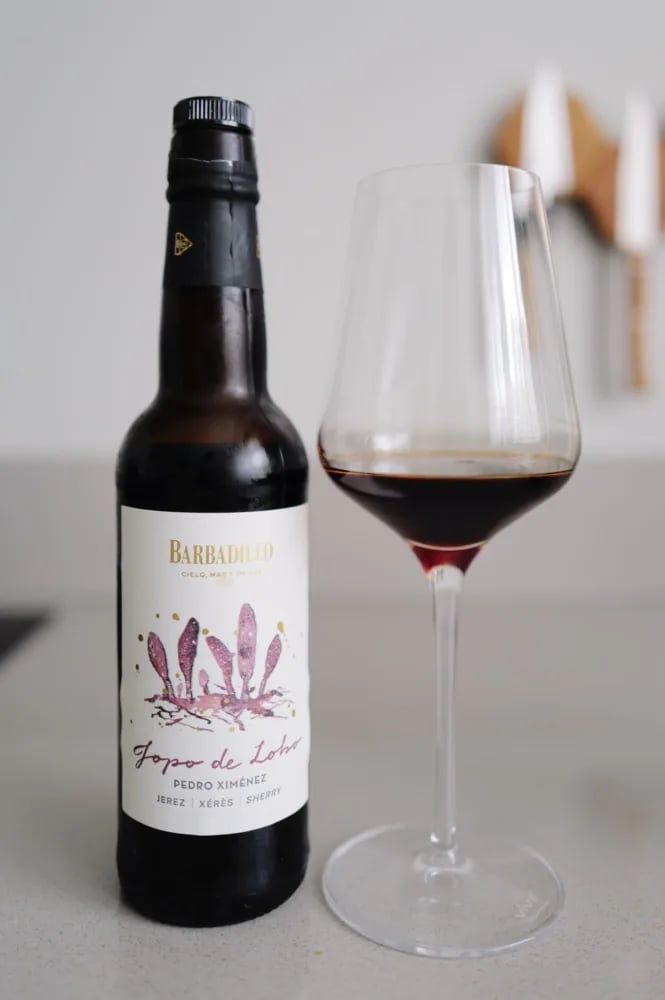
Biologische Pedro Ximénez van zongedroogde druiven, volgens Barbadillo genoemd naar een bedreigde zoutminnende plant op de Andalusische rode lijst. Alle suiker komt uit de vrucht. De druiven liggen in de zon, het water verdwijnt en de suiker concentreert. Ze persen, laten kort gisten, versterken tot 15% en laten de wijn rijpen in een oxidatieve solera met volle vaten: vier tot vijf jaar, zegt Montse. Barbadillo’s eigen persbericht uit augustus 2023 noemt drie jaar op Amerikaans eiken. Misschien noemt het persbericht een minimum. Ik houd het cijfer van de wijnmaker aan.
Ik had gehoord dat je hem koud serveert, zes tot acht graden, en dat deed ik. Montses redenering: met zoveel suiker maakt een lagere temperatuur de mond “less big”, dus minder zwaar. Ik proef heel rijk donker fruit, een beetje bloesem, koffie en toffee. Zij denkt aan koffie ‘s ochtends. Haar favoriete combinatie is pittig eten: de wijn dempt de pit en de pit laat de suiker lichter voelen. Zelf zet ik er rijke Franse kazen naast.
Albariza: waar het zout vandaan komt
Ik vroeg waar de zoutigheid in Sábalo vandaan komt, want hij zag nooit flor. Haar antwoord is de bodem. Alle Palomino staat op albariza, de krijtwitte grond van een oude zee, rijk aan calciumcarbonaat en silica. Flor versterkt het in de manzanilla, zegt ze, maar de jonge wijn heeft het al.
Zou de druif elders hetzelfde smaken? Niet helemaal, zegt ze: je krijgt de zoutigheid van de bodem en de delicatesse van Palomino samen, en Palomino op een andere bodem voelt waarschijnlijk lichter. Ik dronk ooit een Zuid-Afrikaanse Palomino die warmer en voller was, met tropisch fruit. Dat past niet bij haar “lichter”. Of dat aan de bodem lag, aan het klimaat of aan de stijl van die wijnmaker, weet ik niet.
Hoe overleven de stokken 40 graden? De bodem is diep en houdt de winter- en lenteregen vast als een spons, en oude stokken sturen hun wortels erheen. Het bladerdak groeit als een parasol boven druiven die dicht bij de grond hangen. Lees ook de sherrydriehoek en albariza.
Jonge solera versus oude solera
Salicornia komt uit een jonge solera en Barbadillo heeft ook oude. Proef je verschil? Ja, zegt ze, deels door de druiven en deels door de leeftijd, en ze verwacht dat het leeftijdsdeel met de jaren verschuift. “But at the end, each solera is different.” Zelfs binnen één gebouw maken de Levante-kant en de Poniente-kant een andere manzanilla. De saca (het onttrekken van wijn voor de botteling) en de rocío (het bijvullen) lopen elke vier maanden van de ene kant naar de andere. Meestal blenden ze beide, want de blend is ronder en complexer. Soms bottelen ze de kanten apart, zodat mensen het verschil proeven. Dat zouden meer producenten mogen doen.
Waar begin je met sherry
Haar advies: begin met witte wijnen van albariza, sommige gegist in vaten waar manzanilla in zat, waar gist een hulpmiddel is en de wijn niet maakt. Ga dan naar manzanilla, “the easiest style of wine to understand” op die route. Probeer verschillende, want sommigen liggen beter bij een jonge manzanilla en anderen bij een oude. “It’s a matter of trying and looking for what you like.” Mijn gidsen over vino de pasto, manzanilla en sherry voor beginners beschrijven de stijlen.
Waar dit naartoe gaat
Ze maken verschillende wijnen van verschillende pago’s in verschillende zones, en testen hoe die zich gedragen als ze in vaten gisten. Nog niets aan te kondigen. Bezoekers zijn welkom in de bodega, met gebouwen uit de zeventiende of achttiende eeuw, zegt ze. Kijk op de bezoekpagina voor rondleidingen en tijden; Montse noemde tijden in de aflevering, maar was er niet zeker van.
Proef de wijnen
Granada Wijnen, de Nederlandse importeur van Barbadillo, stuurde me de wijnen en introduceerde me bij Montse. Wat ik ervan vind is van mij. In hun Barbadillo-assortiment vind je Jopo de Lobo (fles van 0,375 l), Sábalo en Salicornia. De shop noemt bij Jopo de Lobo drie jaar rijping, net als Barbadillo’s persbericht; Montse zei vier tot vijf.
Met code SherryGW10 krijg je 10% korting in de webshop van Granada Wijnen, geldig tot 1 januari 2027. Ik verdien niets aan de code.
De wijnen zijn opgestuurd door de importeur. Geen betaling, mijn oordeel is onafhankelijk.
Volledig transcript
Het gesprek is in het Engels gevoerd. Hieronder staat het volledige transcript, licht bewerkt voor eigennamen en wijntermen.
Het transcript is letterlijk uit de opname, dus het bevat nog de claims uit de opening die ik hierboven heb gecorrigeerd (“second organic wine”, “first organic Pedro Ximénez” en de opmerking over het plukken van de plant).
Toon volledig transcript
Jeroen Vonk [00:00] There’s a plant that grows in the salt marshes around Cádiz. Sailors used to carry it on their long voyages to keep from getting sick. It’s so fragile that picking it is now forbidden by law. Barbadillo named a wine after it. And that wine is the second organic wine ever made in the Sherry region, from a house that has been making wine since 1821. Today I’m talking to the woman who made it. Welcome to Sparks by VinoVonk. I’m Jeroen. Sanlúcar de Barrameda is not a place you would expect a revolution. This is one of the most traditional corners of the wine world. Soleras that are hundreds of years old, cellars where the barrels are repaired by hand, a way of working that has barely changed in two centuries. And in the middle of that, Bodegas Barbadillo, founded in 1821, still family owned, the biggest wine company in Sanlúcar. They decided to start making organic wines: the first organic Pedro Ximénez the region has ever seen, and a dry, unfortified Palomino, which is a bit like a jazz musician suddenly recording a folk album. The person behind all of this is my guest today, Montse Molina. Montse Molina has been a winemaker at Barbadillo since the late nineties. Every wine that leaves that house is hers. Her motto is simple: clean and pure wines. One thing before we start. These wines were sent to me by Granada Wijnen, the importer of Barbadillo in the Netherlands, who also introduced me to Montse. Thank you very much for that. What I think of the wines is entirely my own, as you’ll hear. Montse, welcome. It’s really good to have you here. Hello Montse, thank you for your time. How are you?
Montse Molina [01:46] Fine, thank you.
Jeroen Vonk [01:48] How is the weather in Sanlúcar?
Montse Molina [01:50] The weather is beautiful today. We have a sunny day with 32 degrees, so it’s not so high.
Jeroen Vonk [01:56] Okay, not so hot. That’s better for the people, and better for the grapes.
Montse Molina [02:00] Yeah, also.
Jeroen Vonk [02:02] You have been the winemaker at Barbadillo since the late nineties. How did you start, and what has kept you here all these years?
Montse Molina [02:13] Yes, well, I saw an advertisement in a newspaper. It was a long time ago, so we did these kinds of things back then. I was looking to be an oenologist. I’m a pharmacist, but I also did a master’s in viticulture and oenology. I was looking for a job and I came to Sanlúcar, but I knew almost nothing about Manzanilla or Jerez. I came for the whites and the reds, to start a research and development department. And then, well, I’ve been here for 30 years.
Jeroen Vonk [03:04] Yes, a long time.
Montse Molina [03:05] Barbadillo has been a family company since 1821, and it still is.
Jeroen Vonk [03:06] How does it feel to make the wines of a house with so much history? Does the history ever get in the way? Is there anything you’d like to change, but can’t?
Montse Molina [03:24] Well, it’s a big responsibility for me to be here, because of all this history, and because we have a lot of old wines from those times. So I have very old soleras, very old Olorosos and Amontillados, with a very beautiful style, made over all these years by a lot of people before me. There are a lot of people here, not just me. But we try to continue with the style of the wines and to capture the essence of the company and the place, because Sanlúcar is really special, with the manzanillas and the style of manzanilla in Sanlúcar, and especially at Barbadillo.
Jeroen Vonk [04:17] And you also started making organic wines, certified organic. But it was all completely new. Is that the hardest part for a traditional company, a new, organic way of working?
Montse Molina [04:47] Not really, because of the company. Barbadillo is very, very traditional, but it’s also very, very innovative. We started making a white wine in the seventies that was very successful for a long time. We did reds, we did sparkling, we did a lot of different types of wine. Doing organic was a challenge in the vineyard, especially because you have to grow organic grapes. But in the winery it’s not really so different. It’s different in the case of the Pedro Ximénez and the Salicornia, the manzanilla, because we had to start a new criadera. We couldn’t use a criadera with wine without organic certification.
Jeroen Vonk [05:45] You had to start with a completely new system. Is it difficult to work organically with flor? I figured it must be, because the sea and the grapes are different when you’re organic.
Montse Molina [06:09] I don’t know. We have a big range of different types of yeast. You can see the DNA of almost each one, so we have a high diversity of yeast. I can’t say it’s different. They are different because the grapes are different in the field. It’s quite difficult for me to say. That’s the way I think.
Jeroen Vonk [06:41] But is it harder with organic grapes than with conventional grapes?
Montse Molina [06:45] Not so much. It’s hard to start a new criadera. Because when you have a criadera, it’s like a machine that is working. You have the selection of the yeast in each cask, so you just have to keep the ecosystem inside. And when you start with new casks and new wine, sometimes we can use the flor from others to help start the movement and to get a feel for the style of the manzanilla. It’s not the first month. You have to be patient, wait, and feel the style of the wine. It will also change with the years.
Jeroen Vonk [07:43] And you’re the first winemaker to make an organic Pedro Ximénez, and the second is this one, I think, the Salicornia. This is a manzanilla. But how did other producers react to you going organic?
Montse Molina [08:03] I don’t really know if we are the first, you say, but I don’t know. There is not so much to think about this. It’s one more product to show to the people who are interested in organic grapes.
Jeroen Vonk [08:25] So for you it’s nothing special, it’s just something new. Working on new things is normal.
Montse Molina [08:34] Yes, for us it’s normal to have new things every time. So I think it’s hard work in the vineyard, and sometimes we don’t have the grapes. I remember that sometimes we didn’t make the organic wine, or just a small volume, because we had problems in the vineyard. But it also rains, so it depends if you have strong rain. Last year we had that, in spring, so in the end not all the vineyards go for the ecological.
Jeroen Vonk [09:17] The whole organic line carries a message about protecting nature. Does that change how you work in the vineyard? Is it a message, or is it really the way you work?
Montse Molina [09:36] We always work with, I don’t know how to say, with logic, in a logical way, in a vineyard. But for doing organic, you can use less products for growing the grapes. So it’s a different way to do it, you have different challenges, and you have to work with this.
Jeroen Vonk [10:11] We have three wines: the vino de pasto, the manzanilla en rama and the Pedro Ximénez. What is the best order to taste them? For the people listening and watching, why is that the perfect order?
Montse Molina [10:31] Yes, the best order is the one you have on the table, from the left hand to the right hand. So start with the young wine and then the manzanilla, because of the alcohol and the power in the mouth, which is higher. And end with the Pedro Ximénez, also because of the alcohol and the sweetness that we have inside.
Jeroen Vonk [10:57] Yes, because there’s a lot of sugar in it. Shall we taste the wines?
Montse Molina [11:04] Yes. Yeah.
Jeroen Vonk [11:06] Let’s start with this first wine. It’s organic. The alcohol is 13.5%, 100% Palomino. Can you tell me something about this wine? I thought vino de pasto was new. Well, new to me. I’ve known it for a few years. But you said you were already making a dry white wine in the late seventies.
Montse Molina [11:34] Yes. I don’t know what vino de pasto really means, different from white wine. Just a young wine for drinking. So maybe sometimes vino de pasto has a little bit of yeast on the surface, or it’s fermented in casks of manzanilla, or something like this. That would be a style much closer to Jerez, or to the smell of Jerez and Manzanilla. But in this case it’s vino de pasto with less of this flavor, because it’s fermented 100% in a stainless steel tank, and it’s en rama, so we only filter it to go clean into the bottle and nothing else. The special thing here is that the wines come from the organic vineyards. The organic vines in Pago Burujena, which is here between Sanlúcar and Trebujena, near the river. And then another vineyard, much nearer to the sea. So the pagos are very, very fresh. And we also have in the Sábalo a special saltiness or freshness in the nose, and in the mouth too.
Jeroen Vonk [13:06] Yes, when you smell it, it’s like the sea with lots of flowers, lots of chamomile, lots of freshness. On the nose you think, okay, this is a white wine, maybe a strong white wine, but it’s very light and very fresh. For me it’s also a very good introduction for people who think, oh, sherry, I don’t like it. I say, try this.
Montse Molina [13:38] And then some people call it “sherry light”. Yes, it’s like a step. And this is the 2023 harvest, so it has almost two years in the bottle. This strength in the nose comes from that, but it adds some richness in the nose. When we start bottling, it’s much more like an apple or a pear. Yes, very shy. And inside the bottle it keeps increasing, and all this chamomile and the saltiness of the iodine appear. And when you smell the manzanilla, you will see that there is a link between them.
Jeroen Vonk [14:29] If you buy it, can you keep it for a while?
Montse Molina [14:36] Well, yes, but not now. It’s for drinking yet. If you buy a recent harvest, you can wait.
Jeroen Vonk [14:49] Yes, you can wait. Salute! Salut! It’s very fresh, round, full. You have different forms of complexity, but not hard. Very light, very elegant. A lot of chamomile again, but also apple, pear, some stone fruit.
Montse Molina [15:27] And I think the saltiness as well. You feel a lot of salivation, I don’t know if that’s the word, and a very low acidity. We call it sapidity, from the Spanish sapidez. It’s fresh, but not because of the acidity. It’s because of the saltiness. It’s light, but with a lot of flavor.
Jeroen Vonk [15:55] And it’s also good with food, because there’s a fish on the label, so it pairs very well with fish, I think. I like the saltiness in this, because it works with more kinds of food, even meat.
Montse Molina [16:12] Yes, and it helps a lot with the food. Sometimes we did the exercise of trying different types. For example, one time it was a tuna. The different parts of the tuna, some are much more fatty and the other side is more dry. And using the same wine, the wine changes to help you each time. So it works when the fish is fatty or heavier, but it also helps when the dish is drier.
Jeroen Vonk [16:53] And I think it’s a special thing with the Palomino.
Montse Molina [16:55] This always happens. At the end it goes with you, and it doesn’t change the flavor in your mouth of the dish you are eating very much. So it’s easy for people to drink, because it always helps. And it’s not the protagonist, it’s not the main thing, because it adapts to the food.
Jeroen Vonk [17:16] Yes, it goes with everything. I really love it. This wine never saw the flor, only stainless steel. But where does the saltiness come from? Is it the soil?
Montse Molina [17:36] It’s because of the soil. We have the albariza, the soil that we have for these plants. All the Palomino is on albariza, which is a soil that comes from an old sea that we had in this zone. So we have a lot of calcium carbonate and a lot of silica. At the end it makes the saltiness in the mouth. This is a young wine, with no yeast. When we add the yeast, it increases the saltiness, as we will see in the next wine. But even in the young wines we have this sensation of saltiness.
Jeroen Vonk [18:17] If you take the same grape to a different place, you get a completely different wine.
Montse Molina [18:24] Not completely, because the Palomino makes a good… In the sensation that you have in the mouth, you have both things: the saltiness because of the soil, and the delicacy of the Palomino. If you don’t have the Palomino, you don’t have the same sensation in the mouth, because maybe a little more acidity changes the thing. But in another soil with less saltiness, the Palomino will maybe be lighter. Your sensation in the mouth will be lighter, I think.
Jeroen Vonk [19:00] I once had a Palomino wine from South Africa. And I thought, yes, I get a bit of Palomino, but it’s warmer, fuller, more tropical fruit. I had almost forgotten. But yes, that’s what terroir does to a wine, to the grapes. Very interesting. Shall we go to the next one?
Montse Molina [19:24] Yes.
Jeroen Vonk [19:30] And that’s the Manzanilla en Rama, Salicornia. You see a slightly different color. Can you tell me something about this wine?
Montse Molina [19:48] So this wine is made from the same wine that we had before, because this vino de pago was really the wine that we used for making a manzanilla. For a long time they didn’t drink that wine. In this zone they call manzanilla simply “wine”. And the base wine, they call it Sábalo, the first wine. They call it mosto. Mosto, or must, it’s the sugar. It’s not a wine, it’s a step before the wine. Now, the Salicornia comes from Sábalo, with more or less two or three years of aging, under a layer of velo, in a solera system with three steps, three criaderas, and the yeast. So we add alcohol up to 15, to avoid that other microorganisms live on the surface, just to select the yeast. And it’s because of the life of the yeast that the wine changes.
Jeroen Vonk [21:16] On the nose it’s the same identity: full, rich, floral, salty. But you have an extra layer, like a punch. With music, sometimes there’s music that really gets to you. And sometimes there’s music that’s okay, you can listen to it, but sometimes it’s like: boom, it’s in there. And for me, that’s what happens here. This goes straight to your head. Do you have that experience too?
Montse Molina [22:07] Well, it has a lot of personality. I think these wines you have to get a little bit used to. That’s why you told me before that Sábalo is like the first step, and then you can go up. Because you have a very strong nose, and in the mouth too, because of the alcohol, and the saltiness is higher. And it’s dry. We don’t have any sugar here, or even the glycerin that we have in Sábalo from the fermentation. All the rest of the sugars the yeast eats for living, and it produces the acetaldehyde, which is the smell of apple. Dried apple, apple in the oven. Yeah, manzana asada.
Jeroen Vonk [23:09] Also some hazelnuts and potatoes, and bread, with apple and some butter too. I love this, because it’s very dry, but it doesn’t make your mouth pucker. There’s a lot going on in your mouth, and the saltiness makes your mouth feel heavier and gives a really beautiful sensation. And I love the salt.
Montse Molina [23:56] And a lot of aftertaste, yeah? It’s long, long, long, long at the end.
Jeroen Vonk [24:03] Sometimes I ask people, “Would you like a glass of sherry?” “No, I don’t like sherry.” “Okay, would you like a glass of a very dry Spanish wine?” “Oh yes.” And then they get a glass of sherry. “Oh, this is nice, what is this? Is this sherry? Oh wow.”
Montse Molina [24:20] Yes, because if you put the sherry sticker on it, they say, “Oh, that’s heavy.”
Jeroen Vonk [24:28] But in your opinion, for years sherry was a wine that people really forgot. Do you feel that’s changing? And where do you see it? Because in the Netherlands you see more and more sherry, in restaurants. You have sherry bars. You can even do sherry education here in the Netherlands now.
Montse Molina [25:02] Yeah, I think so, because people are much more interested in wines and in understanding wines than 25 years ago. So when you understand the history, you understand the wine, and you get used to it in the mouth a little bit. At the end you have a lot of sensation with the wine. It helps a lot with the food, and it’s a very high level of happiness when you drink it.
Jeroen Vonk [25:35] And for this one you also had a new solera and criadera system. In which year did you start? Was that around 2020?
Montse Molina [25:50] I haven’t checked. I think it was 2020, yes, maybe, or 2022, maybe. Around 2020.
Jeroen Vonk [26:07] Sherry comes from different years, and you have an old system. I’ll put information about it in the show notes. Normally you use very old vintages, but because you’re organic, you had to start right away. But when you compare it with older systems, you see a lot of differences. This is a young solera system, and you have an older solera system. Do you find it very different in taste?
Montse Molina [26:56] Yes, they are different. I think there is a part because of the grapes, and there is a part that comes from the age of the solera system. And I think the second part is going to change with the years, and maybe we will feel it much more delicate than now. I think it’s because we had old wine in it, and it helps a lot with the sensation at the end of the mouth. But at the end, each solera is different, so it’s quite difficult to say it’s because of this or because of that. Even in the place inside the building, the bodega, you have a style of manzanilla in one part different from the other. But the wine is the same. We make a saca and a rocío in a criadera that goes from the Levante side to the Poniente side, for example, for 20 years, every four months. So it’s dynamic. You have a style on the Levante side and you have a style on the Poniente side. So at the end, all of them are different.
Jeroen Vonk [28:17] And do you mix everything together, or do you make a separate line from the Levante or the Poniente side?
Montse Molina [28:28] Yes, usually we make a mix of them, because when you taste each of them and you keep in mind what they are like, the blend of all together is always better. You have much more complexity and it’s rounder. But we sometimes make special bottles, just to show what I’m saying. People want to learn, and I think it’s better than me speaking about it. It’s better for people to try, and they can draw their own conclusions.
Jeroen Vonk [29:12] This is the organic line, but is the whole bodega now working organically, or do you have separate lines of organic and conventional?
Montse Molina [29:29] We have separate lines. We are not going organic with all… No.
Jeroen Vonk [29:36] No, maybe in the future. Who knows what will happen. Shall we go to the last one?
Montse Molina [29:42] It’s beautiful, the color.
Jeroen Vonk [29:52] A completely different style, beautiful color. And it’s Jopo de Lobo. Normally people think you should drink this at room temperature. But you told me to serve it cold, between 6 and 8 degrees. For me that was very different. Normally I chill it too, but for me this was different. You have to serve this cooler than the other wines.
Montse Molina [30:33] Well, it’s a matter of the sensation that you have in the mouth. In this case it’s 17 degrees, I think, 17, no, 15 degrees. But we have all the sugar here. So if you lower the temperature, the mouth is less big.
Jeroen Vonk [30:58] Yes, the nose is very rich, concentrated. You smell it as very heavy, but at the same time it also has freshness. Is that because of the soil again?
Montse Molina [31:16] Yes, because here we don’t have the yeast. This is oxidative aging.
Jeroen Vonk [31:33] This one is very rich, very full. Dark, only dark. Dark fruit, and again some blossom. Ah, it pairs well with rich cheeses, with French cheeses. But you can also pair it with some savory food. Not the whole night, but you can try.
Montse Molina [32:03] Yes, definitely.
Jeroen Vonk [32:04] What is your favorite pairing with this wine?
Montse Molina [32:07] With this wine, we taste it with something spicy. In English, picante, it’s spicy.
Jeroen Vonk [32:16] Yes, spicy food.
Montse Molina [32:18] Yes, and it calms the spice in the mouth. So if you combine them, you feel the food as less spicy, and you feel less sugar in the PX also. So it’s a different balance in both.
Jeroen Vonk [32:35] Yes, that would be a great combination. And can you tell me something about how you make this wine?
Montse Molina [32:42] Yes, well, this is a wine where all the sugar comes from the grapes. We let the grapes sit under the sun, so the water goes out and the sugar concentration increases. And then it’s pressed, and it ferments just a little bit, because with so much sugar it’s difficult for the yeast to do. We add alcohol up to 15, and then we go to the bodega for the same solera and criadera system, but in this case with the casks completely full, and with all the movements of sacas and rocíos. After more or less four or five years of aging, it’s a middle age, yes, it increases all these toffee or coffee notes, and chocolate. Because at the beginning it’s like a prune. I don’t know what the name is in English.
Jeroen Vonk [33:54] Yes, it has coffee notes. I thought, what is it?
Montse Molina [33:59] But it reminds me of morning coffee. Yes, it comes from the oxidative aging.
Jeroen Vonk [34:07] You are the winemaker of all these wines. How different is it to make a Pedro Ximénez or a manzanilla? Is working with the casks and with the grapes completely different?
Montse Molina [34:28] Yes, but it’s what we do here all the time, so it’s nothing special.
Jeroen Vonk [34:46] Okay, and all the grapes are grown on white albariza, chalky soil, and that gives a lot of salt. But summer is very hot. If you look at the weather, it’s normally 40, 45, maybe more.
Montse Molina [35:09] Not usually 45, but 40 in the last years, yes.
Jeroen Vonk [35:15] How come the vines don’t die, when there’s no water?
Montse Molina [35:22] Yeah, well, we have water inside the soil, because this is a very deep soil, and if you have old vines the roots go down. It’s like a sponge. So when it rains in springtime or in winter, we have all the water inside the soil, and the vines can reach it. You can feel the heat outside, but you see that the leaves are green and they can resist, and you see the grapes. And also we make an umbrella with the leaves. In the north of Spain, or even in the north of Europe, you see the leaves as a solar panel, with all the grapes perfectly in the sun. We don’t do this. We make it just like an umbrella, and the grapes are near the soil, to be protected from the sun.
Jeroen Vonk [36:34] If someone is listening and thinks, okay, I want to try sherry, which wine should you start with?
Montse Molina [36:47] I recommend to start with all these white wines that come from albariza soil, and then some of them fermented in casks of manzanilla, for example, with a little bit of yeast, but just as a tool. The yeast does not make the wine. And then going to a manzanilla, I think it’s the easiest style of wine to understand, going this way. And try different styles of manzanilla, because for some people it’s better to start with a young one, and others say it’s better to go to the oldest manzanillas, that they are easier to understand. But I don’t know. It’s a matter of trying and looking for what you like.
Jeroen Vonk [37:47] You don’t only make this white wine, you make other white wines, you said.
Montse Molina [37:53] Yes, we make another white wine. For example, we can show Alba de Balbaína, that we make from a pago called Balbaína, which is very near the sea. This is also fermented in a stainless steel tank, but it has five months on the lees of fermentation. But then we make another one called Mirabrás, and this is fermented in casks of manzanilla, with yeast on the surface, but only for six months or something like this, not so much. And then we add the manzanilla.
Jeroen Vonk [38:40] So you have different kinds of options to taste with.
Montse Molina [38:45] A lot of them.
Jeroen Vonk [38:47] And what are you working on now that excites you? Something you can tell us about, or maybe not.
Montse Molina [38:57] No, we are doing different wines from different pagos. We are working on this now in different zones, trying to understand how they go with the fermentation in casks, and trying different places.
Jeroen Vonk [39:17] Yes, new things, but nothing yet. Is there something I didn’t ask that you wanted to tell?
Montse Molina [39:22] No, I don’t think so.
Jeroen Vonk [39:31] Okay, well, if people want to visit you, can they go to your website and make a booking, or are you open every day? Can people just knock on the door?
Montse Molina [39:44] Yes, yes, every day. On the website, which is barbadillo.com. For the visits, we have them every day. In English I think it’s at 12, then we have one at 1, and in the afternoon it’s also open. It’s a very good visit because it’s very beautiful, the place, with all the style of the bodega buildings. We have had bodegas since the 18th century or 17th century, so it’s very beautiful. And Sanlúcar too: we are in the north, and we have in front of us Doñana and the river. It’s a very beautiful place, so they are very welcome.
Jeroen Vonk [40:38] I’ll put some links in the show notes. Montse, thank you for your time. Salute.
Montse Molina [40:45] Thank you, salut!
Jeroen Vonk [40:46] This was a new episode of Sparks by VinoVonk. Let me know which of these wines you want to try first. Salute.
Montse Molina [40:54] Salute!
Luister en kijk
YouTube: youtu.be/Y2STQZlamw8 Spotify: open.spotify.com/episode/2gVX7RrTS7G4jugsO9E6K0
Schrijf je in voor de In het Glas-nieuwsbrief voor de wekelijkse flespick en als eerste te horen wanneer de volgende Sparks online komt.
Vorige aflevering: Christian Kloss over sparkling tea zonder alcohol. Alle afleveringen: Sparks.
Luister
Bekijk