

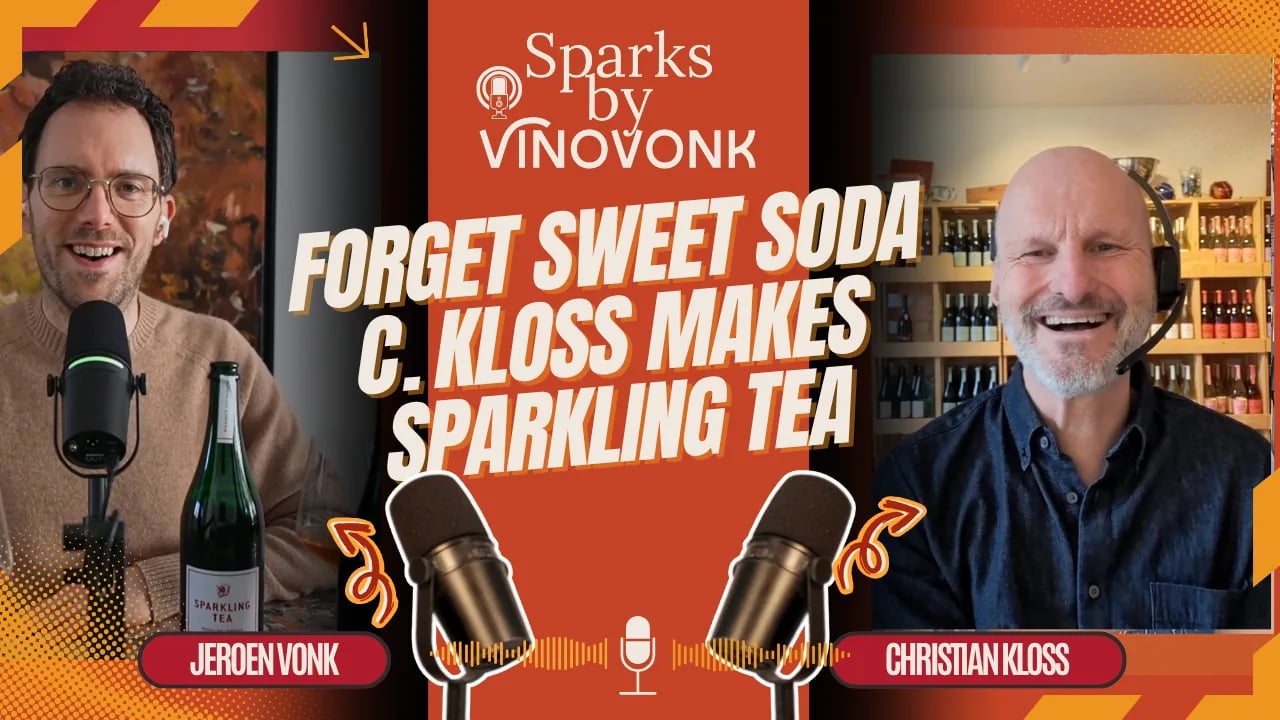
Christian Kloss maakt Sekt in Winningen, het laatste dorp aan de Mosel voordat de rivier in de Rijn verdwijnt. Hij kocht er drie jaar geleden een historische kelder en liep meteen tegen de rekensom aan die elke mousserende wijn kent: een goede fles ligt een tot vijf jaar op de gist voordat je kunt degorgeren en verkopen. De bank rekent in maanden.
Dus zocht hij iets voor de tussenliggende jaren. Het werd thee. Vijf flessen, allemaal alcoholvrij, allemaal met iets erin wat je niet verwacht.
Ik proefde ze voor het eerst op een evenement, waar ik Christian en zijn vrouw ontmoette. In Nederland waren ze toen niet te koop. Ik bracht hem in contact met Amavine, en die importeert ze nu.
De vijf flessen
Op het voorlabel staat alleen “Sparkling Tea” en de kleur. De naam staat op de achterkant, in het Duits.
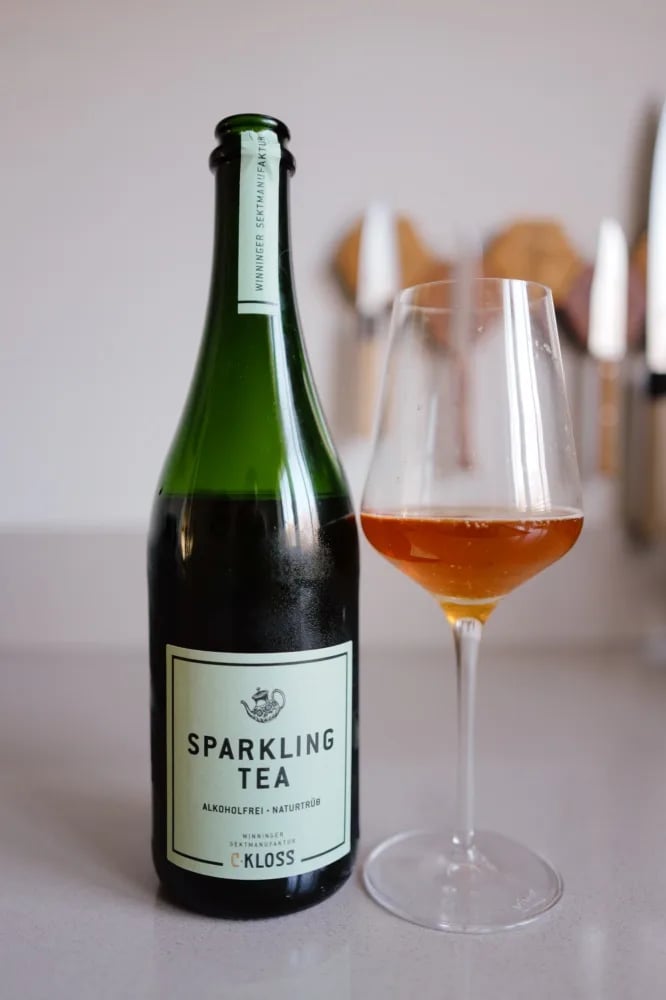
Weiss, in de Engelse communicatie Wild Herbs. Lindebloesem voorop, een bittertje uit braam- en brandnetelblad, en daaronder de gefermenteerde selderij die je niet als selderij herkent maar wel voelt als gewicht. 2,7 gram suiker per 100 ml.
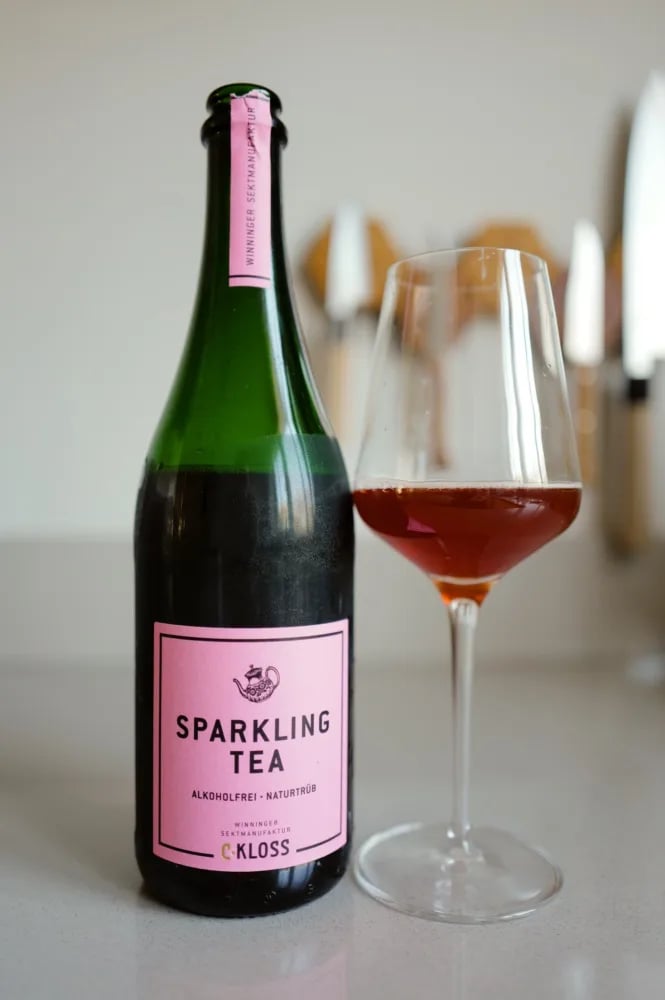
Rose. Kaneel, braam, gestoofde peer, lavendel als kern en gekneusde venkel eronder. Perensap in plaats van appelsap. Falstaff gaf hem 96 punten. 3,4 gram.
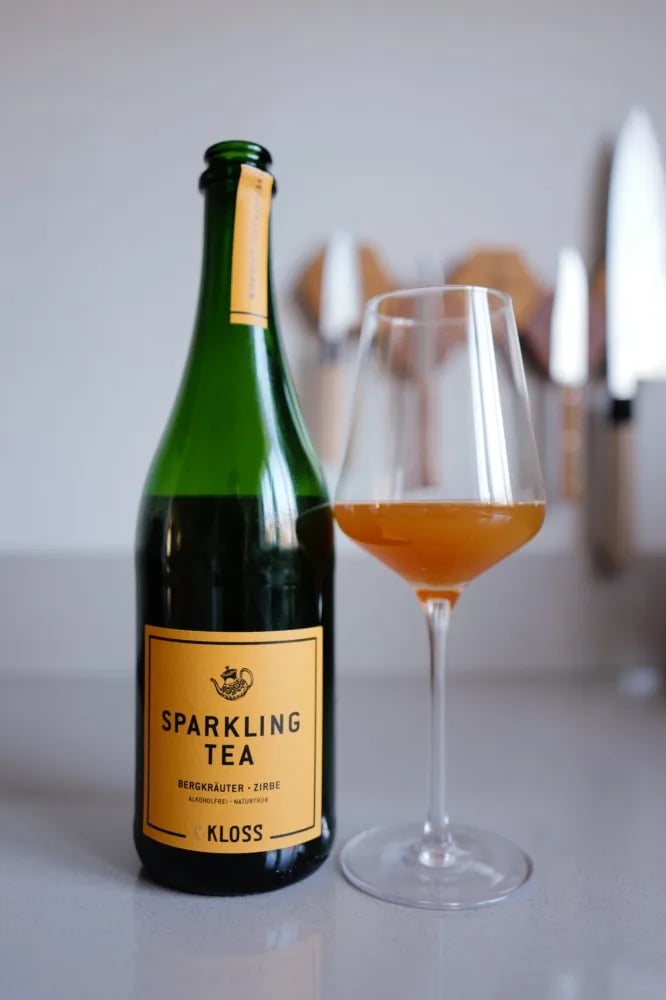
Bergkraeuter. Groene haver, salie, pepermunt, vlierbloesem, calendula, en zelfgemaakte siroop van dennenappels die in juli geoogst zijn, als ze nog zacht zijn. Vol in de mond, kurkdroog bij het doorslikken. 5,4 gram, het dubbele van de rest.
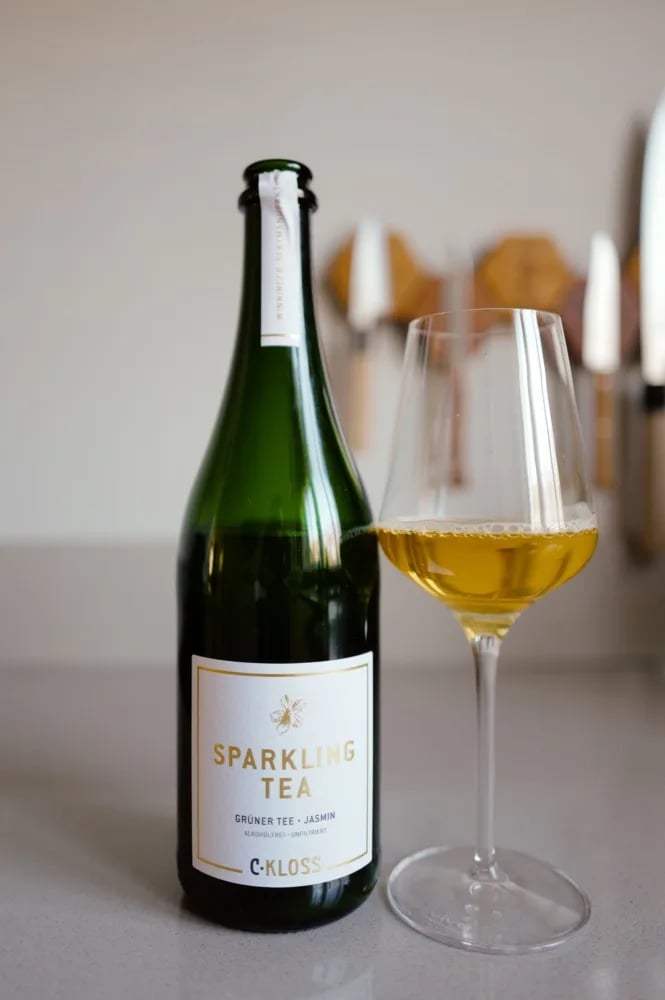
Green Tea. Groene en witte theeën met een spaarzame hand jasmijn, kweepeersap en wat druivensap van Mosel-Riesling. Rokerig, wit fruit, droog. 2,8 gram.
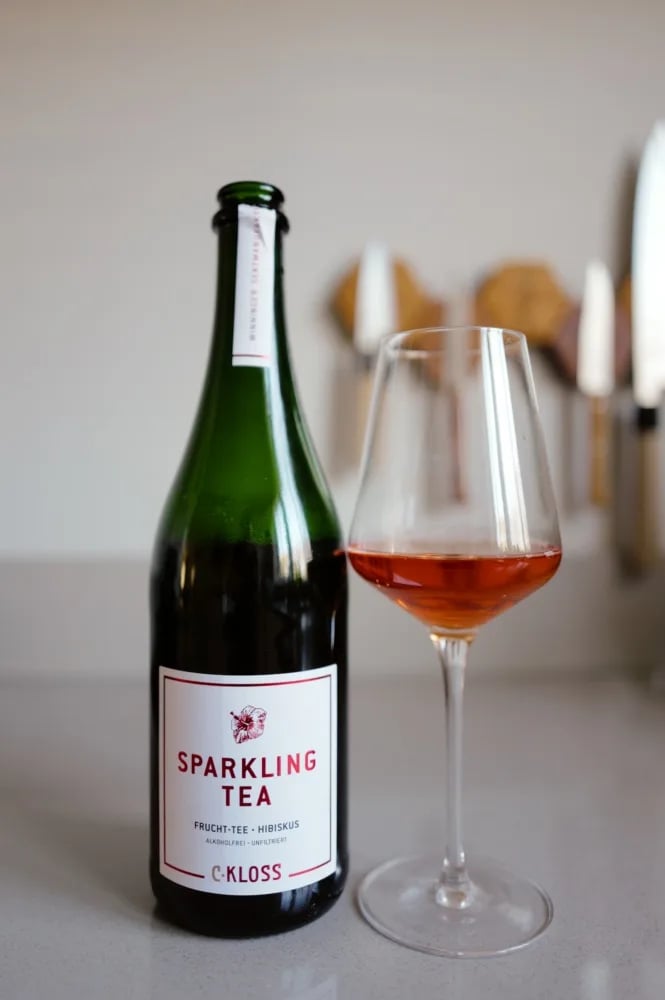
Fruit Tea. Echte gedroogde vruchten in plaats van aroma’s: bosbes, aardbei, kers, met hibiscus en een streepje kaneel. De makkelijkste van de vijf. 2,9 gram.
Proef mee
De bubbel
Wat mij bij deze sparkling teas opviel, zat niet in de neus. Christian zet de bubbel er zelf in, net als een frisdrankmaker. Toch krijg je een fijne mousse die in je mond blijft hangen, dichter bij champagne dan bij mineraalwater, geen colabubbel. Het verschil zit in de tijd. Een sodastream of een colafabriek perst het koolzuur er in één keer in. Kloss doet het over een langere periode, zodat het gas zich beter in de drank voegt en de belletjes klein blijven.
Twee kanttekeningen
Er is geen flesgisting. De fles heeft de vorm van een champagnefles en staat naast sekt in het schap, maar de bubbel is toegevoegd, zij het traag en zorgvuldig. Christian is daar open over en noemt flesvergiste versies zijn doel.
En het suikergehalte verschilt per vulling. Alle suiker komt uit sap, dus een warm jaar stuwt het omhoog en een koud jaar duwt het omlaag. Lees het etiket van jouw fles.
Waar koop je ze
In Nederland verkoopt Amavine de lijn, onder eigen namen: Weiss, Rosé, Bergkruiden, Jasmijn (de Green Tea) en Hibiscus (de Fruit Tea). Een fles van 750 ml kost er €14,99, ongeveer het Duitse prijsniveau van €13 tot €15. Populaire sparkling teas in Nederland kosten eerder 20 tot 35 euro. Voor één fles van 30 euro heb je hier twee, en die vergelijking naast elkaar wil ik nog een keer maken.
Transcript
Het gesprek is in het Engels gevoerd. Hieronder staat het volledige transcript, verbatim uit de Engelse ondertiteling van de aflevering.
Toon volledig transcript
Hi, welcome to Sparks by VinoVonk. I’m Jeroen Vonk, wine writer, educator, been quietly obsessing over the non-alcoholic sparkling category for longer than I’d like to admit. Today’s guest runs the Winninger Sektmanufaktur, C. Kloss… on the Mosel in Germany, a house with a family history going back to 1856.
- His great-great-grandfather Julius Kloss co-founded what eventually became Rotkäppchen Sekt, one of the largest sparkling wine producers in Germany. Christian studied oenology in Geisenheim, spent nine years directing a state wine estate. and then came back to Winningen with the question what else can bubbles be? The answer apparently is this.
Five sparkling teas, zero alcohol, regional herbs, fermented vegetables. juice from the Mosel, no de-alcoholization, no shortcuts, just a completely different starting point. I first met him and his wife wife at an event. Tasted his sparkling teas. and I really was blown away.
I found out that they weren’t available here yet in the Netherlands, made contact with an importer and I’m happy to say they are now available in the Netherlands by Amavine. Christian, welcome to Sparks. Could you please introduce yourself Yes. Yes. My name is Christian Kloss.
I’m coming from one of the most beautiful wine growing areas in the world, the Mosel. Hope to see some of your listeners at a later point in time. are the last one or how depends on how you look at it. The first ones at the Mosel. We are right next at Koblenz.
So the very last town before the Mosel hits the Rhine River and we are the only Protestant town along the Mosel. This is also one of the reasons why we have so much gastronomy and so many beautiful buildings because 150 years ago when you wanted to go to church as a good Protestant you weren’t going there just for the morning mass. You were going there for a whole weekend. So Please continue. It doesn’t matter if you come by car or by bike or if you do the Moselsteig walking.
And yeah, we are a little winery. making, we have our own vineyards. have, we are doing sparkling wine for many of the wineries here along the river. So they bring us the wine and then we make a beautiful sparkling wine out of it. But that’s a different topic.
Today we’re talking about next generation. Yeah, yeah, because we met in in Utrecht during an event of the German wines and I was blown away of your wines and your story blew me away also because a lot of people think, OK, I want to do something different. I want to make sparkling tea and they have, well, none or a little bit experience in making beverages. But I didn’t find anybody. who is making wine and making sparkling wine and making sparkling tea.
So because you told me you are an expert in making bubbles into wine, it’s a completely different story. I had an interview with Johan Schauvelberger, also a sect maker. He makes the sparkling wine for Wijn de Meindeboe in Zeeland in the Netherlands. And then I found out, I thought it’s not so difficult. Well, it’s very difficult.
So you are an expert in making sparkling wine. But why did you decide to make sparkling tea? Yeah, my great great grandfather, started making sparkling wine 170 years ago. So they decided to make a sparkling winery to found that his brother and his best friend that was called Kloss & Foerster. And nowadays the same company is called because of its biggest brand Rotkäppchen.
which is the second biggest sparkling winery in the world by now. And several years later, my family was still always in the sparkling wine business. So it’s kind of in my blood. And when I had the chance three years ago to buy here this winery, I for sure was intrigued by the fact to produce sparkling wine. But the problem is, that the former owner, his style was very baroque, very bold, like how wines were made in the old times before climate change.
So during this period, it was important to have as much sugar as possible, to have as much alcohol as possible because of the weather you were never sure here in the northern part of Europe. And this has changed, unfortunately. I mean, for us at the Mosel, it’s good luck that it’s now warmer and it’s easier to make a great sparkling wine. But so the idea was that to change the style to a more modern, more slim sparkling wine style, and this takes time. This is the bad thing about sparkling wine.
Great sparkling wine needs one, two, three, four, five years on the lees before you disgorge it and it’s ready to be served. And my problem is, I mean, the bank doesn’t wait for you to pay the credits just by love and many stories. So I needed something in between for the first three years. And so I was looking around and as you can tell in the background, we have like many, different products, some also with alcohol. And the story is always, we want to have natural regional products.
ingredients that have a story to be told. So we started off with alcohol, but very soon I discovered sparkling tea as a new category. And that’s how we started first with ingredients, herbal teas that are coming here from Mosel. But yeah, we are still producing everything else, but so to speak, to fill the gap, we started accidentally with sparkling tea and now We are at six different products and who knows where we’re going. Yeah, because you sent me five of your different kinds of sparkling teas.
The sixth one is very new. But could you tell me something about, because you started analogy, so you know everything about making wine. But how is it different of making a sparkling tea? As always, mean, for sure, some parts are totally different, but some parts are very, very similar. And one of the parts that is super similar is that with all wines, especially sparkling wines, but with many other wines as well, the first starting point after harvest is you think about how to create the base, the assemblage, the cuvée, where you go ahead.
To give you a feeling, when you have different vineyards, maybe it’s a wet year. And in a wet year, then you want to harvest the vineyards who are at the lower part first, and then later on the higher elevation, because in the lower parts, it’s too wet and the upper parts still are dry. In a warm year, it’s quite the opposite, because… At the lower parts you have more shadows and at the top of the vineyard then you have the sun. So what you do, you always mix and try to find out every year a little bit different warm years, cold years, wet years, dry years and so on.
And here we’re doing the same, but here we’re doing it with different types of ingredients, different types of tea varietals. And so we do an assemblage, not with wine, but with tea. But the idea is the same. all the great wines or many of the great wines in the world. If you look at Bordeaux, if you look at Italy, our assemblages, our cuvées, our blends.
And how did you start with this project? Because it was necessary Yeah, that’s… because you had to make money. But how did you start? I guess that’s the main difference between our sparkling teas and everybody else’s so far.
We are the only ones who making it like the three of who started with three products that are entirely made out of herbal tea. Like all the sparkling teas and this is probably part of the fascination that you had when we met in Utrecht is that our products taste really different from what you usually have in mind. And a lot of it was accidental. I mean, when we’re going to taste, can tell you, tell a little bit of the background, but to give you a feeling, I was, I didn’t know anything about herbal tea, let’s face it. So the first step was to talk, when you visit Mosel, you can also do some herbal walking tours.
where specialists in herbals, show you, this is typical, this is something that is almost gone in nature and so on. And so I was asking one of the ladies which teas she would recommend that are growing here at along the river. And so that was a very first step. But then in the second step, I got a huge disappointment. I was going because I thought, you know, when you want to buy tea, where do you go to one of the big harbors in the Netherlands would probably end up going to to some of the coastal lines, to some of the big harbors.
In my case, I called some of the importers in Hamburg. And for them, mean, imagine you are selling Oolong, Darjeeling, all these great teas. And then suddenly a guy is calling you from Mosel and asking for herbal tea. That’s like if I ask a wine importer, I’m looking for a really nice Dornfelder, but it needs to be very, very sweet. They hated that question.
So it was a long trial and error, but I can tell a little bit more about this when we traced the different spark links. Yeah, shall we start tasting the first one? Yes. And that’s the green one. It’s in German.
It says, Naturtrüb. Yes, that is the nowadays because we have so many different ones. are also have some new names for them. We introduce them. But this one is we like to call it wild herbs, wild herbs.
And then the main note is linden, linden tree, linden flowers. And it has beautiful amber color. And I’m fascinated about the back label because a lot of non-alcoholic beverages, non-alcoholic wines, the alcoholized wines have a lot of sugar in it. But this bottle only has, per 100 ml, has 2.7 grams of sugar and 11 calories. So…
Almost like drinking water. Yes. So one of the things, yeah, first of all, cheers. Thank you very much for being Yeah, cheers. here at this podcast.
totally forgot to thank you for being invited. You’re very welcome and thank you very much for sending me the bottles. the notes are so fascinating. It’s like you have a lot of herbs, but some minty notes and it’s fruity. And you think, is it beer?
Is it cider? No, it’s wine. No, it’s nuts. It’s completely a new category. Absolutely true.
So we did a lot of trial and error. It took us almost one and a half years until we had the final product. And we’re still experimenting a little bit with it. But yeah, so the idea here is to use only. ingredients only herbal teas that could be growing in our vineyards.
I mean, let’s face it, like the main ingredients are like the base is blackberry and nettle leaves and nettle leaves. mean, it’s the plant when you touch it. ow, ow, ow. So I don’t know the Dutch word for it, but. and brandnetels.
And. nobody’s going to collect that. So we are not collecting that neither. mean, let’s face it. yeah, this is the base for the whole thing.
And so therefore you already have something entirely different. It’s this nice bitterness. These tannins are deriving from these two. And then we add and this is very important and also differentiates us from most of the others. We are adding a little bit of apple juice from a wild orchards.
And these are these tiny little apples that have a lot of acidity and very little sugar. And it’s exactly the opposite from pink lady that you can buy in a supermarket. So those are only sweets. Those have no acidity. They are made for children and Pink Lady, you can also tell about the name, but we’re trying to use the opposite.
And because we’re only using a little bit, so the only sugar in all of these beverages is coming from the fruits. And you can taste that because there is a difference between putting a lot of sugar in it, saccharose, or you’re using the sugar from the fruits, Fructose. And you can already tell by the name, saccharose tastes different. then fructose. So fructose tastes very sweet, fruity, sorry, not sweet, saccharose sweet, fructose fruity.
And therefore you have less sugar, but still a lot of taste. And then, what you, encountered is the main note is from linden tree. That’s the very nice nose. And then the secret part that is kind of confusing in the first moment is umami from fermented celery. And that makes a huge difference.
So this is why our products, a lot of the sparkling teas, but especially this one is being bought from restaurants that are into vegan, vegetarian food where it’s necessary to have something like, a lot of times you have very delicate flavors in vegetarian cuisine. And so therefore you also need something that is matching this. So yeah, Yeah. thank you very much that you like it. Yeah, The best part that I like so much is it’s a new category.
It’s not OK. It’s it want to taste a little bit like a wine or it want to taste like this. No, it’s completely different. It’s completely completely new. And it’s not sweet.
But indeed what you said, you have some acidity, some tannins. So you have the gastronomic vibes of wine and beer also. But it’s completely, it’s a new category. And that’s why I like it so much. And you can drink Thank you very much, yes.
the whole bottle and you still can drive. That’s also very handy. Yeah, but the next one I’m going to show why this is also important for gastronomy But yeah, if you’re at home, definitely they are made. This is the problem with many sweet drinks like when you think about Cola or Juice based drinks the first class is beautiful because it’s intriguing you have the sweetness and everybody loves sweet. I mean everybody loves chocolate but As soon as you hit the second or third glass, then suddenly you feel, oh no, this is too much.
It’s too much sweet. Like the first piece of cake is great, but eating a second piece of cake, then it’s too much sugar, too much fat, too much everything. And this is why, I mean, this is the fascination of wine as well. It’s always about the balance of sweetness and acidity. And here we have that the same thing here in the glass.
That’s up. And I guess that also explains why we love making these products, because by the end of the day, we’re doing the same thing as winemakers. What makes a Riesling so such a fascinating white wine in comparison with, let’s say Pinot Gris or with like like like like a model, a lot of the wines from from which have less acidity. So it’s this fascination of that the tongue doesn’t know it’s sweet and sour at the same time. And here this is a little bit the same.
I guess that’s also why you are intrigued. Yeah, yeah, I’m very intrigued. Shall we go to the next one? Yes. Yeah, next one and it’s dead.
is I’m using a different bottle because this is we are also differentiating ourselves that we are one of the only ones who are also offering our products in small bottles, which helps a lot of times for doesn’t matter if you are enjoying it at home and you don’t want to open up a whole bottle because you’re on your own and you don’t want to drink a whole bottle. But the same thing is especially in gastronomy. People love it. You have four people, it’s a Tuesday night. Three are sharing a bottle of wine and number four is the driver.
Here you go. Yeah, and are you also experimenting with doing it in a can? No, the problem with cans is this is one of the only disadvantages of this product that because of the juice level cans are the lining, the inner lining of cans, acidity from the apples is so high that the can makers only give a best before date for 12 months. So maximum. I mean, which is kind of, I mean, it blows your mind because a cola or something can last forever in a can.
But by law, they say maximum time is 12 months and especially for many shops, this is too short because wine, I mean, most of our products are being sold in wine shops and then they’re not used to best before dates. and then suddenly they are turning around the can and it’s, ooh, ooh, it’s almost over. But this is, I mean, it’s always a give and take. The taste is beautiful because of the juice, but that means cans are difficult. We’ll see.
Maybe in the future there’s a different way, but currently that’s it. Yeah, and this one has an, of course, because it’s a rosé, it has a dark rosé color. And the smell is completely different, completely different aromas. Very warm, like a warm blanket. Cinnamon, blackberries.
Yeah, it’s really intriguing. And only 3.4 grams of sugar, again, it’s almost… Like drinking water? You told me before we start the recording, you told me, you have to have a spittoon because you have to spit it out. A lot of people don’t understand it when you want to it like a good way.
In wine, it’s about taste, but also not getting drunk. But why do you think it’s important to have a good taste, to spit it out even for a sparkling tea? I that’s more me being a winemaker. I’m so much used to spitting that I do it automatically. But yeah, that’s…
You’re absolutely right. I mean, it’s not necessary because it’s… that’s important. All of our sparklings are 0.0, which for some people is very important for religious, for health, for whatever reasons, because… As you probably, everybody knows of your listeners, the majority of all the non-alcoholic beers are not non-alcoholic.
They have 0.5, a volume of 0.5 % of alcohol. But yeah, this one is zero zero. And this is our favorite child so far. I just received 96 points in Falstaff Magazine. Falstaff Magazine is the biggest wine magazine in the German speaking world.
And it is considered now a couple of weeks ago, we received the title of being the best non-alcoholic wine alternative in the German speaking world. So we’re very proud of it. Yeah, yeah. I couldn’t agree more because it’s very, very fascinating. It’s very beautiful and the aftertaste is very long.
The question I have is how do you get the bubbles inside? It’s carbonated. are experimenting right now with products that are bottle fermented. I mean, we are sparkling wineries. So this is the ultimate goals.
And hopefully the next time we see each other, then I can present you such a product as well. But currently, yes, we are doing a, we’re carbonating it. And here, The taste is a bit different from the one before. We’re still using blackberry and nettle leaves as a base, but this tastes sweeter, the product, even though it is not so much sweeter as you just mentioned, because here we’re using pear juice instead of apple juice. And pear juice is always, I mean, if you bite into a pear, it’s very soft.
If you bite into an orchard apple, this is… then you have the acidity. So here this is a bit more easy drinking. The main note is lavender and the lavender grows here even at the Mosel and we have as the exotic part a little bit of crushed fennel. It’s fascinating because you have fruit, have herbs, you have the tea vibe.
Again, think gastronomy with nice vegetable dish, a vegan dish. I know what I’m cooking tonight. I’m cooking lots of vegetables, so I’m going to taste a lot of different kind of flavors. And are you also experimenting with like the cuve close method or the kombucha method to make it sparkling. Yes, we have two products or no, currently we have one product that is sparkling coffee, which is fermented with, it’s basically it’s kombucha not fermented with tea, but with coffee.
We are absolutely sold out with it. And the problem is that the kombucha fermentation is really, really slow. I have here as an example, this is the sparkling coffee, but yeah, this is one of the very last bottles and the fermentation is still going on and might take really a couple of more weeks or a month because it’s, mean, kombucha loves tea, but hates coffee, as you can imagine. So it’s a very slow fermentation. But we will see, next round is coming hopefully sometime in April.
So yes, we’re doing kombucha and we are also experimenting with water kefir, which is my personal favorite because I assume that the majority of your listeners have never tasted something like this, least me, until two years ago, I didn’t know what water kefir is. and now we’re even very close to producing something along those lines. So as I said, the next Sorry. time we meet, you will have more products to taste. Yeah, I can’t wait to try it.
Shall we go on to the next one? Yellow label. Yellow label, Zirbe and Bergkräuter. Yes. And this one is a little bit higher in sugar.
It’s 5.4 grams. Yes. This is the highest in sugar. And the reason for that is that here, the amount of, even though it is apple juice, we’re using here a little bit more apple juice than as in comparison with the others. And here the base and the ingredients are really different from the ones before.
Number one is we have as a base green oat tea. The nose is sage. Then we have peppermint in it. We have elderflower blossom tea. And for the color and for the, this is why we’re also using the yellow color, it’s calendula as calendula blossoms.
And this also gives the mouth feel. And the last ingredient here that is kind of the exotic part and this also adds to the sugar is homemade syrup from pine cones. So when you harvest pine cones in July, like everybody knows pine cones, but usually you know it from winter when they’re really hard. But in the summer, if you harvest them in July, then they’re still soft. And then we’re cutting them up.
and make a syrup out of it and this also elevates the sugar level and it gives you this nice tannic feeling to it. And also a bit of the smell is coming from the tannins from the pine cones. What I like the most is it’s very dry, especially when you swallow it or spit it out, you have a very dry feeling. But during tasting, when it’s in your mouth, it’s very full and very aromatic. I think it would be also very nice with some cheese, with desserts, with some savory dishes.
But what I found very, very new to me for sparkling tea, the bubbles are almost like a champagne bubble. In champagne, the bubbles are very thin, very integrated. And you told me you carbonated it like a big soda stream, but normally you get like a Coca-Cola bubble. And these bubbles are very Yeah, I don’t know how to say it, but very thin, very fine, fine mousse. Thank you, yes.
Yes, And what’s the secret or can you tell it? that’s the reason for that is we are producing with a different method than cola or your, like a, how do you say, soda stream. In a soda stream, what you do is, or with cola as well, you just put the pressure in, and that’s it. And I mean, This is, it’s difficult to, it’s a bit difficult to explain, but we don’t do the carbonation just once, but we do it over an extended period. So it’s a longer time period that we’re using for the carbonization, and therefore the bubbles have more time to be integrated into the beverage.
And that makes them smaller and more integrated. exactly the same thing that you’re looking for in champagne. You don’t want the big bubbles from mineral water. You want fine bubbles that stay on the tongue and gives it a more elegant and soft feeling. Yeah, it’s very fascinating.
And also in the Netherlands, they are available through Amavine. I connected you and the shop is now importing it. And a Dutch platform called De Grote Hamersma. They tasted it and they scored it between one and 10. And I think almost all the wines or all the sparkling teas are nine, nine plus.
maybe eight and a half, but in higher region. So even independent experts see the quality very good. Did you already knew that or? In which sense? What do mean?
Did you hear that also from Marielle that you get high scores in the Netherlands? no no no, she didn’t tell me that yet. That’s new to me. OK, well, I will send you some articles and I will send out the articles also in the show notes because it’s the biggest platform in the Netherlands for scoring wines and also no, now I understand. I’m sorry, I’m sorry.
Now I get it. Yeah, yeah, No, you’re absolutely right. I’m sorry. I misunderstood that. No, no, I met her just the other week again.
so, yeah, it’s, Marielle is a fascinating person. She is so much into the product that she was asking me questions that I, didn’t even ask myself. So it’s funny if somebody is coming from a very, like on the one hand side, being an expert over the years as she is. And then again, she’s asking questions that are make all the sense in the world, but it’s like little children. I mean, I’m not saying that Marielle is a little child, but they are asking sometimes questions where you are like, she’s right.
That’s a good point. Never thought about it. And so she pushes you to the limit with her questions. so you can tell on her website with all the details she’s putting in, very, very interesting. Yeah, she’s very curious and she’s very straightforward and she wants to know everything about it.
And could you give an example of how she challenged you? For instance, she was asking this question, okay, I understand that the sugar level is low, but where is the sugar coming from? And she was really pushy on the fact, for instance, what I explained earlier, is it just put in by a saccharose, just white sugar that you buy in the supermarket, or where is it coming from? And that was the first time that really somebody was… going the next step.
So one thing is that you are like, this is very low. But then the next step is what type of sugar is it? And as you have encountered when you ever bought sugar in the supermarket, there’s a difference between the white sugar, the brown sugar, and the fructose sugar that you can also buy there. But the taste is also totally different. mean, the brown sugar has this malty flavor.
The white sugar is just sweet. And fructose has always this fruity feeling. So that was interesting that there is somebody who’s really curious about everything. Yeah. And you just came back from ProWein.
How were the reactions at ProWein? Because there was a large area of non-alcoholic beverages, I saw. Yes, mean, Germans, I have two theories about the reactions during ProWein. Number one is that we have the situation that we are a winemaking country. So people are more conservative when it comes to this category.
They’re not so open minded. They are not willing to go into new categories. And so it takes some time and this has changed now. Last year it was still like, yeah, well I don’t know, let me try but if you go with this mindset into a tasting, well you know I have to try it but well I’m not sure, blah, blah, then it never works. And this changed.
And the other thing that really also changed is that, especially from an international perspective, we had more visitors that said, now is the time. like what if we expected minimum per day, I had two to three professional visitors, potential buyers from Poland. And I have to admit when two years ago when I started selling to Poland, I was like, Poland, I you would never think, you think about vodka, you think about schnapps, you think about all these product categories. No, it’s a fast changing world. The modern Polish society, they are eating different and therefore they are drinking different.
And then they demand a different type of tasting profile. And then suddenly you end up with people coming from all these countries where you would have never expected them. to be so interested in these products. So it’s fast changing right now. Yeah, I had an interview with Rosa from Brito Farms making proxy wines while sparkling teas in Poland.
the biggest problem there is they can’t make enough to the Ha high demand. And I thought, but it’s quite new. No, they’re making it sometime now, but they can’t make enough. So yeah. Good, very good, cool.
That sounds good. Yeah. Shall we go to the Yes. other line because you’re also making an other line with Yes, yes, we have now, now we have to rinse a little bit because the taste is now quite different. So the first three ones.
were very delicate and very, very, the first one, quite the opposite. The first ones are big, are bold, have a lot of flavor to it. And now we’re coming to products that are, that are more, that are more subtle. Here, it’s, we had a lot of questions because many people, when you think about herbal tea, you think about, the last time I went to hospital, there I had to drink herbal tea. so we have it all every time, not that, we have it lot of times that people are like, no, I don’t know, herbal tea.
And this is one perception and the other perception is, that people were like, I mean, you’re making such great herbal sparkling teas, can’t you have like ones made out of classical tea varietals? And accidentally, I was really lucky that very close here to Koblenz in a little bit south of Bonn, there is the location of Germany’s biggest sparkling, biggest tea importer. and they have shops all over Germany and they are making really upscale teas. Some of the best teas I have ever tasted in my life. And the tea sommeliers, they have two tea sommeliers, they are so big that they have two people who are just constantly flying around the world and sourcing the best teas from Asia, from Japan, India, China, and so on.
And so, we created together with them these sparkling teas. And here, what you said in your introduction is the most important part here. They said, we want them to be as close to real, original teas as possible. Still with a lot of depth, but not like this cheap, sweet stuff. We want it to be even drier.
So what you have in your glass right now, is I think if I recall it right, yeah, 19 grams of sugar. I have 2.8 grams. Okay, then it’s the next serving. That’s an interesting one because what we had to find out is every time, know, every filling, I have the filling before, that could be, because what we also had to find out that because the only sugar that is in these products is coming from the juice that is in there, that every time when it’s a new vintage of the juice, then if it’s a warm year, boom. the sugar goes up and if it’s a cold year, boom, the sugar goes down.
So here, Aha. the main ingredients is several green and white teas. Then we have jasmine, but not like the cheap jasmine from the China restaurant around the corner, but just a little bit of jasmine. And then the mouth feel is coming from, and the sweetness in this case, is coming from quince juice. and also a little bit of grape juice from Riesling from Mosel.
And so this adds then if it’s like last year was a perfect year for quince. So that explains the a little bit higher sugar level than with the old vintage that I still have in my glass here. You have the same identity, but it’s completely different because it doesn’t contain herbs, but it’s very dry. It’s like umami depth flavors. It’s like the same aromas, the same flavors, but…
They are in different layers, like small, medium, large, extra large. And they’re going up and down in your mouth. And Absolutely. it mixes up your completely. Thank you.
It’s very complex, but very interesting. I don’t think this is one for everybody. Actually, that’s exactly how we’re introducing it. We are selling it a lot to restaurants that are doing instead of wine pairing, they do a tea pairing. That is happening.
And also people who are really into tea, who want something that reflects the delicateness, the variances of all these different tea flavors, and you don’t… These are the people who don’t put lemon or sugar or milk into their tea. They want tea flavor. They want all these high quality teas and that’s exactly what we’re using it for. And if you look at it in the glass and also from the dryness that it has, it’s perfect if you have like a reception, like a birthday, a wedding reception or something, and you have people Maybe half of the people, they want a beautiful glass of Riesling sparkling wine from Mosel.
And then you have the other people who are like, no, for whatever reason, I want to be to drink today something without alcohol. And still you have the same thing in your glass, a very dry product that on a hot afternoon, let’s assume a wedding end of May in right next to to the beach and then you have something to pour and grandma can also drink with her grandchildren and they’re all drinking a non-alcoholic sparkling tea that almost tastes like champagne. So that’s great. Yeah, and it’s also very gastronomic, because I think you could pair it beautiful with different dishes, with spicy dishes, with lots of herbs. It’s very versatile.
And could you tell something about the price point of these sparkling wines, sparkling teas? All these are usually, yeah, I don’t know about the Netherlands because of the taxation and everything. So these are usually in Germany. They are around 13 euros. So, but because of the taxation, I have to admit because they’re there, I’m not 100 % sure.
Like for instance, Marielle at what price points she’s selling it. But usually it’s somewhere they are based between 13 and 15 euros. Yeah, I thought maybe I can find it very quickly on the website, but I’m not good at doing two things at the same time. I thought it was about between 14 and 15 euros. Yeah.
Here you go. Yeah, taxation is slightly different because in Germany it’s considered not wine but food and therefore you’re in a different lower taxation level. Yeah, yeah, in the Netherlands we have sugar tax and there’s Ugh. sugar in it and they don’t look okay, is it fructose or is it saccharose? No, it’s it’s sugar.
Yeah. Yeah, yeah, so… So, but I think when you look at the price point, because lots of sparkling teas that are very popular in the Netherlands, they are between 20, 25, 30, 35. I once had a sparkling tea, I think about 50 euros. And when you look at the price quality range, this is much better than, let’s say, Thank you.
like something for 30 euros, you can buy two bottles. And I’m very curious when you do side by side tasting. I will do that one time. We’re going to the last one. And I remember I tasted this one in Utrecht because I love hibiscus.
I also have a hibiscus at my home. Very good. I love the color. And again, the bubbles are so beautiful. and the smell.
you like hibiscus and you’re fascinated about fruit and blossom and in your wine or other beverages, this is your drink. And it has a beautiful color. And again, this one has 2.9 grams of sugar. So it’s not so much. Yeah, here it’s also a blend of several green teas, but what was very important to our friends at TeeGschwendner, for them it was important to say they are not using fruity tea, but fruit tea.
So the fruit tea that you buy in the supermarkets is usually that It’s targeted towards children. So it’s made out of apples. They cut it, then they take the pieces, colorize them, put artificial flavors on top, and then a lot of sugar. And children love it. And it’s called a fruit tea or fruity tea.
Here it’s also fruity, but it’s real fruits. It’s dried fruits that TeeGschwendner is using there. So we have like real blueberries, real strawberries. real cherries, all this is really dried. And this is why the sugar level is a little bit higher because during the production, the fructose from all these fruits is getting sucked out and put into the beverage.
So you have the tannic part and the delicateness of the green tea. And here you add a little bit of the fruity part. But like as I said, fruity, not sweet. part from the different dried fruits. And on top, we have a little bit of cinnamon that we added for an exotic part and grape juice from Mosel Riesling again.
It’s beautiful, it’s very delicate, complex again, very long aftertaste. I can’t imagine people don’t like this. Very good. Yeah. Yeah.
How do you come, how do you source the hibiscus? Is it from the Mosel also? The hibiscus is, we are buying at a, how do you say, a maker, a farmer, that’s the one I was missing. There is in the most northern mountain range, Harz, there is many fields of herbal teas. It’s our partner there is a tea producer who is only specializing in herbal teas and they are making them all themselves and they have like different, yeah, all different types and they have like, if you look at when you buy them in bulk, in big bags, it’s when you open the bag, it’s like boom, it comes into your face.
You open it up and it’s a beautiful, smell and the fascinating thing about hibiscus is always that you have this acidity coming out of, you have the beautiful color but then again, besides the aroma and the smell, you have this beautiful acidity coming with it. So it’s not just sweet but when you add it, you always get this additional flavor profile that you’re looking for. in wine as well, you always want acidity. But natural acidity and not added ascorbic acidity from vitamin C or something. It’s very, very fascinating.
And it started with an experiment. It started because you needed to make money. In the meantime, you’re also making sparkling wines. How is that journey going? It is now becoming more and more, the situation or the task with sparkling wine is always the same.
If it’s a beautiful day, if you have something to celebrate, what are you celebrating it with? It’s with sparkling wine. But right now, I mean, if you look at how this world is changing and becoming more and more confusing, let’s say this. Let’s try to be polite. mean, if you’ve in sometimes it feels as if you’re in the middle of a storm.
So many people don’t feel that they want to open a bottle of sparkling wine and celebrate life. So it’s it’s it’s it’s challenging these days. But this is the biggest mistake that most people make when it comes to sparkling wine. The difference between still wine and start sparkling wine is still wine. is developing further, is aging, sparkling wine is becoming old.
That’s the problem because as soon as the cork is on it, the pressure wants to go out and oxygen is coming in. So most people never had like a beautiful glass of French champagne. Why? Because they’re waiting too long. Oh, the bottle is 30, 40, 50 euros.
No, no, no, I can’t open it today. No, no, we have to wait until the next birthday, like grandma’s 80th birthday, blah, blah, blah. And what happens? You wait too long, the product oxidizes, you open the champagne, finally, five, 10 years later, that you taste it, it’s brown, it’s boring, and everybody looks at each other, champagne. And nobody’s willing to say it tastes like shit.
Sorry. And this is what you shouldn’t do. You shouldn’t wait. It’s celebrate life. Say to your significant other one, honey, I love you.
Let’s open a bottle and celebrate life. It doesn’t matter if there is a strange world right now, but it’s a beautiful day. The sun is shining. It’s the end of March and it feels like May. Let’s open a bottle.
But yeah. We have to work on it and, Jeroen, I am pretty much sure the two of us are going to open one tonight. Yeah, well, not tonight because I have enough open, but tomorrow I will. And Hahaha. do you only make these sparkling teas with this label because I found also another label of you or is that something different?
No, no, we have two different styles in the German market. It’s very important. Restaurants want to have their own label and their own line extension. And therefore, it’s very important to have the product in two different styles. You find that with wine also.
you find that, I’m saying in Germany, so I don’t know about other countries, but here in Germany, restaurants want to have maybe even different sizes for pouring to use it as to accompany wine to give you feeling. One second. with our, I don’t have another bottle here, but with sparkling wine, lot of times gastronomy loves the small bottle. then in other occasions they’re using this one. So this is our Pinot Noir Rosé, but it comes then in different bottle sizes, for instance.
But yes, you’re right. Depending on the sales channel, we have sometimes the same product in different bottles or different styles. Is there something else you want to share with us? I want to share with you to come here and invite you to come here to Mosel that you are able to see some of the, like for instance, to come here to Winningen and see where the lavender is growing because especially in the summer, there’s nothing more beautiful to have let’s say a, to go by bike. down the river.
mean, there are no mountains, no nothing. You just go along with the river and then you have the chance not only to see and experience the herbs by passing by the vineyards. And then later on, you should come here to beautiful Winningen and have a nice evening here at the campground and then tasting maybe here at our place. but this is the best way to experience what we have to offer not only in tea but also in the wine world. And yeah, see you soon.
I will repeat the question. One last question for me because I have five open bottles. How long does a bottle last and how should people close it? mean, you just use normal champagne stopper that you have for your sparkling wine, your Prosecco, for your Cava, or for your champagne that you’re using with alcoholic products. That’s easiest.
mean, if you don’t have that, a normal cork will also do because when you put it in the fridge, then the CO2 stays in the liquid and doesn’t go out. then it depends on how much you drank. For sure, if from the whole bottle you drank like only a third, then it lasts for a couple of days. But if you drank like two thirds, then you should continue the next day because of the headroom, then the product, the sparkling tea gets more flat. But it’s the same if you drink like a cola or any other carbonated beverage.
The lower it is, the less there is in the bottle, the sooner it becomes flat. But the difference is really, as you mentioned earlier, that the bubbles are more fine, are more integrated, so you have more time in comparison with mineral water. OK, well, thank you very much for this explanation. And Christian, thank you very much for sending me these bottles. A fascinating story.
will leave the contact details in the show notes. Also, Terrific. if you want to buy the wines in the Netherlands, some links, or in Germany or somewhere else. If you have any questions, just mail me. Christian, thank you very much.
This was a new episode of Sparks by VinoVonk. My name is Jeroen. Don’t forget to subscribe in your favorite podcast channel and leave me a comment what you want to hear next. Cheers. Thank you very much.
Cheers. Prost. Prost.
Deze aflevering is gebaseerd op persmonsters, opgestuurd door Christian Kloss. Geen betaling, beoordeling onafhankelijk. Ik bracht Christian in contact met Amavine; ik ontvang daar niets voor.
Luister
Bekijk