

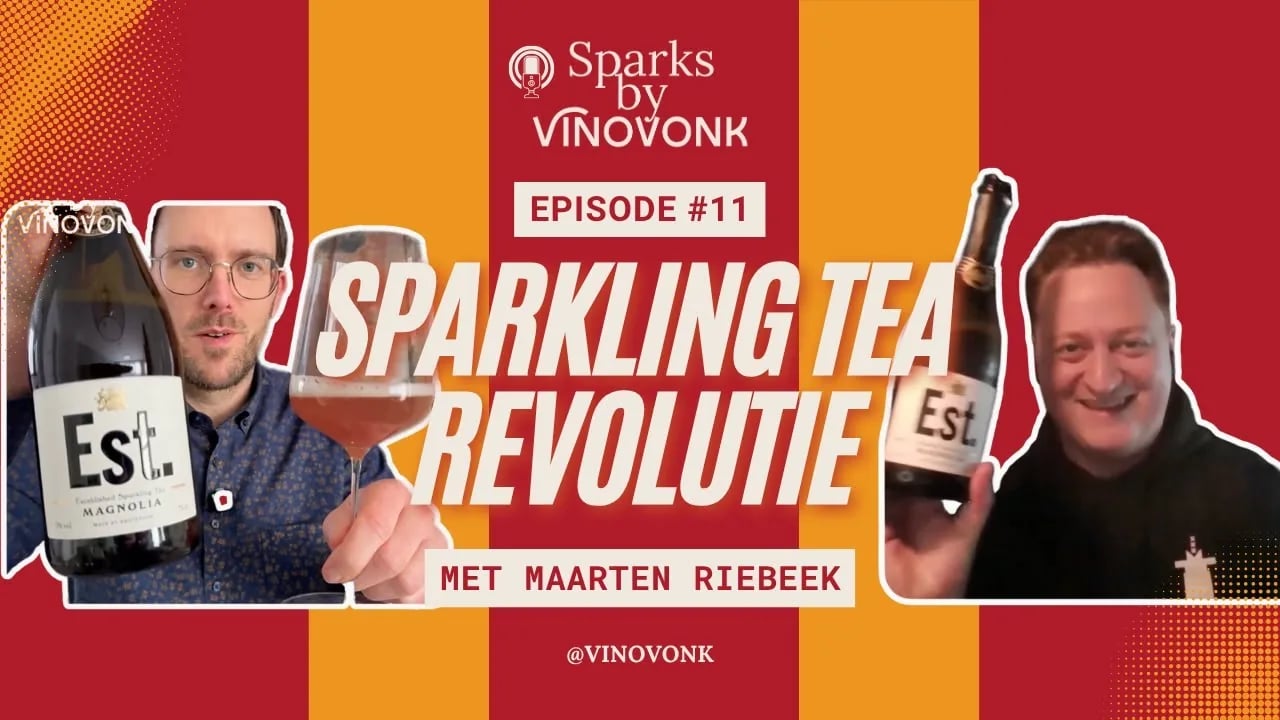
I had tasted Established Sparkling Tea once and wanted to know more. In this episode of Sparks I talk to Maarten Riebeek, one of the people behind it. He works at restaurant Moon in the A’DAM Tower, where guests who aren’t drinking wine get tea from him instead. Those tea pairings grew into an alcohol-free sparkler in a champagne bottle.
Maarten gave me the bottle; I received no payment and the opinions are my own.
Who is Maarten Riebeek
Maarten Riebeek works at restaurant Moon in the A’DAM Tower in Amsterdam. For friends and guests he brewed teas to match the dishes. One of the tower’s owners asked him why he wasn’t doing anything with it, and came on board as a co-investor. Maarten started out with Wesley; the two of them make the tea, now with a larger group around them.
By their own account they come from front of house: managers, sommeliers, hosts. The brand’s look was created by the Stone Twins.
What you’ll learn in this episode
- How restaurant tea pairings turned into a bottled brand
- Why Established comes in a champagne bottle with a gold wire cage, and what the Mad Hatter and a UFO are doing on the label
- The seven ingredients in the Magnolia, built on Japanese sencha and Chinese gunpowder
- Why the bubbles come from added CO2 rather than fermentation
- Why there is still some sugar in it: 3.4 g per 100 ml, for mouthfeel alongside food
- How the team tests what happens in the bottle over time, and Maarten’s dream of a vintage sparkling tea
- Why the next flavour won’t strictly be a tea
In the glass
We tasted from a Riedel champagne glass. What struck me straight away was how floral it is. The label says magnolia, but I picked up far more flowers than that, like walking through a wood in blossom in spring. It isn’t sweet, it is complex, and you smell and taste tea. As the glass warmed up, the floral side came through even more.
Maarten describes the build like this: sencha gives a fresh, grassy start, and gunpowder follows with tannin and bitterness, which is where the tension comes from. Magnolia leaf, verbena and juniper run through it.
Caveats
I tasted one bottle, with the maker beside me, and the account of the blend is Maarten’s. Established had been on the market for less than a year when we recorded. There are no E-numbers in it, so it carries a best-before date, and the team is still testing how it develops in the bottle. There was a single flavour, and outside restaurants only a handful of shops stocked it.
Frequently asked questions
What is Established Sparkling Tea?
An alcohol-free sparkling drink from Amsterdam, made from tea. The Magnolia has seven ingredients: sencha, gunpowder, magnolia leaf, verbena, juniper, a little agave syrup and a little lemon juice. It isn’t fermented; the CO2 is added, at around six bar, similar to sparkling wine.
Does it contain alcohol?
No. Nothing is fermented and nothing is removed, so there has never been any alcohol in it.
What does it taste like?
Floral and not sweet, with tea on the nose and palate. The label lists 15 kcal and 3.4 g of sugar per 100 ml. According to Maarten, restaurants often pour it as an aperitif, especially with oysters, and it also works with chocolate.
What does a bottle cost and where can you buy it?
At the time of recording a bottle cost €23.95. A few shops in the Netherlands stocked it, including cheese affineur Betty Koster at L’Amuse. Restaurants order through Hanos, and you can have it delivered at home via the Established website, also in a gift box.
Who is this episode for?
People working in the drinks trade, hospitality professionals, and anyone curious about what alcohol-free can be at the table.
Listen on your own podcast platform
Sparks by VinoVonk is on Spotify, and you can watch the episode on YouTube. Listen wherever you like, and subscribe for new episodes.
Transcript
The full conversation transcript.
Show full transcript
This transcript is generated automatically from the audio and has not been edited. Speech recognition makes mistakes, so treat wording as an approximation rather than a verbatim quote. It is here for accessibility and search.
Hi, I’m Jeroen Vonk, and welcome to Sparks by VinoVonk. The series in which I take you into the world of wine, spirits and innovative drinks. And in that last category we have a very special guest today, Maarten Riebeek, from Established Sparkling Tea. Well, you’ve heard it, sparkling tea. I tasted it once and then I thought yes, I want to know more about this.
Only I think yes, that’s immediately fun to share it with you and I have one of the makers… I hope, if I remember correctly. In our midst, Maarten, welcome and thank you for taking the time for this interview. Thank you for letting me be here Jeroen. I really enjoy telling you about Established Sparkling Tea.
That beautiful product but you have to find out by tasting it indeed. Yes, can you tell us something about it? Did you make it and or did you make it with others? We are actually a kind of group of friends actually. And what is actually fun, actually started with me in the restaurant.
I work in the restaurant Moon in the A’DAM Tower. And that is really centrally located in Amsterdam. And what is actually, yes I do a lot with tea. I think that is really fantastic. In the restaurant too, if you don’t drink wine, you drink tea with me in the restaurant.
And that is actually where it all started. That can… Yes, for friends and guests I just made a little bit of matching tea with the dishes. That is so hard with one of our investors of the tower. One of the owners, sorry.
And he has also become a co-investor in Established Sparkling Tea. Because he says yes, it is so cool, why don’t you do something with it? Why don’t you go to the market with all your knowledge? Don’t do it alone. I have Wesley.
Wesley is… He looks like my big brother, he is not. Not all redheads are related, but it seems that way. And the two of us are really incredibly skilled in what we do with tea and how we combine it in dishes. So yeah, we just took on that challenge.
More like, why not? Why don’t we just try? More and more people have joined. So yeah, we do it with a very large group. Wes and I are the tea makers.
We think about everything, tastes, innovation, how does it end up in that bottle, how does that bubble get on it. Those are actually all the things we are involved with. Fortunately yes, because otherwise if I had done it it would probably have become a coloring page. But the Stone Twins have created a very nice… image around Established.
More based on who we are. We are actually originally, managers sommeliers, hosts in restaurants. But we do it in a completely new way and we sometimes attracted that. That they thought okay then Established is something new. Everything new in it.
and that is in a very nice champagne bottle. It really feels like champagne, also with such a logo. The logo of Amsterdam reminds me of it, but it is not quite. It’s a bit of a mockery of the wine from the Spanish houses. Let me see it properly.
So you really see all kinds of things in it, like the Mad Hatter from Alice in Wonderland. We’d like to take you to a special place. Amsterdam is in it. We all have a huge heart for Amsterdam. My entire family comes from Amsterdam.
I’m not completely an Amsterdammer, but I’m more Amsterdam than… the rest of the Netherlands, so to speak. Not the rest of the Netherlands, but where I come from, that’s really a birth in Amsterdam. There’s a UFO with a cross on it. And that’s also one of our fans, Robbie.
He’s religious, but he also believes in UFOs. I really think that, yes, it’s a bit contradictory, but that’s also what makes it really cool. And that’s also with the emblem, the sword in it. It just really looks like, okay, something really cool and it has the memory behind it. That’s also our idea behind it, or everything has been thought through.
Yes, I initially thought that it consists of different components. Just like the dough, it consists of different components and it has a lot of complex flavors. But that was my fantasy, but that’s not true. No, no, look, is, Established also comes a bit from there from the story of tea. If we go back in history, tea is one of the oldest drinks that is drunk in the whole world.
We want to do it in a new way. And that was, that is always just my driving force. I want to, I keep it traditional, keep tea an honor, but in that new way. That new way is just much more attractive. I think it’s cool.
I like experimenting. I really like to just be busy. And actually yes, for me things are not crazy enough. So it’s just the beginning, so to speak. Very cool.
Shall we open it together and we’re going to taste and then you tell us what we actually tasted? …there is just as much pressure on the bottle as with a normal sparkling wine, around 6 bar. there is actually a little more but we will not taste it, then it is funny too yes, you can also see that with that beautiful golden musulet there is also an emblem on it here we just got that in New Bits that also makes, you know when you celebrate something then you want to hear something and that is a popping sound, because we are going to celebrate something We are now going to be transferred via this bottle. Let’s hear the sound. I always try to do it very quietly, because I never know how hard it will come out.
Yes, it has become quite stable. that also sounds very good I always use a champagne glass from the Riedel brand then just a little bit of taste in it for Cheers. Cheers! What immediately strikes me is, it is incredibly floral. You think it is a beer, but it is incredibly floral.
But it is not beer. It is tea, but you also smell tea indeed. The first time I tasted this, then I thought, bubble tea or vanilla vanilla. Bubble tea is iced tea. I think, I don’t want that at all.
That is very sweet. That is not nice. Yes, that was. for the first time an association with this is tea, but just very nice, very complex. Yes, yes, that is…
We were a bit done with all those alternatives that are very sweet indeed. I do not like sweet at all. what I find funny, it is indeed not very sweet, but it is also very complex. Also in terms of smell, it is listed on magnolia, but here too many different flowers smell. It is as if you are walking through the forest in the spring with lots of flowers.
Yes, I think that is a nice description actually. have never done that before. It is a pure product, it is made from seven ingredients. They are two types of green tea. There is a sencha, a sencha is a bit more of a torn tea.
And gunpowder, sencha comes from Japan. The gunpowder comes from the Hunan part of China. and that is more of a rolled tea, that gives a completely different character. What sencha is exactly the first approach, where it’s really just about freshness in the first approach and indeed a bit of that grass that you smell, really the spring feeling, then that gunpowder behind it a lot of dynamics and a lot of those beautiful, yes I think it’s fantastic with tea, those tanning hours, those bitternesses that are in it, they come from behind that . So it gives an incredibly beautiful tension in it, which is precisely interwoven with a little bit of magnolia, magnolia leaves.
Verbena in your cousin berry. And for the rest we actually put a tiny bit of agave syrup in and a tiny bit of lemon juice and that’s there. It’s not E-numbers, it’s a pure product based on tea. I really hope that you taste that, that you really just, yes I smell tea and I taste it too. And I find that funny too, that everyone who tastes it, they also say, it really tastes like tea.
Then I say, yes it’s a sparkling tea, what else did you expect? I’ve tasted other things and it reminded me of a very strong brewed tea that you just let cool and then put through the soda stream and with a lot of sugar to mask the bitterness and you don’t have that here. It has no E numbers, that’s why it has an expiration date because it doesn’t last that long, I think that’s nice too, but how do you make sure that it’s so… bubbles nicely. Because yes, it is not fermented I assume.
with fermentation it starts to become kombucha. That is why it says alcohol, then there are sugars that are converted. Actually into acid and into carbon dioxide. We then inject carbon dioxide into it. That is simply necessary also for the mouthfeel, but also certainly for the shelf life.
So with more carbon dioxide it will last a bit longer. We have done tests, it may not even be drinkable, it has not even been launched for a year… we have been working longer behind the scenes but we are really already doing tests of okay how long will it last we have actually come a long way we have a kind of cabinet where we really put different batches in and then we taste continuously every time of okay what happens in the bottle and in the glass as you get older actually surprisingly enough it really starts to change in dynamics yes it is my dream one day because if it is possible with the aging to bring a vintage sparkling tea. I would think that would be really cool. But yes, that is the first dream.
It’s as if it can become work. That’s what I’m working on. What’s interesting is that, you hear that very often and that with sparkling wines, the longer you leave them the better they become. But even after they’ve been with sparkling wines, at some point you take the guesswork out of it, you put the crown cap on. But if you leave it for even longer, then it has to have a much deeper taste.
And that’s what you’re trying to do, gosh, let’s do that. Because you could of course easily put a kind of lot number on the back. and the year is often in there, then people can deduce it. Yes, no, that can be deduced. It’s also in there if it’s good.
Not yet, no, that will come. We’re already working on that. We just keep developing continuously. We just don’t sit still. It is, it’s good, but can it be even better?
Perfection doesn’t exist in my eyes. We always have to just keep developing things and keep working on how do we deal with this? We’re still learning, every day. I think it’s great and I’m in the lab, in the laboratory. I call it a laboratory, it’s actually just a corner where we just do tests.
It doesn’t look like a laboratory, mind you. And then we increasingly find out things like okay, this also works and this also works. I think that’s really cool. not because we’re all doing it together. It’s also just actually a change year project.
Definitely. And what’s also interesting, because of course it’s a drink, so then it falls under a different car law. Then you have to put what the calories are, among other things. So nice that they’re also starting to do that with wine and things like that. But what immediately strikes me, that’s only 15 calories per 100 ml.
No fat, no saturated fat. 3.4 grams of carbohydrates. And that’s 3.4 grams of sugar. It’s only 3 grams of sugar. That’s practically nothing.
It’s something, but it’s incredibly low. The point is… I don’t want to… Sugar is a mouthfeel. And that’s what I was looking for.
That’s the balancing of… How do you get this drink not to go away too quickly, so that the sparkling tea lingers, because it also has to accompany a dish, then there has to be something filming. Then you do use your sugar. I’m not really anti-sugar, but I want to keep it as low as possible, so that all the tea comes forward. That ‘s really what it’s all about.
I see that a lot of restaurants use it in… As an aperitif, especially with oysters it goes very well. But it also goes for a base and it also works well with chocolate. I wouldn’t have thought that behind a green tea. That’s also what I say, I learn something new every day.
Then someone comes along, Laurent Richet, master sommelier of de Bruijn. He has written out exactly what this Sparkling Tea does when it goes to another glass. And that’s really fantastic, I’ll emphasize it in there too. I’ll send you the link later. It’s very interesting to see how he approached it in different large glasses.
And that also ensures that you can apply it to one tea on different dishes. If you touch the glass nicely… fantastic. And probably also with temperature. Because I notice now that it’s getting warmer, you could almost say.
Then the floral comes forward even more. Very interesting. But you say, you’re not done learning. Is this the only flavour you’re working on? Are you saying, I also want to do another flavour?
No, we’re definitely going to move on to the next flavour. Hopefully that will come as soon as possible. We’re going, perfection doesn’t exist. It’s only going to happen when we’re both convinced. This is it, this is it.
Yes, we’re going for it. We do have the guidelines, but we’re still playing around with, okay. here’s a bit of this, of that, really that very small fine tuning that ensures that it’s really surprising that people think yes what else is in there? we also like that because actually the next flavor is not going to be tea I also like that because that is I like mockery a bit, but it is not tea? It is still a sparkling tea.
This is a tea, a tea in quotation marks, that a lot of people drink. I also think that is really cool, because it also just shows, it can also be done in a different way. That we do have tea, but not the tea. Super interesting. There is more to come.
If people say well, I want to buy a bottle of that. Where can they buy it and what price should they think of? It is 23.95 per bottle and is available in a few stores in the Netherlands. Betty Koster from Le Muse, actually there has been Established since day 1, she has it in her store. She is actually a cheese refiner and she really likes to help with that.
For the rest, it is still available in a lot of restaurants. Hanos does have it. That is actually more for the catering customers. We can also send it online via Established Sparkling Tea. Also a nice gift box around it.
is a very nice shiny gift box. I should have taken that with me, but I didn’t. Then we can just send it there. Then you just get it delivered to your home. Ideal, a child can do the laundry, serve it nice and cold, easy in the fridge, no hassle.
And what I think is really nice is, this has never contained alcohol. And because you do hear people with alcohol-free alternatives, I think, yes you get alcohol out of it, but there is always something in it. And there are just people who absolutely do not want or are not allowed to have alcohol. And yes, then this is really a very nice alternative for that. And it just looks cozy.
It’s not that you think, There comes someone who doesn’t drink. No, you just join in. and that was also the goal. It is a serious, adult drink, so to speak. Yes, you’re welcome, certainly.
And I would say, do you want to try something really nice? Buy this. Really a nice product. And I would say cheers! Cheers.
Read also
Related article on this topic →Listen
Watch