

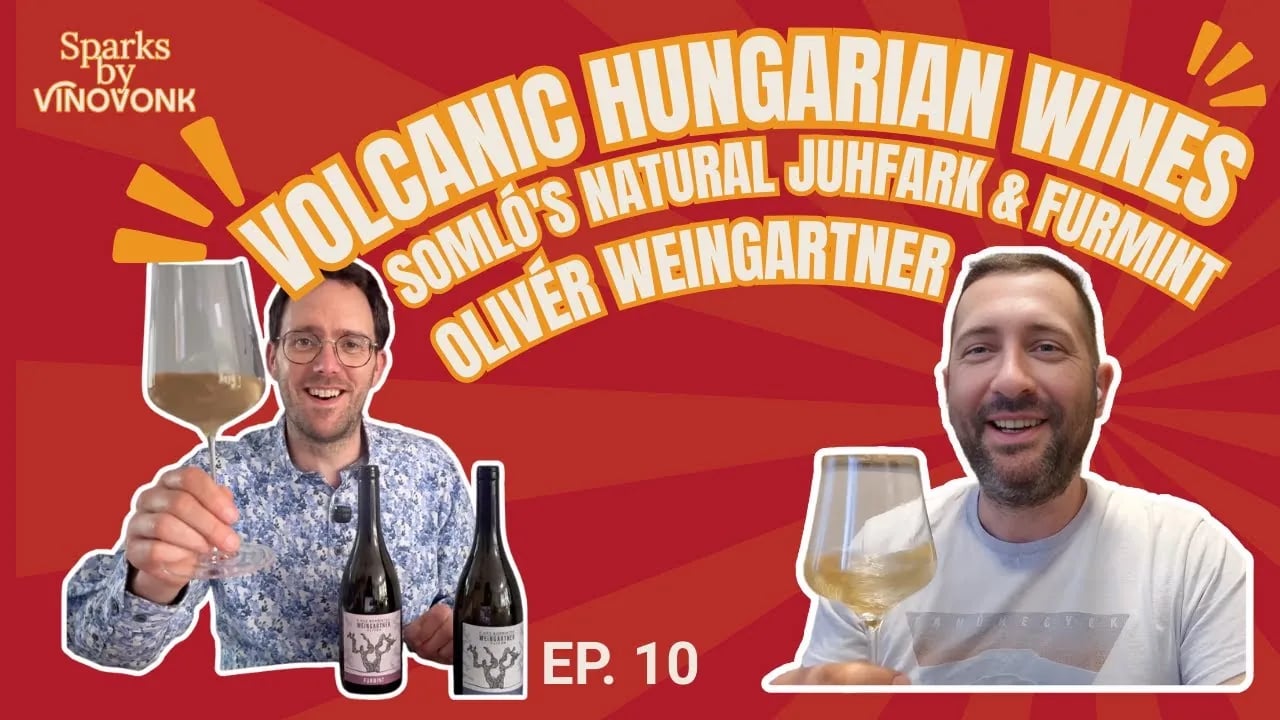
I had never heard of Somló. It never came up on my WSET course or at any tasting. In this Sparks I talk to Oliver Weingartner, who farms four hectares on that extinct volcano in western Hungary, forty kilometres from Lake Balaton. We taste two dry natural wines together, the Juhfark 2022 and the Furmint 2022, and talk about what basalt does to a glass of wine.
MAG Wijnen sent me both bottles; I received no payment and the verdict is my own. When I thank MAG Wijnen as a “sponsor” in the recording, those bottles are what I mean.
Who is Oliver Weingartner
Oliver calls himself more of a vineyard man than a cellar man. Besides his own four hectares, he advises other organic wineries and buys grapes from them, which takes him to around 24,000 bottles a year. He makes two kinds of wine under separate labels: classic Somló wines from Furmint, Juhfark and Olaszrizling, and a line he describes as “hipster style”, with orange wine and pét-nat.
In his telling, the soil is so dominant that terroir wins in the end. “After five years the terroir takes everything over,” he says, to the point where you sometimes can’t tell which grape you’re drinking. It just tastes of Somló.
There’s a legend that a French princess drank Somló because it was supposed to make getting pregnant easier. Oliver has two children himself. Does it work? “Yeah, it works,” he laughs.
What you learn in this episode
- Why Somló’s basalt makes its wines so mineral and salty
- What Juhfark is, the grape Oliver says belongs to the hill of Somló
- How Oliver makes natural wine with spontaneous fermentation and sulphur only at bottling
- Why older growers on the hill think Somló needs at least three years in bottle
- How, centuries ago, Somló and Tokaj were the only Hungarian regions exporting to France and England
- How the heat of 2024 pulled harvest forward to mid-August
In the glass
Juhfark 2022. Medium golden yellow. On the nose I get plenty of apple and pear juice, melon and fresh herbs such as parsley and basil. The palate is salty without overdoing it, with dried fruit from the bottle age sitting next to the fresh fruit. Round, complex and long. Oliver explains the roasted edge: in barrel the fermentation stalled after three weeks with a lot of residual sugar, then restarted three or four times.
Furmint 2022. Typical Furmint on the nose, but with plenty of structure and a full body. I pick up something clay-like, the way wines from loess and limestone can taste. Oliver confirms it: this parcel sits on clay mixed with brown forest soil rather than basalt. The acidity is moderate and the texture soft, with concentrated fruit: dried apricot, peach, nectarine, a little cherry and herbs.
After about two weeks of fermenting in steel, the wines move to barrels and porous tanks, where they spend eight to ten months on fine lees. Rather than filtering, Oliver lets the lees settle out. Before bottling he puts some of them back, because the small dose of sulphur alone wouldn’t protect the wine. Somló, he says, isn’t a party wine. It belongs on a table with friends and a long conversation.
The catches
- Drunk too young. Older growers on the hill want Somló kept for four or five years. Oliver admits almost nobody does that: people buy a bottle and drink it the following week. He has to sell to make a living too, though from 2024 he plans to hold more wine back.
- Sold out. The Juhfark 2022 and Furmint 2022 are gone. The next vintage has just gone to MAG Wijnen, but the bottles I tasted are no longer available.
- Climate. By Oliver’s own account the alcohol is “not the lowest”, though he thinks this one is the lowest on the hill among natural wines. In 2024 harvest started in mid-August, about two months earlier than a decade ago, and two weeks before picking he had to cut grapes off to save the vines.
- One bottle each. I tasted a single bottle of each wine, and Oliver hadn’t opened the Juhfark himself for four or five months. Natural wine moves fast, so yours may taste different.
Frequently asked questions
What is Juhfark?
Juhfark is Hungarian for sheep’s tail: juh means sheep, fark means tail. According to Oliver, the bunches curve near ripeness in a way that resembles one. Every Hungarian region has a grape of its own, and Juhfark is Somló’s. It’s awkward in the cellar because fermentation tends to stall and restart.
What makes Somló special?
Somló is an extinct volcano in western Hungary with basalt all over the hill, which Oliver credits for the saltiness and minerality in the wines. Centuries ago only Tokaj and Somló exported to France and England: Tokaj thanks to its sugar, Somló thanks to high acidity and alcohol that helped the wine survive the journey.
What does Oliver mean by lazy winemaking?
Oliver reckons natural winemaking is for lazy winemakers. Nature does the work, so he doesn’t need to buy starters or anything else. Sulphur only goes in at bottling. His energy goes into the vineyard, with one hundred percent healthy grapes as the goal.
Where can I buy these wines?
In the Netherlands, MAG Wijnen sells Weingartner’s wines. The 2022s I tasted are sold out; the next vintage is on its way.
Listen on your own podcast platform
Prefer Apple Podcasts, Pocket Casts, Overcast or another app? Open the episode on Spotify and hop through to any major podcast platform.
Transcript
The full conversation transcript.
Show full transcript
This transcript is generated automatically from the audio and has not been edited. Speech recognition makes mistakes, so treat wording as an approximation rather than a verbatim quote. It is here for accessibility and search.
Hi and welcome to a new episode of Sparks by VinoVonk. My name is Jeroen Vonk. I’m your host today. We’re inspired by wine and we’re inviting people to tell their inspiring stories. And today we’re going to Hungary and we’re not going to Tokaj.
We’re not talking about sweet wines. We’re talking about dry natural wines. And my guest today is Oliver Weingartner. Hi Oliver. Hi guys.
Very nice to meet you. I received two of your wines from MAG Wijnen, a wine shop in the Netherlands. So shout out to MAG Wijnen for sponsoring this show with these two wines. But first of all, Oliver, how are you doing today? Yeah, thank you.
It’s a really harsh time in the vineyards, you know. And yeah, I’m glad that we find an opportunity to make this podcast with you. And thank you for your invitation. I’m very glad and honored that you want to be my guest. I see you have four hectares of vineyards and you make natural wines but we’re not in Tokaj.
Everybody knows Tokaj in Hungary but where are you located? Yeah, this is the middle of Hungary, 40 kilometers from Lake Balaton. Maybe you heard about Balaton. It’s a very famous tourist lake in Hungary. Also with some wine regions next to the lake.
We are just half an hour from the lake on the north side. Yeah, Somló is… a… one… Yeah, you know, every winemaker says the same, but…
I think it’s one of the famous wine regions in the world. So you’re located in Somló? I would be honest, I never heard of it. I didn’t learn it during my WSET or any other tastings or something. So I’m very curious about the wines.
We have two wines. We have a Furmint. Well, I know Furmint, but we have also another variety. Juhfark. Am I pronouncing it correctly?
Juhfark? It was perfect. It was perfect. I never heard of it also. But what kind of wines do you make?
Normally, I’m saying that I’m doing two kinds of wines. Classic Somló wines like these two, Furmint and Juhfark. And Olaszrizling, this is Welschriesling. And some other Hungarian varieties. These are like classic, classical volcanic wines.
Because Somló is an extinct volcano. And I have some other wines, little bit like this hipster style. Orange wines, pet-nat, so these two styles are separated with the labels as well. Yeah, but normally no sweet wine because natural wines are not working with sweet wines. No.
So you say you have volcanic soils? Yeah, exactly. Somló is one of the spots in the world with the most mineral, with the most… Do you know what is basalt? This is a stone.
Yeah, this is the kind of stone that is on the hill. It’s really, really everywhere on the hill. And it’s so much mineral, so much saltiness. In the soil that in a Somló wine, the terroir is so strong with this volcanic soil that after a couple of years, each wine, doesn’t matter what kind of variety you have, the terroir will take over the will of the wine and sometimes you can’t say what kind of wine you are drinking. This is just a Somló terroir wine.
Yeah. It doesn’t matter what kind of grape variety you use, it’s just a Somló wine. Yeah, after five years the terroir takes everything over and normally when there is a good vine, then after five, six years this is just a strong Somló terroir wine. Yeah. And so you have different kinds of varieties, but how do you make the wines?
Because, I understand, okay, you make it naturally, but you grow it organically. Are the conditions okay there? Yeah, everything of course is perfect for us. The climate change of course is not helping like any other winemakers, the same situation. So the climate change is not good.
But we are on the north side of the hill. So our place, our spot on the hill, we are on the north side. So this is something I think it’s helping us. On the south side, the acidity, acid levels in the grapes in a hot summer it’s yeah it’s not working so good but on the north side Somló was really known about the high acidities, the high alcohols before like 10, 20, 30 years before. With the climate change it’s changing so of course as you can see on the black labels that the alcohol is not the lowest.
Yeah. This is a normal Somló wine, this is the lowest alcohol on the hill, I think, with natural wines. Yeah, so Somló buzzes minerality, saltiness and terroir. That’s all about Somló. Maybe it’s just a story about Somló.
Like centuries before, there was just two wine regions which could export wines to France, to England. It was Tokaj and Somló. Tokaj because of the sugar level, you know, sweet wines, and this method making Aszú sweet wines made their good conservation for the traveling and Somló wines with high alcohol and high acidity made the same situation so it was a nice protection for the long way to exporting wines you know with horses and with in this time and one of one of the story another part of the story that the French Princess was drinking Somló wines because in the legend, when somebody drinks wine from Somló, that makes it easier to be pregnant. Yeah, it’s just a legend. But I have two kids too.
I have two kids, so I can’t say anything else. Well, it kind of worked. Yeah, it works. Yeah, and how do you make the wines? Is it fermentation?
Do you use stainless steel? In wood? So I would say I am more like a vineyard man, more than a cellar man. So I like to be in the vineyards. For me it’s much more interesting and much more important that we can produce 100% healthy grapes.
And with these healthy grapes, we can produce like this easily the natural wines. So we are really giving 100% energy for producing nice grapes in the vineyard. And after that, it’s really easy, like whole bunch pressing with this classical wines like Furmint and Juhfark is whole bunch pressed. This is like a classical Pneumatic air press. Three hours we are pressing the grapes.
The juice is going in the cellar. We are doing one night this settling. So we settle the juice. We are separating from the first sediments. And after that the fermentation normally starts in a steel tank.
Spontaneous and after… After two weeks when the fermentation is almost over, we just pump the wines in barrels and in porous tanks. So the fermentation ends with fine lees together in the barrels and in the porous tanks. We are using some new technology like these porous breathable tanks from the USA and from Australia. This is not like a kind of new things in the winemaking.
It’s not the most authentic, but it’s working. Yeah, it’s working, you know, it’s modern and for me… But it’s yeah, it’s not cheaper, but it’s easier to take care of the quality. And so the fermentation ends in the barrels or in these tanks with a fine lees and we are just leaving the wines for 8, 9, 10 months with fine lees till the next harvest. So we are bottling the wines in next year, July.
That’s all with the winemaking process. And you don’t filter or remove any sediments. What does mean removing? So, with the first pumping during the fermentation, we’re just leaving the hard lees in the tanks and we are pumping just the fine lees to the barrels. And after 10 months, this fine lees is settling down in the barrels and most of these lees we are leaving in the barrel.
So the wine is crystal-clear after 10 months. But we have to give some lees back in the wines because we are using just a little bit sulfur just at the bottling. But this sulfur level would be not enough for protecting the wines. That’s why we are just giving some lees back to the wines before the bottling. But not everything.
So that’s what is the process. Sounds perfect and very interesting also because a lot of times you hear, okay, we do a spontaneous fermentation, but we make our own starters and after a couple of hours we use our other starter and you’re saying, okay, we do it with real spontaneous fermentation. That’s very interesting to hear. Yeah, because the nature is working alone, so we don’t have to use any of this stuff. I would say natural winemaking is for the lazy winemakers.
Because really you don’t have to think about buying something, other stuff, starters, as you said. Other winemakers, this technology winemakers, the plastic winemakers, but that’s it. You know, from February they are filtering, pumping from here, from there. I don’t know, fining, filtering, doing stuff in the cellar. For us it’s really easy because after the harvest, after the fermentation, 10 months in the bottle and of course we are checking the quality, you know, sometimes once in a month.
We are just checking the quality while we are checking the wines. But when normally everything is okay, then we just have time with the bottling. And of course for a classic Somló wine needs time in a barrel, needs time in a tank. So it’s not that easy to style wines from the hill. Because the acidity is very harsh and a lot of salinity and minerality and saltiness.
Yeah, so classic Somló wine is not the easiest wine. You know, the Somló wine is to sit on the table with a couple of friends and it’s good for deep conversations or you can sit alone and just drinking and thinking. But it’s not that party, they are not that party wines at all. I’m very curious, let’s start tasting some wines. Which wine do you want to start with?
The Juhfark or the Furmint? Yeah, I think with the Juhfark but it’s a good question in this case because as I said to you before the recording I have the very last bottles from this wine so I was looking for this vintage like one hour in the cellar and natural wines are changing really really fast so I think I didn’t check this wine, this vintage like, I don’t know, four, five months from now. So maybe for me it will be a nice surprise. I don’t know. Let’s check the report first.
Because your wines are very popular in the Netherlands also, a very famous restaurant, Naska in Amsterdam, it’s Peruvian style, serves these wines and paired also with their dishes because the wines can compare with the complexity of the dishes. The sommelier told me, and yeah, he wants more, he wants more, but yeah, sold out. Yeah, 2022 is all. I just sent it last week to MAG Wijnen the new vintage. So hopefully we’ll have a new vintage in Netherlands.
Yeah, now I already opened them because I didn’t want to make any mistakes. You And I love the label also. Very nice. In the Netherlands we say Proost, and what do you say in Hungary? It’s not easy.
It says Egészségére. It’s like you drink, you already had too much. Yeah, it was okay. Yeah. Egészségére.
A lot of apples and pear juice, also a lot of melon and a lot of fresh herbs like parsley and basil. Honestly, I’m not that good to describe the wines, but I really enjoyed the heat. Yeah, and I love the color. It’s like a medium golden yellow. It’s very interesting.
Let’s taste it. Hmm. It’s very salty, but it’s not too much. And a lot of fruit flavors, but also a lot of dried fruits because of the bottle aging, because now it’s 2025, vintage 2022. And when it’s very round, very complex, and the aftertaste is very long, I still can taste it.
It tastes a lot of fruit. Very nice. I understand why it’s so popular. Thank you. About this variety, a couple words.
Juhfark is… it belongs to Somló. So in Hungary, every one region has kind of an own variety. And this variety belongs to this hill, Somló. It’s not easy to make wines from Juhfark.
Juhfark has a meaning. Juh means sheep. And fark means tail. So this is the tail of the sheep. It means when the grapes are close to the ripeness, the edge of the grapes makes a little bit like this curve.
And it’s kind of, you know, with the tail of the sheep. Yeah, that’s the meaning. But it’s not easy to make wine with Juhfark. I can remember this vintage. As always, the Juhfark in the barrels stopped stopping the fermentation after three weeks.
with a lot of rest sugar. Then starting again, then stopping, and starting. And this flavor what you feel, I would say it is roasty taste. It comes from this three, four times refermentation. Yeah, it’s…
the Juhfark is… it’s not easy in the cellar, you know, it makes some… It makes some interesting moments because with natural wines you have to be sure that all of the sugar is going for close to zero. Yeah. And how was your experience because you didn’t taste it like four or five months?
And how do you like it now? Yeah, I’m Yeah, it’s really nice and it’s a shame that it’s sold out. I should start selling with this wine now, in this moment. Yeah, so we’re drinking it in a better drinking window than you already drink it. Yeah, yeah, so there are some older winemakers from the hill and they say drinking Somló wines like too young, like one, two, three years old wines, it’s worth like the pedophilia, you know.
So they say you have to wait with the wines because it’s too early with the drinking show. So they think at least three years, but better four or five years waiting with the wines. Yeah, but when you start making wine, you have to earn money. You can’t afford it to don’t sell anything. Maybe after a couple of years, maybe you can keep like half of it, but then you have to store it and then you need to have the space for it.
Yeah, that’s not easy. Of course, when someone wants the wines then… Yeah, of course I could keep it back. No, no, I don’t want to sell the wine. I have to wait one, two, three years more.
It’s not working, of course. With this vintage, like the last vintage with 2024, we are just doing this… this kind of stuff. I mean, we just started to show the 2023 wines right now. 2024 are in the barrel.
Yeah, we will try to make it a little bit more to aging the wines because drinking too young, too young Somló wines is really not the best. No, you’re not drinking it in the full potential. You have to drink it in when it’s full blown also. Yeah, who has to make the aging? The winemaker or the buyer or the restaurants?
So it’s not easy because really good restaurants, the sommelier see the potential and they are buying it and they are just putting it in the cellar and waiting two, three years. In these times, you know, it’s not working. You know, we are living like fast. And when at this moment when someone likes the wine, then we are selling it and the next couple of weeks, they are drinking, the customers drinking it. So Yeah, because customers go to the wine shops, buy them online when they get it, maybe the same day, maybe the same couple of weeks they drink it.
Almost nobody buys wine. Okay, let’s buy it for over a couple of years. Yeah, it’s really rare. Maybe it’s not like you, I mean, but when someone likes this wine, buy both online. And okay, this is a good wine.
I will buy two bottles more, but they don’t want to age it, just drink it the next week. Yeah, shall we go to the second one? Yep. This is the Furmint. Also again, the same great label.
Is this the same shape of your vines? Yeah, I like the old vines and we had before this old bush vines on the hill and as you can see the W and the O in the vine. Yeah, it’s hiding. Yeah. With some imagination you could also see somebody dancing.
Yes. But yeah. And again, very nice color. Yeah. Proost.
I just figured, I just figured that. Thank you, It’s typically Furmint in the nose but with a lot of structure, very full-bodied. And it’s also a little bit like. like when a wine is from a terroir that has a lot of loess and limestone you get these kind of clayish and vibes You are seeing it good because this parcel, Furmint, is not really on basalt. This is more like a little bit less clay, mixing with brown forest soil.
This is very nice. It’s very complex. The acidity isn’t too high. It’s very soft in your mouth. And the fruit flavors are very concentrated.
And fresh fruit, dried fruit, also a lot of dried apricots. It’s very nice. Also a lot of peach and nectarine. Yeah. But also some cherries, herbs.
That’s very nice. And the peaches is really good. It’s sold out, at least for me it’s sold out the same. The last 200 bottles was just, I don’t know, one month ago exported to Belgium. And the last week I just heard a good news from this wine that two Michelin star restaurant wants it like, you know, food pairing with some fried algae and yeah, yeah, stuff what, you know, I am so glad that our wines like this, this Furmint, but which is really the best known Hungarian variety I think, the Furmint.
We can show the Hungarian varieties in this restaurant in Belgium or in the Netherlands. So it’s a really good thing too. I hope your wines aren’t getting too popular because consumers also want to buy it. But it’s a very good sign that your wines has a lot of complexity and a lot of body that could stand on the fine dining side. Like Naska is also about fine dining, but it’s very high intensity in flavors, a lot of spices, a lot of herbs.
You have to stand with a good wine. Otherwise, yeah. Otherwise your wine is getting lost and you have to build a bridge between the dish and the wine. Yeah, but this wines, these two, they are perfect to food pairing, I think. This spiciness, this saltiness, this minerality is perfect to food pairing.
Yeah, I love it. And could you tell me something about the vintage 2024? Because like in France, in the Netherlands, in Belgium, it was a very bad year. A lot of wineries lost a lot of their yields. And how was it in Somló?
It was not easy. As I heard from other winemakers, older ones, it was the vintage, what was the earliest in the last, I don’t know, 100 years. We started, it was so hot the summer. Yeah, we started the harvest middle of August. And we ended the harvest the 3rd of September.
You know, Somló was known about the harvest was like, I don’t know, middle of October, end of October, like 10 years before. And now we are doing like two months earlier. You know, this is crazy. Yeah, actually the vegetation… started too early last year.
February was really too warm, it was too hot and there was no frost in Hungary and the vegetation just went through so we knew that the harvest will be so early but we didn’t know that so early. So middle of September we was ready with the harvest. Everything, you know, the fermentation ended with the end of September and in October we were just looking, okay, what should we do now because in this time normally we are harvesting, what’s now? Yeah. Yeah.
Early vacation maybe. And how was the winter? Because the winter in Europe was colder than, well, normally. I heard that in France and in Belgium the summer was other. In Hungary it was really hot, but as I heard that in France and in Belgium it was not so dry.
In September it was lot of rain. So as I know this was like a classic vintage for France or for Belgium. Hungary was totally dry, totally hot. The winters were catastrophic because there is not so cold. There is not so much snow like 10 years before.
We have to think about irrigation in the winters because there is no snow in the winter. Then there is no rain in the March, in April. So yeah, it’s not easy. The last three years was really, really like too hot, too dry, no rains. Yeah.
2024 was the first year when it was so hot and so dry that we had in the before the, two weeks before the harvest, we had to cut. The grapes on the floor because the grapes were dying and we had to save the vines because the leaves were getting yellow, there was no water in the soil and we had to save the vines so we just… cut the grapes down to save the vineyards. Yeah, because the grapes use a lot of energy during ripening. Yes.
So 2024 was not so easy in Hungary. And how are the vineyards looking now? This year looks now like a classic vintage. It is perfect right now. Of course, the grass is growing, so there’s so much work in the vineyards, you know.
Right now we are putting new plants in the, between the rows, so making the dead plants with new ones again. Yeah. We are bottling, we are packing some pallets for export. Yeah. Busy times.
Yeah. Busy times. Yeah. And how do you see the future? Because now you have four hectares and you’re doing it mostly by yourself.
Yeah, so we have four hectares, but I am an advisor for other wineries as well. Only bio, so only ecological work. And from these vineyards I’m doing some good stuff. So I’m just getting grapes from these vineyards, from other varieties. So we are producing like 24,000 bottles a year.
Yeah, the future, this 4 hectare right now, it’s enough. The market is not the best right now. So the export is really quiet. Like two years before, the importers was grabbing for the wines. Right now, it’s really slowly.
Yeah, everybody’s quiet and yeah. We can feel the things from the USA as well, you know, this bad news, good news. Yeah, but it could be good news just buy a lot of these wines because they get better over the years. Buy it now. Then you have very good wines a little bit later.
Yeah, yeah, we’re going to spread that news. And what do you think about the future of wine from Hungary? Because nowadays more and more dry wines come from Hungary, also a lot of in the Netherlands. Yeah, there are couple of wine regions in Hungary which are able to make a good export like Somló, Tokaj, Mátra, Móra and Badacsony, here where we are living with the family. In the future of the Hungarian winemaking I think is in the variety.
That means in the white wines we have to sing in Furmint, in the red we have to sing in Hungarian varieties like Kékfrankos and Kadarka. With this varieties we can show the character of the Hungarian wines. And Hungarian wine regions like Somló. Yeah, Central European wines are getting stronger, you know. Like 10 years ago in Poland, there was no winemaking in Poland.
And now they are just, you know, with the climate change, this level is just going higher. So there are lots of Polish winemakers as well. It’s interesting what’s happening right now in the world with the winemaking. Yeah, it’s very interesting. A lot of winemakers are starting now more working organically, also a lot of biodynamically, because everybody wants to, if they’re drinking, they want to drink it more responsible, more healthy.
And yeah, if you work organically, it’s more healthy than conventional, you could say that. Well, alcohol isn’t good for your life, but you have to drink it in… small portions, not too much a day per person. Yes, of course. So this kind of wines what we are producing, these are not for the people who want to drink three bottles a day.
But they can if they want. Of course, responsibility is really, really matters. Yeah, but drink less, but drink better. And if you want to have a new experience, very nice experience, go for these kinds of wines because it’s new, it’s indigenous, you have an experience from a country that you don’t know. It’s an adventure and it’s very nice adventure.
Thank you, thank you very much. Oliver, thank you very much for your time. And I hope to drink more of your wines in the future. MAG Wijnen, again, thank you for sponsoring this show. If you want to find the shop, it’s in the show notes.
I will also add a link where you can contact Oliver if you want to buy his wines, if you want to import them, because it’s a little bit quiet now, but it’s getting busier now. So Oliver, have a good vintage in 2025. Looking forward and tasting 2023, 2024 and the rest. Thank you very much. And if someone wants to meet me and taste some wines that we can taste together, end of May there will be a natural wine fest in Amsterdam.
So I will be pouring the wines there and come and taste some Hungarian wines. You find the link in the show notes. And I will be there also because I want to meet you in person, of course. That’s about a real conversation, not too strictly prepared. That’s what I do.
Thank you very much. And join me the next time in a new episode of Sparks by VinoVonk. Have a nice day. Have a nice day. Ciao.
Read also
Related article on this topic →Listen
Watch