

Oliver Weingartner: Natural Wines from Volcanic Somló
Oliver Weingartner makes natural wine on Somló, an extinct Hungarian volcano. On basalt, Juhfark and Furmint, and why these wines need time in bottle.
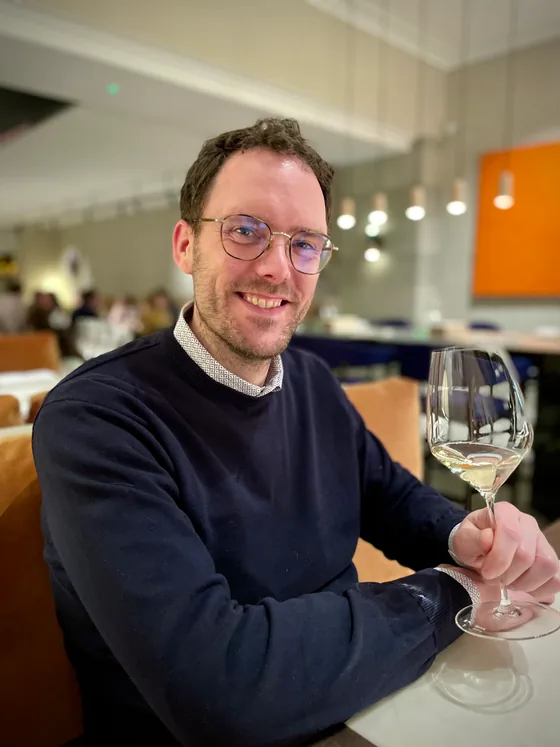
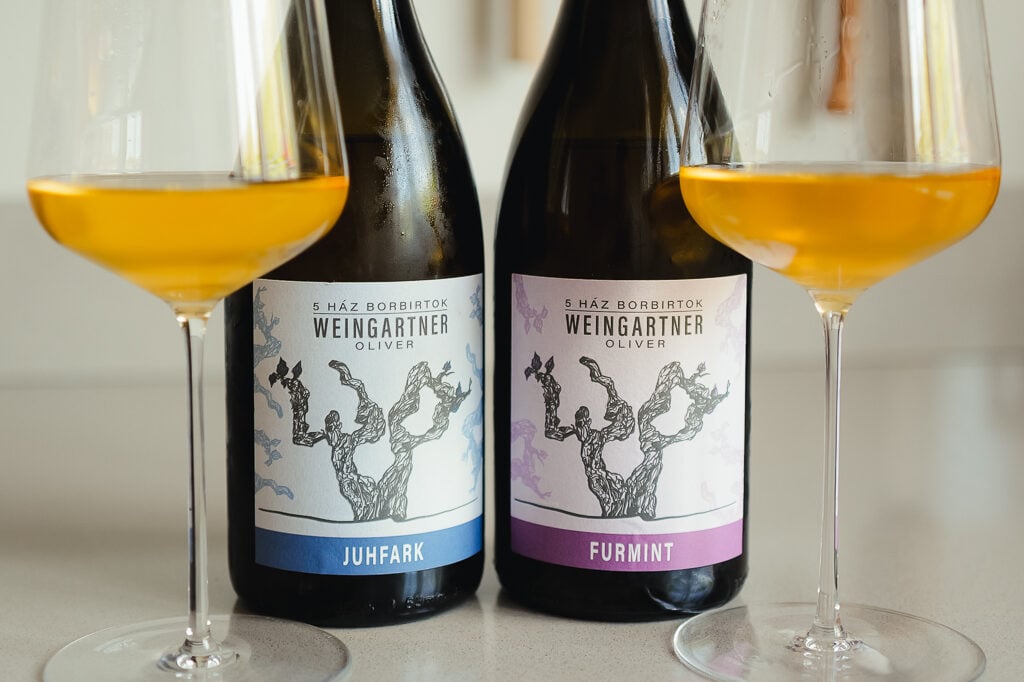
I had never heard of Somló until MAG Wijnen sent me two bottles from Oliver Weingartner. He farms four hectares on an extinct volcano in western Hungary and makes dry natural wine there. For Sparks episode 11 I tasted his Juhfark 2022 and Furmint 2022 with him. What follows is what he told me and what I found in the glass.
The volcanic canvas of Somló
Somló sits forty kilometres from Lake Balaton, with basalt all over the hill. Oliver credits that stone for the saltiness and minerality in the wines, and goes further still. “After five years the terroir takes everything over,” he says, to the point where you sometimes can’t tell which grape you’re drinking. It just tastes of Somló.
Centuries ago, Tokaj and Somló were the only Hungarian regions exporting to France and England. Tokaj managed it thanks to the sugar in its sweet wines, Somló thanks to high acidity and alcohol, which got the wine through a long journey by horse and cart. There’s also a legend that a French princess drank Somló because it was supposed to make getting pregnant easier. Oliver has two children and says, laughing, that it works.
A natural philosophy: “lazy winemaking”
Oliver reckons natural winemaking is for lazy winemakers. He doesn’t need to buy starters or anything else. “The nature is working alone, so we don’t have to use any of this stuff,” he says. Fermentation is spontaneous and sulphur only goes in at bottling.
The laziness stops at the cellar door. Oliver calls himself more of a vineyard man than a cellar man and puts his energy into the vines, aiming for one hundred percent healthy grapes. Beyond his own plots, he advises other organic wineries and buys grapes from them, which takes him to around 24,000 bottles a year.
Indigenous grapes: Juhfark and Furmint
Oliver makes two kinds of wine under separate labels: classic Somló wines from Furmint, Juhfark and Olaszrizling among others, and a line he calls “hipster style”, with orange wine and pét-nat. Juhfark is Hungarian for sheep’s tail. According to Oliver, the bunches curve near ripeness in a way that resembles one. Every Hungarian region has a grape of its own, and Juhfark is Somló’s.
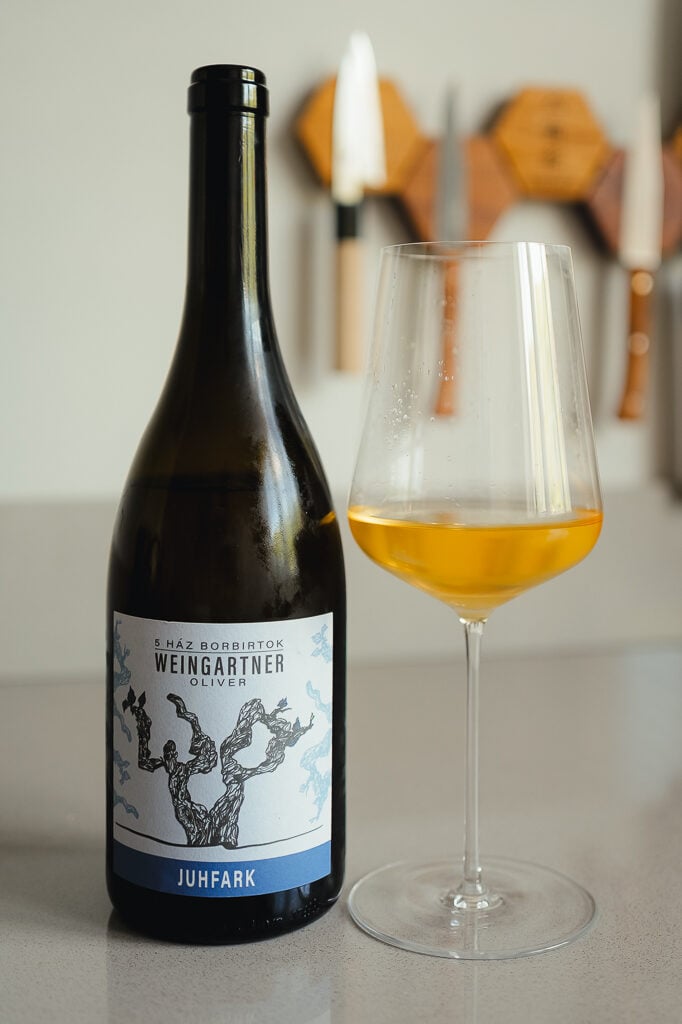
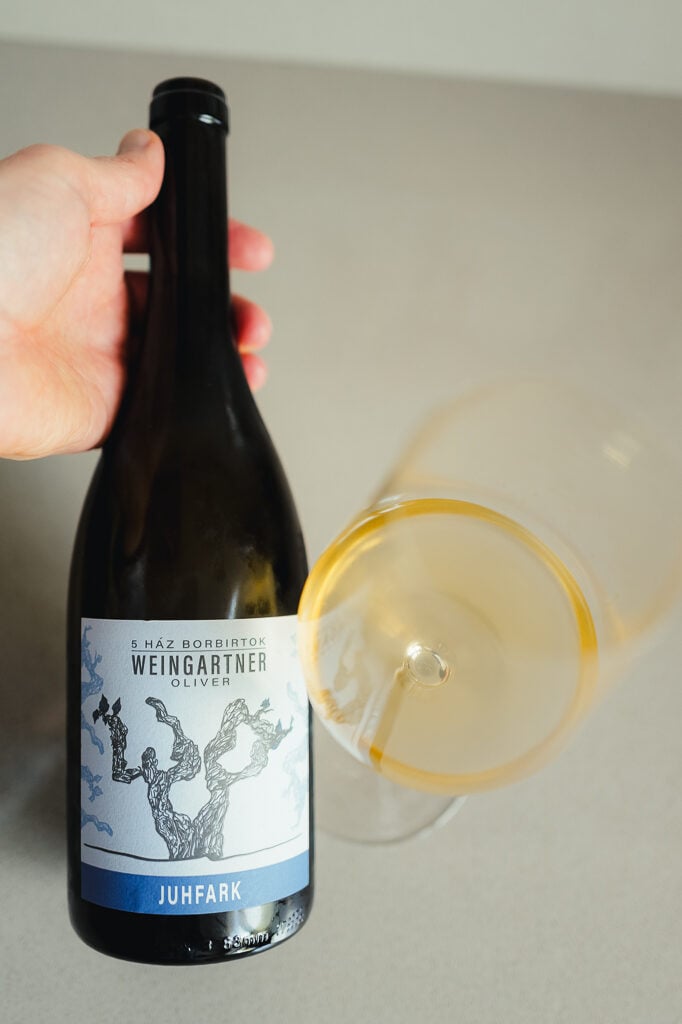
The Juhfark 2022 is medium golden yellow. On the nose I got plenty of apple and pear juice, melon and fresh herbs such as parsley and basil. The palate is salty without overdoing it, with dried fruit from the bottle age, round and complex with a long finish. Oliver says Juhfark is awkward in the cellar: in this vintage the fermentation stalled after three weeks with a lot of residual sugar, then restarted three or four times. That, in his view, is where the roasted edge comes from.
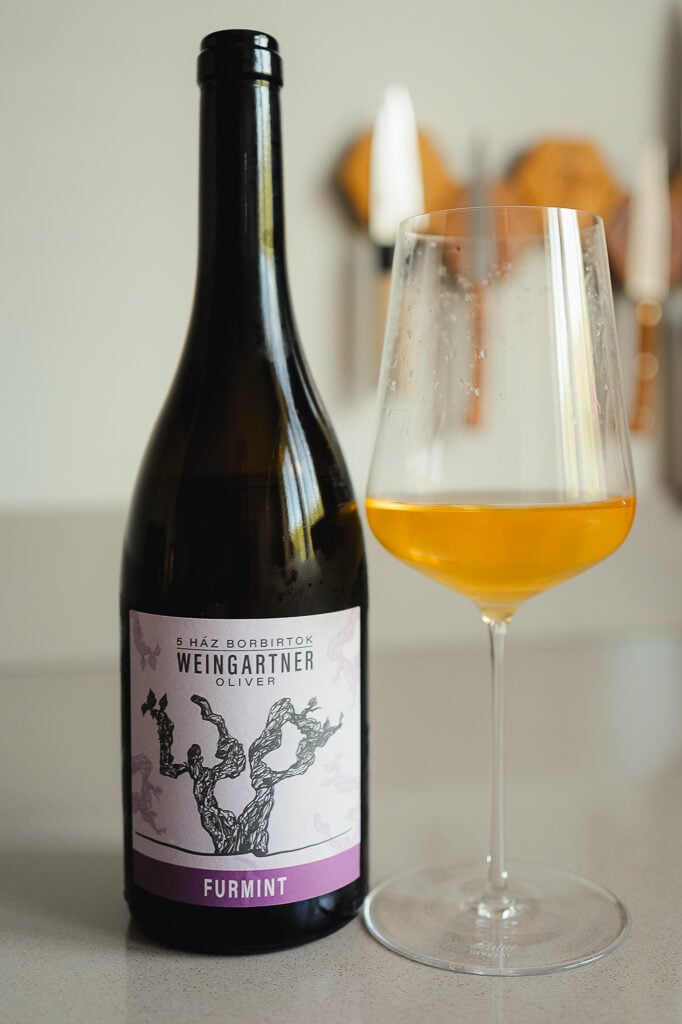
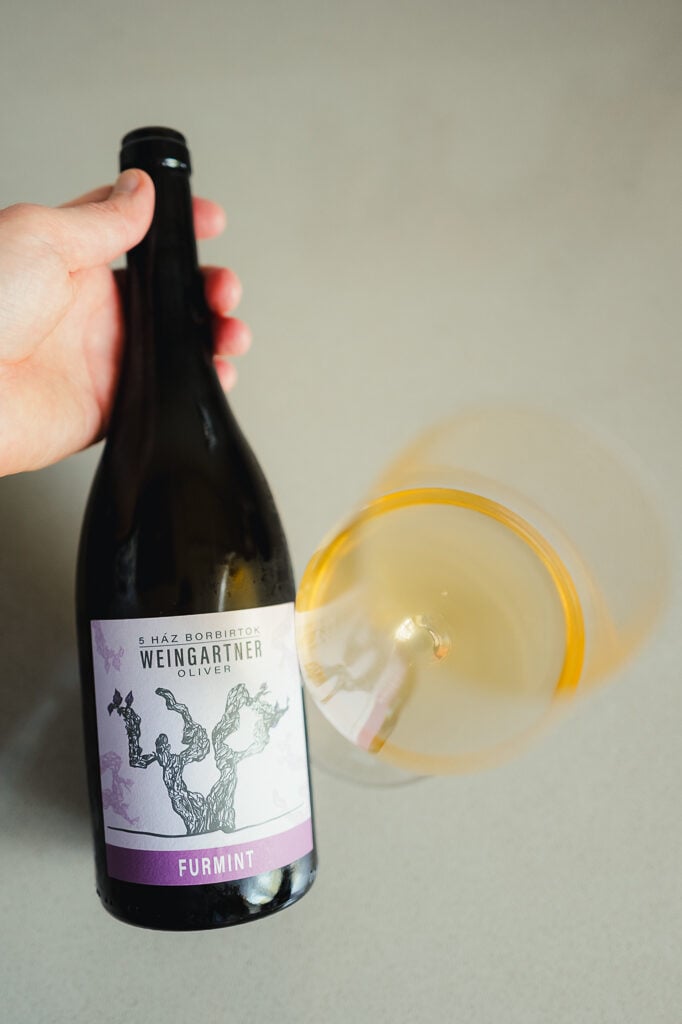
The Furmint 2022 is typical Furmint on the nose, but with plenty of structure and a full body. I picked up something clay-like, the way wines from loess and limestone can taste. Oliver confirmed it: this parcel sits on clay mixed with brown forest soil rather than basalt. The acidity is moderate and the texture soft, with dried apricot, peach, nectarine, a little cherry and herbs.
From vineyard to cellar
Oliver presses whole bunches in a pneumatic press over three hours. The juice settles for one night, then ferments spontaneously in stainless steel. After about two weeks, with fermentation nearly done, the wines go into barrels and into porous tanks from the USA and Australia. Those tanks aren’t cheaper, he says, but they make it easier to look after quality.
The wines then spend eight to ten months on fine lees, until the July after the next harvest. Rather than filtering, Oliver lets the lees settle out. Before bottling he puts some back, because the small dose of sulphur alone wouldn’t protect the wine. Somló, he says, isn’t a party wine. It belongs on a table with friends and a long conversation.
The catches
Older growers on the hill want Somló kept for four or five years. Oliver admits almost nobody does that: people buy a bottle and drink it the following week, and he has to sell to make a living too. From the 2024 vintage onwards he plans to hold more wine back.
Climate is the other worry. By his own account the alcohol is “not the lowest”, though he thinks this one is the lowest on the hill among natural wines. In 2024 harvest started in mid-August, about two months earlier than a decade ago, and two weeks before picking he had to cut grapes off to save the vines.
The bottles I tasted are gone, as the 2022s have sold out. And I tasted one bottle of each. Oliver himself hadn’t opened the Juhfark for four or five months, and natural wine moves fast.
The next vintage has just gone to MAG Wijnen: magwijnen.nl
Sources
- Weingartner Vines (official, Somló, Hungary): weingartnervines.com
- Wines of Hungary: winesofhungary.org
- Somló Wine Region (PDO): somloihegyi.hu
More on Winemaker
Biodynamic tasting calendar: does the fruit day hold?
A reel from Ploder-Rosenberg says wine shows best on fruit and flower days. The biodynamic tasting calendar sounds logical. The blind tasting says otherwise.
Read on →
Champagne Gallimard: Six Generations in Les Riceys
Two Gallimard bottles from a July subscription box. A solera running 2009 to 2022, hand disgorgement, and a label code that says something the story doesn't.
Read on →
Podere Sapaio: Bordeaux on the Bolgheri coast
Podere Sapaio makes Bordeaux blends in Bolgheri, with time as its guiding principle and concrete beside wood in the cellar. A portrait after La Grande Bellezza.
Read on →