

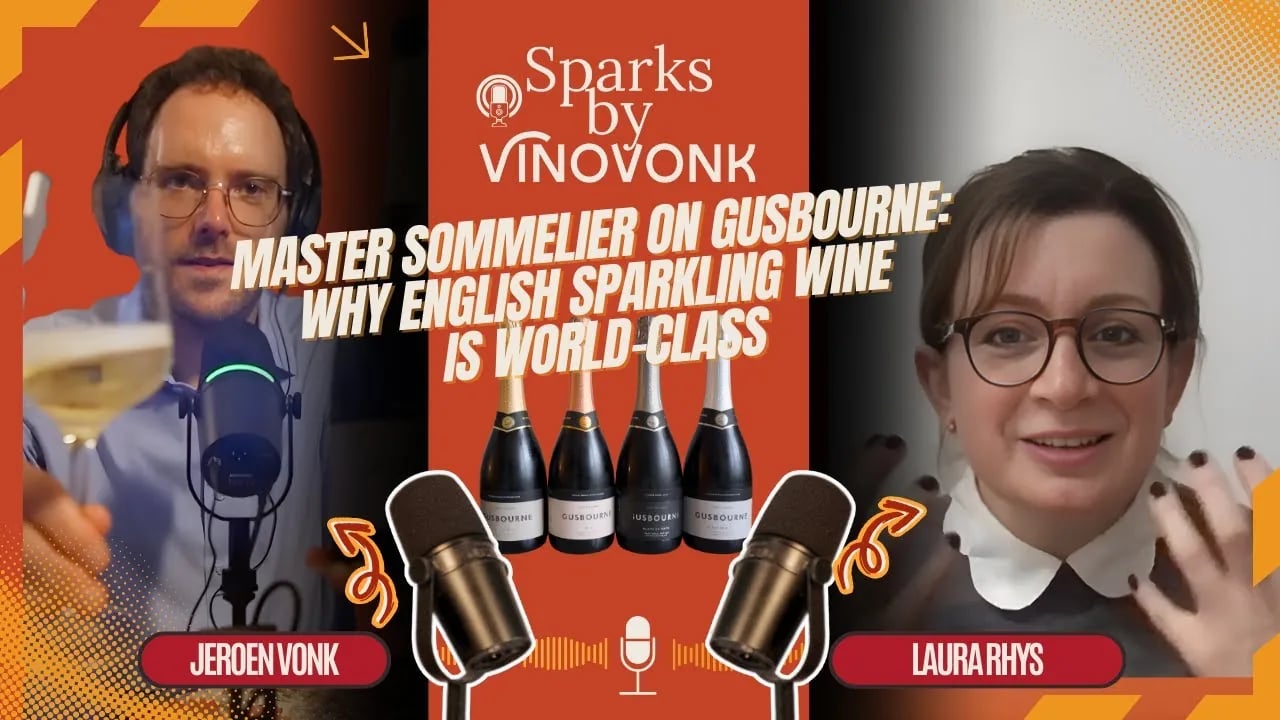
English sparkling wine at number two on the Wine Enthusiast Top 100, and according to Laura Rhys the highest-placed sparkling wine on the list as well. That news only comes up near the end of our conversation. For this Sparks I talk to Laura Rhys, Master Sommelier and Global Brand Ambassador at Gusbourne in Kent. We taste through four bottles and talk about what English fizz shares with Champagne, and where it parts ways.
Who is Laura Rhys
Laura studied hospitality, found her way into wine through the WSET courses, and then spent around twelve years as a sommelier in the UK. As head sommelier at a Michelin-starred restaurant in London she tasted Gusbourne, and the style and quality impressed her enough that she joined in 2015. She is one of around 300 Master Sommeliers worldwide. Compared with the Master of Wine, that qualification leans towards the sommelier’s craft: service, a practical exam, and a blind tasting delivered out loud rather than on paper.
At Gusbourne she runs the ambassador programmes in the UK and the export markets. Before the second fermentation she also grades every base wine, together with head winemaker Mary, Mary’s assistant and the head of operations. The final blend is Mary’s call.
“Winemakers and sommeliers taste in very different ways,” Laura says. “They come to it from a very different position.”
What you learn in this episode
- Why Gusbourne uses only its own grapes and makes only vintage wine, with no non-vintage at all
- How clay and sand in Kent and chalk in Sussex each bring something different to the blend
- Why Gusbourne vinifies around 200 base wines per vintage separately, and tastes no more than 15 a morning
- What UK law requires (nine months on lees) and what Gusbourne does on top of that
- How harvest dates are shifting: more often in September than before, yet 2024 ran to late October
- How Fifty One Degrees North became the first English wine in the Wine Enthusiast Top 100, at number two
- Why 90 hectares of vineyard is less than it sounds
Kent, Sussex and Champagne
The first vines went in in 2004 and the first vintage was 2006. Gusbourne buys no fruit and makes only vintage wine. Laura says that started out of necessity, as there was no wine to spare for reserves in the early years. They stuck with it because they wanted each bottle to show the vineyard in a single year.
The Kent vineyards sit about six miles inland from the Channel, roughly 40 metres above sea level, on clay and sand. That, in Laura’s view, is where the ripeness and weight come from. Around ten years later Gusbourne took on land in Sussex, on chalk and at higher elevation, which brings racier acidity and more precision. Both sit within the Paris Basin, as Champagne does. The climate is another matter: cooler and more maritime.
The four bottles
Brut Reserve 2019. 62 per cent Chardonnay, 28 per cent Pinot Noir and 10 per cent Pinot Meunier. Laura finds citrus, green apple, red apple, peach and apricot. I picked up something of an oaked Chardonnay, and that is partly right: Gusbourne puts 8 to 12 per cent oak, often old, into every blend for texture. I find it rich and full, with layers of acidity cutting through that richness like knives. It is not very complex, but it is very approachable.
Blanc de Blancs 2018. All Chardonnay, drawn from the base wines with the most precision. Laura mentions lemon, green apple and a salty, wet-stone note. I get lemon curd with marzipan, a sea breeze running through it, and spices like cardamom and cinnamon. Laura puts those sweeter spices down to the warm 2018 vintage.
Blanc de Noirs 2018. Pinot Noir only. For this wine they look for intensity and weight: red and stone fruit, but also something darker, blue fruit and spice. On the nose the Blanc de Blancs is, to me, a walk through a biscuit factory, and the Blanc de Noirs a walk through a forest after rain, wet leaves and damp earth.
Rosé 2018. 59 per cent Chardonnay, 23 per cent Pinot Noir and 18 per cent Pinot Meunier. The colour comes from four to five per cent of still red Pinot Noir aged in barrel. Gusbourne tried saignée in the early years and settled on blending instead. With age, Laura says, the Pinot in this wine turns more savoury, with a herbal edge.
Laura pours the Brut Reserve with pan-seared scallops, the Blanc de Blancs with seafood in a lemon butter sauce, and the Blanc de Noirs with wagyu or roasted squash. With that last one I would reach for pan-fried mushrooms and truffle.
What is still open
Laura is cautious about long ageing. Of the four, the Blanc de Blancs will keep longest; the other three can easily go five to ten years in a cellar. Leave them for twenty and you get fewer bubbles, a darker colour and more nuttiness, which is not to everyone’s taste. Gusbourne is not organic: with so much moisture in England, Laura finds that too hard. The weather is unpredictable too. On average it is getting warmer, yet 2024 was not picked until late October. She also finds English wines sometimes take longer to show their yeasty, autolytic side.
These are Laura’s descriptions alongside mine. I tasted one bottle of each wine, not blind and not alongside Champagne. Prices did not come up in our conversation.
Frequently asked questions
Why is English sparkling wine compared to Champagne?
Gusbourne uses the same grapes as Champagne and the same traditional method, with the second fermentation in bottle. The soils sit in the same Paris Basin. According to Laura, England is cooler and more maritime, and the acidity is different. The fruit feels more lifted, and the wines lean on fruit for longer.
What is Fifty One Degrees North?
Gusbourne’s prestige cuvée, made from Chardonnay and Pinot Noir. It comes only from the best parcels and only in the best years, so some vintages have none. The current release is 2016. It is the first English wine to make the Wine Enthusiast Top 100, at number two.
How long can you age Gusbourne?
Of the four core wines, Laura expects the Blanc de Blancs to last longest. The Brut Reserve, Blanc de Noirs and Rosé will easily take five to ten years. My advice: buy two bottles, drink one, note what you taste, and open the second after five or ten years.
How long does Gusbourne spend on lees?
UK law requires nine months. The Brut Reserve 2019 had about three years on lees; in some years the Brut Reserve is released at just under two and a half. After disgorgement the wine rests for at least three months before release.
Listen on your own podcast platform
Prefer Apple Podcasts, Pocket Casts, Overcast or another app? Search for Sparks by VinoVonk and you will find this episode with Laura Rhys.
Vinites, Gusbourne’s Dutch importer, sent me the four bottles; I was not paid and the opinions are my own. Thanks to Rose at Vinites for the delivery.
Transcript
Automatic captions from the recording, unedited.
Open the full transcript (English)
[00:00] Welcome to Spark by Fenof Funk, the podcast where we uncor the stories behind exceptional wines and today sparkling wines. I’m Yun and today we’re rising the glass to English sparkling wines to and we’re going to Ken to explore Gusborn. One of the pioneers putting English sparkling wines firmly on the world map. My guess is Laura Reese from Gusbourne and we’re tasting through four exceptional wines from their range. 2019 Brute Reserve, the Rosé, Blond Blond, and the Blond Noir from 2018. And if you ever wondered why what makes English Park wine so special and why critics compare it to Champagne, the this conversation will give you all the answers. We’ll talk about teroir wine making philosophy challenges producing wine in England and what it takes to create worldclass bubbles in a relatively
[01:00] young region. So let’s dive into the world of Gusborn and welcome Laura. Hi. Hi Laura. Thank you very much for your time and thank you very much for organizing this. I got four exceptional bottles of Gusbborne and I got them through your uh Dutch importer Finitus. Yes. So Finitus, thank you very much for sending these bottles. But first of all, Laura, who is Laura and how did you uh became what you do and at Gusbornne? Okay. Uh so I um I studied hospitality at university and um through that um I discovered the WCT courses and started learning about wine and then when I graduated university I started working as a sumeier um in the UK and uh worked
[02:00] with some really amazing amazing sumeas very um inspirational as well. Uh and so because of that I also um at the same time as working started to look at competitions and exams and that kind of thing. And throughout the I guess 12 years that I was a sier I was always very excited about English wine and about the prospect and the promise I think of English wine and you know it’s a young industry. It’s an industry in a cool climate. Uh and it’s certainly an industry with challenges and it’s also um uh an industry which has grown just so much over the last even 20 years. And so uh when I first started as a sier sometimes it was quite difficult to introduce people to English sparkling wine but that’s not the case anymore. Um, and I always remember I was working as um a head sleier uh in a Michelin
[03:00] star restaurant in London and I tasted Gusbornne and I just was so completely blown away by the style by the quality um of the wine and so started chatting to them um and then um started to work for them 10 years ago. So, so I I joined Gusborn in 2015. Um, and now my role is um both ambassadorial in the sense that I I am in charge of all the ambassadorial programs I suppose throughout our export markets and in the UK. So, you work in Gusbornne and you are a global ambassador. Yes. And but you told me about you’re a samo, but you’re not a standard samoy because I found out you’re a master samoy. Yes, I am. And and there are only like two 200 master su in the world. Yeah, I think there’s closer to 300 now,
[04:00] but yes. Yeah, 300 is it’s it’s like the equivalent of master of wine, but a master of wine knows a lot about wine. But a master of sier knows a lot about beverages, about drinks. It’s not only about wine. Yeah. And you know, there’s a lot of correlations in some regards uh between master of wine and master smellier. And then there’s a lot of differences as well. And I think probably one of the most striking differences is that the master sleier uh um qualification, the diploma um focuses much more on the role of a sleier. So all of the exams are focused much more towards service um and towards well the the job of a sleier as well as all of the um all of the knowledge aspect. And so the blind tasting is spoken instead of written. Um we all of course have the I’m so sorry. Um we of
[05:00] course have the practical exam as well which is a large part of uh of of the exam. But yeah, it’s an amazing um it was an amazing process to go through um the people I met and the things I learned and and it’s really lovely now to be able to be on the other side and to be able to give back to people who are are um are studying for it now. Yeah. So beside the WACT courses you did, you also did the master suo. So you know about how it’s how it’s done working in in in a restaurant, even in Michelin star restaurants on a very high level, working with exceptional wines. And now you’re representing uh and working at the at one of uh in the UK biggest uh sparkling wine makers. And how is how is it to to combine that knowledge and and and and bringing him
[06:00] to practicality? Yeah, I mean it’s it’s great. I um when I um when I joined Gusbborne, I was hugely excited to be able to dive a little bit deeper into the producer side of things as well. And so I’m very fortunate that I can work uh quite closely with our wine makers uh so Mary um and her team. Um, and so for all of the bass wine grading and the bass wine blending prior to the second fermentation, um, I am kind of I’m involved in that. Uh, which is great. And, you know, over the last 10 years, I’ve learned a huge amount, but also I think it’s really interesting because, um, wine makers and sleass taste in very different ways. They come to it from a very different position. And so I think it’s really exciting to be able to blend that and and to be able to see it from the wine- making perspective as well as the I guess you know the the the the
[07:00] perspective of seeing those bottles once they finished their journey on a wine list and on a restaurant table or you know on on our tables at home. Yeah. And and and how do you compare the the wine- making process in different is it very much different like uh making a wine for a customer. Sorry, I’m not sure I understand what you mean. Sorry. Is is it is is there a a huge gap between okay we’re making a wine because we can we we can make it or is there also uh the possibility to make a wine that suits uh like it’s more accessible to a large audience? Okay. Yes. Um yeah, I think you know it’s all a balance and um
[08:00] um any wine maker will always be thinking about who’s going to be drinking the wine when you know when they’ve made it. And it’s no different at Gusbornne. And I think um that that’s a really kind of natural way. And um and I’m sure it’s the same for many different wine makers that you know we when we work in the wine industry, we develop a sort of pallet that likes a certain style of wine. And I think it’s about recognizing that and then also thinking about kind of finding that balance um so that so that the wines are still accessible. So yeah. Yeah. And and talking about Gusborn, uh it’s a very young company if you compare it to other uh wine companies or sparkling wine comp companies. But when was it founded? So we planted our first vines in 2004
[09:00] and then our first vintage was in 2006. So we’re just coming up to gosh 20 years since our first vintage, which is hugely exciting. Yeah. And uh just a curious question, you have almost 20 years uh history. When will the the the 2026 vintage will be launched because that’s a very special vintage? Yeah. Yeah, that’s true. Um well, I mean, we need to have the vintage first. So, let’s see. Um you know, let’s see what next summer is like. Um but I suppose you know if if uh if all goes well then the grapes will be harvested September October time next year. Um first fermentation. Um of course you know if go to the winery now all the wine is in tank and barrel and
[10:00] waiting to be blended. Um, so blending normally happens in the spring the following year and then bottling in the early summer and then let’s say three years on lees. So I would say probably at least 2030. Well, mark your calendars. Uh, put it in your agenda. 2030 the the 20 years anniversary of Gusborn will be celebrated if all go well. But we’ll see. It’s it’s it’s good to have something in the in the future, of course. And what is the what is the vision about behind Gusbornne? So when when Andrew planted those first vines in 2004, his his vision, well, his vision was to make worldclass wine. He wanted to make some of the best wines in the UK, but also some of the best wines that could really stand up against some of the best wines being produced around
[11:00] the world. And so, um, you know, right from the word go, everything that that, uh, Andrew did and that we carry on every day as well is how we can do everything in the best possible way, you know, without compromising on on on quality. And so, that’s always been our our vision. ultimately. And so to that end, um, we don’t ever buy fruit. All of our fruit is estate grown. It all comes from our own vineyards. Um, and also we only ever produce vintage wine. So we don’t make anything that’s non vintage at all. Um, and I think that’s really important for us at least because um we want to celebrate our vineyards and and really I think showcase um uh showcase a snapshot of time in in a sense of where these grapes came from and in which year. And um it’s been so
[12:00] fascinating over the last two decades to look at these vintages, each of them different and yet each of them with something kind of special and and with a um a Gusbornne um a Gusborn feel to the wines. Um, but it’s lovely now to be able to go back along those vintages and look at, I don’t know, warmer years or cooler years and and how they age and and how they develop, which is great. So, yeah. Yeah. Because uh for people who don’t know it yet, in Champagne, the most known uh uh area region that makes sparkling wine, they use a blush. They blend different kind of years with a vintage champagne. Like for now they making uh we’re now in 2025. They make wines from champagne from 2025 and reserve wines from other years. And it’s
[13:00] very special in that area when they make a vintage wine. They make wine from uh grapes from that year and nothing else. And that is your signature. You only use grapes from one year. So it’s it’s what what they think in champagne is very special. We do it they do only do it in exceptional years. That’s your signature. You only do that. You only make wines from one year from grapes from one year. And yes, what is what is that? Why why do you have that philosophy? Because you could also think okay they do it in champagne. They could do it for a reason. Well, let’s do it also. Yeah. Um, well, when we first started making wine, we didn’t really have the opportunity to make a non vintage or a multi vintage blend because we we planted four
[14:00] hectares the first year and I think a sim similar amount the second year and the third year and we’ve sort of grown gradually. So those very first years we didn’t really have wine that we could afford to set aside. So it was naturally anyway a single vintage wine. And I think as the years carried on, we noticed how special I think the wines were and and how special the vineyards were and we wanted to keep highlighting that every year. I think so. Um, so that’s not to say that the the conversation of non vintage hasn’t come up with, oh, you know, shall we, shalln’t we? Uh, but we’ve always decided to to stay single vintage. It’s for us, uh, I think just makes the wines very special. So yeah, because it’s not like it’s not a choice by the teroir in England because there are also other sparkling wine makers in England. Very
[15:00] well known is also night timber. Yes. What is the main difference between Gusbornne and Nimbra in in your opinion? Um well certainly I mean Night Timber uh they do single vintage wines but their kind of classic cuet is non vintage. So I suppose we’re different in that sense. Um they um uh have vineyards in Sussex and um and Hampshire and and Kent and I think we’re much more firmly based towards Kent in terms of our um of of where our vineyards are. Um but you know we also have have similarities. I mean certainly um the uh the teroir in some regards is quite similar that the grape varieties that we’re using of course you know Chardonnay pon noir and pom minier we’re using that and um um so I think
[16:00] stylistically certainly there’s differences um but um but some similarities too I think. Yeah. and and you you you were only focusing on Kent, but uh why only on on Kent? So, our first vineyards were in Kent. Um and um uh they’re they’re very coastal vineyards. They’re six miles in land from the coast from the English Channel. So really in the uh the warmest uh driest corner of the UK really that southeastern bit and the coastal uh the coastal climate and the maritime influence is really beneficial for us in terms of uh how it moderates the climate and helps with frost risk. Um the vineyards are really low down so they’re well you know uh 40 m um above sea level. I think we’re all quite familiar with low
[17:00] elevation. Um, but that really helps capture uh warmth as well. We have clay and sand soils in Kent. And I think um having having that kind of richer clay gives lovely ripeness and lovely weight and intensity um to the um to the wines, which I think is is great. And you know 10 years later we then took on some vineyard land in Sussex but still the majority of our fruit comes from Kent. Um so you have two sort of quite different terois I suppose Kent obviously clay and sand and and and uh lovely ripeness coming from the fruit and then our vineyards that we have in Sussex are on chalk and they’re higher in elevation and there’s more sort of um kind of racy acidity and um um more um precision I think in the Sussex fruit. And then then
[18:00] the weight and the generosity comes from the Kent fruit. And I think it’s the Kent site that probably marks Gusbornne’s style in terms of the style of wine that we make, which you know, they tend to be slightly more generous, more uh rounded, kind of richer um in style. And I think a lot of that is because of those really special vineyards with with clay in Kent. Yeah. And if you compare the teroir from Kent and Sussex into uh like the the teroir of Champagne, are there a lot of similarities or is it completely different? No, I mean there’s similarities. If you look at the soil structure, um, we’re both both regions are within what we call the Paris basin, which is the the geological kind of uh
[19:00] soil structure and it’s shaped like an oval goes north to south and the northern tip is in the southeast of England and the southern tip um encapsulates regions like Champagne, the north of Burgundy, um the east is L valley. So that that whole kind of soil system underneath is very similar. Um I think climatically we’re quite different. Certainly we’re cooler than Champagne. Um but also probably more maritime in terms of our influence but um so there’s similarities and differences which is which is nice and I think you see that in the wines as well. I think a lot of producers in the UK um absolutely took inspiration from Champagne both in terms of style but also in terms of quality as well and you know what we were all aspiring to was you know was the quality and and the style of champagne but what’s really interesting is over the last 10 20 years to see the development
[20:00] of the industry in the UK and and to see I think uh the emergence of a style of English sparkling wine. And you know, you can put them side by side, champagne and sparkling, and you’ll see sorry, champagne and English sparkling, and you’ll see a lot of similarities, but I think sometimes you can also pick out some differences, too. And and and what what are the main differences for you? Um, I think well, you know, it’s hard to generalize because there’s so many producers in Champagne and so many producers in in England. And so, um, it’s hard to put it into just one sentence. But I do think that the acidity is different in English sparkling wine to champagne. And also I wonder if the fruit profile feels more um more kind of lifted in in in English wines. You know, you get all of that
[21:00] like super intense citrus green apple fruit. Um and I sometimes notice that maybe it takes a bit longer for English wines to show some of those more autoytic characters. And whether or not that’s to do with I I don’t know. I don’t know what it’s to do with, but sometimes I feel that. And you know these wines major on the fruit perhaps for a little bit longer. Maybe it’s all about temperature because like 20 25 maybe 30 years ago the temperature and the climate was how it’s now in Kent or southern England was in Champagne. So like uh maybe you are you you are 25 years uh behind of the the climate uh in in Champagne. A lot of people tell that okay the climatal conditions in southern England are like
[22:00] uh the climat conditions like 25 30 years ago in Champagne. Uh well, I I I I don’t know. But what do you think? Well, I think if you look at average temperatures, then it’s easy to say that the average temperature we have now in the UK is similar to the average temperatures that they had in Champagne kind of 30 or 40 years ago. That I think we can say for sure. Um, in terms of where we go from here, I don’t know. That’s a little bit more uncertain, isn’t it? Because I think none of us quite know what’s what’s happening to the climate. But um I think I think what what we can certainly see in the UK and at Gusbborne as well is that even in you know 20 years there’s been a shift in terms of average temperatures within our vineyards and the ripeness of the fruit within our vineyards as well. So, um, you know,
[23:00] it’s it’s certainly, you know, it’s certainly positive in one way, but it also, I think, brings with it a lot of unpredictability in the weather, and I think, you know, we’re all seeing that. Um, so it’s about finding that balance, I think, really. Yeah. So, so, so you you’re already founding that the the moment of harvesting is getting early earlier every year. You have to harvest earlier because the fruit is uh is ripe already. Yeah. Not earlier every year actually. Um if you looked at it on an average then you would say that it was getting earlier. But if you took five years in a row, it wouldn’t be a a standard, you know, because you still have cooler years and warmer years. and and sometimes you’ll still have years where you know it was a warm summer but not a
[24:00] particularly early harvest and um uh so it’s really interesting to see but yes I think if you tracked it on a chart then then that it’s certainly on average getting warmer and if you looked I don’t know if you looked in the first decade that we were producing Um I think we harvested more times in October than we did in September. And then if you look at the second decade, I think we harvested more times in September than in October. But then in 2024, which of course is, you know, only last year, we were harvesting towards the very back end of October, nearly November. So it’s not it doesn’t always kind of Yeah. doesn’t always track though. No. And and talking about vineyards, uh you you you talked about what kind of grape varieties you use. You use
[25:00] Shardonnet, Paninoir, Munet, or Perun, the same main grape varieties from Champagne. But do you also use the same clones as they use in Champagne or other uh parts of France or uh so in our vineyards, we’ve got about 40 different clones. Um, and they’re split in the majority between uh burgundy clones and champagne clones. Um, the champagne clones are great for sparkling wine. And the burgundy clones are also really exciting for sparkling wine. They tend to, uh, yield a bit lower, so you have a bit more intensity, um, a bit more weight, a bit more ripess as well. Um, uh, but also allows us, although we’re tasting the sparkling wines here today, Um because we have Beondian clones, it also allows us to make tiny parcels of steel wines as well, which is really exciting. So you also make steel wines.
[26:00] We do. Yeah. Like uh like in Champagne, they also makes steel wines. It’s like uh called champagne. Uh champ. No, how that how how do do they do they call it? Um um goshto. Yeah. Yeah. So like in champagne they know they call it kto champ but how do you call it in in in England? We just call it pan noir and chardonnay. Yeah. Yeah. It’s so simple because what I found very interesting because uh it’s like it’s not English champagne because champagne is a very strict regulation. You call it English sparkling wine, but a lot of similarities are on the bottles like uh
[27:00] you you you call it brut reserv and you call it blond blond blond noir. Is that because of the terms that people know these kind of terms of of of wines? Yeah, I think it probably is. I think that uh blong blanc for example and blong noir are terms which you can find around the world. So yes of course champagne um and English sparkling wine but also you can find it on a Tasmanian sparkling uh or maybe a sparkling wine from the US as well. So it has become I think a very universal term um when we talk about yeah blond blond so wines made only from chardonnay or from white grapes for example and um and so we decided to to adopt that as well. Yeah. Yeah. Maybe also in the Netherlands they make blond blondwire. I have to do some research of it. But uh
[28:00] the last question about the vineyards and how you work. Do you work organically? Do you work sustainable? How does it how do you work? Um we so we’re one of the founding members of the um wine to Great Britain sustainability initiative. Um and we do take sustainability very seriously. So you know from all aspects yes in the vineyards but also in the winery as well in terms of water consumption and looking at packaging and all of the different ways in which we can consume less ultimately. Um in terms of the vineyards we are not organic. So we’re not certified as organic or or biodnamic. Um, unfortunately in the UK it’s just so hard um to be organic with the amount of moisture that we have. Um, but that being said, um, John, who’s our vineyard manager and he planted the
[29:00] first vines back in 2004, so he’s been with us for our whole journey. Um and his um his um um his feeling is always about how we can preserve the long-term health of the vine and of the vineyards. So, you know, it’s not only about what we can do this year, but also what we can do next year and the year after and the year after to to get the best um uh the best health in the vine and then ultimately the best quality fruit, too. Um, and so he’s done a lot of work with the biome um of the soil and all of the fungi and how that all interacts. Um, and uh, and I know he’s um, a great fan of of learning more about regenerative farming and and everything that goes with that. So um we will look at um wildflower meadows for example
[30:00] um and we we want to use our additional plantings so our sort of nonvine planting in ways that can allow us to get the best from the land. So whether or not that’s from a soil nutrition perspective or from I don’t know the perspective of of allowing good insects in to to to get rid of the bad insects. It’s something that we don’t need to spray as much for example. So there’s lots that we about balancing it’s a whole ecosystem. Yeah for sure. And that’s exactly it. And I think it’s about preserving that whole ecosystem. So, you know, we’ll have sheep that come into the vineyard in the winter from a local farmer, and it means that the local farmer now doesn’t need to put his sheep. He was driving his sheep 200 miles to give them winter winter um uh winter grass grazing. And now he brings them to us. It’s great for us because it keeps the uh the grass
[31:00] cut. Um they’re great natural fertilizers as well. So it, you know, it works well. But um but yes, so there’s lots that we can try. Yeah. And he doesn’t have to drive the sheep for 200 miles. Yes. I’m pretty sure it was 200 miles. Either way, it was a long way. So it was a long way. It’s better for the sheep also because the sheep can walk and they don’t have to get in a big truck because they wouldn’t walk 200 miles. Shall we? Uh I have some uh uh wines uh brought by Rose from Finites. A big shout out to Rose for uh sending or delivering this butters to me. Uh you don’t have the butters with you. Yeah. Uh I will pour in the first uh wine. It’s the Brit Reserve 2019. Great. Could you tell me something about it?
[32:00] Sure. So, uh, Brute Reserve, uh, is a wine that we make, um, every year. Sorry, I’m so sorry, I’m losing my voice. Um, the Brute Reserve is a wine that we make every year. Um, and it’s always a blend. So, it’s always a blend of Chardonnay, Pinoir, and Pommen. And in 19, it was 62% Chardonnay, uh, 28% Paninoir, and 10% Pommen. Uh, and um, when we blend for Brute Reserve, we’re always looking for, I guess, perhaps a softer um, more fruit driven um, um, more round styles of bass wine. So, uh, in this vintage, it’s quite heavily dominated by Chardonnay. Um, but that will change year by year because we’re blending, of course, every year and every year the base wines are different. So um in in 19 it was quite heavily dominated by Chardonnay and I think on the nose you get a lot of that kind of citrus green
[33:00] apple orchard fruit but also underneath that there’s more kind of red apple or apple skin um or kind of peach apricot stone fruit characters coming through to you. Yeah. and a lot of richness. I the main thing I think I got is like an oak chardonnay. Okay. Do you use oak in it or not or is it it’s just the richness? I think it’s a bit of both. So, we do use a little bit of oak here uh in all of our wines when we are uh when we’re blending. The the kind of backbone of the blend is from stainless steel fermented base wines. But we will always add in a little bit of oak. And I think normally it’s normally it’s the kind of 8 to 12% uh oak. And and a lot of that can be old oak as well. Um because what we want from the oak is more from a mouth feel
[34:00] perspective rather than from a very flavor perspective. But you know the 19 vintage will have had probably about 3 years on lees and now it’s had some more time on cork as well. And I think that time post disorgment on cork also helps to bring kind of that really sort of toasted more nutty more character as well. Yeah. So so in that way you have the flexibility because the regulation doesn’t say okay you have to have like three years on lease. The regulation is like the same as as in champagne like 15 months on on the second fermentation for sparkling English sparkling wines. No, it’s nine months. Nine months. Oh, guess nine months. And nine months you do a minimum of three years. Yeah. I mean brute reserve it depends on the vintage. So sometimes we might um sometimes we might release it with maybe
[35:00] two and a half just under two and a half years. Um but then um every vintage will be slightly different because it’s about when the the wine is ready. And also we don’t discourage everything all at once. So when we release a wine versus kind of the last discorgging of that wine could have I guess you know six or nine months more on le. Perfect. And after the disgruntment, what I learned also at my champagne specialist course and it’s also suitable here of course is that you develop more outly characters because you have like the the mayar effect of the of the Chardonnay, but you also have a lot of more balance. And uh one time I had a conversation with a champagne maker. He said like uh like when you do the disgruntment, it’s like if if a bottle of champagne was a
[36:00] human, you cut off an arm and you have to recover because you don’t live anymore without you live without an arm. And is that the the same philosophy of of Gossbborne waiting a couple of months more before releasing after this discoursement? Yes. Yeah. Exactly. Yeah. And and you know it’s absolutely right. It takes a little bit of time for the um for the wine to recover post disgorging. So I think we tried to aim for at least 3 months pre-release. I tasted it. I already uh knew Guzbourne and I already loved it. But what I found very interesting is it’s very rich, very full. You have a lot of flavor
[37:00] aromas, but it’s not too complex. It’s very accessible. And at the same time, you have a different layers of acidity. And the layers of acidity are like uh knives between the the rich uh aromas and at the same time they’re like a shaker shaking everything up making it a very nice balance. Yes. And it’s not need it’s not your typical uh standard basic uh sparkling wine. It’s very serious, but at the same time, I have a little bit of a seab breeze and it’s a little bit lighter than a a tropical flavor, but it’s not as warm as a champagne. It’s it’s different but at the same time the the the the the effescence the the moose the bubbles are
[38:00] integrated and and it’s it’s on the on one side it’s completely different and at the other side it’s the same h how do you explain that? I think you know um I think a lot of it is down to tvoir. I think that is down to where the grapes are grown but also the wine- makingaking philosophy as well. You know, we look for for ripeness in the fruit and and really kind of solid flavor development. Uh and yet at the same time, we’re in the UK so we have that kind of natural high acid which is great. And then then when you look at the blending process and we’ll blend these base wines together to create the kind of wine that we want from Brute Reserve or or Blond Blond or any of the others. Uh and then add in the le aging and ultimately the cork caging. I think that’s when you get this really nice balance between yes richness of fruit and more complexity
[39:00] but also that acid profile coming from the fact that yeah it’s it’s grown in a cool climate ultimately. Yeah. Yeah. it, but it’s not as uh do you think okay it’s very high in acidity. It’s like like a vinegar. It’s it’s higher in acidity, but it’s still a sparkling wine that’s with a lot of richness. So, it’s rich and high in acidity at the same time. Yeah. And I think you know what we find is that the acidity, yes, it’s present, but it’s very friendly. And I think what it does is just add that little bit of freshness I think to to the richness. So I will go into the rosé then. and the rosé. And the Sorry, no, I was going to say if you wanted to save the rosé till last, then it might be nice as a as a final glass perhaps. But um
[40:00] but not to disrupt your um your tasting order. No, I’m you’re not disrupting. I’m just uh adapting it. And should I start with the blond and blah or blondire? Let’s go for blond blah sounds good. Okay. So this is a blond and blonde 2018. Yes. 100% Chardonnay I guess because you work with pinir is a red blue red variety. Munet also. Yeah. and how it’s how do you make this? So, Blond Blanc um of course 100% Chardonnay and then when we blend the base wines for Blond Blanc, we’re looking for the particular base wines that have the most um uh most precision, the most elegance. Um we want to really highlight, I think, the kind of citrus,
[41:00] green apple, orchard fruit notes. And you know, unlike the Brute Reserve that you just tasted, the Blond Blanc on the nose feels probably, you know, a little bit more uh uh lemon citrus rather than orange citrus. A little more um uh more mineral driven. Um the apple notes are really kind of green apple rather than red apple. And and then you have Yeah. this really kind of uh wet stone salty mineral character which then carries on throughout the palette as well. Yeah, it’s also a little bit like lemon curd pie and uh with uh with marshapin. So you have the the the the almonds and the sweetness and the roundness and the richness. Yes. Yeah, for sure. But at the same time, the the the flintiness, the the the the salin, the the the minerality, the
[42:00] saltiness, it’s like a a seab breeze is coming through it. Yes. Yeah, that’s very interesting. So, we do try to intentionally pick some of these bass wines which have that really lovely minerality and and the kind of salty seab breeze notes as well. And the Oh, it’s lovely again. Uh, but the the moose is more calmed down like the 2019 and it’s very rich, very round, very nice structured. Normally a blond blonde from the famous area in France Champagne for me is a little bit the the effrovescent the moose is a little bit too shy. Okay. And it’s like it’s it’s a it’s a little bit the moose is like when you open a a
[43:00] bottle of Coca-Cola for after one week that kind of experience. It’s a little bit off. But this one is very uh present in a very nice way and giving it more aromomas more. Yeah, it pops very nice in your mouth and and and all the aromomas and all the flavors and but I also have a lot of spiciness in it. Uh spices like cardamon, cinnamon, Asian spices. Yes. Yeah. that that that’s not why I think it’s cool climate. I don’t think about spices. It’s true, you know. So, um uh often in the blond blah um we’ll pick up maybe some spice, but you’re right. I think a lot of that kind of sweeter spice is coming from the vintage. And 18 was a very warm vintage.
[44:00] Um and so the ripeness levels uh that we saw in 18, I guess, versus 19 were different. And I think the intensity of the ripeness in 18 was really pronounced. And so because of that, that’s where I think perhaps, you know, we’re talking about lemons, but it’s lemon curd or it’s kind of that marzy pan note because there’s so much richness in the fruit because it was a lovely it was a lovely warm vintage. So yeah. Oh, it’s it’s amazing. But how do you uh make the selection between okay this uh because you have different uh vineyards different plots do you make a selection of the plots and do you vify it uh by themselves and do you uh select them okay this will be one in the brute reserve this is one of the blond yes or yes no exactly that Yeah, exactly that. So, you know, within the vineyards and
[45:00] the I don’t know 40 odd clones that we have um and and different um root stocks as well, then we’ll pick um the blocks separately, vinify them separately. And it means that when we’re blending, we’re probably working with somewhere around 200 different base whites for any given vintage. So that’s how we can then set aside particular styles of bass wines for the different cues. So for for the blond blah you uh have you make a selection of 200 base wines but yeah for for all the for all of the wines but how do you make the selection okay this will be pure shardonnay because I think it’s about the structure so when you have each of these base wines and you know we might have um so we taste them in different flights and so we might have a flight of six wines It’ll be six different Chardonnese. Um, and they’ll be from
[46:00] different parts of the vineyard with different clones, but they’ll all taste different. They’ll all have different structure, different flavor profile, different length. So when we say okay this is for blond blond then the baselines need to have a bit more um uh not length because it’s not as straightforward as that but they need this kind of this line of structure running through. And so if you imagine that perhaps a base wine for Brute Reserve might finish on the pallet and feel round, then a base wine for Blond Blonde might finish on the palette and feel like it finishes in a point if that makes sense. And so it’s structurally flavor profile. Um yeah, the wines are different and and and you know and also blonde blon ultimately I think is made as a wine to age longer than Brute Reserve. And so that has uh an effect in terms of what
[47:00] we decide to uh to blend. Yeah. And and what is your role in that blending process? Are you part of the tasting team? Yeah. So, I mean, obviously Mary, our head wine maker, heads it all up. Um, and generally Mary, her assistant, Joe, um, AJ, who’s head of operations, and myself, we’ll all four of us sit down and grade all of the base wines. And during that grading process, we’ll look at structure and flavor profile and how these wines fit into the different blends. Um, and then that kind of starts the process. And then Mary and Joe and the wine making team will take that away and they’ll look at prospective blends. Um, and then sometimes I’ll come in and taste some of the blends and sometimes I won’t because I might be in, I don’t know, Japan or America or the Netherlands. Um, uh, but it’s very much Mary’s
[48:00] decision anyway. So, um, uh, as much as I can, I really like to be there for the baseline grading. And if I can be there for the blending, then I love it because it’s so interesting and I love to be, uh, you know, I love to I love to watch it and to be involved in it, but sometimes it’s not always possible. So, I tend to at least Yeah. Yeah. And is it always at the same time in the day? Uh, we tend to do it in the morning. Yeah. Uh, and we’ll split it over lots of different days because you can’t taste too many base wines in a row because the acidity is so high at that point. Um, so we tend to probably taste maybe only about 15 wines a day max. Um, and then we’ll do it in the morning before lunch. Yeah. And uh, why is it so hard? because the the acidity is so high. But why is the acidity so high for the base wines? Uh because they’re naturally so high.
[49:00] And I think um it’s like I suppose it’s like um if you were going to taste I don’t know if you were going to sit down and taste 50 Shiraats from Australia. If you had one, then yes, you would think, okay, well, the tannin’s quite quite a lot and the and the fruit profile is really intense and, you know, the alcohol’s medium plus to high and, you know, that’s lovely. Um, and I think by the time you tasted 50 of them, your palette would be very tired and you wouldn’t feel the nuances. Uh, and it’s the same with these base wines. So, I mean, yes, you know, we probably could taste 50 in a day, but I think by the time you get to the end of it, you’ve lost the ability to pick up those little things that make it different. So, that’s why I think Mary made the decision that we would taste 15 a day. And I think that’s a good number. And then that allows us to give full focus
[50:00] on that. Yeah. And so 15 is a is the magical number for tasting the base wines. But I also learned that during the second fermentation, the acidity level will lower because of the second fermentation. Yes, that’s true as well. Yeah. So that’s so you’re not tasting the same acidity level as I’m tasting now or as in the bottle. It’s it’s much higher. Yes. Yeah. Absolutely. Yeah. Shall I go to the blonden? Yeah, that’s a great Is it made of paninoir and m or only? Uh no, that’s 100% panir. Mhm. Yep. It is a lovely color. Yes. Yes. And it’s 18 vintage 18 again as well, isn’t it? It’s 2018.
[51:00] Yes. Yeah. And is it the same uh process as the blond blah broadly speaking? Yeah, for sure. Um, so again, we will um isolate the pen noir base wines that um I mean when we think about blond blonde, we’re thinking about precision and elegance and that salty minerality. I mean we’re thinking about blond noir we’re thinking about the intensity the weight the generosity like the richness that we find in pon noir and I think we have to be very um selective in terms of the basel wines that make sense to go into blond noir. So yes you know they need to have the red fruit maybe stone fruit character but also they need to have something a little bit darker so blue fruits or something more spicy something richer um and fuller as well. Yeah, I compared it in the nose very very fast. And the
[52:00] blond blah is for me like walking into a cookie factory. And the blondoir is like walking into a forest. And of course with with a little bit of rain, with wet leaves, wet uh uh wet soil and and in that way you get more in the blond noir you have more spiciness, more uh yeah more warm characters and and the blond blah is more sweet characters, more roundness, more uh like it’s more like a a happy place and uh the forest is like okay we’re chilling, we’re clearing our mind and it’s it’s more cozy. Well, that’s a really nice way to describe them both. Oh, thank you very much. And but but but
[53:00] also the spiciness give give it more uh flexibility to serve it during a meal. One of the questions I got on on Instagram was from a friend of mine, Antonella Nikastri. He’s he’s working in uh at Hotel Larup as the head uh Somo. It’s he’s the wine director there and he’s working mostly also on in Flora, the twostar Michelin restaurant. And he asked me, okay, but can I serve it into into the wine pairing? Can I serve it in my restaurant? What are the the the references in in the world? So that’s one question I got for you. Do you have experience working with Gusborn like Blondon Blonde, Blond Noir or other wines in a Michelin star restaurant? Yes, for sure. So I mean we um we work um in the UK and and in our
[54:00] export markets with lots of really amazing restaurants and uh some are Michelan star restaurants some are you know they don’t have Michelan star but they are like wonderful restaurants anyway and I think what’s really wonderful about working with restaurants like that is the ability to have fun with matching these wines with food And there’s so much versatility when we think about uh sparkling wines and food and especially these wines. You know, Gusbornne wines are very food friendly because they have that structure um and perhaps a little bit more complexity and a bit more weight and generosity and you know um I love the Brute Reserve with um pansiered scallops for example. Um, and I love blond blonde with I don’t know, seafood with a lemon butter sauce or or I don’t know. I mean, there’s there’s so much that that we can do with all of them. And you’re right, you know, the blond noir because there’s a bit more
[55:00] weight to it. I think um we’ve we’ve had a lot of fun matching um uh things like Wagu steak with Blanca Noir because you’ve got the fattiness. Um, we never really think perhaps about red meat and sparkling wines, but I think we should think about it more because when you when you have that acidity, but also the weight and the generosity and I think the textural element of bubbles and what that brings to the match. I think there’s so much fun to be had with these wines and food. And you know, I love to do wine dinners and uh to work with the chef and the smellier and and uh find some really exciting matches. So yeah, it it’s a very nice it has a very nice backbone. I also think okay, when you don’t eat meat, like you’re vegetarian or vegan, this could work very good with mushrooms, with a with a with a vegan
[56:00] butter sauce, some truffles on top. Oh, it would be amazing. And I’ve also had it recently with like roasted squash and that works really beautifully, too. Yeah. Yeah. Roasted squash time or something like that. Because Because squash when you fry it a little bit or put it in the oven, you braze it a little bit, you get the caramelized character, make it more deep in flavors. Exactly. Exactly. And exactly the same, you know, when you pan fry mushrooms and they get that caramelization. It’s exactly exactly that. And I think that works really well. Oh, perfect. Shall we go to the last one? Yes. Yeah. Okay. Let’s stop about food. Let’s go back to the wine. No, don’t worry. I love to talk about food. I love talking about food and wine. It’s like my favorite thing to do. So, we’re going to the rocher. A lovely
[57:00] color. Yes. This is the rose 2018 vintage as well. Um and so our rosé uh it’s always uh Chardonnay Pinoir and pin min but again a bit like the Brute Reserve the percentages of those varieties will change depending on the vintage and and on the style of baseline that that we had come through and so in 2018 it was 59% Chardonnay 23% pon noir and 18% pommen so again quite dominating by Chardonnay and the color comes from the addition of about 5% of still red pon noir that we barrel age and then we’ll blend in um to give the color and and also gives a bit more structure and a bit more weight as well. So you always make a a blend or a shablash of a rosé. You don’t make s
[58:00] rosé. We don’t we did experiment with it actually in the uh in the earlier years of rosé. We we looked at san um and then we decided that um we preferred the blending method. Again, it’s it’s a combination of the Blondon Noir and the Brit Reserve and with a gentle touch of the of the little cookie factory of the blond noir. It’s it’s it’s a combination in in the nose because I haven’t taste them taste yet. But how do you make the the the the blend for this? Because you have to have a a base wine of a red wine in it also. So, you have to make a several amounts of red wines for this also. Yeah. So, we’ll when we’re blending for uh for rosé, we’ll blend the kind of
[59:00] core blend first. And you know, again, we’re looking for base wines which maybe have uh a little bit more fruit character, more leaning towards red fruits or stone fruits or kind of slightly spicy orange citrus, that kind of character. but something that feels really um fruit driven I think. Um and then once we have that then we’ll add in the still pon noir which is is pon noir that we set aside especially for rosé. Um and we it’s interesting because it’s always a balance like as all these things are you know when you’re balancing between having um uh enough color but you know the panor will bring color but it will also bring flavor and structure. you add too much in then then it changes the structure too much. So um
[60:00] that’s I think we sort of we generally feel kind of four to 5%ish is a nice amount. Yeah. And it’s not too much to add too much tenants but the 5% four 5% uh adds a little bit of tenants also because you have more tension on it. more tension in your mouth, more tension in the nose, and it’s it’s it’s more a serious backbone, making it a more uh more better wine to end with this tasting also. and making it also more okay this is what we could also do because we we we’re now tasting four different kind of wines from Gusbornne but you make lots of more still wines but also more sparkling wines what is the main goal of of the rosé for the for the rosé lots of people think okay ros is for the summer
[61:00] we don’t need it in the in the spring or in in the in the winter time. But this wine is very has a lot of structure is for all year. Is that the main goal making a rosé sparkling wine for all year? I think the goal I mean it’s an unintended consequence of the goal for sure. I think the goal is to make a wine which um in its youth, yes, you know, it has all of that vibrancy of red fruit character and um and and a lovely kind of weight and generosity. And so it can be um a a perfect aity for a summer barbecue, for example. And and believe me, it can be quite dangerous as such. Um, but I think what’s fascinating is as you see this wine age as well, then it picks up more complexity
[62:00] and it does it becomes more serious and the pino within the blend becomes more savory and so you get this kind of savory herbal note coming through. And um, you know, we were talking about um, uh, food matching for wines. I think food matching with this rosé is so special because you can you can match it with um a dessert that’s not too sweet, maybe something that’s a bit nutty or creamy or red fruit uh based. You can match it with with meat, with vegetables, with seafood, with um there so much. I think it’s I think it’s a fascinating wine and and I always love watching the roses age and seeing how they develop. So yeah, you you talk a lot about aging the wines. It’s a very new perspective for lots of people like using different kind of wine glasses also because I’m using
[63:00] the same glasses now because I want to have the the same experience every time. But if if people have buying these kinds of wines, a lots of people think, okay, I have to buy this wine. I have to drink it straight away. But in your opinion, what do people have to know when they buy a bottle of Gusbornne? Uh so well um I would say that if you want to buy it and drink it, then do absolutely go ahead. Um but these wines will age as well. Especially something like the Blond Blonde. I think of the four that we’re tasting today, the Blond Blonde will probably age for the longest. But even so, you know, the Brute Reserve or the Blond, sorry, the Blonded Noir or the Rosé, you know, you could you could easily put these wines into a cellar for five years or 5 to 10
[64:00] years and see how they develop as well. So I think um as these wines age and I think as traditional method sparkling wines age generally because of the acid profile um the and because of the le aging they end up picking up much more of these I guess what we’d call tertiary or ottolytic or toasted yeasty um um nutty brios um complexity characters which I think make the wine really interesting as well. You know, I do say that with some caution because I know that some people love sparkling wine with more age, like 20 years age, and then some people don’t because as you age sparkling wines, then yes, they become more complex, but that really long-term aging will result in less bubbles and of course a darker color and something that’s more nutty and and and and then isn’t to everybody’s taste. But
[65:00] I think in the short term it’s really interesting for everybody to experiment perhaps with aging sparkling wines. Yeah. And and that’s why Gborn is in in an big advantage because the year of the vintage is on the bottle. Uh when you uh pick up just any kind of bottle of sparkling wine, the vintage isn’t on the bottle. Uh so you don’t know uh is the is it a is it a blend is it a vintage because a lot of cues are also a vintage but they don’t pronounce on the on the bottle and Gusbornne says it’s on the bottle. So if you store it in your cellar like 2019 or 2018, if you store it in your cellar in 10 years, you still know, okay, it’s 2019. And so my advice is to people when you buy one bottle, don’t buy only one bottle, buy two bottles. Store one, keep
[66:00] patient, and drink one bottle and write something down. And after five or after 10 years, you grab the other bottle, you find out your notes. Okay, this this what five or 10 years ago. And this and this time I think okay, this time I I I found more wet leaves, more mushroom, more marupin. The bubbles are less intense. Mhm. that in in that way you learn a lot and you have a a whole new experience and I think in 10 years a bottle of uh even Gusbborne or other wine will be much less cheaper. Let’s say the price will be higher and if you buy it in 10 years you know it’s a good investment. It’s a good good investment of your experience
[67:00] and also a g good investment of your wallet. It’s true. But talking about 10 years, uh where do you see English wine go in uh 10 years? Um well, you know, I I think um I I can see only positive movement and I’m really excited. You know, it’s great to see um more producers looking to export wines, for example. We’re seeing that. So hopefully uh in in uh in Amsterdam and beyond uh we will see uh more English producers which I think is very exciting because it helps to to to build I think an understanding of the category and and and what’s happening. Um I think that still wines will increase. You know, you look at um all
[68:00] of the recent plantings in Essex and a lot of those recent Essex plantings were for still wine uh still wine production. Um that’s quite exciting. Um and I think previously we’ve had and we still do have to be so sight selective when we look at um uh growing fruit for still wine because of course you know unlike traditional method sparkling wine which welcomes that high acid when you’re looking at still wines it’s the opposite. So I think I think it’ll be interesting to see what happens in Essics and and and other places for still wines over the next 10 years as well. Yeah. And uh what do you think will uh sparkling wines be the next uh like a disruptive drink from England? Sorry. Well, uh nowadays a lot of people think
[69:00] okay uh uh wines from England or from the UK are okay. It’s it’s it’s a nice to have. they are there. But yes and and like in the WSAT courses uh and also you have the the the Dutch equivalent of the WST it cost called SDEN when you do it uh the the biggest uh uh chunk of the lessons are France. Yes. Like for WCT I I I did a WCT3 course and we got I thought I think two or three days of France and sometimes we get okay one day is is South Africa, New Zealand, Australia in one time. Yes. But do you and and the UK, okay,
[70:00] they they make they make wine there, but it’s not in the WST course. Do you think in one day uh maybe the the WSAT courses or some other wine uh studies will be three days of wines from Great Britain? Um, well, I think that, um, it’s a really interesting question. Um, I think that we’ll see a lot more happening over the coming decades in in England and Wales. Um, and I think it’s going to be really interesting to watch it. And and I think even if you look at what’s happened in the last 10 years and um the improvements that that have been made as well in terms of of wine quality and and and what’s happening in the vineyards, then I I’m really excited for the future. Um, I’m not sure if we’ll get to a three-day point with WCT
[71:00] lectures, but I do think that people are starting to take, um, you know, they’re starting to stand up and take notice of what’s happening in the UK wine industry, and I think that’s hugely exciting. So, uh, very looking forward to that because we have a long wait ahead also. Uh but uh I tasted four wines of Gossbborne today, but uh what kind of uh sparkling wines Gosh also make? Yes. Uh so yes, you tasted our sort of core range if you like. Um we also uh love to uh create smaller volume wines as well. And we uh we released a very interesting wine recently which was an oak reserve which was a blond blonde that we aged entirely uh in oak vified entirely in oak which was quite fun. Um
[72:00] we also have of course our prestige cuet 51 degrees north. Um and the current vintage for that is 2016. Um, and that’s really um a wine that celebrates absolutely what’s possible in the UK if you’re willing to take some risks and to and to and to be just so focused on making absolutely the very best wine that we can. And so that’s what we do with 51 degrees north. It’s Chardonnay and Pon Noir. Um, only from the best blocks and we’ll only make it in the best vintages as well. So there will be years that we know that we won’t make 51 degrees north, but that’s, you know, that’s very exciting. Um, uh, and that wine just got named the number the world number two wine of the wine enthusiasts, uh, um, wine list of, you know, the year this year, which is amazing. you know, it’s the it’s the first time I think
[73:00] it’s their top 100 and it’s the first time that an English wine has ever made it into wine enthusiasts top 100 which is really exciting and um so the first time in in top 100 and it it is the second one. Yeah, we’re number two. Yeah, you’re number two. But but but of large uh uh competitions, nobody knows number one because number one is almost always one day fly. The number two is everybody remembers that one. Well, let’s hope so. Let’s hope so. But you know, the only English wine in there and in terms of and it was the top sparkling wine of of wine enthusiasts of of the world. And I think that’s really, you know, that’s really exciting. So, um I think um I I I can’t wait to see that wine continue to develop. And you know, you were talking about aging and I can’t
[74:00] wait to see that continue to age in Bossel uh and in Magnum as well. So, we’ll see. Oh, yeah. We do some Magnums. We have some fun with Magnums, which is lovely. Um it’s a great format and especially for aging. So, yeah. And uh in terms of uh sizes, you only make magnums or do you also make other uh sizes? No, I think for commercial purposes magnums is as large as we get. So we have bottles, magnums and some half bottles. So we bottle brute reserve in half bottles as well. Yeah. And the magnums you do it all only for the brute reserve or also for for the rosé the blond blah. So, all of our core wines will bottle in magnum as well. So, the four that you tasted today, we’ll have a magnum. Uh 51° north in Magnum. Occasionally, we’ve bottled still wines in Magnum as well because that’s quite fun. Uh but not really for commercial uh release. Um
[75:00] and that’s pretty much it. We you know we also we work a lot with our late discouraged wines which are wines which um we’ve left on the lees for longer so they’ve had a longer time on le so more complexity. Um uh yes so the LD late discouraged range as well. We have to find some bottles of the LD uh line also. Yes. Yeah. Yeah. It’s it’s very diverse. Uh I I don’t know if you mentioned but how many hectares of vineyards do you have? Because you only make wines of your own vineyards of your own fruit. Yes. So we have 60 hectares in Kent and we had 30 se uh 30 hectares in Sussex. 90 hectares which sounds like a lot but actually the vines are are planted quite far apart.
[76:00] So we’ll have 2 meters by one meter really because we need wide rows um to stop shadow and to allow you know enough um air uh air flow and air circulation as well. Um and also we keep our yields very low too. So I mean it sounds a lot but the reality is it’s not it’s not so much. I know it sounds a lot but uh the density of the vineyards are smaller because the the the the like in France they use less space between every vine. So you have in terms of vines you have less vines per hectare. Yes. Exactly. Yeah. Yeah. And probably generally lower yields as well. because of uh you want to have more quality and not quantity. Exactly that. Exactly that. Yeah.
[77:00] Do you have any uh uh closing remarks or closing words for our audience? Well, just to say that, you know, I hope that you enjoy discovering Gusbornne and if you’ve already already discovered it, then hopefully you’ve enjoyed learning uh a little bit about us. Um, if anyone’s ever in the UK and you’d ever would like to visit, then, you know, please feel free. It would be lovely to welcome people to the vineyard as well. you know, it’s lovely to chat um and to be able to tell people, but I think there’s something really special about standing in the vineyards and and being there as well. So, I will uh uh uh I will uh I will put some links on the in the show notes to have contact with you and your colleagues, of course. Yes. Uh Laura, thank you very much for your time. Thanks again. Thank you. Uh, thanks again for Finite for sending me these bottles, delivering
[78:00] these bottles. Rose, shout, big shout out to Rose from Finite for delivering these bottles. This was a new episode of Sparks Bino Funk. Laura, thank you very much for your time and I hope to see you next time on Sparks Bino Funk. Thank you. Bye bye.
Read also
Related article on this topic →Listen
Watch