

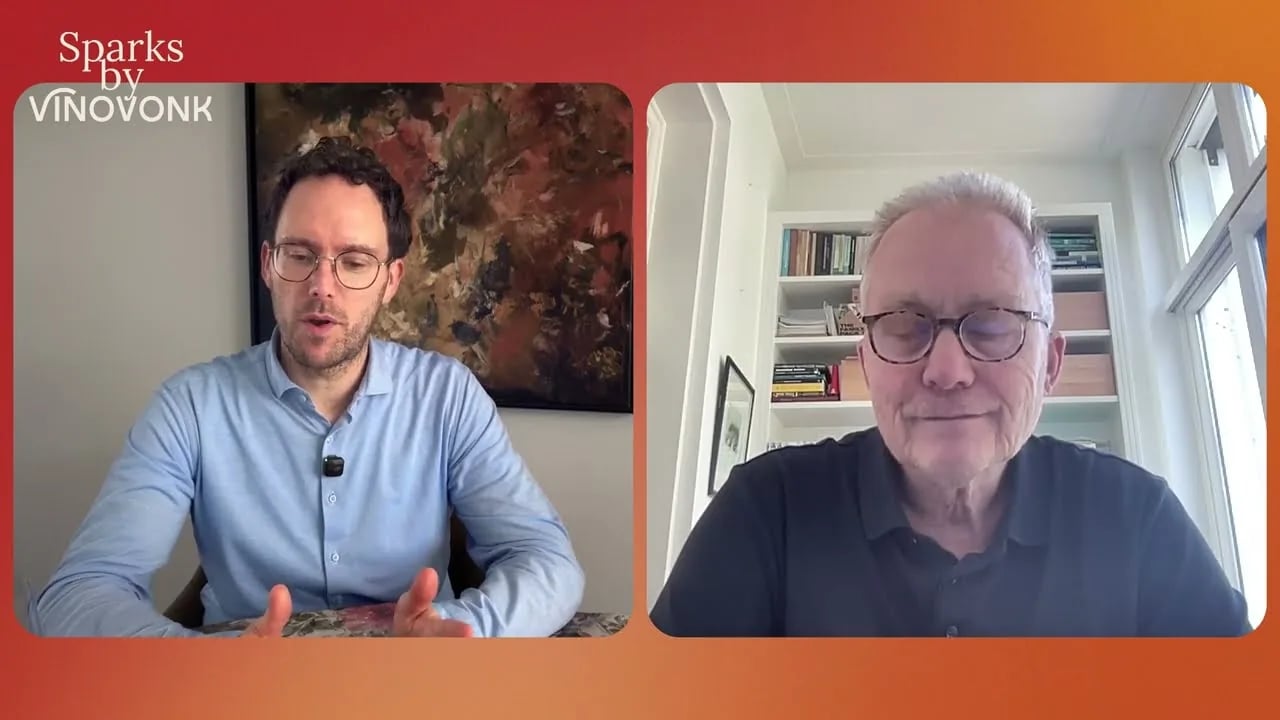
Jeen Akkerman and his son Auke sent me a pack from The Winepack for the Sparks podcast. The Winepack makes four claims: organic wine, 80 percent less CO2, 30 days fresh after opening and 100 percent recyclable packaging. In this episode I ask Jeen what those claims rest on, and we taste the wine inside.
The Winepack sent me the pack; I received no payment and the opinions are my own.
Who is Jeen Akkerman
Jeen Akkerman studied at what was then the agricultural college in Wageningen, worked as an agricultural journalist and at the dairy group FrieslandCampina, then set up his own communications agency, which he has since handed over. Three years ago he started The Winepack with his eldest son Auke, a designer. They do not make wine. They buy organic European wine from producers and sell it in a box of their own. Jeen gives two reasons: he loves wine, and having two grandchildren has made him think more often about where the planet is heading.
“If you put bad wine in bag-in-box, bad wine comes out. But if you put good wine in bag-in-box, good wine comes out.”
In this episode
- What the 80 percent less CO2 claim rests on, and what The Winepack worked out for itself
- Why bag-in-box has a mediocre image in the Netherlands, Belgium and Germany, and how supermarkets shaped it
- Why The Winepack uses a bag without an aluminium layer
- How filling works, with as little oxygen as possible and a small shot of nitrogen
- Why Jeen goes to the Biomillésime fair in Montpellier every year, usually at the end of January
- How Vivino serves as the quality floor for selection
- What the Domaine Villemain Sauvignon Blanc from Touraine shows in the glass
- Where Jeen sees openings in hospitality, and why the bottle stays on the table in a smart restaurant
In the glass
During the recording I poured the Domaine Villemain Sauvignon Blanc from Touraine in the Loire. Jeen met the producer, Alexandre Villemain, in Montpellier; he makes the wine with his brother and their father. I found a textbook Sauvignon Blanc, very pure and a touch fuller on the nose, with a faint hint of the New Zealand style but none of its pungency. Then apple, citrus, a little peach, some tropical fruit and something floral. On the palate it struck me as approachable and supple, with plenty of fruit, fresh without sharp acidity, and a long finish.
A 3-litre pack holds the equivalent of four bottles and works out at about 10 euros a bottle. In the recording I said that 10 euros in a wine shop would not buy you a Loire Sauvignon Blanc of this level. A few caveats. I tasted a single wine, from a 1.5-litre pack The Winepack sent me, and I did not test the 30-day shelf life after opening. The price is also hard to benchmark: according to Jeen, The Winepack is currently the only importer of this wine in the Netherlands.
What I still do not know
The Winepack bases its 80 percent figure on a Scandinavian study that Jeen did not name in our conversation. The company also made its own calculation of how much wine fits in a lorry: roughly twice as much as in bottles packed six to a carton. Jeen is candid about the limits, too. Plastic has drawbacks, there is no biodegradable bag that protects wine well enough, The Winepack is not the cheapest option, and it is not yet reaching buyers around thirty.
Frequently asked questions
Does wine keep its quality in bag-in-box?
According to Jeen, that depends on what goes in. Filling takes experience: the bag should hold as little oxygen as possible, and just before the tap goes on a small amount of nitrogen is injected. Nitrogen is inert and drives out the last of the oxygen, so the wine does not oxidise.
How much more sustainable is bag-in-box than glass?
The Winepack claims 80 percent less CO2, based on a Scandinavian study. Its own sum: about twice as much wine per lorry as in glass. The bag has no aluminium layer, which, Jeen says, keeps it fully recyclable; with a metal coating, the plastic is hard or impossible to recycle.
For which wines does bag-in-box work and not work?
Jeen reckons glass bottles are only needed for 5 to 10 percent of wine, the wine meant to age. Ninety percent of all wine is drunk within two years, and that can go in a box.
Where does The Winepack source its wines?
Mainly at Biomillésime in Montpellier, which Jeen describes as the fair for the whole European organic wine sector. Dutch importers of organic wine liked the idea but preferred to wait and see, so Jeen goes to producers himself. Jeen says every wine scores 3.7 or higher on Vivino, and The Winepack only takes wines that also exist in bottle, so the Vivino rating works as a reference.
Listen on your own podcast platform
Prefer Apple Podcasts, Pocket Casts, Overcast or another app? Search for “Sparks by VinoVonk” and you will find the episode on your own platform.
Transcript
The full conversation transcript.
Show full transcript
This transcript is generated automatically from the audio and has not been edited. Speech recognition makes mistakes, so treat wording as an approximation rather than a verbatim quote. It is here for accessibility and search.
Hello everyone and welcome to a new episode of Sparks by VinoVonk. My name is Jeroen Vonk and I am going to take you into the beautiful world of wine. Today we are going to talk about a story that is personally very important to me, namely sustainability and organic wine, and I have a special guest with me for that. That is Jeen Akkerman. Jeen, welcome.
Hello! Jeen, together with his eldest son Auke, is the founder of The Winepack. And they were kind enough to send me a pack. What it says: Organic Wine, 80% less CO2 emission, 30 days fresh after opening, 100% recyclable packaging. Well, that is exactly what we are going to talk about.
But before we begin, Jeen, for those who don’t know you yet, could you briefly introduce yourself? Yes, I can. My name is Jeen Akkerman. I have a background in the agricultural sector in the Netherlands. I once studied at what was then called the Wageningen Agricultural University, so that was a very long time ago.
And during my working life, I focused on agricultural journalism, news for people in that business. After that, I worked for a large company in that world, FrieslandCampina, which I think is known to many people. And then I started my own business, first as a freelancer, as a communications consultant. That eventually became a marketing and communications agency, which still exists and also bears my name. That agency is called JEM.
I handed that over a number of years ago. So now I still do a communications gig every now and then, as I call it. And three years ago, I started The Winepack with my eldest son Auke , and that was based on two considerations. The first is that I discovered wine over the course of my life and learned to appreciate it immensely. So I am a wine lover.
I find it a very fascinating product. I don’t think I need to explain that to the viewers of this video either, because wine fascinates us. But what also occupies my mind a great deal—and I must honestly admit that, as perhaps with many people, this becomes more important at a somewhat later age, because my eldest son Auke also has two children, and they are my grandchildren— so yes, I think that plays a role too—that you tend to think a bit more often and more deeply about what the future holds for us. Well, we all know that is uncertain; we live in very uncertain times, but… We know at least one thing: that if we don’t start taking better care of our planet, that future looks less promising.
And so that is an important motivation to start The Winepack. And to be clear, it is not the case that you make the wine yourselves. No, we do not make wine. I haven’t learned all that much in my life yet, but one of the things I have learned is that there are a lot of things you can think, “I can do that too.” The Pippi Longstocking method. What is often—and in my experience, it is certainly true more often—is that there are almost always people who can do certain things very well, and better than you can.
There are countless ambitious and passionate winemakers in Europe who master that craft down to the last detail. So we are very happy to leave that to them. We are idealistic, but everyone has a role. And we believe our role is to support the winemakers who share a similar vision for the future as we do. These are often new generations, or at least younger winemakers, who work organically and agree that we need to take the impact of our actions on the planet more into account.
We are essentially trying to give them a platform. That is how you should view the role of The Winepack. That is indeed a beautiful philosophy, mission, and vision, of course. But regarding what you say yourself, I think: you shouldn’t think that you can do something better yourself, because there are people who can do it so much better, yet you started—or you all started—setting up a wine brand. Yes, marketing, communication, I get it, but you do have to consider what kind of packaging you are using to do that.
How did you find that out, then? Or is that something you’ve already encountered in your career? Well, a bit of both. Of course, I have picked up a thing or two about marketing and communication during my working life. But I’m certainly not going to say that I’m a genius or a guru in that regard; quite the opposite.
However, you are familiar with a number of principles. Your question is very relevant, because it is a process of trial and error, a matter of falling and getting back up. Even if you don’t make the wine yourself. That is, after all, the most important aspect of The Winepack. But developing packaging, our own packaging—we paid our dues for that too.
We also tried out things that we thought on the drawing board were fantastic, but which turned out differently in practice. But then again, designing a good box and Auke, my son, is a designer. That isn’t exactly the hardest part. So it’s a bit of both. But I can still remember that before we started The Winepack, I already knew it was a much more environmentally friendly and climate-friendly packaging.
And I looked into it back then as well, also with a friend of mine who is active in the wine world. We thought, “Well, we’ll just do that quickly; the box will come later, and we’ll just arrange some wine and some organic wine in bags.” My friend spent a while on that, but he eventually realized that, well, sourcing—to use a fancy word—that wine in bags is actually very difficult. And ensuring good quality, too. Yes, that is quite a challenge. And eventually, when Auke and I started taking it seriously, I decided to take the sourcing—finding the wine—into my own hands.
And on the one hand, that is difficult, but on the other, it is also really fun. Yes, but how did it all come about? I can imagine making the box, but also the bag inside—that is a 100% plastic bag, making everything recyclable. I have had bag-in-box wine in a box before; back then, you had to put the bag in the general waste because it couldn’t be recycled. But do you make this bag, do you make it yourselves, or is that something you purchase from somewhere?
We buy it in. And what you bring up is indeed an important point. Bag-in-box is a concept that has existed for a very long time. I believe it was developed in Australia in the 1950s or 60s. We don’t do anything with that.
Technically, it is quite a thing, of course. A plastic bag like that with a tap. The plastic, that synthetic material, also has to meet a lot of quality requirements to protect the wine sufficiently. So we just buy that in. And we did make the choice right from the start, because there are actually two variants when it comes to that synthetic material.
One is just plain synthetic material, which is what we use. Another is synthetic material with a metallic, an aluminium layer, a coating for extra protection. We chose the first variant from the beginning because it is 100% recyclable. If there is a metallic coating on plastic, it is not recyclable, or perhaps very difficult to recycle. We are not out to use as much plastic as possible, because plastic definitely has a number of disadvantages.
But our conviction is that if you don’t release plastic into the environment and recycle it properly, it doesn’t have to be harmful. We also looked into whether there might be an option to use biodegradable plastic. That doesn’t exist for this application. I understood from the companies involved in that field that they assume it isn’t possible anyway, because biodegradable plastic offers insufficient protection for the wine. Well, that’s a clear story.
And what I wonder then is, how do you go looking for new wines? Is it that you say, “Well, I know some people who still have a million liters standing around, bulk wine, and I’m going to buy that in”? Or do you go to tastings yourself or work with importers? When we started, we didn’t have any wine yet, of course. We did contact a few Dutch importers who are also active in organic wine.
In any case, we wanted organic wine. That is part of this concept. And that is what we mainly heard from them: “What an incredibly nice idea.” And we are very curious to see how things will go for you. That might sound a bit weak, but parties like that—and they are quite large companies—are not keen on experiments. And from their perspective, what we are doing is an experiment.
I understand that, too. After all, it has the track record, the image in the Netherlands—because we might briefly touch upon bag-in-box in a broader sense in a moment—but it is quite a risk, and we are taking a small risk. We are a small start-up, and that is doable, but for an importer like that, it isn’t interesting. It is much more interesting to see how things go and if it takes off; what we do is, of course, not that difficult to copy. So we thought, yes, we really just have to do it ourselves there.
And we have found a good way to do that. Because in the south of France, in Montpellier, where very good wine is already being made, there is the annual Biomillésime, which is a trade fair. And that is actually the fair for all of Europe, for the organic wine sector. So every year, usually at the end of January, I go there for a few days. It is an incredibly fun fair.
I have experienced many trade fairs in my working life. I always found them rather tiring. That is actually the case in Montpellier as well, because a whole day of wine tasting really takes its toll. But that fair is in any case… I find it incredibly likeable because it is sort of democratic.
So there are hundreds of organic winemakers there from France, Spain, Italy, Germany, Austria—so really very broad. And there is no distinction between stands. Everyone simply has a table. And I am used to fairs where the really big companies stand there with enormous structures. Here, everyone just has their own; everyone is equal.
That really appeals to me. You just walk through those aisles. By now, they have a good website beforehand where you can also filter by packaging method if you are looking for specific things, and there is a growing number of farmers who also offer wine in bag-in-box. So I pick those out and I also check their position on Vivino, the wine app Vivino, because we use that for the selection too. Yes, and then you start tasting and you strike up a conversation and then it either comes to nothing or a connection is made.
And if the latter is the case, then we are going to bring their wine to the Netherlands. What I like about your story is that you really go to the people themselves, to a very large trade fair. And it’s not like, we’ll go somewhere out of the way, or you just happen to stumble upon it. You really actively go looking for the source there, the largest trade fair in Europe when it comes to organic wine. Yes, there are two reasons for that.
I think it is very important to know the origin of the product. I have to be honest, I also just enjoy it. You get to know nice people who are passionate about something that you enjoy yourself. That is just fun to do. But anyway, on the other hand…
We are not looking for the most special wine, but rather wine that is organically produced and meets a number of quality criteria. And such a fair is much more efficient than driving around Europe yourself for weeks. And of course, you do come across something sometimes. I visit a winemaker occasionally, and I go to Italy quite often myself. And then I taste wine, and sometimes I ask if you’ve ever heard of bag-in-box?
That usually comes pretty quickly. A lot of wineries find bag-in-box troublesome or beneath their dignity. That is still the case. Much more than half of the wines are made to be drunk very quickly, within 1, 2, or 3 years anyway, and the amount of wine made to be aged longer to improve is simply much smaller. If you look at it closely, you only need glass bottles for 5 or 10% of the wine.
And 90% of all wine is drunk within 2 years. And that can simply be done in bag-in-box. We aren’t there yet, by the way. No, what I also find funny is that if you look at a lot of wine coming from Chile and Argentina, for example. I thought, “Yes, it’s not sustainable at all, all those bottles come on a boat.” I was told that it also goes in bulk, in big plastic bags.
So they aren’t in bag-in-box, but bag-in-the-ship, you could almost say. And then they arrive here in Europe, or probably somewhere in Amsterdam or Antwerp or something. And then they are put into bottles. I think… Just put it straight into the bag then, because it’s in there anyway…
That would be better, but the fact that it is transported in bulk is already a good step. Suppose you were to bottle it in Chile or Argentina and then put it on that boat; that would be much less efficient and cause much more emissions. But you are right; if you take it from a very large bag and put it into small sachets and then offer it to the consumer, that is better. But that is exactly what we do. Not with wine from Chile or Argentina, by the way.
Although some pretty good wines come from there too. But we find it logical to limit the distance in a sustainability concept. So we only say European wines. And I think most wine lovers will agree with me that there is more than enough choice in Europe if you want to drink many different and tasty wines. Certainly.
What I also find funny is that when your package arrived at my place, I also received a package with two bottles of wine. Because this is a one-and-a-half-liter carton. So there are two bottles in it, you could say. The equivalent of what is normally in two standard bottles. However, I also took a photo of it, and I will put that in that article mentioned in the show notes.
But this one was in a small box. And the other one, that was really in a very large box. And I think, that is just much more waste, much more cardboard. And then there is the weight as well. It really made a huge difference in weight.
I think, yes, people don’t really take that into account either. At the moment it is transported from, let’s say, the distribution point, the webshop, to your home. The more often you can transport things in lower weight, the greater the reduction in emissions. Yes, that is true. I don’t have that for this last stretch, the last mile or whatever they call it, the final stretch.
That is certainly the case. Having noted that I, we ship with PostNL, and I am seeing more and more electric vehicles from PostNL on the road. So that is only a good thing. But you are right, that weight and also the compactness play quite an important role. Because our claim is 80 percent less CO2, which we base on a study from Scandinavia.
But we also made a calculation ourselves once, comparing our lighter and more compact packages with glass bottles packed in boxes of six. And if you look at how much wine you can transport in a truck, our packaging allows for about twice as much wine in the same truck. Almost all trucks still emit CO2, so that also contributes to a lower carbon footprint for the wine. So you can carry twice as much wine relative to the weight. So that is simply an advantage.
And the advantage is also that you simply have much less waste. Yes, you have much less waste, that is true. What you sent me is a new Sauvignon Blanc. With what I am used to from bag-in-box, generally speaking, you can’t really say where it comes from. But with all your wines—because you have quite an extensive range—it simply states who makes the wine.
So the domain is listed, and you can therefore also buy that wine in a bottle. Yes, that is one of the things. Yes, sorry. And I find that very interesting. It’s not just bag-in-box, you know.
It is in bag-in-box here, but it also exists in a glass bottle. So it’s not something that’s left over, no. It’s simply that we are choosing an alternative packaging. Yes, look, a few things regarding that. We have high-quality wine and so we aren’t the cheapest either, you can mention that right away, but we do that also because we want bag-in-box to be taken seriously, so to speak.
And the image of bag-in-box in the Netherlands and in Belgium and in Germany is simply mediocre to less than mediocre. And that has a lot to do with retail in those countries. Retail in the Netherlands too. You see a fairly limited number of bag-in-box wines at Albert Heijn and at Jumbo and at Lidl, but retail actually uses bag-in-box because, I think, because that packaging is cheaper than glass bottles. And if you also put cheap wine in it, for example from Chile, then you have a super cheap offering.
I think retailers think in terms of target groups, market segments, et cetera. And there are people on a tight budget who aren’t too concerned about wine quality. I was a student myself. I bought a bag-in-box once back then too. I remember that I didn’t like it very much.
Waking up the next day wasn’t a pleasant experience. But anyway, that market segment exists and it is being filled in that way. But because of that, over the years, the idea has developed in many people’s minds that bag-in-box can’t be much good. That is actually the biggest challenge we face: making people understand that that doesn’t have to be the case. When people ask me about this, I sometimes say that I conducted extensive scientific research and made a very important finding: namely, that if you put bad wine in a bag-in-box, bad wine comes out.
But if you put good wine in a bag-in-box… then good wine comes out. That is why we try to show that this is interesting. Now, just a word about those bottles, because we do indeed want wine that is also available in bottles. This has mainly to do with the fact that we use Vivino, so to speak, as a reference.
Most wines packaged in bottles, and certainly the wines listed on Vivino—and I think all our wines also have a significant number of reviews on Vivino—are available. For some people—I think for quite a few people—Vivino is a handy tool. So, we also show the Vivino rating of our wines on our website. For every wine, we also have a link to the relevant page on Vivino so that people can verify that the rating is correct, and it is 3.7 or higher. So, we want to offer wine starting from that quality level, from that review level.
And if people look a little further, Vivino also lists an average price for most wines. Well, then you can also see that if you buy 3 liters of wine from us—which is the same as four bottles—you actually end up saving money. That isn’t the goal of our project, but it is a pleasant bonus. A very nice bonus indeed. I did some research on the wine you sent.
It is made from a Sauvignon Blanc from the Loire at Domaine Villemain. Yes, my French is very rusty. And I have already poured it here. What struck me was that it is immediately a typical Sauvignon Blanc, but that it is just very clean, very pure , and just a bit fuller on the nose. It isn’t that whole effervescence of Sauvignon Blanc from New Zealand, but it does have a slight hint of it.
It really is just super fresh. Yes, Touraine, that is the area around Tours in France, so roughly in the middle of France. That is, as far as I know, the birthplace of Sauvignon Blanc. And Sauvignon Blanc is perhaps produced even more in New Zealand now. It is super popular.
It is also really delicious. However, this is a bit more of the traditional Sauvignon Blanc. As you say, glad you like it. Personally—though that is very subjective—I find the nose, the aroma of the wine, very important. And I find that particularly pleasant with this Sauvignon Blanc.
Right. Yes, because it is very fruity, but it is also immediately the case that you think, it’s a bit of apple, a bit of citrus, also a little bit of peach, some tropical notes. And there is just a very beautiful bouquet in it. It is also a bit floral. It is quite a serious nose right away, so to speak.
Yes. I like it. I think you are very good at tasting wine. I am much less so. At least, I get a little further than just tasty or not tasty.
But I am not very good at describing very precisely what you smell. By the way, I have recently started my first wine course, so I am learning a bit. But it’s nice that you like it, yes. And what are you doing, if I may ask? I live in Arnhem and there are two lovely people there who have an initiative called Wijn op Maat.
Erik Peeters is teaching us. I’m not really that familiar with it, but I think it’s called SDEN. And then a, that is a… SDEN Netherlands. So I’m trying to learn a bit more about wine.
Applying some theory to practice with my extensive practical experience. Yes, a little bit, actually. The fascination is enormous, but the motivation to master it down to the finest details—that motivation is smaller than discovering many different wines in my own way . Yes, but it is also important that you do it your own way. Yes, and that starts with tasting.
If I remember correctly, do you have some of that too? Shall we taste it together? Cheers ! Mmm. I hope you don’t mind, Jeroen, that I took a sip.
That I didn’t spit it out. Didn’t spit it out. What I’ve learned is that if you taste a lot of wine and you keep spitting it out, you have the same experience every time. I’ve heard people say, yes, that’s how we’re calibrated. But that doesn’t mean I can’t enjoy it too, of course.
What I really like about this wine is that, on the one hand, it is very accessible. You could say smooth in the mouth. But if you hold it in your mouth for a little longer , the flavor continues to develop. You have a lot of fruit, a lot of depth. It is a very full-bodied wine, but also fresh.
Fortunately, it isn’t super acidic, because people would probably get a bit allergic to that—you think with such an OEM, very acidic—but it has a nice fullness to it as well. And the aftertaste is very long; you keep tasting it, you keep tasting that fruit for a very long time. I really think it is a very beautiful wine. To be completely honest, if you look at the price-quality ratio. Off the top of my head, you are looking at about 9 to 10 euros per bottle for this wine.
This wine is 10 euros per bottle if you buy a 3-liter carton. Yes, maybe it sounds very strange to say, but I actually think that is a cheap wine for what you get. If you look at the price-quality ratio. I think if you take 10 euros right now and walk into a wine shop and say, “Give me a Sauvignon Blanc from the Loire,” you won’t get this quality. That is incredibly nice to hear.
By the way, something I didn’t know but found out—because we have this producer, Alexandre Villemain—I met him in Montpellier. He works with his brother, whose name I believe is Jérémie, and their father, Jean-Marc. And it turns out that we are, at least for the moment, the only importer of this wine in the Netherlands. That is just funny. And incidentally, we are not striving for that kind of exclusivity at all in that regard.
I would only applaud it if this wine producer could sell even more wine in the Netherlands and not just in The Winepack. What I also like about this wine is that if you start learning a lot about wine, at some point you get a kind of feeling that a Sauvignon from that region is supposed to be like that. There are exceptions, of course, but if you want to learn what a typical Sauvignon from the Loire is like, this is truly a prime example. And is that what you strive for, saying, “Because I saw you have a Riesling too”? That it’s also a case of, “Yes, but it has to be a Riesling.” It is a Riesling, but you really just want a typical Riesling taste.
Which is what we strive for, in any case—because you just said we have quite an extensive range—we actually don’t think so ourselves yet. Of course, it can always be bigger and better, and a wide range is nice to look at and I think interesting for our customers too. We ourselves feel that we still have quite a way to go in that regard. Furthermore, we could, of course, start putting very exotic wines from almost unknown regions in bag-in-box. That would be great fun.
But I don’t think that would be a wise thing to do. Because let’s be honest, most wine consumers know something about wine. I know by now that there are so many grape varieties that I don’t know half of them. You might know a bit more than half or maybe even all of them, I don’t know. But if you’re just for ordinary people who like wine And if you want to offer something to someone who cares about the planet, then I think that first and foremost you should choose wine that meets your criteria and, above all, is very tasty.
That too; there are simply lovers of Riesling—there are also haters of Riesling, by the way, you know that too. And so we have a Riesling. And in my opinion, that is also a very good wine. Whether that is a typical Riesling, yes, I think so. So we don’t look for anything too special.
It can certainly be a bit different, but we try to find good representatives from the various well-known regions in Europe of the wines that are often originally made there, in order to find a good one. Yes, because what I also like, whatever you say—well, you know there are different grape varieties— I regularly have contact with people who think they know a lot about wine, but who don’t even know that wine is made from different grapes, that there are simply different grape varieties. And what I really like about your website is that if you don’t really know what you like, what suits you well, you have a special taste test. You can answer a few questions and the system says, “Well, you like this flavor, then this wine pairs with it.” I also think it’s a really fun way to discover what kind of wine I would actually like. There’s also an option like, “Well, you like this, but try this too.” Yes, that’s right.
If you take that test with us—I believe there are 12 choices: A or B, A or B. So you can do that very quickly—and of course, it’s quick and dirty, it’s not scientific—and you get what we call a flavor profile. And that profile contains three or four grape varieties. Primary ones, and we also provide a few secondary ones. So then you have a bit of an idea of what you could try.
I think we can help people on their way a bit with that. That’s all great, because then people also have an alternative. One of the last questions I have is… Do you put the wine in the bags yourself? Or do the winemakers do that?
Or could you tell me briefly, and if you say, the trade secret, is that okay too? Yes, that is top secret. No, no, that is actually very simple. It is what we talked about earlier. You shouldn’t do things you can’t do or that you can’t learn very well.
Filling such a bag sounds very simple. I have a bag and I fill it. I turn on the tap. But it requires a bit more precision. Or actually, much more precision.
So you do need some experience in it. Technically, there are two ways to do that. With a fully automatic machine. Then the wine is connected to such a machine in a vat. Those bags are fed into it and then the filled bags come out.
There is also a more manual method where you fill those bags yourself, one by one. But it is essential that the bags are filled and that before they are sealed—and that sealing of the bag is done by attaching the tap to that… and that opening intended for that—there is as little oxygen as possible inside those bags, and also that just before the tap is closed or the bag is sealed, a very small amount of nitrogen is injected. That sounds a bit technical, but it is actually very simple. That nitrogen displaces the remaining, that very small amount of oxygen that is still there from the bag, so that there is only wine and a little nitrogen inside.
Nitrogen is inert, so it has no effect on the wine. But by expelling the oxygen in that way, you prevent oxidation of the wine. Well, I don’t know if you would still want to do that on your countertop or in your kitchen, but I don’t think you would succeed. No, certainly not. Definitely not.
So that is why we do it differently. We have a company in France that supplies those bags. So when we do business with a farmer, we make arrangements. Some farmers also have the right bags in stock. If that is not the case, then we send the bags there.
We have our box produced in the Netherlands, so we send the box to the farmer. And the farmer fills the bags, either himself, or—also very nice—in France there is Le Camion Potion. That is an interesting phenomenon. That is a truck with a filling line for those bags inside. So, for example, one of our producers in the Camargue in France works that way, and he just calls every three months and says, “Okay, could you just drop by?” and he has a barrel of wine.
And then they switch on the line. And then he has his filled bags, which he puts into boxes, and that’s it. So no, we certainly don’t do that ourselves, Jeroen. Yes. What you just said was that the future is actually about, well, I want to broaden the assortment a bit.
But I can also imagine that at some point you see it in terms of stock and things like that. But what other things do you see in the future? What do I see in the future? Well, look, we started selling this product to the consumer. And we have been doing that for two years now.
Well, there is some nice growth in that. So yes, we are going to continue with that. What is a challenge for us—and this also has to do with my age—is that we are not yet reaching the new generation, my son’s 30-generation, sufficiently. While I do believe there is fertile ground there for our product. The difficult thing for my son is that he is in a different phase of his life.
So he is very busy with all sorts of things, including raising my two grandchildren. But I absolutely see opportunities there. And another option I do see is the hospitality industry. Specifically, look, because if you go to eat at a chic restaurant and you order a bottle of wine, you want a bottle. I don’t see people trying to impress their dining companion by ordering a carton of wine anytime soon.
That seems like a bridge too far to me. But there is also a lot of wine in the hospitality industry that is served by the glass. House wine or wines by the glass. And I think there are very interesting opportunities there for the hospitality industry. I don’t want to reveal everything about that just yet, but we are working hard on adding something substantial to our packages to make it even more attractive for the hospitality industry to do things this way.
We will be conducting a few trials with this after the summer. It sounds very exciting. Be sure to keep an eye on the website. I would say, if you are a hospitality business interested in this, the contact details are in the show notes. By all means, join the experiment, if that is how you want to view it.
May I make one more remark? Following up on the last point we discussed. Well, as you have probably noticed, I am not doing this to get rich. I have essentially closed my working life, and I really enjoy doing this. I would also really love it if, in five years, I could be at a point where I only have to go to Montpellier occasionally, and someone else takes over and can perhaps make a living from it as well.
So if there are people who see this video and say “I’m young and I want something,” email you, because I am absolutely open to that and I am not out to sell something very expensive. But that should be clear. Well, nice call. Jeen, thank you very much for your time. Thanks again for sending it.
Fits super easily in your fridge. Because it is very small. This is a one and a half liter pack. But I assume that three liters is there, that isn’t exactly super big. That is also a really nice advantage.
Keeps good for thirty days. Everything is recyclable. I think the price-quality ratio is very good. You get a lot of wine for the money. I would definitely buy it myself again.
I don’t say that easily. So Jeen, thank you very much for your time. This was another episode of Sparks by VinoVonk. And I would say, until next time. Cheers!
Cheers Jeroen!
Read also
Related article on this topic →Listen
Watch