

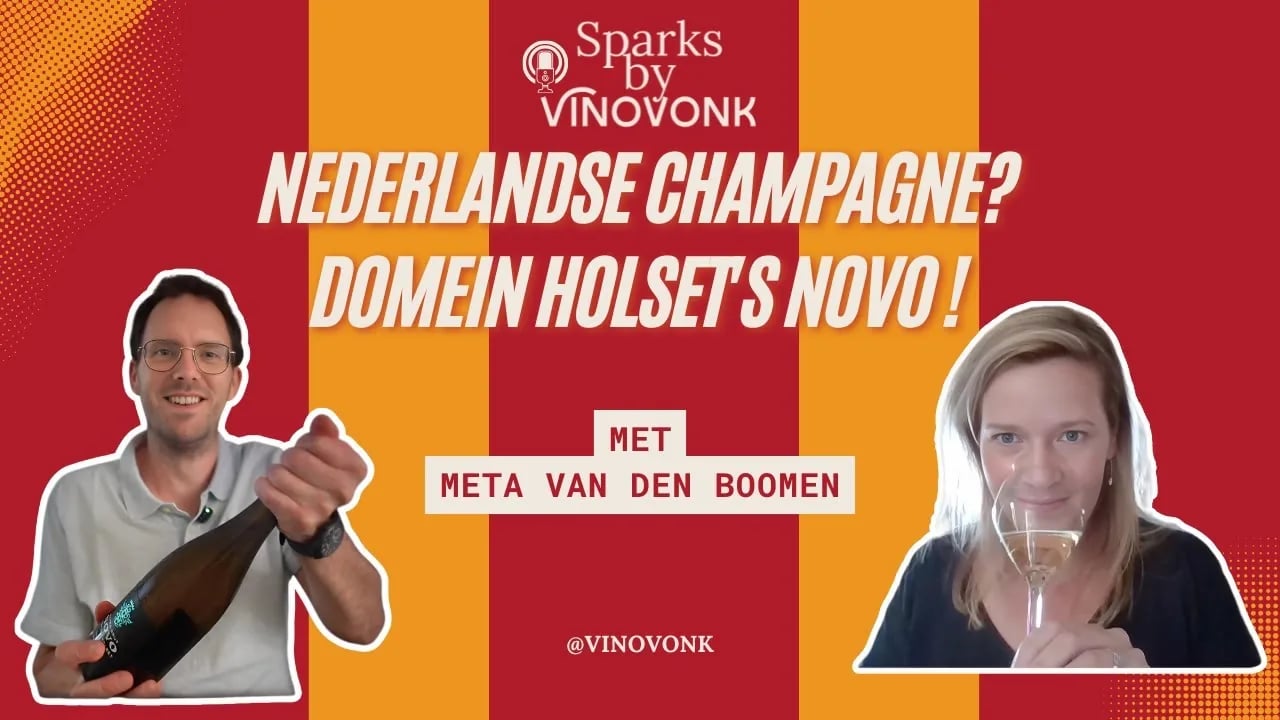
A visitor from Borgloon, who made wine there himself for years, recently told Meta van den Boomen that Domein Holset can now hold its own against Champagne. For this Sparks the estate sent me its newest wine, the Novo 2022, and I tasted it during my conversation with Meta. Holset sits at the very tip of the Netherlands, at the foot of the Vaalserberg near the point where three countries meet. Alongside Chardonnay and Pinot Noir it grows PIWI varieties, and the Novo is made from two of them: Souvignier Gris and Johanniter.
Domein Holset sent me the bottle; I received no payment and the verdict is my own. I was already a fan of their other wines, and I said as much at the end of the recording.
Who is Meta van den Boomen
Meta van den Boomen works at Domein Holset and shows visitors around; book a tour and you may well find yourself with her or one of her colleagues. In our conversation she explains that Holset looks to Champagne and the German Sekt regions without ever having wanted to copy them. The aim is Limburg sparkling wine of its own, grown on layers of sandstone and marl over limestone. On the warming climate, she puts it like this:
“In Champagne they might admit that now and then they sit with clenched buttocks too, because it is of course getting warmer. And for this style of wine, at a certain point that becomes essential to keep those fine, delicate acids.”
What you learn in this episode
- Why Holset plants PIWI varieties such as Souvignier Gris, Johanniter and Cabernet Blanc alongside Chardonnay and Pinot Noir
- Why the Novo spent 24 months on the lees when nine months is the minimum
- How the base wine was fermented partly in stainless steel and partly in oak and ceramic
- Why it takes at least eight years to get from planting a vine to a bottle of sparkling wine
- What the spring frost of 2024 did: almost no harvest, so part of the 2023 wine stayed in tank for blending
- What PDO Mergelland requires and why Holset cannot bottle under it yet
In the glass
The bottle had not long been disgorged and foamed eagerly in the glass. On the nose I found it very fresh and aromatic, with plenty of fresh apple and a hint of bread dough, brioche and toast. Meta says visitors are surprised by how fragrant it is, since sparkling wines are usually more reserved. She picks up fruit, perhaps even something floral, a certain spiciness and a touch of stone fruit, nectarine and peach.
On the palate it is taut and tart, yet balanced. It is an Extra Brut with 3 grams of dosage. Dosage is often what gives a sparkling wine its balance and its kick, and this one has that by nature. Meta puts that down to the malolactic conversion all Holset base wines go through in barrel, turning the sharper malic acid into softer lactic acid. In her view the portion in oak and ceramic gives the wine a little more ripeness and shape, while the stainless-steel portion keeps it fresh.
I found it a serious wine and a renewal of something established, and above all very good to drink. Visitors ask what to drink it with: as an apéritif, perhaps with a meal too. Meta finds it a good match for the lighter, Scandinavian- and Japanese-inspired cooking in good restaurants.
Caveats
- Disgorgement still happens in Germany. Holset handles the lees ageing itself, but as long as the wine crosses the border it cannot be bottled as PDO Mergelland. With its own disgorging line the estate hopes to manage that from 2026.
- Meta was not entirely sure about the vinification. The Souvignier Gris fermented in wood and ceramic; the Johanniter, she thought, only in stainless steel, though she would not say so with certainty.
- Price did not come up in the conversation.
- I tasted a single bottle, sent by the estate.
Frequently asked questions
What is the Domein Holset Novo 2022?
A sparkling wine from southern Limburg, made by the traditional method from 85% Souvignier Gris and 15% Johanniter. It spent 24 months on the lees and, at 3 grams of dosage, is an Extra Brut. The name comes from the Latin novus, new.
Why does Domein Holset use PIWI grapes?
According to Meta, PIWI varieties suit a cooler climate and a sustainable way of working. They are less susceptible to fungal diseases such as powdery and downy mildew, so they need less crop protection. That makes organic farming easier. In the longer run the estate wants to go biodynamic, with Demeter certification as the goal.
Can Dutch sparkling wine measure up to Champagne?
A visitor who made wine in Borgloon for years thought so, Meta told me. She points to the climate: Champagne is getting warmer, and the German Sekt producer who advises Holset called its base wines a textbook case for sparkling wine on their pH values. I have not tasted the Novo side by side with a Champagne myself.
Where can I taste or order Domein Holset?
The tasting room is open daily, no appointment needed, and tastings and tours can be booked. The wines are sold through the estate’s webshop and at a number of wine merchants.
Listen on your own podcast platform
Prefer Apple Podcasts, Pocket Casts, Overcast or another app? Search for Sparks by VinoVonk and you will find this episode with Meta van den Boomen.
Transcript
The full conversation transcript.
Show full transcript
This transcript is generated automatically from the audio and has not been edited. Speech recognition makes mistakes, so treat wording as an approximation rather than a verbatim quote. It is here for accessibility and search.
Hello everyone, and welcome to a new episode of Sparks at VinoVonk. My name is Jeroen, and I’m taking you into the inspiring world of wine. And today, a very special moment. We’re going to taste this new wine from Domein Holset, the Novo. And of course, I’m not doing it alone; I’m doing it with Meta van den Boomen from Domein Holset.
Hello Meta, welcome. It’s great to be here. And thank you so much for sending me this beautiful bottle. I’ll show you a good look. If you listen to it, you can also watch us.
And it’s your newest wine. But can you tell us a little about Domein Holset for those who don’t know? That you’re one of the few in the Netherlands to do the sparkling wine process entirely in-house. Yes, we are a sparkling winery, as we call it. We’re located at the very tip of the Netherlands, right at the foot of the Vaalserberg, near the three-country point.
And we are, indeed, fully specialized in producing quality sparkling wines. Real Limburg bubbles, in other words. And we do it all ourselves. In our own winery, from our own grapes. And we do this as sustainably as possible.
And according to the méthode traditionnelle, so essentially the same process as they use in the Champagne region. Fantastic, and you’ve been doing this for a while. I’ve been following you for a while, but lately you’ve been growing enormously. New vineyards and also new grapes. This wine is called Novo.
That stands for innovation, new. But what does innovation mean to you as a wine estate? Yes, that’s actually something we’re constantly working on, I think. The name Novo does indeed originate from the Latin ‘novus’. And for us, that truly symbolizes the signature of Domein Holset.
We are, of course, a Dutch wine estate. And that means we do look to regions like Champagne or German regions where sekt is produced. German sparkling wine. But we’ve never aimed to recreate that, for example. We truly want to make our own Limburg sparkling wines.
And in doing so, we do pay close attention to traditions and high quality standards. But we do forge our own path. In sustainability, which naturally holds a lot of promise for the future. In the use of both classic and new grape varieties. Yes, the winemaker is also willing to experiment.
It seems very good to have precisely that focus in the cellar. So I think that brings a bit of innovation to the classic wine world for us. It’s wonderful to hear, because you work with both classic and modern grapes. And which classic and modern grapes are those? We’ve planted Chardonnay and Pinot Noir, like those found in the Champagne region, for example.
And alongside them, indeed, new, or rather, modern, varieties. They’re also called hybrids or PIWIs. All names for the same type of grape variety. And these are grape varieties that lend themselves very well, also to sustainable methods and to a somewhat cooler climate. Because although it’s getting hot right now, the Netherlands is actually still a cool-climate country.
And we have Souvignier Gris, Johanniter, Cabernet Blanc, and Sauvignon Blanc here. And those varieties are very well-suited for refined sparkling wines. But the great thing is that they’re also somewhat less susceptible to fungal diseases in the vineyard. Mildew, false mildew, you might have heard of it. You probably know it.
It remains a challenge for every winemaker. Yes, those new varieties have the advantage of being somewhat less susceptible to those diseases. They have a somewhat higher degree of mold tolerance. Which means they can also mature well with fewer pesticides. Yes, that’s very nice.
Does that also make it easier to work organically or biodynamically? Those new varieties do make that a bit easier indeed. And that’s indeed what we’re aiming for: as organic as possible. Ultimately, we even want to produce completely biodynamically. And hopefully obtain the Demeter quality mark for that.
That’s a point for the future. But what we’re doing now is indeed limiting the use of pesticides to a minimum. And that makes perfect sense, but it’s simply crucial to maintain healthy vines. If you take better care of yourself, you’re less likely to get sick. We do that by working very carefully in the vineyard.
So, very gentle vineyard management, sustainable soil management, not using chemical herbicides, for example. And as organically as possible, actually. This wine contains Souvignier Gris and Johanniter, 85 to 15. But if you had to tell us something about the different characters and qualities of those grapes, how did you arrive at that 85-15 ratio? Regarding the character of the grapes, Souvignier Gris is a very fine grape in the vineyard.
It grows relatively easily. It produces beautiful images when the grapes ripen. The name says it all, that Gris. It actually turns gray, purple, or pinkish as the grapes ripen. The flesh is white, so you ultimately make white wine from it.
Johanniter, also a grape that… One of the first varieties planted here on the estate in 2009 is related to Riesling. It shares with Riesling the beautiful, fresh acidity and the fresh citrus fruit, the appley aroma. These are varieties that were planted partly with an eye, a bit of an eye on the local climate. Varieties that can ripen well here, whose flavor palette lends itself very well to sparkling wine.
Beautiful, fresh acidity is essential. And the blending is, of course, a bit of a combination of factors. And when you’re fermenting, you’re essentially putting together a jigsaw puzzle. So you look at how much wine do I have from a particular variety. Sometimes we blend a certain vintage for years.
Sometimes a slightly different wine is made from Johanniter. And how can I best bring that wine together in the bottle? So it’s always a bit of a puzzle, and yes, not by chance, but in 2022 it worked out like this: these proportions. But it’s actually always a bit more Souvignier Gris, supplemented with Johanniter. And that already makes it complicated, that jigsaw puzzle.
But as if that puzzle wasn’t enough, you say, well, we’re adding more pieces. We’re going to ferment this wine using three different methods: stainless steel, oak, and ceramic. But did you do that with both grapes? That’s a very good question, very technical at the same time. Sorry, you might want to leave this part out.
Souvignier Gris, I know it was fermented in oak and ceramic. I think Johanniter is only in stainless steel, but I can’t say for sure. No, but also because it’s the smallest percentage, so that might be the easiest. It then rested on the lees for 24 months, so that’s two years. That’s a really long time.
Why did you leave it for so long? Yes, it really has everything to do with the taste. For sparkling wines, the minimum required is nine months. But now, the longer you leave wine on the lees, the more refined the mousse and the more beautiful the aromas become. You have to imagine that this process is called autolysis.
Essentially, the yeast sinks to the bottom of the bottle after fermentation. Those bottles are all in the cellar, and those yeast cells actually break down, and then the flavor ripens and becomes more mature. You can compare it to when you first have crisp apples, and they lean towards baked apples. You get a bit of light brioche, slightly toasted notes, nutty notes. So yes, those 24 months—we consider that the minimum for truly beautiful flavor.
We sometimes even extend it, sometimes even 36 months. That’s a very long time. And we are indeed talking about PIWI varieties. These are grape varieties that are more resistant to mold. It’s a very beautiful German word.
I still haven’t been able to pronounce it. Do you see that as the way forward? Since you’re currently working with classic and hybrid, or rather, modern grapes, do you foresee this continuing in the future? Or will the volume of PIWI grapes continue to grow and become more important? Yes, that’s an interesting question.
I think it’s precisely differentiation, or both, that yields the best results here. What’s really important is to be very forward-looking. As a winemaker, you’re constantly focused on the here and now, anticipating what the weather will be like a week from now. And at the same time, you need a 10-year plan. That has to do with…
Because it takes quite a while after planting a stock of grapes… before you can even harvest grapes and make wine from them. What many people don’t realize is that… … from the moment a planting goes into the ground…
… it takes at least eight years before you have a bottle of sparkling wine. And you also have to consider that the climate changes, of course. So, grape varieties that, for example, nine were planted here in 2000 when the estate was founded. Yes, if they’re still doing well now, they’ll still be doing well in ten years.
So you really do need to plan carefully. That’s why we added some grapes in 2023, for example. We planted Pinot Blanc. These are varieties originally from Alsace, and in 2009, we didn’t really expect them to ripen here. But it’s a…
Yes, a little bit now with the warming, although it does have its downside, so with the possibility of cooler grape varieties, yes, you do have more possibilities. So we’ve planted those varieties now. But also Sauvignac, for example. And this year we added a new, different Cabernet Blanc. We’ve had that for a while in small quantities, but we’re seeing it perform very well.
Yes, a very beautiful variety. We make our “dot” from it, our other wine. So it actually remains a beautiful collaboration between the two varieties. Yes, super cool, and the more different grape varieties you have, the more complex the puzzle could become. So who knows, maybe in the future there will be an extreme example of all the grapes fermented in different ways.
Super complex wines, instead of this, it’s all this, and you just call them Holset. Because it’s basically everything in one. But yeah, gum cuveren. No, I think this jigsaw puzzle is already extremely difficult. The more complicated and difficult it gets, I don’t think you’ll be very happy with it.
It’s very difficult, and at the same time, we learn more and more about our signature throughout the year. There are certain wines that always return. They might be blended differently. For example, one year, the prince or a well-known wine might contain a little more Souvignier Gris than another. And our lady, for example, is always…
Chardonnay oaked. But one year, a little more oak. Yes, that fluctuates a bit, of course. You get the best out of your grapes every year. And no year is the same.
So we do see that we have more of a consistent style. But new wines are also coming. And we’re still thinking naturally about that. For example, we’ve just made a limited edition Blanc de Noirs for Hans van Wolde’s Bolenius. Oh well, maybe…
Then another Blanc de Noirs will be released at some point. You currently only make wines from grapes from a single vintage, or, like Champagne, you make the majority from a single vintage plus some reserve wines. Both. That’s obviously an advantage with sparkling wines, being able to blend vintages. With still wines, it’s actually a bit of a no-go.
But sometimes it’s also a necessity. For example, 2024 was, well, I can only say it was a pretty terrible vintage. We were able to harvest very little to almost nothing. A tiny bit of Johanniter. That’s not enough to bottle as a vintage.
So when we… did that in the spring last year. We had significant losses due to the spring frost, so it will probably be a smaller harvest. We also left part of the 2023 wine that was still in tank in tank. Because we thought, yes, we can start cuving again and combine vintages with each other again.
Yes, it’s not that we… Actually, the consideration is always to make the best possible wine. So it’s not that we say we always want to blend vintages to get a consistent flavor, like some large systems, sometimes Champagne houses, have in their house style. But it’s actually that we always make good wine, and sometimes that means multiple vintages, and if possible, we really enjoy vintages too. Yes, that’s actually the innovative aspect, I think.
Super nice. Speaking of innovation. He’s starting to get quite warm, because he’s starting to sweat. Shall we open it? I’ve already opened it, but you’re going to cork it.
I think, normally I do it in the kitchen, because sometimes it doesn’t stay neatly in the bottle. Let’s put it that way. But I think, this is a special occasion. See? A little bit.
And that’s why people sometimes ask, “Why do you always have such a floral tablecloth?” I think, “Yes, it’s a tablecloth, because things sometimes get spilled on it. You spill something sometimes.” Yes, that’s how it goes. It foams nicely. It wasn’t disgorged that long ago, so it still foams quite a bit in the glass. Nice and lively.
Like that, and super aromatic. That’s very special. Before I forget, cheers. To a wonderful success. Oh, that’s very refreshing.
Lots of fresh apple, but indeed, as you just said, a bit of that bread dough, brioche, toast. Yes, it really is, people find it very surprising, because it’s the same, sparkling wines are generally a little less fragrant, often a bit more restrained. And this is truly a wine, as you say, that fruity, a bit floral perhaps even. A certain spiciness and a certain softness emerge. Also a little bit of stone fruit, a bit of nectarine, a peach.
Oh, really very pleasant. But I’m very curious to see how it tastes. Shall we? Come on, shall we? Hello.
Here it is in the mouth, so I swallow it. That’s very nice. It’s an extra brut. So that means the dosage is very low. I see 3 grams.
But it’s tight and acidic, but there’s balance. It’s not like you think, “It lacks balance.” It’s still a bit lacking, because a dosage, a bit of that sweetness, often gives it balance and a certain kick. Like, “Yes, I’m there.” But it naturally has this. But that’s also because all our wines undergo malolactic fermentation in the cellar. That doesn’t always happen with sparkling wines, because that lively acidity is very important for sparkling wines.
But now we’re here, and that’s also a bit of an advantage here in Limburg, the northern part of course, that we already have a very nice pH in the base wine, so good acidity. And we actually let all the wines, the base wine, mature in barrels for ten months. Before we bottle them for a second fermentation, they undergo malolactic conversion, where the sharper malic acid is converted into the slightly softer lactic acid. That sounds very technical, but you have to imagine it going from “oh, gremlin-like” to slightly softer, yes, yogurt-like acidity. There’s no yogurt in it , mind you, but lactic acid, and that does indeed create what you describe: “oh, it’s lively, but it’s still soft.” And then you can indeed leave it very pure with just a little dosage.
It really is a very serious wine. You might think, “Renewal, innovation.” Is it an experiment, but this is certainly not an experiment. You really notice that this is simply a true renewal of the existing. I’d like to say, very successful, but it’s simply very delicious. Thank you.
It’s quite a process, of course. It’s assembling, blending different ratios, different vinification methods. But do you remember that first taste and thinking, well, this is it? Yes, that was with Kirsten Abeels, our director and winemaker at the estate. She would have loved to join us for a tasting, but it’s mid-August and she’s incredibly busy preparing for harvest.
Both in the cellar this morning, as they were busy getting everything ready. They were also looking at the different plots of grapes, measuring, and seeing how the aging is going so far. But the first tasting was actually with her. She’s actually in the lead-up to when a wine is about to arrive, do we actually disgorge bottles by hand and see how they are now? Are they good ?
And what dosage should they ultimately have when we disgorge them? We’ve had wine from Souvignier Gris before. But the great thing about this one is that you’ve had a little aging in oak and ceramic. That gives it a touch of maturity, a bit more shape. At the same time, some of the aging in stainless steel is also very fresh.
So I immediately understood what you just said. That it’s really different. It’s very uplifting and very exciting. That was my first impression. Super cool.
I announced on Instagram that I was having this conversation. What’s causing people to have questions? And what I thought was a good question was how do you position this wine in relation to the Dot and the Dame? Those are other wines you make. Yes, Novo is truly a member of our wine family, as we sometimes say.
How does that wine compare to the others is perhaps a good question. Dot is made from Cabernet Blanc, another PIWI variety. That’s also very aromatic, but even has some light green vegetal notes. It reminds you of lovely freshly mown grass, green herbs, a bit of that limey note. So I really like that.
Yes, they also launched it in the spring. A real addition to springtime: fresh green salads, very refreshing dishes. Dame is actually a permanent Dame in our range. Chardonnay here from Holset. They also share it in oak, ceramic.
That one is brut nature. Yes, it might also have a bit more body, a higher oak content. I think the Novo is a bit fruitier. Yes, super cool, it’s a member of the family, so for now it’ll stay in the family. It’s not a one-off.
I think that will become clear. But so far it’s been well received. Yes, that’s good to hear. You’re saying welcome to the family. And I’m also curious about what other reactions you’ve gotten from people.
Because I think it reminds me a lot of… you also tasted a sparkling wine once, I think it was last year at the Low Countries Wine Festival. That was the non-traditional method. I think there was a lot of Souvignier Gris in it too. And that was also very fresh, accessible…
You’d almost call it a nice, easy-drinking wine, which isn’t good, of course, but it is very appealing. Well, the nice thing is, we still have a little Brusch. And we’re now serving a tour during our tasting. I’ll let you know right away, but anyway. We’re now serving Brusch alongside the Novo.
And that’s really great, because it also illustrates very well what the méthode traditionnelle does. Brusch is actually a semi-sparkling wine. This is something we did once as a side dish, a lightly sparkling wine. But the Novo is made with the traditional method. If you compare them, you do taste in the wines that…
…yes, the fruity notes of the souvignier gris return. But then you also notice that the Novo has a bit more complexity. And more of those brioche-like notes. Also that it’s really fresh and dry. So you can tell from the reactions of people who say…
…wow, but also really… This really is a serious wine. Yes, very surprising. And because it’s quite colorful, yes, people also ask: What can you do with this? As an aperitif, perhaps with a meal, for example.
And do you only get visitors from the Netherlands or also from abroad? A lot from the Netherlands. I think I even had Chinese people recently, but also Flemish and Germans, for example. We’re naturally on that border. Belgians are also real fizz drinkers, so they’re finding us more and more.
So it’s great to see us becoming increasingly well-known abroad. And what are people’s reactions like? They’re like, “Do you make sparkling wine here?” Do you make it all yourself? And just to be clear, a few weeks ago I had a chat with Jochen Schaukelberger, who makes a lot of sparkling wine using the traditional method. He also produces it for Dutch wineries.
Then the wine goes to Germany, and the entire process is done there, including disgorging. So after the resting period, it’s corked. And then the bottles are returned to the Netherlands. But you do everything in-house. So everything stays at the estate itself.
Yes, to be honest, we still have the disgorging done in Germany at the moment. So we do the aging on yeast entirely ourselves. But we are indeed working on our own disgorging line. Yes, we’ve invested heavily in the cellar in recent years. But to get that there as well.
And from that moment on, our wines can also be bottled under the PDO Mergelland. The protected designation of origin here in South Limburg. It’s actually comparable to the AOC in France. And that means the wine must be made from start to finish here in Limburg, so it can’t really be exported. So yes, that’s something we hope to be able to do starting in 2026.
I remember getting a tour of the entire facility, and I thought, wow, what a lot of equipment! It was extraordinary. I think, yes, it’s logical for a small winemaker not to have that. But like you, yes, it’s still an investment. But what are the reactions from people from China, France, Belgium, and Germany?
We happened to have a man here this week—I don’t actually remember his name, but he was from Borgloon, or he had been making wine there for years. I think he started in the early days around 1989. Including Seyval, Pinot Blanc I believe, and Pinot Gris at some point, and he said, “Yes, I’m really impressed, because you can now hold your own against Champagne. ” I think so, because that’s really nice to hear, of course. Yes, that’s fantastic.
But aside from that, you can hold your own against Champagne. There are so many different producers in Champagne. You’d think it’s all the same. Well, from personal experience, I know there’s also a lot of Champagne made that isn’t very good. Let’s keep it civil before the hateful comments start pouring in again.
[Laughs] If you look at the future of winemaking in the Netherlands, climate change is what you mentioned. Last year the harvest was much lower due to the bad weather. But if you look at the future, how do you see it? Yes, very positive. On the one hand, the climate here is, of course, super suitable.
Terroir in Limburg, in particular. We’re beautifully situated in the hills here. That means good sunshine. The soil—sandstone, marl on limestone, layer upon layer— is a fine soil for good acidity, including in your grapes. And what’s really nice is that a German sekt producer who also advises us used to say, “We actually measure with base wines.” Recently, he said, “Yes, your wines are technically perfectly suitable for sparkling wines.” If you look at the pH values and such, that’s really according to the textbook example.
And in Champagne, they might admit they sometimes have to clench their jaws because it’s getting warmer, of course. And for this style of wine, at some point it’s essential to have that beautiful, fine acidity. So, in that sense, I think we’re in a very good position here. And the second thing, which is of course more important, is that it’s actually being drunk. And I think what we’re really noticing is that there’s increasing interest in local wines, of course, also in gastronomy, stylish wines, some from good restaurants, really because of the ticket-grabbers.
You see that they often say, I really want to surprise my guests with a nice sparkling wine, it’s different, it’s from our own country. And that also fits perfectly with the current culinary trend, that Scandinavian Japanese, somewhat lighter, more refined dishes. Our wine complements that perfectly, so we appreciate that. It’s certainly beautiful. I’m encountering it more and more in the hospitality industry.
And every now and then I think, why don’t you work with Dutch wine? Yeah, I’m not really familiar with it. I say, well, we have a lot of Dutch wines. Then you have a few major players. And it’s still unknown that I think, yeah, you know, certain regions in France.
But not in the Netherlands. While I think, take a different route back if you’re driving to Amsterdam or Rotterdam or somewhere else. And you pass by you, you pass somewhere else. It’s also interesting, of course. You can just stop by.
You’re open daily. Take a sip. For people listening now who say, yes, I want to try it too, I want to drink it. Where can people buy this? We aim to be very accessible as a domain, so we’re open daily.
The tasting room—if you’d like to learn more, you can also book a tasting and tour. Our wines are also available through our webshop and are now available at several fine wine merchants. You don’t have to search very hard for beautiful Dutch Limburg wines. Yes, as I just said, just try something different. But you’re open every day, so if people say, “I want to come by sometime,” you can just drop by without an appointment or with an appointment.
No, you can just drop by. Yes. Absolutely. Well, people be warned, if they come around the end of August, you might also be asked to help with the harvest. Oh yes, we expect to start harvesting in early September and actually be busy throughout September.
So, that’s nice that you mentioned that. We put out a call today again. We could use all the help we can get, because it looks like it’s going to be a great harvest. Fantastic! 2025 will be a better year than 2024.
We won’t dare say it until that harvest is in the cellar. But let’s toast to it anyway, because it does look promising. Great to hear. That pretty much runs out of questions. Do you have anything else you’d like to share to wrap up?
I could tell you a lot, but I’d really say come by. Book a tour, because then you might meet me or one of my fellow winemakers. I also really enjoy explaining the sustainable methods. You can even do that right out in the vineyard. I’d say come and experience it.
Well, that’s a great invitation. I’m going to enjoy it for a while longer. Want to know more about Domein Holset? The link to the website is in the show notes. Do you have any other questions?
Send me a message or Meta. All the details are in the show notes. Thank you so much for sending me this bottle. I really enjoyed it. And I was already a fan of the other wines, but…
That doesn’t mean I can’t be objective. Really, super cool. Meta, thank you so much for your time. Yes, thank you so much for letting me be here, it was so nice. Yes.
You’re welcome. This was another episode of Sparks at VinoVonk. The wine podcast where I share inspiring stories from the wine world. I’m definitely a bit inspired again. I hope you are too.
Until next time. Cheers! Cheers!
Read also
Related article on this topic →Listen
Watch