

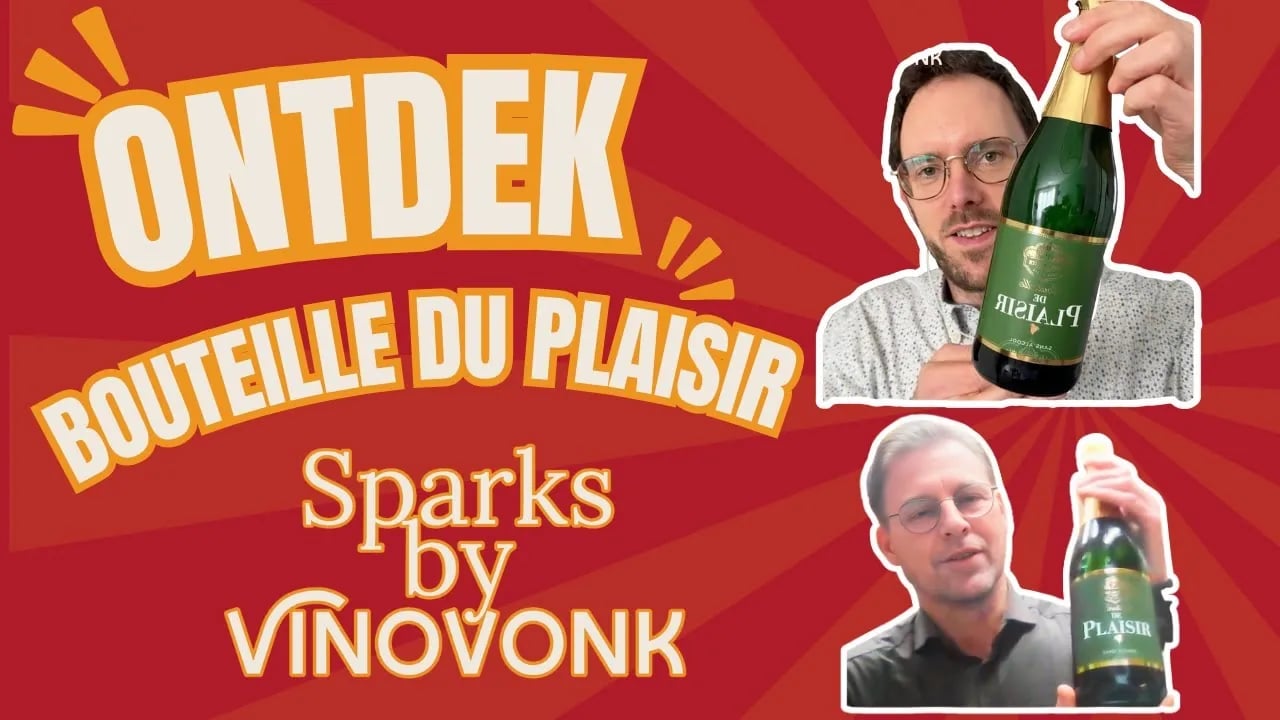
During the conversation 31-1 goes on a cork, the date of the recording. In this Sparks I talk to Pascal Noordover, a wine importer and the founder of Bouteille de Plaisir, about fizz for marking an occasion. We open two bottles together: an alcohol-free cuvée from Württemberg and an organic Riesling sekt from Rheinhessen.
Pascal sent me the bottles; I received no payment and the opinions are my own.
Who is Pascal
Pascal Noordover is a wine importer, and Bouteille de Plaisir is his private label. He went looking among German winemakers for two sparkling wines to sell under that name, one alcohol-free and one with alcohol.
The idea came from Irene, a marketer he knows through a business network. She once visited a company with a wall of corks, each marked with the date of a big client win or an anniversary. The two of them wondered whether you could put that into a bottle.
“The moment you uncork a bottle of sparkling wine passes quickly. But you’re making a memory right then,” Pascal says. That is why the gift box includes a small marker for writing the date and the occasion on the cork.
What you learn in this episode
- How a wall of dated corks became the idea behind Bouteille de Plaisir
- Which grapes go into the alcohol-free cuvée from Württemberg, and what PIWI varieties are
- Why Pascal sees demand for alcohol-free growing, including among companies buying client gifts
- How the organic Riesling Winzersekt from Rheinhessen differs from the alcohol-free
- Why the bubbles in the sekt feel different from the added carbon dioxide in the alcohol-free
- What both bottles cost, on their own and in a gift box
In the glass
The alcohol-free from Württemberg is dealcoholised wine, with its fizz coming from added carbon dioxide. It foams up readily, the mousse settles fast and then it keeps a fine, steady stream of bubbles. On the nose we find fresh apple, close to the first bite of a Granny Smith, with lime, lemon zest, a bitter edge of grapefruit and something floral that recalls jasmine. The palate is fuller than you might expect, with a touch of sweetness that keeps the acidity in check. The tell-tale smell of dealcoholised wine barely shows; according to Pascal, people served it blind don’t immediately notice there is no alcohol in it. Price 19.99 euros, or 27.50 euros in the gift box.
The organic Riesling sekt comes from a winemaker in Rheinhessen: 100 per cent Riesling, traditional method with second fermentation in bottle, 12.5 per cent alcohol and, according to Pascal, around 6 grams of residual sugar per litre. It is golden yellow and the mousse is finer still. I get lots of honey first and a hint of butterscotch, then apple, fresh lime and a little pineapple. Pascal puts that richness down to late, ripe picking, yet the wine is dry and has more acidity than the alcohol-free. Price 21.49 euros, or 28.99 euros in the gift box.
Going back and forth between them, the sekt is tighter and more serious, the alcohol-free softer and more easy-going. In the sekt the bubbles sit within the wine itself; in the alcohol-free they seem to sit around it.
Caveats
Pascal admits himself that the bottles are on the pricey side. The conversation also touches on alcohol-free wine still having ground to make up on quality, as alcohol-free beer did before it. Pascal imports and sells both bottles, so what he says about the winemakers is his account. And we tasted one bottle of each wine.
Frequently asked questions
What is Bouteille de Plaisir?
Bouteille de Plaisir is the private label of wine importer Pascal Noordover. It sells two German sparkling wines, one alcohol-free and one with alcohol, for celebrating special occasions. The gift box comes with a marker for writing the date on the cork.
Which bubbles do you taste in this episode?
Two: a dealcoholised cuvée from Württemberg made from Muscaris, Cabernet Blanc and Müller-Thurgau, and an organic Riesling Winzersekt from Rheinhessen made by the traditional method.
How good is the alcohol-free version?
The mousse is fine and lasts, and the typical smell of dealcoholised wine barely shows. Its fizz does come from added carbon dioxide, and you notice that next to the sekt.
Where can I find Bouteille de Plaisir?
Through bouteilledeplaisir.nl, as a single bottle or in a gift box, for both styles.
Listen on your own podcast platform
Prefer Apple Podcasts, Pocket Casts, Overcast or another app? Search for Sparks by VinoVonk in your podcast app and you will find this episode with Pascal Noordover on Bouteille de Plaisir.
Transcript
The full conversation transcript.
Show full transcript
This transcript is generated automatically from the audio and has not been edited. Speech recognition makes mistakes, so treat wording as an approximation rather than a verbatim quote. It is here for accessibility and search.
Hey everyone, I’m Jeroen. Welcome to Spark by VinoVonk A series in which I take you into the world of wine, spirits and other innovative drinks. And today I have a nice guest, Pascal from Bouteille de Plaisir. Hello Pascal, welcome. Hi Jeroen, thank you.
Nice that we can have this conversation. Certainly. People wonder what is Bouteille de Plaisir? That’s one of those bottles. And Pascal, I understand that you make it and take care of it.
Can you tell us something about Bouteille de Plaisir Bouteille de Plaisir is, I have it here too, is a private label. I am a wine importer and I really enjoyed launching something under my own label. And not just anything, but something that stands out. The name says it all, Bouteille de Plaisir is a bottle of sparkling wine. We have an alcohol-free version and a version with alcohol.
with which you celebrate special moments. That’s all well and good of course in the sense that the appearance and the name already makes it a party. But ultimately it is also about the content. And that’s what I looked for and found as an importer. Two wines that I think can easily tolerate this label.
And they are really worth that moment of pleasure. So that’s the background and we’ve recently introduced and launched this. And we are very curious to hear what people think of it. We are very enthusiastic, but that goes without saying. nice and funny too.
It’s a bottle for pleasure. This green variant contains no alcohol. We also have a version with alcohol. That is a biologically produced cult. But talking about this one, what is the consumer price of this?
consumer price is 21.49 euros, that is for the bottle, but what we offer for 7.5 euros more is that when you buy it in the gift box, it actually supports that special festive moment. So it’s actually a very nice gift where you also get a small marker in the set with box. whether it is clearly visible. But the idea behind that marker is that when you celebrate the moment, you also write down the date and occasion of that moment on the cork with that marker and that you can keep that mark. so that you can also think back to that nice moment.
Because the moment of uncorking a sparkling bottle of wine passes quickly. But you make a memory at that moment. So that’s the whole idea. But the bottle itself costs 21.5 euros for the alcohol-free variant. And can you tell us something about the wine?
Is it a drink that does not originally contain alcohol? Or is it dealcoholized wine? Yes, it is de-occolized wine. Comes from Wurtemberg, so it comes from a German winemaker. Is a blend of various typical German grape varieties.
So it first had occol and was de-occolized. And I think that’s the trick, that often with de-occolized wine, the wine has a kind of… Then there is an aftertaste, as well as a very recognizable aroma of de-occolized wine in the smell. And this one has that to a very limited extent, but not at all unpleasantly. And that also means that people really have to think for a moment when they drink: is this alcohol or is it alcohol-free?
And that’s actually what I like about this product from Wurtenberg. Interesting. And how did you come up with the idea to do this? Well, we, and then I talk about Irene and I. Irene is a marketer.
I am a wine importer. We know each other from a business network. we were talking about capturing beautiful moments. And she once visited a customer, at a company, where they had a cork wall. So there they had a wall with all the corks with a date on them.
And on that date something special was celebrated. A major customer had been won, or an anniversary had been celebrated. And they collected those moments together. And so everyone came up with the idea of, can we also capture that in a bottle? Can we make a bottle that is especially suitable for those kinds of moments?
Then you can open any bottle of champagne or non-alcoholic bubbles. But this appearance and etiquette naturally reinforce that moment. Well, that’s the whole idea. Interesting. then I understand that you start with such an idea.
But why do you choose to make an eyelet-free version? Yes, that is a good question, but I think it is very topical. From a social perspective, you notice that there are more and more requests for alcohol-free alternatives. And I notice that you recognize that among the younger generation, but also among, well, the over-50s. That people are more conscious about alcohol consumption and are therefore looking for alternatives.
And especially if you have such an example of what I just mentioned within the business community. If you celebrate a moment within the company, the norm is increasingly that this is done without alcohol. As an importer, I also notice that when donating to relations, last Christmas, companies are increasingly supplying alcohol-free alternatives because they do not want to give alcohol as a gift to their relations. Yes, with alcohol it comes together in this way, but you really have to look for that high-quality non-alcoholic wine. Interesting.
I have become very curious about this one. Shall we open it and taste it? Do we do that synchronously? We try. Let’s try yes.
I tasted this non-alcoholic for the first time at the winemaker. An introductory drink. I was actually immediately very enthusiastic about the freshness and about what I just said, the fact that you don’t notice at first that it is alcohol-free. Are you going Jeroen? Very coy, yes.
That’s how it should be, right? And in a normal beautiful white wine glass, not a flute white wine glass or a beautiful tulle. I have a beautiful tulip. What stands out about this one is that it foams quite well. the mousse also settles down quite quickly.
It continues to bubble nicely. I have to keep him that way. Just turn. That’s a beautiful mousse. Yes.
And it will last for a while. And I always wonder how quickly it goes flat again when it comes to dealcooled wine. Well, how do those bibbles get in there? by the addition of Colesure in this case. But it is very nice, because you can see with the Colesure addition that it is really very…
Those are not those coke bubbles. No, it is a very nice mousse. Also a very nice scent, lots of fresh apple. It’s almost like taking the first bite out of a Granny Smith in the smell. It is fresh and acidic, quite aromatic.
And there is hardly any recognizability of dealcoholized wine. Yes, I often find that you also have that sparkling double soda and then a sweetish hint comes over you, but I don’t have that at all with this. It also very spicy, very lime, zest and lemon zest, also a bit of cranberry fruit. Lobster greeting indeed, so that sweet and sour. That sweetness is really there too.
That also makes it a bit fuller. But the sweet-sour balance is just very beautiful. that very fresh. Usually it is also very sour, this is not so sour at all. The fresh Granny Smith apple is also delicious.
Also a bit of that bit of grapefruit. Also a bit floral, a bit bitter jasmine. What you said, the spiciness that is in it, it fills the mouth. It is also highly permeable. If you serve this at a party, people will quickly ask for a second glass.
Yes, me, it’s very nice. Very pleasant mouthfeel, nice and full in the mouth. But not that it… You sometimes have that with a Prosecco that all those bubbles explode in your mouth and then they are gone. Remains very pleasant.
precisely. And that’s a very nice thing, yes. need to cheat for a while. As for the grape varieties used in this. These are muscaris, cabernet blanc and mularturkou.
So muscaris and cabernet blanc are so-called PIWI Relatively new grape varieties that are made to be highly resistant to mold. And Müller-Thurgau has been around for much longer, but it is also typically German. I think the Müller-Thurgau in particular also softens it a bit. It’s that I know it’s without alcohol. You said it, but it’s not like you don’t feel that way.
No, it would also be very nice if you tasted this blind, so you don’t tell people that this is alcohol-free. people will initially just start drinking, as if they think, I am offered a glass of wine, sparkling with wine. after the second glass, don’t worry, I still have to drive. that is, yes, I am alcohol free. Yes.
Yes, and that’s also… Yes. So I think that, if you look at consumer prices, we also realize that this is quite expensive, to be honest. On the other hand, you also have a good quality glass of bubbles. Yes, exactly.
Shall I just do that? You have it too, the marker. Yeah, I didn’t catch it again. Very bad. So if I put it now, today is 31.
On the fern you still have the dry January for a lot of people, nowadays people also just have dry year or dry old. Well 31-1, Jeroen is on it, so I’ll keep that. Very nice. Do you also have the feeling, Jeroen, that when you taste it, you are always used to spitting it out, especially if it is just as functional? Yes, that is not necessary.
No, but I do notice that if you don’t do it, you taste different. So, Esmee Langereis once said, we are calibrated to spit it out and then taste it a certain way. So out of habit I just started doing that. And you often notice that with alcohol-free wines that have been deal-cooled, they still retain a certain sharp acidity, because you… That alcohol always determines a bit of sweetness, structure, body, but that is not the case here at all.
is nice and sweet. Yes, what you say, alcohol increases the sweet impression. Wines with a lot of alcohol often make people think, is this sweet? But that’s the alcohol. So indeed, the moment you take it out, you would think yes, acid will dominate.
But here that balance has simply been maintained. And they did that very nicely. By the way, I am very enthusiastic, because of course we have a German wine. just a French name. The French name is of course a bit reminiscent of champagne, but I am very enthusiastic about the quality of the wines made in this part of Germany.
Many young winemakers who are very innovative and innovative, but also work very sustainably. So this one may not be certified organic, but I’ve seen what that family business does. They also want to pass on the vineyards to the next generation in a good way. To be honest, I think that’s an important aspect of the choice you make to import something or not. Certainly important.
And which part of Germany are we talking about? Wurtemberg is in the Stuttgart area, so that is southern Germany. That is less known. Most people know the Baden area in southern Germany. But Wurtemberg is very lovely, hilly.
Lots of beautiful rieselings from there. And they don’t have so much Speetbogunders, but you have Lemberger as a red, red, red grape variety, which they do a lot with. And Trollinger is more mass-produced wines for consumption. But lemberger, you can make very beautiful matured wines from it in all kinds of gradations. I’m really surprised by that.
So the area is small, but in my opinion underexposed. Very interesting. Shall we also open the alcohol bottle and taste the difference? Yes. Have you chosen to also release the variant with alcohol so that people say yes, but I want it with alcohol, because I also find it festive that you offer both?
We market this mainly with the idea of alcohol-free. That is our showpiece. The quality is also very good with alcohol, because it is a Winzersekt. It is a traditional method, second fermentation in the bottle. But we just see, as I said at the beginning, that the trend towards alcohol-free and that demand that…
We really wanted to respond to that. But what you say is the moment when people say yes, I have a party or I just want to be able to donate that too. I want to celebrate my birthday and I really want a nice, sparkling wine to go with it, so we have this one. And that actually doesn’t make that much of a difference in price. By the way, I see that I made a mistake about the price.
Because the prices I just mentioned Jeroen. Those are the prices of that kind of with alcohol. I don’t know if we can fix that. So this is the consumer price 21.50. And with the box 28.99.
And the one without alcohol is 19.99. So it is under 20 euros. And with the box it comes to 27.50. I’ll just mix them up. Here too there is quite a presence, I would almost say like with beer, foam tap.
But you have less of that, But you might get through the glass. very fresh, very fruity. If you compare it with each other, the metal carbon is indeed a bit dark yellowish, the other is a bit lighter yellow. I have to open something. Yes.
until cutting! Haha. Hey man, thanks. Lightly timed. So all seeing.
Well, let’s cut. Yes, this one with alcohol is indeed golden yellow in color. That full of color. The mousse is even nicer than the one without alcohol. Yes, that has to do with the process, of course.
Making it, so second fermentation in the bottle. Method traditional, yes. This is made by a winemaker. organic from Rhinehessen. 100% rieseling.
he has in Rhinehessen, he not only but many winemakers in Rhinehessen, have the style of picking the fruit full of ripeness. So a really long wait before it is harvested. That also gives a bit of sweetness. That is the German character. But if you look at how much residual sugar it contains, it’s not that bad.
That is around 6 grams per liter and that is then compensated by the acids. So here too there is that sweet-sour balance, which you will taste in a moment. That’s really fine. At 12.5 percent it is not that bad. The first thing that comes to mind is lots of honey.
But also a bit of those butterbabelaars, butterscotch from here. But also lots of fruit. Lots of apple, fresh lime. But also a bit of tropical fruit, also a bit of pineapple. Very interesting.
I think that the qualification of tropical fruit butterscotch honey that you say makes it really full. And that is completely true with, say, ripe fruit. So because of the relatively later harvest of those Rieseling grapes, this is a very full sect. it is fresh, it has the necessary acidity, but because of that full and yet pleasant sweetness because it is not a sweet wine, it is just dry but it is also nicely balanced. It is also very fresh, nice acidity.
You simply notice more acids here than with the previous, alcohol-free version. but they both have the character that this is about fun. Yes, that’s nice because that’s the intention. is to reinforce that moment when you open it. It’s nice if you actually know the difference and you would like to taste the other one again.
That’s always interesting, tasting it again. Look, what does that do? Then you will notice that the bubble is more present. It is just a little tighter in the mouth. And other things, it’s all a bit sweeter.
This is more serious, so to speak. But at the same time also that pleasant tropical thing you mentioned. With the version with alcohol you notice that the bubbles are really intrigued. They come from the drink. And in the alcohol-free version you notice that the bubbles are, as it were, surrounding it.
But usually if you drink without alcohol, then with alcohol, and then go back again, it can always be a bit cowardly. But that is not the case at all in this case. It’s correct… Yes, I believe you, it now says… less than 0.5 percent alcohol.
But you really don’t notice it. It really is a very nicely made product. When I was there, I actually noticed that right away. I had tried and tasted quite a bit of alcohol before. Never really enthusiastic about it, but I immediately thought, this is great.
Then I decided to import that. It is of course very nice if you can present it in this way with great pleasure . You can just show it off, you can give it as a gift. A beautiful gift box surrounding it. It is also a complete story.
Certainly. And, I think, it really gives that festive moment that champagne or sparkling wine has, alcohol-free. That’s absolutely fantastic these days. Especially if you do it in the office, you don’t necessarily have to wait until five or six o’clock. Then you can also do it in the afternoon if necessary.
Yes, if you wish, you may look a bit strange, but it could be possible. That could very well be the case. And what you now see is that non-alcoholic beer took quite a long time to develop to a level where you say this is simply very good and beautiful. But from a social point of view, non-alcoholic beer is fully accepted. So if you ask for a 0.0 at a party because you have to drive.
Well, in the past I might have looked a bit like, well, have a nice time. But that’s, that’s. completely leveled. And wine still has some catching up to do when it comes to quality. During Dry January in particular, many opinions have been expressed about non-alcoholic wine.
And of course there is a difference, because you take away a pretty important component of wine, namely the alcohol. But if you see that things are also going in this direction, then I have good hope for the future. Sure, me too. I would say, if you want to choose something for fun, you have an alcohol-free version and it costs… 1999 And you also have it with alcohol and then it costs.
21 49. That makes almost no difference. So very nice alternatives and very nice drinks. Very innovative too. And where can people buy or order these drinks?
That is bouteilledeplaisir.nl. Then you go to our webshop. There you can choose between alcohol-free or with alcohol. And you can also choose the bottle alone or with the gift packaging. So you can give it as a gift in a nice way.
Okay, thanks a lot. Very nice to get to know this. And I would say people, if you want something different to have fun, to celebrate something, they have a choice. Pascal, thank you very much. You too Jeroen.
Thank you very much. And I would say to everyone, have fun. Have fun!
Read also
Related article on this topic →Listen
Watch