

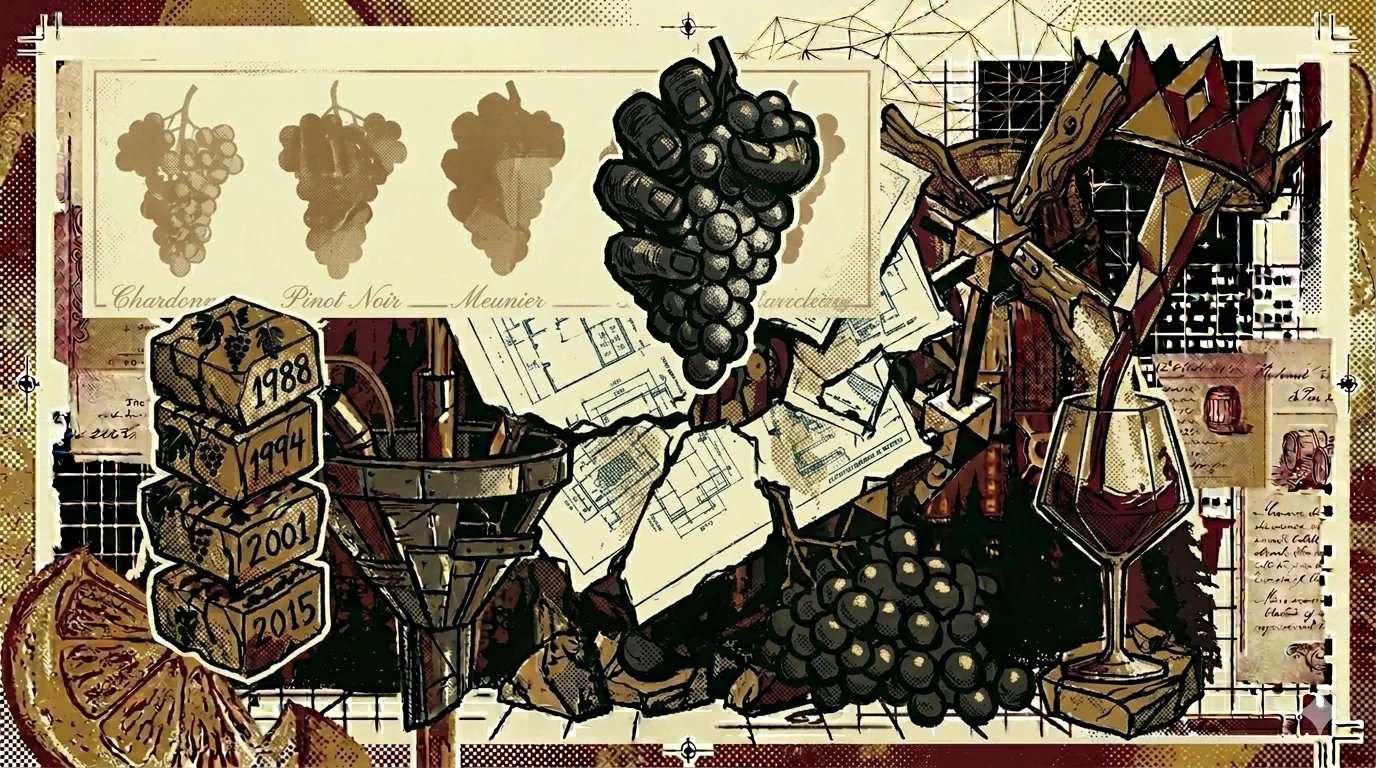
Alongside the three main varieties (Chardonnay, Pinot Noir, Meunier) and the two newest (Chardonnay Rose, Voltis), four others sit on the Champagne cahier des charges: Arbane, Petit Meslier, Pinot Blanc and Pinot Gris. Together they cover less than 0.3 percent of the vineyard area. Long dismissed as folklore, over the past twenty years they have been replanted by a handful of growers as climate-change insurance and as a statement of terroir identity.
The four rare varieties side by side
| Grape | What it does | Where it stands | Who bottles it |
|---|---|---|---|
| Arbane | Fine florality of jasmine and white blossom, with acidity more complex than Chardonnay’s and a citrus bite | Chiefly in the Aube around Bar-sur-Seine and Bar-sur-Aube; rarely above 50 hectolitres per hectare against 100 or more for Chardonnay | Moutard in Buxeuil has mono-varietal cuvées, Drappier uses it in Quattuor and Sept Cépages |
| Petit Meslier | Very high acidity that holds freshness in warm years, spicy and citrus-driven | Almost lost in the second half of the twentieth century, under 10 hectares in the 1980s | Moutard, Tarlant with a mono-varietal cuvée, and Aubry |
| Pinot Blanc, locally Blanc Vrai | Roundness and soft fruit of yellow apple, pear and cream, with lower acidity than Chardonnay | Marginal in the Aube and a few Montagne villages, while it leads in Alsace and Germany | Cédric Bouchard makes an occasional mono-varietal cuvée, Drappier uses it in Quattuor and Sept Cépages |
| Pinot Gris, locally Fromenteau | Perfumed with dried fruit and honey, and a faintly oxidative edge; early ripening, sometimes too early in warm years | In old vineyards in the Aube and southern Champagne, often in field blends | Aubry in a sept-cépages cuvée, Drappier in Quattuor |
Together they cover less than 0.3 percent of the Champagne vineyard.
Arbane: modesty and high acidity
Arbane is a white grape with small berries, low yields and late ripening. It is characterised by:
- Fine florals: jasmine, white blossom, sometimes spice.
- Unusual acidity: more complex than Chardonnay’s, with a citrus bite.
- Low production: rarely above 50 hectolitres per hectare, compared to 100+ for Chardonnay.
Arbane is concentrated in the Aube, especially around Bar-sur-Seine and Bar-sur-Aube. Moutard in Buxeuil makes mono-Arbane cuvées. Drappier uses Arbane in its “Quattuor” and “Sept Cépages” cuvées.
For anyone wanting to taste it: mono-Arbane cuvées are very rare and usually only available through specialist retailers.
Petit Meslier: the weapon for warm years
Petit Meslier is also white and late-ripening, with several strengths:
- Very high acidity: keeps freshness in warm years when Chardonnay would drop.
- Spicy and citrussy: comparable to Petit Manseng or a Riesling-like feel.
- Suited to a warming climate: long seasons, late harvest.
The variety almost disappeared during the second half of the twentieth century, with surface area under 10 hectares in the 1980s. Recent rediscovery by Moutard, Tarlant (mono-Petit Meslier cuvée) and Aubry has lifted the area slightly. In climate-change discussions, Petit Meslier is often mentioned as a natural vinifera answer, alongside Voltis as the hybrid solution.
Pinot Blanc: roundness without tension
Pinot Blanc (in Champagne sometimes called “Blanc Vrai” to avoid confusion) is a colour mutation of Pinot Noir with white skin. The variety brings:
- Roundness and soft fruit: yellow apple, pear, cream.
- Lower acidity than Chardonnay.
- Easy to grow, but rarely planted in Champagne.
Pinot Blanc is much more dominant in other regions (Alsace, Germany, Austria) than in Champagne. Locally it appears in the Aube and in a few villages on the Montagne. Cédric Bouchard occasionally makes a mono-Pinot Blanc cuvée. Drappier uses it in “Quattuor” and “Sept Cépages”.
Pinot Gris (Fromenteau): aromatic lift
Pinot Gris, locally known in Champagne as Fromenteau, is a colour mutation of Pinot Noir with a grey-pink skin. The grape:
- Early-ripening, sometimes too early in warm years.
- Perfumed: dried fruit, honey, sometimes exotic notes.
- Slightly oxidative character, comparable to Pinot Gris in Alsace.
Pinot Gris still appears in old vineyards in the Aube and southern Champagne, often in field blends. Aubry makes a sept-cépages cuvée. Drappier uses it in “Quattuor”.
Sept-cépages cuvées: all seven together
A few growers produce cuvées with all seven traditional grapes together, to show Champagne’s full genetic diversity. Notable examples:
- Aubry “Le Nombre d’Or” and “Sablé Blanc des Blancs” (Jouy-lès-Reims).
- Laherte Frères “Les 7” (Chavot-Courcourt).
- Drappier “Quattuor” (4 varieties) and “Trop m’en faut” (mono-cuvées per variety).
These wines are educational: they show Champagne has more dimensions than the three main varieties. In flavour they often carry a unique aromatic signature. Not necessarily better than a top single-variety cuvée, but a different experience.
Drappier’s experiment: from seven to eight to nine
Champagne Drappier in Urville (Côte des Bar) is the most expressive experimenter. In 2023 the house released the first cuvée with all eight traditional and historical varieties (including Chardonnay Rose), and since 2025 Drappier is planting Voltis for future cuvées with all nine permitted varieties. That is no marketing stunt, but a principled statement that the cahier des charges spectrum should be used.
Why this matters
Three reasons the four marginal grapes deserve serious attention:
- Climate change. Arbane and Petit Meslier keep their acidity in warm years, a trait Chardonnay and Pinot Noir lose.
- Genetic diversity. Keeping old varieties reduces the risk of monoculture catastrophes (think of the 19th-century phylloxera crisis).
- Stylistic breadth. Pinot Gris and Arbane bring aromatic dimensions the three main varieties do not.
How to spot it on a bottle
Mono-cuvées of these four varieties are always clearly labelled. Sept-cépages or multi-grape cuvées list the composition on the label or tech sheet. To find them: focus on Aube growers and on the known “experimental” makers (Drappier, Aubry, Laherte, Moutard, Tarlant).
Frequently asked questions
Which forgotten grapes are allowed in Champagne?
Four alongside the three main varieties: Arbane, Petit Meslier, Pinot Blanc and Pinot Gris. Together they cover less than 0.3 percent of the vineyard area. They were never banned, only nearly lost.
Why are they being replanted?
Mostly because of the climate. Petit Meslier holds its acidity through warm years where Chardonnay fades, and ripens late, which suits longer seasons. Its area fell below 10 hectares in the 1980s and has been climbing since Moutard, Tarlant and Aubry revived it. They also serve as a statement of local identity.
Where can you find a bottle with these grapes?
With Aube growers and a handful of makers who work with them deliberately: Drappier, Aubry, Laherte, Moutard and Tarlant. Mono-varietal cuvées always say so on the label, and a sept-cépages lists its composition on the label or tech sheet. Mono-Arbane is the rarest and usually reaches you through specialists.