

White port on ice: putting Kopke On Ice to the test
Kopke says On Ice was built more concentrated so melting ice won't water it down. Nobody checked. Two glasses, three cubes, ten minutes on the clock.

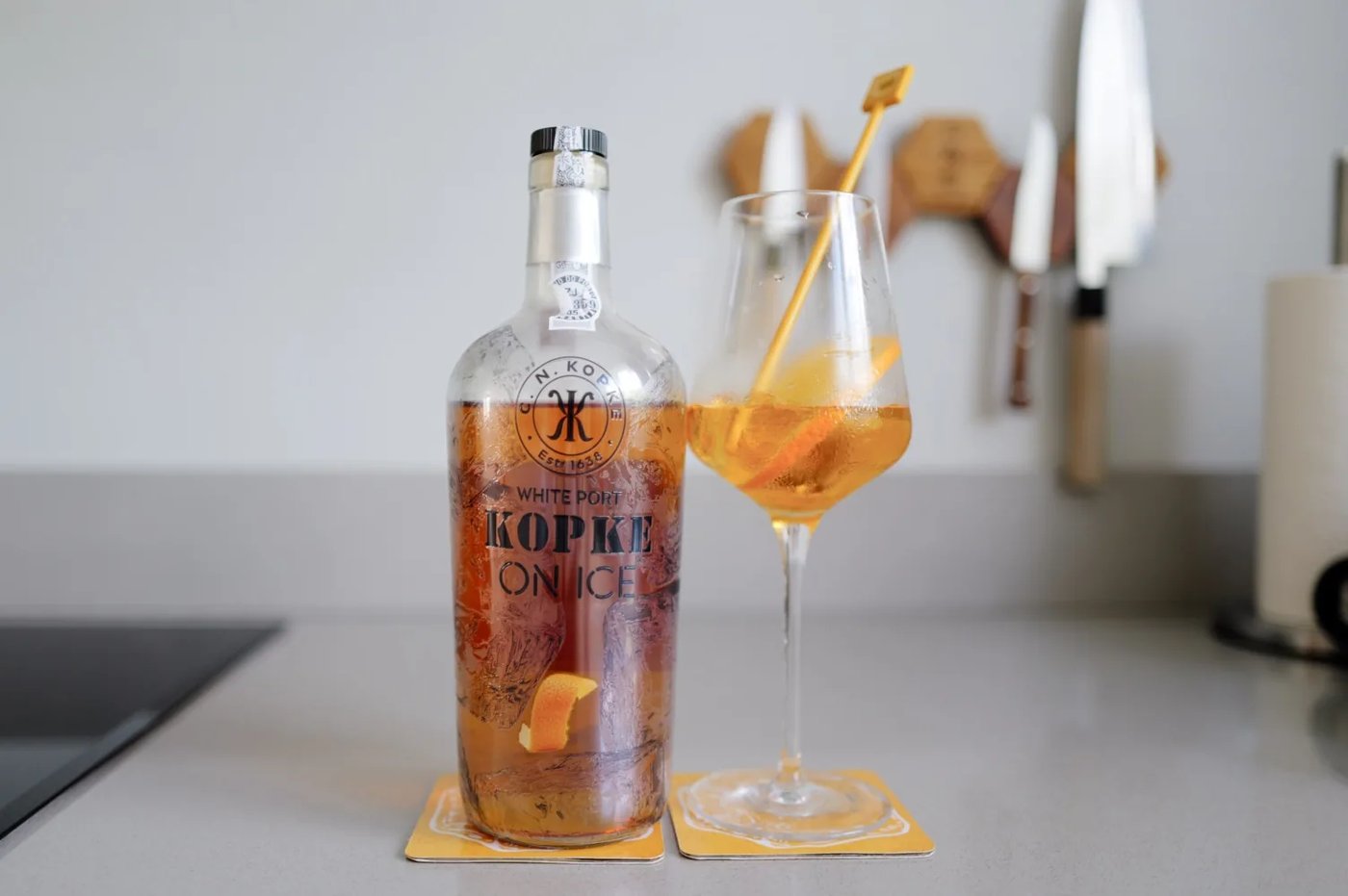
Same port, same 60 millilitres, two glasses. The only difference is three ice cubes in the one on the right: white port on ice, the way Kopke intends it. I set a timer for ten minutes.
That is the whole experiment. Kopke claims On Ice, its sweet white port at 19.5 percent, was deliberately made more concentrated so meltwater doesn’t flatten it. Every piece written about it so far repeats that line from the release. Nobody put two glasses side by side. White port on ice has been a drink for roughly ninety years, so a bottle that says it was engineered for the job earns a stopwatch, not applause.
Kopke sent the bottle as a press sample. No money changed hands, and nobody saw this text before you did.
What happened in the glass
The neat glass first. A deep, sweet nose: orange, mandarin, something floral. In the mouth it is very sweet, very sticky, thick, with a warm burn from the alcohol. I said it on camera and I’ll say it here: poured neat, I don’t find this attractive to drink. No disgrace for a port that was never meant to be drunk neat, but it needs saying.
Then the iced glass, straight after pouring. Broadly the same. The ice is already doing something, just not much yet.
Ten minutes on, I go back to the neat glass: still that full, sweet nose, mandarin, orange, a little peach. The iced glass smells of almost nothing. Everything sits far away, the ice has taken the aromatics with it. There is meltwater in there now and the alcohol has dropped.
Then the sip. A lot better. Fresh, no longer sweet and cloying, plenty of orange, mandarin, apricot, a touch of bruised pear, and noticeably spicy. I don’t think it’s bad, and I mean that. This is the glass you want on a warm evening, and the neat glass is not.
What the ice test proves, and what it doesn’t
The test shows what ice does to this wine: the stickiness goes, the fruit steps forward, the nose largely disappears. That last part is a real cost. If you drink port to smell it, don’t drink it on ice.
What the test does not show is whether On Ice holds up better than an ordinary sweet white port. For that I needed a second bottle from another house, with the same three cubes next to it. I didn’t have one. So the concentration claim stays untested. All I can say is that after ten minutes of meltwater the wine still tastes like port rather than diluted squash. Whether that is down to the special grape selection or simply to 19.5 percent alcohol and a heavy dose of sugar, I don’t know.
How Kopke made it
Winemaker Carlos Alves told Brummell Magazine what sets it apart: a specific grape selection and an extended pre-maceration on the skins. That brings more intensity, more structure and a deeper golden colour than a classic white port. You can see that gold in the glass.
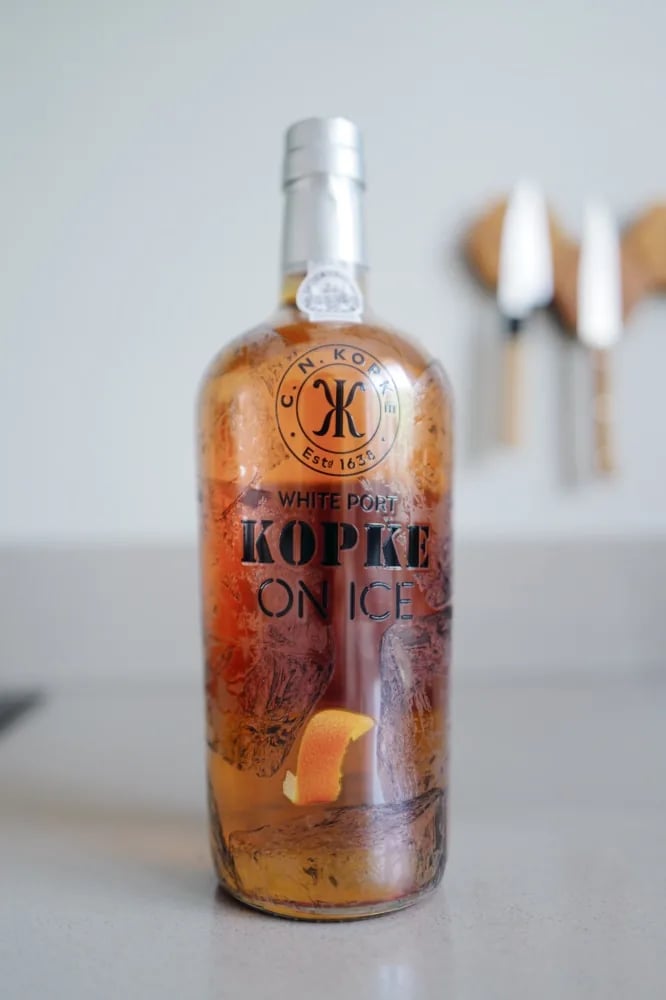
Alves also says it didn’t have to be white. Reserve tawny was ruled out because, over ice, too much wood character surfaced, almost metallic. Ruby was ruled out for turning syrupy. White was what remained.
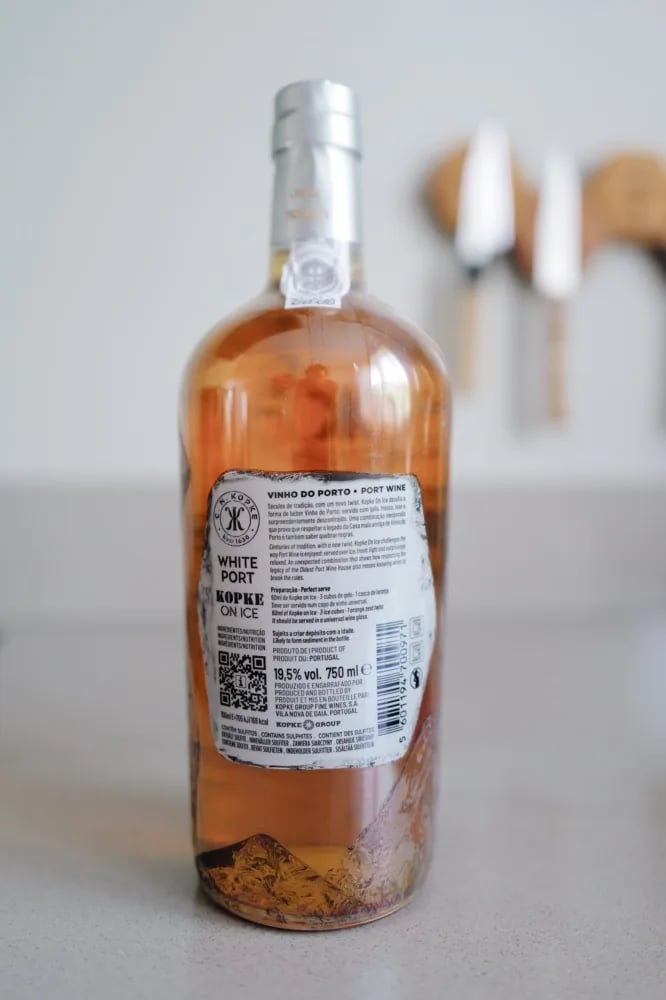
The numbers Kopke publishes itself: 19.5 percent alcohol, a pH of 3.44 and total acidity of 3.30 grams per litre. That is little acid for that much sugar, which is exactly what reads as sticky when you taste it neat. The ice, and the meltwater after it, do the work the acidity doesn’t. Kopke gives no official sugar figure; I’ll call it sweet. Nor does the house name the grapes, beyond “traditional varieties”. Ageing, filtration and the exact time on skins are published nowhere. For a product whose reason to exist is a technical choice, that is thin.
The orange slice, and the lemon still to come
Kopke’s classic serve is 60 millilitres of On Ice, three ice cubes, a universal wine glass and a twist of orange peel. No need to chill the bottle, the campaign says: the ice does the work. In the second video I did almost that: a cold bottle, three cubes, and a slice of orange instead of just the peel.
Nosed without ice there is far more richness than with it: orange blossom, mandarin, lemon peel, peach, nectarine, bruised apple and pear. With ice and orange in the mouth: remarkably fresh, the concentration gone, apple and pear but above all orange peel, mandarin, peach. Summer in a glass, I said on camera.
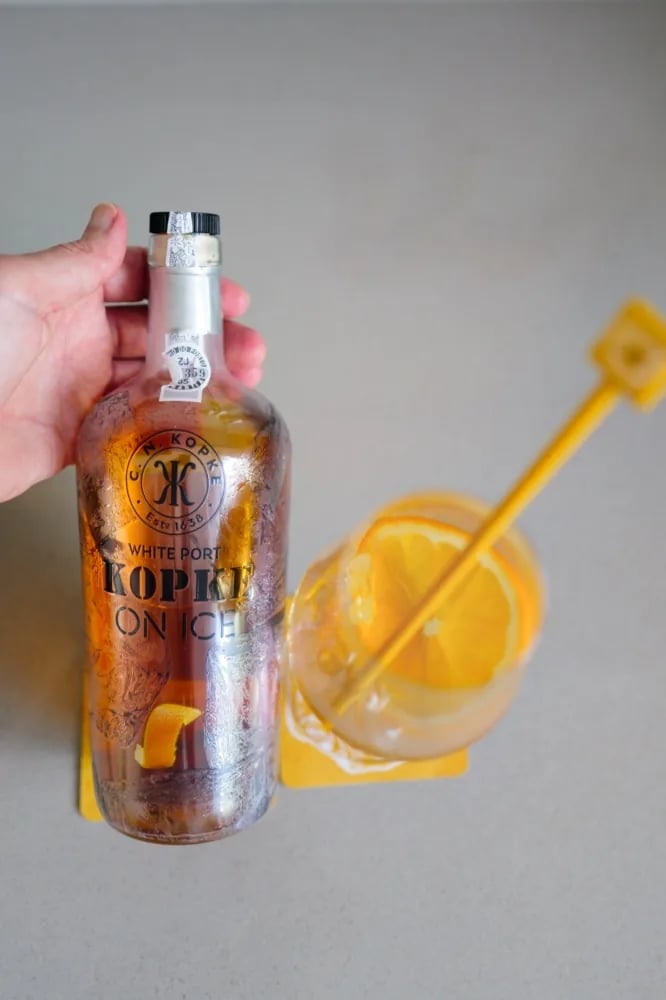
At the end of the first video I announce I’ll try it with a slice of lemon. That is my idea, not Kopke’s. Across their three serves, lemon appears only as a few drops of juice in the Passionspritz, alongside 125 millilitres of sparkling passion-fruit water and a basil leaf. The Grapefizz is 60 millilitres of port with 100 millilitres of grapefruit soda. The logic behind the lemon is simple: this is a sweet port with little acid, and acid is what pulls it into balance. Whether it works, I haven’t yet tested on camera.
Why this bottle exists
Global port volume fell from 10.5 million cases in 2000 to 7.3 million in 2023, according to IVDP figures Forbes published in May 2024. Over the last ten years of that series it went from 8.7 million to 7.3 million, roughly 16 percent down, The Drinks Business reported in October 2025. Premium now accounts for about half the value of all port sold. The big houses are looking for a new drinker for the bottle that isn’t premium, and that drinker is sitting on a terrace with a glass full of ice.
Which is why “on ice” is not a new category. Taylor’s Chip Dry, the first dry white aperitif port, dates from 1934. Croft Pink arrived in 2008 as the first rosé port, aimed squarely at younger drinkers and the on-trade. Graham’s Blend No. 5 from Symington, built on Malvasia Fina and Moscatel Galego and named after the fifth generation of Symington cousins, was the first white port made specifically for mixing. That is the closest comparison to On Ice. Then there are the cans from Taylor’s, Croft, Offley and Cockburn’s, and Adrian Bridge of Fladgate dates white port and tonic as a drink to the 1970s.
Kopke’s own twist is that there is no pre-mix in a can, but a full-strength bottle where the dilution happens in the glass. That is more honest than a 5.5 percent can. It does not make the bottle lighter. “Lighter” applies to the serve, not the wine: 19.5 percent and sweet, entirely normal under IVDP rules, which put white port between 18 and 22 percent, with a single downward exception for light dry white. “On ice” appears nowhere in those rules. It is a marketing construct inside the existing category of sweet white port, and that is fine, provided you call it that.
Who makes money on white port on ice
Kopke was founded in 1638 by the Köpke family from Hamburg and is regarded as the oldest port house still producing. That heritage is printed large on the bottle. What isn’t printed: owner Sogevinus renamed itself Kopke Group in 2025, adding “By Escotet Family Estates”. The group, which also holds Barros, Burmester, Calém and Velhotes, is owned by Banesco International, founded by the Spanish-Venezuelan banker Juan Carlos Escotet, who is also a major shareholder in Abanca. The rebrand coincided with the opening of the Tivoli Kopke Hotel in Vila Nova de Gaia. Kopke Group is the least known of the five companies that together handle roughly four fifths of the world’s port trade.
Meanwhile in the Douro, the benefício, the volume of must legally allowed to become port, fell from 104,000 pipes in 2023 to 90,000 in 2024 to 75,000 in 2025. IVDP president Gilberto Igrejas announced the 75,000 in Público in July 2025. For the 2026 harvest the IVDP nudged the figure up to 76,000. One pipe is 550 litres and represents roughly a thousand euros for a grower. Growers demonstrated in Peso da Régua in 2024 and 2025. Some received letters cancelling their grape orders.
That raises the question I cannot answer: does an aperitif SKU like this absorb extra Douro fruit and put more money in a grower’s pocket, or does the margin on this repositioning mostly stay in Gaia, with the group and the hotel? Kopke publishes nothing on it, and I found no figures proving either way. What I do see: a label dated 1638 and a campaign about breaking taboos, next to a bank as owner and a grower who may deliver less than last year. Buy On Ice and you buy that story too.
Verdict: white port on ice, and whether this one
Buy it if you want a summer aperitif you can make at home in five seconds and that gets better after ten minutes instead of worse. Don’t drink it neat, and don’t expect a nose once the ice goes in.
Do watch where you buy it. In the Netherlands the same bottle costs 24.99 euros at Gall & Gall, 19.95 at vinhodoporto.nl and 15.95 at Gevo Slijterij. In the UK, Jeroboams lists it at 24.95 pounds. Nine euros of spread on a single product is the biggest objection I have to this bottle, and it has nothing to do with the wine. Under twenty euros it is a recommendation for what it is. Above twenty I would first check whether Graham’s Blend No. 5, or any sweet white port with a twist of orange, doesn’t do the same job.
The Dutch importer is Wijnhandel van Ouwerkerk in Arkel, Kopke’s exclusive importer in the Netherlands since 1953. I found no awards or scores for this bottle.
- Producer
- Kopke, Vila Nova de Gaia
- Wine
- Kopke On Ice, sweet white port, NV
- Winemaker
- Carlos Alves
- Alcohol
- 19.5%
- pH
- 3.44
- Total acidity
- 3.30 g/l
- Format
- 75 cl, no gift box
- Serve
- 60 ml + 3 ice cubes + orange peel; retailers suggest 6-8 °C
- Price
- €15.95 to €24.99 (NL), £24.95 (UK)
- Importer
- Wijnhandel van Ouwerkerk, Arkel (NL)
Sources
- Primary source: Kopke On Ice campaign site, for the three serves and the product description
- Primary source: Kopke Group web shop, for alcohol, pH, acidity, winemaker and format
- Brummell Magazine, interview with Carlos Alves on pre-maceration and the choice of white
- Público, 18 July 2025, Gilberto Igrejas on the benefício 2023 to 2025
- IVDP, 2026 harvest communiqué, benefício of 76,000 pipes for 2026
- Forbes, Paul Caputo, “Port For A New Generation”, 9 May 2024, IVDP volume figures for 2000 and 2023 and the premium share
- The Drinks Business, 28 October 2025, volume decline 2013 to 2023
- Prices: Gall & Gall, vinhodoporto.nl, Gevo Slijterij and Jeroboams, checked August 2026
More on Wine Review
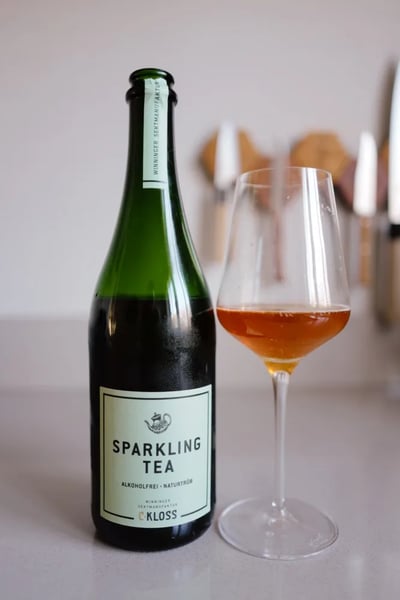
C. Kloss Sparkling Tea Weiss: Fermented Celery
Non-alcoholic sparkling tea Weiss from C. Kloss: linden blossom, nettle and fermented celery. Dry, 2.7 g sugar per 100 ml, €14.99 at Amavine.
Read on →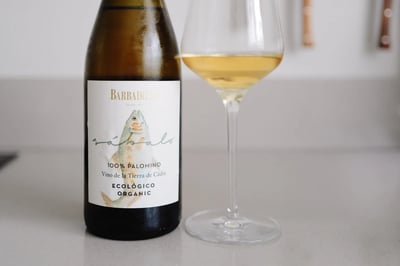
Barbadillo Sábalo: Organic Palomino Without Flor
Organic Palomino Sábalo from Barbadillo: no flor, salt from albariza soil. Chamomile, apple, sea. €17.95 at Granada Wijnen, with discount code.
Read on →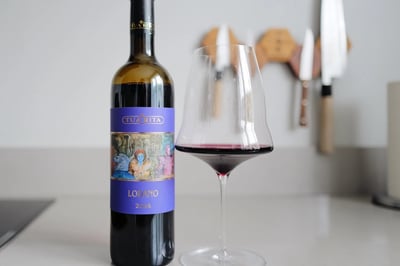
Tua Rita Lodano Rosso 2024: Petit Verdot Leads
A €50.95 Super Tuscan built on 60 percent Petit Verdot and 18 months of barrique. Why I chill it, decant it and never drink it without food.
Read on →