

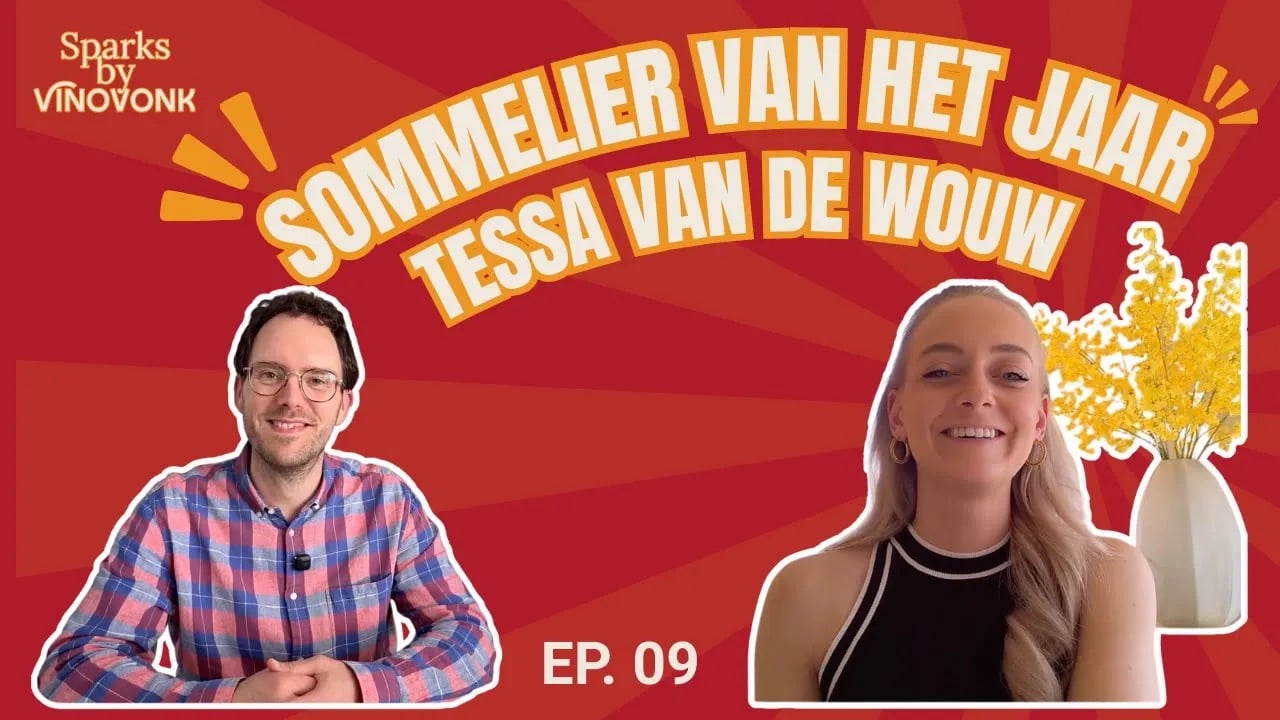
At the GaultMillau awards Tessa van der Wouw was sitting a long way from the stage. “Otherwise I would probably have sat a bit closer to the stage,” she says. Nobody had rung her beforehand. The team had mainly come to see what would happen to the restaurant’s score.
For Sparks episode 10 Tessa joined me as the newly named Sommelier of the Year 2025, from Inter Scaldes in Kruiningen. She talks about six years in the same restaurant, her preference for Spanish wine and the alcohol-free pairings her team makes itself.
This episode was recorded in Dutch. Watch on YouTube with auto-translated subtitles via the video below.
Who is Tessa van der Wouw
Tessa has worked at Inter Scaldes since 2019. She went to hotel school in Maastricht and never specialised in wine there. At the restaurant she started as hostess and maître. When the previous sommelier left, she took WSET 3 so she could step in, followed by the Court of Master Sommeliers, all within a year to eighteen months.
She has been a sommelier for three years now, full-time these days and no longer really maître. Her attention goes entirely to the wine.
Inter Scaldes: a restaurant reborn
Inter Scaldes has been a restaurant for at least fifty years. First under Maartje Boudeling, who according to Tessa was the first female chef to cook her way to two stars. Then for around 22 years under Jannis and Claudia Brevet, who earned three stars.
The old Inter Scaldes closed in July 2023 and reopened in November 2023 with chef Jeroen Achtien and Sanne. Tessa and her partner, sous chef and a pastry chef by background, weighed up their options for a while and stayed. Michelin gave back two stars soon after.
“I believe the pairing between a dish and a wine has to be what leads.” (Tessa van der Wouw)
Accepting the award
Sanne had signed the team up for the ceremony. Chef Jeroen Achtien was cooking on location that day, so Tessa went with part of the front-of-house team. She did not see the award coming. Later she read in an article, from Omroep Zeeland as she recalls, that she had said something like “I’m scared out of my wits”. She has no memory of it.
Since then guests recognise her every day, at lunch and in the evening. She always reckoned about 75 per cent of guests take a pairing menu and the rest order from the list. Since the award that share has crept up a little, she says, because people trust it. It also brings pressure: she now has a title to defend.
How Tessa builds the wine list
When the new Inter Scaldes opened, only a smaller part of the old cellar was left. Tessa was free to fill it as she saw fit. During the months the restaurant was closed she visited every supplier herself, rather than waiting for them to bring their bottles to Kruiningen. That showed her how they work and where they come from, and she took plenty of notes to build the list from later.
Her starting points:
- European wines for the pairing menu, because she wants to stand for sustainability, with the odd trip to South Africa.
- The pairing first, even when a more prestigious bottle is on offer.
- Tasting over reading. She reads little about wine. If a guest wants a bottle she does not know, she suggests sharing the risk and trying it together.
Spain as the main thread
“If I don’t keep myself a bit in check, I sometimes end up pouring three or four Spanish wines on a seven-course menu.” (Tessa van der Wouw)
Spain has been her preference for a while. She points to value for money, especially for a pairing menu, and to the nerve of the winemakers. Regions she mentions:
- Galicia: the climate is often not far off the Dutch one, yet winemakers there get a lot out of a difficult setting.
- Ribeira Sacra: in north-west Spain, with terraces she knows from photographs. She finds the wines pure and beautiful, and it is not a region WSET 3 teaches you.
- Manchuela, in Castilla-La Mancha: home to Ponce, an estate that surprised her because La Mancha is known for bulk wine. According to Tessa one of their wines scored highly with Parker, though she does not know which. Ponce works with indigenous varieties on granite, clay and limestone. The wine she mentions costs around 40 to 45 euros at trade price in the Netherlands, she thinks.
Last September she went to Alicante with a colleague, where friends of Jeroen Achtien and Sanne run a restaurant. They put together around twelve bottles Tessa had never come across, which she is now opening one by one. Through Danny, who sits close to the source, Riojas and Galician wines come in as well.
The price of Burgundy
Spain also wins on price for Tessa. Looking at what is happening in France, Burgundy above all, she wonders whether it is still reasonable to sell certain wines at those prices. What she buys expensively has to earn its money back, and passing on a good deal is getting harder. She does not think a list needs to stick to grands crus, because less celebrated wines often beat them on value. She calls that a blunt statement herself.
No classic pairings
Tessa deliberately ignores the classic food and wine rules. The one that says a dessert wine must be at least as sweet as the dessert is sometimes nonsense, in her view.
“With dry pairings, or with sparkling wine, or with something just off-dry, you can create much more tension.” (Tessa van der Wouw)
She also never writes down what she poured with a dish the year before, in case it comes back on the menu. That keeps pushing her towards different choices.
What she no longer does
Early on, when guests said they did not drink Sauvignon Blanc, Tessa would sometimes put a glass in front of them blind anyway. If they liked it, she told them what it was. Looking back, she thinks you cannot do that, because you are going against what your guest asked for. Now she would rather offer another style or ask whether someone is open to tasting something. She does not want to turn it into her own show, which is something she dislikes when she eats out herself.
Two pairing menus side by side
Inter Scaldes now also offers a prestige pairing menu: a step up, with lesser-known names, older vintages and pricier bottles you would rarely drink by the glass. Chef Jeroen Achtien had wanted it for much longer, and Tessa resisted for a long time. Her objection was that the match with the dish must stay in charge and that guests have to be able to trust those matches. She is glad he always lets her “rant it out” first, after which she came round to the second menu.
A prestige cuvée: Magis Châteauneuf-du-Pape Blanc
At prestige level Tessa names Magis, a white Châteauneuf-du-Pape from Rotem and Mounir Saouma, the pair behind Lucien le Moine in Burgundy. She came across it at a supplier’s tasting and counts it among the best wines she has had so far this year. It suits a dish currently on the menu. If any is left over, she is happy to drink it herself.
Alcohol-free, built from scratch
Alcohol-free is ordered more and more, Tessa says, a shift of the past eighteen months to two years. Apart from the aperitif, the team at Inter Scaldes makes everything itself. Every so often they line up the wines on the pairing menu, taste them again and set the alcohol-free drinks next to them. Tessa picks out the flavours in the wine that suit the dish, without the drink having to pretend to be wine.
One example: with a floral, fairly full and rich Alsace wine that still has clear acidity, the team freezes an ice cube infused with chrysanthemum flowers and serves it in a creamy kefir-based lemonade. According to Tessa, the creamy, milky side of the kefir and the flower make a very comparable alternative when you taste them side by side.
“Go and experiment, make syrups, make a kombucha, and try to mimic what you do with wine.” (Tessa van der Wouw)
She is honest that Inter Scaldes has the time for this, and that not every restaurant does. It works for them because many people on the team can do a lot, from the cheese trolley to the alcohol-free drinks.
What Tessa looks for on her list
- Small producers and suppliers. She works with 15 to 20 suppliers, from bigger names to a small local one.
- Personality in winemakers, and something of her own on the list.
- Perhaps Dutch wine later. She visited De Kleine Schorre with the team and came away impressed. She held off on purpose, because her predecessor Koen van der Plas was deeply into Dutch wine and she did not want to become a copy of him.
I brought up Wijndomein de Boe, where winemaker Bruno now also makes a Savagnin. Tessa had tasted two of his sparkling wines and was surprised how good they already were.
“Anyone can fill a wine list with very big names, but I think bringing personality and something of your own, and seeking out the small producers, is much more interesting. For your guests too.” (Tessa van der Wouw)
Trends she sees coming
Tessa finds trends hard to call. What she mentions:
- Orange wine is drifting into the background, she thinks, though she adds that it may just be a feeling.
- Organic, biodynamic and natural wine keep growing, and there is nothing wrong with that as long as the product stays good.
- England: in the longer run she expects something interesting there in relation to champagne. She does not pour English wine at the moment. She had some on the list before, but did not feel at home enough in it and let it run out.
The credo
Tessa does not call herself avant-garde. She looks for individuality, starts from the match and then sees how far she can go. Her closing advice is something she and her partner always say:
“Work hard, stay humble. […] And above all, work hard. Then you will probably end up where you want to be.” (Tessa van der Wouw)
Frequently asked questions
Who is Tessa van der Wouw? Sommelier at restaurant Inter Scaldes in Kruiningen (Zeeland, the Netherlands), named Sommelier of the Year 2025 by GaultMillau. She has worked at Inter Scaldes since 2019 and took WSET 3 and the Court of Master Sommeliers alongside her job, within about eighteen months.
What is Inter Scaldes? A restaurant in Kruiningen (Zeeland) with a history of at least fifty years. Since November 2023 run by chef Jeroen Achtien and Sanne, with two Michelin stars. Before that it belonged to the Brevet family (three stars), and before them to Maartje Boudeling.
Which wine country does she favour? Spain, including Galicia, Ribeira Sacra and Manchuela in Castilla-La Mancha, home of the Ponce estate.
Does Inter Scaldes make its own alcohol-free pairings? Yes. Apart from the aperitif, the team makes everything itself, such as a creamy kefir lemonade with a chrysanthemum ice cube.
More about Inter Scaldes
Visit interscaldes.nl for reservations and information about the hotel-restaurant in Kruiningen, where you can also stay the night. Alongside the regular pairing menu there is a prestige one.
The wine descriptions in this piece are Tessa’s. We do not taste them together in the recording.
Transcript
The full conversation transcript.
Show full transcript
This transcript is generated automatically from the audio and has not been edited. Speech recognition makes mistakes, so treat wording as an approximation rather than a verbatim quote. It is here for accessibility and search.
Hello everyone and welcome to a new episode of Sparks at VinoVonk. My name is Jeroen Vonk and I take you into the world of wine with wonderful and fun inspiring guests who shape the wine world. And today I have a very nice guest: Tessa van der Wouw, sommelier at Inter Scaldes and, not unimportantly, Sommelier of the Year 2025 according to GaultMillau. Jeroen: Tessa, welcome! And thank you very much for making time.
Because I can imagine that you… are very busy, especially after winning the award. But for those who don’t know you, could you briefly introduce yourself and tell us what you do? Tessa: Certainly. I am Tessa, working at Inter Scaldes in Kruiningen for about six years now.
I actually started there as a hostess and Maître d’ and then grew into a sommelier. It actually crossed my path a bit unexpectedly, and I have been focusing on that for the last few years. And now I am a full-time sommelier and actually not really a Maître d’ in the restaurant anymore. But just full focus on the wine, and that suits me very well. Jeroen: Super cool.
You grew within the company; it came your way unexpectedly. But can you tell us briefly about Inter Scaldes, for those who don’t know it? Tessa: Well, Inter Scaldes is a fairly big name in gastronomy in itself. It has been a restaurant for at least 50 years. First under Maartje Boudeling, who I believe was the first female chef to cook two stars here.
Then the Brevet family, Jannis and Claudia Brevet, who were here for about 22 years and earned three stars. And from 2019, I became part of that and joined them. And now, actually, it has been open again for a year and a half in the new setting. Inter Scaldes is in… I can put it well: in July 2023, we closed with the previous Inter Scaldes.
And in November, we reopened again with Jeroen Achtien and Sanne. Jeroen: What a beautiful story. You’ve also already experienced quite a journey internally, not just a different role, but also the fact that things have simply turned out completely differently. Tessa: Yes, absolutely. Really super educational and a wonderful challenge to be a part of.
When the news came, it hit me and my boyfriend pretty hard. He is a sous chef at Inter Scaldes. We’ve always worked as a pastry chef, and together we really had a very nice, family-run business here with the Brevet family. When they stopped, we did consider for a moment which course we would take. But we are very happy that we stayed.
And it was also great to be able to build everything up again from scratch in a new company, in the same location, but starting from the very beginning. And it was also very nice that Michelin picked that up in no time, awarding us two stars again. That is, of course, the crowning achievement of Jeroen and Sanne’s hard work, but really of the entire team. Jeroen: Super cool to hear. As I said, GaultMillau named you Sommelier of the Year.
I watched the awards ceremony online and I thought the reactions were amazing. How spontaneous, cheerful, and unexpected you actually accepted the award. But what actually happened to you there? Did you really not see it coming, or do you get a call beforehand or something? Tessa: No, if that had been the case, I probably would have stood on the stage differently.
No, we just went there like we actually always do with the team, and Sanne had signed us up. And Jeroen had to cook on location; he wasn’t there himself. We actually went there with part of the service team. Yes, mainly to see what would have happened to the points in another year, of course. You really are a start-up company, after all.
But no, I didn’t see this one coming. Otherwise, I probably would have sat a bit closer to the stage. Because it was quite a ride down that I had to make. But no, it was a huge surprise. I read an article later, I believe from Omroep Zeeland, and it said “I was scared to death.” I thought, yeah, I must have said that again, but I actually didn’t remember anything.
Jeroen: Yes, but isn’t it nice that it’s so spontaneous too? I think that’s the best part, right? If you already see it coming, you start saying everything in such a socially acceptable way. I always find it much nicer to just see it and let it go. So there you are, well, I really hadn’t expected it.
I really hadn’t received a message three weeks ago or anything. But I think that’s also the charm of winning a prize like that. If something like that can’t catch you off guard anymore, then I don’t know what can. Tessa: I found this to be an unexpectedly very special day. I was also really overwhelmed by the number of reactions that came in.
The recognition and the appreciation are one and the same; that is of course very nice. Now, in the evenings in the restaurant and also at lunch, there are still people daily who notice it. And that is very special. Jeroen: Yes, that is really cool. What I did like was the commentary from GaultMillau: that you acquired an incredible amount of knowledge very quickly and that you really have a gift for creating complex food and wine pairings.
Yes, that’s how I understood it. But how do you see it yourself? Tessa: Acquiring that knowledge in a short time, that is certainly a fact. I had actually never really done a wine course. I actually went to hotel school in Maastricht, but never really chose to specialize in wine.
So I basically joined later, at the moment the previous sommelier left. And then I went for WSET 3, just to jump right in. I thought, well, I have to fill certain shoes soon anyway. So I did that, and later the Court of Master Sommeliers. All of that within a timeframe of a year or a year and a half.
I pushed on immediately, because I also felt the pressure within the establishment where I was working. If there is one thing I hate, it is when you have guests sitting there—that will always happen at some point, mind you—but who have greater knowledge everywhere than you do. I think that knowledge is becoming much broader anyway, and there are more and more people doing something with wine. So I wanted to delve into that very quickly. Maybe that is also the luck, that a lot of that knowledge is still quite readily available to me.
It is fairly recent. I have been working as a sommelier for three years now. So I think it is something, and yes, I find food and wine pairing very difficult to define. I can’t really put my finger on it. It’s just something I feel, and when I tasted a dish with Brevet’s cuisine, that was a bit…
easier, perhaps, because I knew it very well. Yes, with Jeroen’s cuisine, we had to reinvent that completely. And maybe that was to my advantage, or maybe not, but yes, tasting very purely and first sticking to wines you know, and then gradually building on that. And that’s what I enjoy doing the most. Jeroen: Yes, I think so too.
But what I also wonder about is, well, there are obviously a huge number of wines. But the moment you taste a dish and you think, you immediately have an association: this pairs with it or that pairs with it. But you also really have to keep up to date with all the wines that are being added. New wines are added every year, or what does a wine do after so many years? And how exactly do you do that?
Tessa: Well, we are lucky that—or I should say, I am lucky—that at the start of the new Inter Scaldes we actually still had a smaller stand from the existing wine cellar. So I had complete freedom to fill it entirely myself. Yes, I was familiar with the wines that were still there. I purchased some new things. Actually, during the months we were closed, I went to all the suppliers to visit them, instead of them always bringing their products to us.
To see how they work and where they come from. And then you discover a lot of new things anyway. So it is a matter of taking a lot of notes and coming back to them later to supplement your menu. But certainly in that regard as well, anyone who tastes with me will know that I always really want to know where to place a dish, whether on the menu or in the pairing. And then I can much more easily make the selection of what ultimately fits the kitchen and what doesn’t.
So I always have a list I can fall back on. Jeroen: Yes, that sort of thing. Tessa: I have to say that I’m not really someone who reads a lot of articles about wine. Every now and then I do, but I’m much more focused on tasting. If someone wants to order a bottle that I don’t actually know myself, I always say, “Come on over, we’ll share the risk, we’ll just give it a try.” I think that kind of exploration suits me much better than burying myself in books.
I’ve been doing that long enough. Jeroen: Yes, I understand that. And when looking at food and wine pairings, what are your favorite pairings? Tessa: Yes, that’s a tough one. I actually always try to choose wines from within Europe.
Especially for the wine pairing, because I advocate for sustainability. But I just don’t think it’s necessary to have large quantities shipped from very far away, when there are so many beautiful things close by. So that is basically always the starting point, with the occasional trip to South Africa. But I don’t really try to follow classic pairings. I do know that you are always taught that a wine with dessert should be at least as sweet.
But I have sometimes found that I don’t agree with that and that it is sometimes really nonsense. Because you can create much more excitement with dry pairings, or with sparkling wine, or even something slightly sweet. So it really depends on what you are looking for. But I don’t really have a classic combination that I always return to. I try to deny myself that a little, because otherwise you aren’t innovative enough, I think.
Jeroen: That is a good tip. Do you want to stay innovative? Don’t stick to the standard, but always go looking for something new. Tessa: That works for me, at least. Otherwise, you can fall back on previous pairings every time.
I also never write down what I did with a dish the year before, should a dish come back. Of course, I do remember it, but sometimes I really have to think back. I actually try not to keep track of that too much because I just want to keep challenging myself to go for different choices every time. Jeroen: And what do most people choose? Do most people choose a pairing, or mostly from the wine list?
Tessa: No, but a lot of pairings. I have to say that we really do sell a total package, with the hotel and everything included. So it’s simply about taking care of everything for an entire evening. There are sometimes people who switch that package for a choice of their own. But generally speaking…
I always said 75% package and the rest à la carte. And I have to say that now, because of this designation, that share of packages has actually increased a bit. Because people have a certain level of trust in that. Which is really nice. And I do notice that guests are a bit more curious about it too.
Jeroen: Yes, I get that. That is, of course, also the advantage of such a designation. That people think, oh, so it’s true. Yes, I can do it here, I trust it here. Tessa: Yes, it does bring some pressure with it.
At least, you don’t get something like that for nothing. But I think that is actually a very good motivator to keep pushing yourself a bit to get the best out of it. Because you do have a kind of title to defend now. So yes. I like that.
I actually like to switch things up a bit more often. We are now also working with a prestige wine pairing. Just a step up with nice, lesser-known names. With somewhat older vintages. Just wines that are a bit more expensive and that you wouldn’t readily drink by the glass.
So yes, that is how we try to go the extra mile every time. And fortunately, I am given the freedom to do that. Jeroen: That seems quite complicated to me, because then you actually have two pairings that have to match the dishes. Tessa: Yes, and that was the thing I was at… I resisted that idea for a very long time, because Jeroen had actually been working on it for much longer and wanted it much earlier.
And I am glad that he always lets me vent for a bit so that I can gain some insight and make that choice after all. But I actually believe that the combination between a dish and a wine should be the guiding principle. Of course, it is nice to sit somewhere and drink certain wines that you thought you would never drink. But I also think it is very important that people can still trust the pairings you create. So I really enjoy seeing that, of course, multiple wines pair well with a dish, but that it is also sometimes a bit more exciting.
Or that you choose something different from what the standard pairing offers. So I really try to prioritize that match, because I find that very important myself. Jeroen: And you say that you mainly work with European wines. Do you really work very locally then? Do we also have Dutch wine or even wine from Zeeland?
Tessa: Yes, we do. And the nice thing is that last week we went on an outing with the team to De Kleine Schorre. I am familiar with their wines, but I also have to be very honest and say that, well, I always have a very strong urge to do things my way. And one of my predecessors, Koen van der Plas, well… Jeroen: I know the name, of course.
Tessa: He was very much into Dutch wine. And actually, when I started in the sommelier profession, I really wanted to find my own thing. And at this moment, whatever that has ultimately become, it could go in any direction. But I didn’t actually want to become a copy of what he was doing. So that is basically why I took a break for a while and only started delving back into it now, three years later.
And I must say that I was really impressed by it. It seems like a nice idea to add that later on, but we actually only work that hyper-locally with products in the kitchen. For the rest, everything is within Europe, and definitely the classic countries that I tend to gravitate towards more quickly. But otherwise, I don’t want to impose too many restrictions on myself. Because then you end up selecting a whole lot of things that wouldn’t work.
Jeroen: Yes, I understand that. I am actually very curious myself about the new wine from Wijndomein de Boe. They are located close to you guys too. Last year, Bruno the winemaker only had a few hundred or 2,000 bottles. Now the vines are getting a lot better, so he has a whole lot more.
And above all, he now also has a 100% Savagnin. And because he is quite fond of the Jura and that soil type he has in Zeeland close to the sea, it also has a lot of similarities to it. I am very curious to see what he will do with it this year. Tessa: Yes, I heard something like that last week too, because I understood he also worked at De Kleine Schorre for a while. So I was curious how he had translated that.
And I did indeed understand that he was focusing a bit more towards the Jura. So very interesting. I think that is a very nice area too. So news. I got to taste two of his wines, those were the sparkling wines.
And then you think, well, how long have you been doing this with these grapes? That was actually the first time you think, this is already so good. Jeroen: I think it is a very special story. If you dare to trust yourself, I think that is nice. His mentor also said that he was really very stubborn.
And that it was precisely what made him such a good winemaker. Tessa: Interesting. It would be nice to visit sometime. We are very close to the source here. Jeroen: That is why I also thought, if you are truly local, where you say, so to speak, do you want to know where that wine comes from, then you just have to look out the window.
And then you might just see it lying there. Tessa: Yes, Zeeland isn’t that small, you know. But anyway, it is possible. Jeroen: And if you look at the wine world today, what do you get really enthusiastic about yourself? Tessa: Well, for quite a while now, Spanish wines.
I have to say, that is nothing new or anything, but I do notice that I reach for them very quickly and that if I don’t keep myself in check a bit, I sometimes end up serving three or four Spanish wines with a seven-course menu. And of course, I do have to take into account that that is a bit… Yes, that they really are quite different styles or that I keep that in check a bit, but I think the price-quality ratio of Spanish wine is good, and certainly for offering it in a wine pairing . Yes, I find the daring and the guts the winemakers there have very special, and I am really working very hard on that. Jeroen: And are there certain areas where you say, well, this area, you actually hear very little about it, but such beautiful wines come from there?
Tessa: I don’t know if you hear little about that, but for example, I am currently working with a lot of wines from Galicia. I really enjoy that. Also because the climate often differs little from the Dutch climate. That does imply that you can actually get quite a lot done in a very difficult environment. Yes, I went to Alicante with a colleague last September.
Friends of Jeroen and Sanne live there; they have a restaurant there. And they made a selection, I believe of twelve bottles. Things that I didn’t know yet. And those came to the Netherlands. And once in a while, I open a bottle from there and start tasting it.
I discover some really nice things in there. Not necessarily focused on a specific area. I myself am quite impressed by the Ribeira Sacra region. And then you might think, where is that? Well, that is also a bit in Northwest Spain.
But you just think, it’s all so pure, so beautiful. And also when you see those regions, the photos, really those terraces, you think, fantastic. You don’t learn about that kind of region with WSET 3. Then you really have to go deep again. Those kinds of things are really cool to experience.
Jeroen: Yes, and that is why I think it is very good to keep tasting with suppliers. Because, well, at a certain point I often have the tendency, when I’m already getting into the flow here and I already have an idea of which dishes are coming, to figure out a lot of things myself . And I think that is a strength, but also a pitfall in a way, because that way you don’t always discover new things and then… You really do end up on a little island here. But because of that, I have indeed gotten to know that kind of wine and have worked with it quite often already.
Beautiful Mencias and yes. Well, in terms of price-quality ratio, there is also a tremendous amount of good quality available at prices that aren’t too expensive. Tessa: Yes, definitely. Definitely. And especially when you look at what is happening in France right now, of course.
Yes, you can put a lot of beautiful things from there on your wine list, but at some point you also have to ask yourself whether it remains reasonable to sell it at certain prices . And of course, if I bought it expensively, then it has to be paid back. But I do try, if I have a good deal, to be able to lower those prices. However, it is becoming increasingly difficult. And certainly when we are talking about Burgundy, of course.
Jeroen: Yes, the tricky thing about Burgundy is, of course, that a lot is already being bought up before it even… I read about a few wine estates that have already sold their 2025 vintage. But it still has to start growing. You think, we don’t even know how much we have. Tessa: Yes, I find that very difficult, because that also leans a bit towards Bordeaux classification.
“We were there once and we did this once.” And now we are 150 years plus further on. And you are still stuck within a certain pattern. Whereas wines coming from nearby plots, or not even from nearby, often come very close or are perhaps even better. It might be a very bold statement, but I do think we no longer need to limit ourselves to all the Grand Crus. Of course.
Because very often, it is precisely the less highly regarded wines that can still stand out in terms of price-quality ratio. Jeroen: Yes, but I think that is also because you already expect something from top estates. So how difficult is it to be surprised by that? Whereas if you taste a wine from a very small winemaker somewhere who is doing something really cool, and you taste a glass and you think, wow, this is special. It is, of course, also much easier to make an impression.
I also think that the bar for the big boys is getting higher and higher in that regard. Because people are simply no longer willing to pay for it. Tessa: Yes, I always think, anyone can fill a wine list with very big names, but I think that bringing personality and something unique, and specifically looking to those small producers for that, is key. going on a quest is much more interesting. For your guests, too.
You do it, of course; ultimately, you don’t do it just for yourself, you do it for your guests. You can be very self-absorbed: “I want this, I want that, and I want to have the biggest wine list.” But yeah, if no one is waiting for it, then it kind of stops there. Jeroen: Yeah, you always have to take things into account a little bit. Tessa: I think some wines really just push your personal style a bit. And if you know you can sell those to people, then it works out fine.
But yeah, it’s always very tricky. Because we also have guests here who simply have cellars with the most beautiful things in them. So, trying to surprise them, that is much more of a challenge for me than selling a nice bottle from a well-known domain. And that happens, more than enough. Yeah, that’s just how it works.
But I think the strength also lies in challenging those people a bit who always choose Bordeaux, always choose a specific domain. To say, “Yes, but I have something nice now, and preferably blind, just to see what they think of it.” Jeroen: And do you ever have people say, “I don’t drink this,” and then you challenge them to eventually drink a certain wine that makes them say, “Before, I thought I would never drink that”? Tessa: Yes, yes, and I also have to be very honest and say that I did do that a bit more often, especially in the beginning, and that I found peace with it again afterwards. That if people said, “I don’t drink Sauvignon Blanc,” I would put a different glass in front of them, but just blind, just without saying anything. And that people would then give up, “Yes, they’d say, ‘Nice glass of wine.’ Yes, this is Sauvignon Blanc.” And then you’re lucky, I think, if you get away with it and make a nice story out of it.
But yes, when I look back on it now, I think, yes, that… You can’t really do that either, because you’re simply going against your guests’ wishes. I have done that before, and I won’t be doing it again anytime soon. But I do enjoy presenting a different style or asking if they are open to tasting something. However, I think it is also important not to make it too much of your own show or party.
Because I hate it myself when others do that when I go out to eat. So that was a good lesson. Jeroen: Yes, that is indeed a good lesson. And is a lot of non-alcoholic food ordered at your place? Tessa: Increasingly so.
I think that is really a new trend of the last year and a half to two years, I think. And that we are also trying to respond to that more and more by coming up with some really nice alternatives. I personally find it a very fun challenge to keep working on this. Definitely. Jeroen: Do you have a tip for people to say, “I am so surprised by this, and it is something non-alcoholic”?
Tessa: I have to say that, apart from the aperitif, we actually make everything ourselves. So, what we do every now and then is line up the wines from the pairing, taste them again, and place the non-alcoholic option next to them. The idea is not to pretend, taste-wise, that it has to be a wine, but rather to pick out the flavors that, for me, are suitable for that particular dish. So, right now I have a wine from Alsace by Zumbaum. It is quite floral, quite full and rich, but certainly still has acidity.
And then, for example, we make an ice cube with chrysanthemum flowers from it. We let the ice cube infuse with that, and then we freeze it. And from that, we make a very creamy lemonade based on kefir. So then you still have that creaminess… that milky texture and the flowers.
And when you put that side by side, you actually have a very comparable alternative, meaning that the food and drink pairing essentially comes down to the same thing. So my advice wouldn’t necessarily be to buy a bottle of this or that, but rather to experiment, make syrups, try making a kombucha, and try to replicate what you do with wine. Because you can really do a lot with that, and I also think people appreciate it much more if you make it yourself. Jeroen: Yes, that is quite an interesting insight. Yeah, pretty cool.
Tessa: Yes, we have the time for that too, of course, to be honest. There isn’t time for that everywhere. But we just have a team where it’s really nice that many people are capable of doing so much. So picking up the cheese cart, but also non-alcoholic drinks, occasionally helping to pour wine. And I think that is also the strength—that we all really make each other stronger in those areas.
And that there is also someone who feels very responsible for it. Because I think that is always the key to a successful team: that you just manage everything very well. And ensure that everyone has their own thing to do. Jeroen: Yes, the most important thing is, do you have the time for it? Are people willing to put in the time?
And the fact that you take that space together is actually really nice to hear. Tessa: You have to make time for some things. We don’t always have time either, but then you just get up earlier and you’re there. Because if you stand behind your product, you also have to make sure that it is always in stock and stays there. I think we are very lucky with the people we work with in that regard.
Jeroen: And when you look at certain wines, do you have certain wines right now that you say, ‘I find this so beautiful, I already have it in the pairing,’ or ‘that is coming soon’? Tessa: Yes, that is at the prestige pairing level. From Rotem and Mounir Saouma; they are also the driving force together behind Lucien le Moine in Burgundy. And they also have a vineyard in Châteauneuf-du-Pape. And they have a white Châteauneuf, Magis.
Jeroen: Well, I know the white ones, but I don’t know this one. Tessa: I think that is a real discovery of… Yes, so far one of the most beautiful of this year, I think. I actually ended up at a tasting with… With a supplier who came up with that.
And it also pairs very nicely with a dish we currently have on the menu. But that is something where I think, yes, I really think it is a magnificent glass of wine. I also waste a lot of that. That is always the case. But if there’s a bit left over, I really enjoy drinking it myself too.
Jeroen: So pouring a little less means more is left over. Tessa: No, no. Jeroen: Yes, I’m pouring some in the meantime. You just mentioned that you brought back a very nice selection from Alicante. Tessa: Hmmm.
Jeroen: Well, aren’t they all local wines from there? Tessa: There were some of those in there too. We visited a winery there ourselves as well. They are actually things they serve in the restaurant. They are, of course, completely into Spanish wine.
They actually have much more Spanish on the menu than what’s outside. Danny always has really nice new wines that nobody knows about yet, but which he can just taste because he is so close to the source. So this doesn’t come from there either. This is Manchuela. If I’m saying it right.
So Castilla-La Mancha, the hinterland of Valencia. So yes, reasonably close, but not exactly. But it is something else again. But he also sent some Riojas, Galician. So basically, we’re going in all directions.
Jeroen: Isn’t La Mancha also the big wine pool where all the bulk wines come from? Tessa: That’s why I was quite surprised by that. Because this winemaker, Ponce, also has a wine that scored really highly with Parker. Yes, I have to say that I don’t know exactly which one that is. But it’s actually still a very unknown domain to me, and perhaps others know it very well.
But I did like that they have a very wide range in terms of price level. I’ve already tasted an entry-level cuvée as well, and what you have in your glass is simply quality. So that’s really nice. Because I believe that if you buy this in the Netherlands, the purchase price is in the 40 to 45 euro range. So that’s quite a step up.
But they are all Indigenous varieties, granite, clay, limestone, stone. So really with a focus on terroir. I think that’s very beautiful. Jeroen: Do you have a supplier that also supplies to consumers? Tessa: I actually work with 15 or 20 suppliers.
So there are undoubtedly a lot among them who supply that way as well. Yes, the larger ones like Anfors of course; Bart de Bruin naturally also has a lot of people buying from them. But also a very small supplier from around here, whom I recently sent guests to, and from whom I received an email saying they had ordered some wines they had tasted from here. So yes, a bit of a mix. I also really enjoy involving someone who works on a much smaller scale in this a bit.
Then you often get some special things too. Jeroen: Small importers might also work with somewhat smaller winemakers. And that you can get the gems out of them. Tessa: Yes, no, absolutely. I think that’s a good thing too; you’re doing something everyone is already doing.
That’s not my thing, you know. If I go somewhere to eat that I already know, then… Jeroen: That’s why. So you can often surprise people with that, I think. But that is your signature, you could say.
Going off the beaten track, doing different things. And doing things people don’t expect. Tessa: Yes, not always, of course. It’s not like I’m that avant-garde. But I do always want individuality.
I really love that. I love personality in winemakers. I like guests who clearly know what they want. Personally, I enjoy choosing things I wasn’t familiar with myself. Guests might have known them, but they are completely new to me.
So that’s what matters more to me. And it’s not about “let’s try to go as crazy as possible.” Not at all. Starting with a match and then seeing how far you can go. I like that. Jeroen: Yes, that is a nice starting point.
And if you look at trends in wine, and you make alcohol-free yourselves, but if you look at trends in wine, what kind of trends do you see coming? Tessa: Yes, I find that difficult. I get the impression that the orange wine thing we’ve been dealing with for a few years now is actually fading into the background a bit. But maybe that’s just a feeling I have. Well, in any case, increasingly organic, biodynamic, natural wine.
So in itself, there’s absolutely nothing wrong with that as long as the product remains good. And for the rest, I am very curious. But regarding the much longer term, what is all going to happen in England soon in relation to Champagne… I think something very interesting is coming up there. And that will also change a lot in terms of structures and such.
Because you might think you’ve seen it all, but that’s not the case. It’s a lifelong learning process. Jeroen: Are you working with wine from England now as well? Tessa: No, I did have it on the menu a bit in the past, but I have to say that I wasn’t so familiar with it that I actually let it just drift off the menu. So I’m still kind of in that Spain tunnel.
Jeroen: Yes, then towards France, then you take the train and you end up in England and then, who knows. Is there anything else you want to share with people about food and wine pairing, wine, your work, your passion? Tessa: No, I don’t necessarily feel in a position right now to be preachy about that. The only thing I always say, and what my boyfriend and I always say too, is just to work hard and stay humble. And then I think you’ll get pretty far.
And especially by working hard. And yes, then you’ll probably end up where you want to be naturally. At least, that’s how I experience it right now, anyway. Jeroen: Yes, that’s a good starting point. Good call to action, everyone keep working hard.
Stay humble. We’ll wrap up the conversation here. Tessa, thank you very much for your time. I’m going to take a sip. Tessa: Cheers!
Jeroen: This was another episode of Sparks by VinoVonk. Until next time. Cheers! And don’t forget, keep working hard. Stay humble.
Thank you, Tessa. Bye!
Listen
Watch