

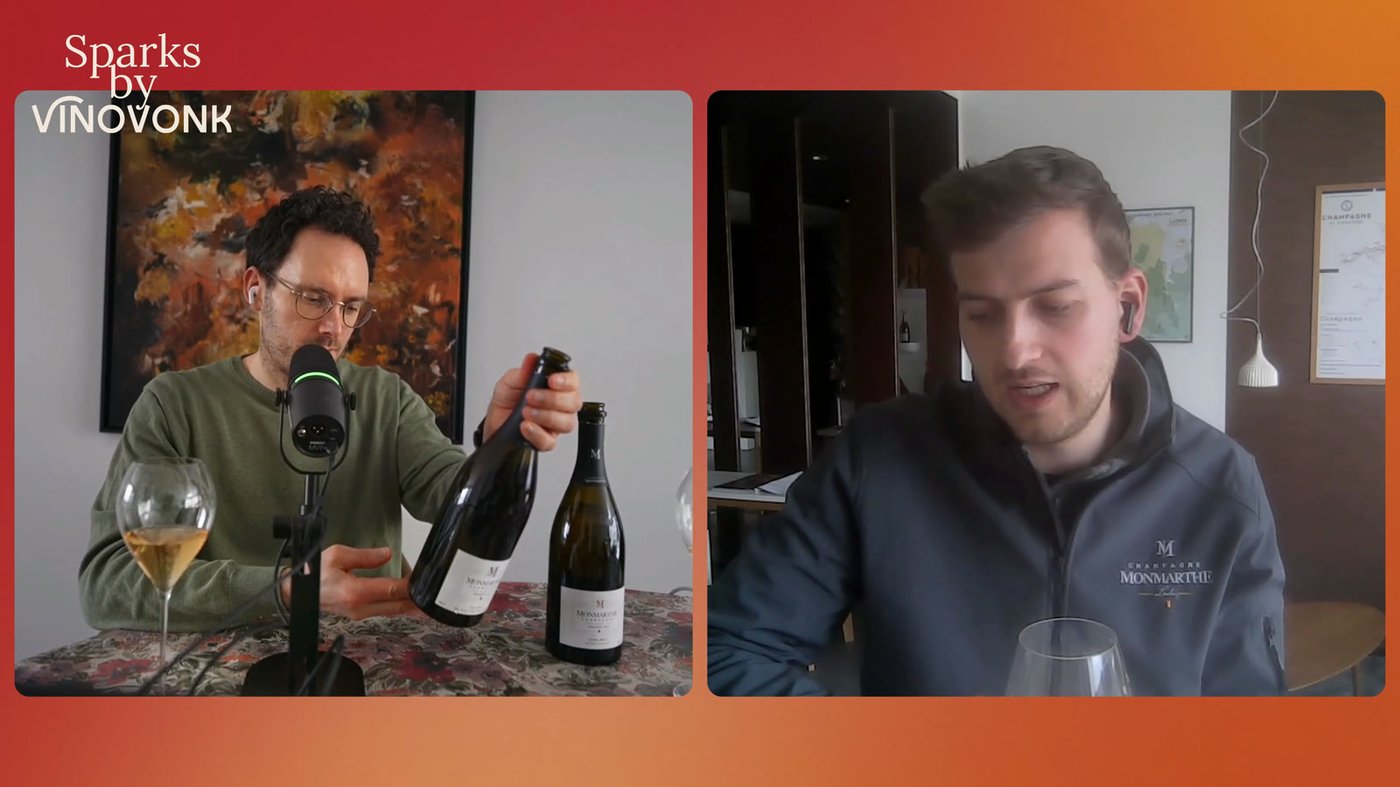
For a long time Pinot Meunier vanished into the blend in Champagne, behind Pinot Noir and Chardonnay. Ten or twenty years ago it was the region’s poor grape, says Gauthier Monmarthe. He puts it on the label and in the glass with no sugar at all.
He sent me two bottles from his single-plot range. For this Sparks episode I tasted them with him, from his cellar in Ludes and mine in the Netherlands.
Who is Gauthier Monmarthe
Gauthier is the seventh generation at his family estate in Ludes, on the north face of the Montagne de Reims. According to the estate, the family has been in Ludes since 1737 and has made its own Champagne since 1930. He works with his father Jean-Guy, the sixth generation, with his mother, and with a team of six in the vineyard and the cellar. According to the estate, 15 of its 17 hectares lie in Ludes and 2 in neighbouring Taissy, all Premier Cru.
Gauthier buys no grapes and sells none either. From planting the vine to harvest, he keeps everything in his own hands. “It’s the main characteristic of a family, to be independent,” he says in the episode.
Staying independent, with the CIVC in the background
Each year the CIVC sets the permitted yield, agreed between the growers, the houses and the cooperatives. That yield follows the previous year’s sales, and with sales slipping worldwide, the yield is coming down too. Grapes above the limit stay on the vine or go off for distillation. You are not allowed to do anything else with them.
Then there is the harvest itself. Seventy pickers from the north of France live on the estate for ten days. Gauthier works under HVE (Haute Valeur Environnementale), a certification which, according to the estate, his father chose in 2014. He is not organic.
In the warm, healthy 2025 vintage he sprayed nine times, once with a chemical product, around flowering. The north face of Ludes is shifting with the climate and now gives better ripeness while keeping its freshness.
Le Nid d’Agace 2018: the co-planted plot
“Le Nid d’Agace” is the name of a one-hectare plot. Agace means magpie, so the plot is the Magpie’s Nest. Two varieties share the plot, sixty-year-old Chardonnay at the top of the slope and young Pinot Noir on the clay below. The grapes are picked together and blended at the press.
No malolactic fermentation. Eight months in large foudres, then six to seven years on the lees. Gauthier avoids small barrels because he and his father dislike a woody taste in Champagne; a foudre brings vinosity and a gastronomic side. The label says Extra Brut.
In the glass I found cookie dough and vanilla biscuits, cloves, rosemary and thyme, with cream, butter and toast behind them. Fresh, and still full and rich. You don’t feel any harsh acidity, even though it is an Extra Brut. Gauthier explains that blocking the malo keeps the freshness and that the Pinot Noir on clay brings the roundness.
The Solera Blanc de Meunier: 100% Meunier on chalk
The second bottle made me curious. A solera is something you know from Jerez, from sherry. Gauthier works with a perpetual reserve in a single tank, topped up with new wine every year. Some Champagne makers use a perpetual reserve, but I had never heard of it for Pinot Meunier alone.
Gauthier started his solera in 2015. The wine sits in the estate’s oldest concrete tank, his great-grandfather’s. Concrete holds the temperature, the freshness and the fruit, he says. Every year he refreshes about 30% of the tank with new wine, and 40% of the harvest for this cuvée is vinified in barrels.
The first release was a blend of 70% solera and 30% of the 2022 harvest. That makes the solera seven years old, according to Gauthier. One hundred percent Meunier, grown on chalk rather than the clay of the Vallée de la Marne where the grape usually comes from.
“And at the end, my big surprise, we don’t need any sugar at all,” he says. The fruit gives enough sweetness, so it became a Brut Nature, zero dosage. There are 4,188 bottles.
I got orange blossom and jasmine, and plenty of red fruit you don’t often find in Meunier: strawberry and raspberry. Then blueberry and cassis, herbs, cookie dough and vanilla, and some dried fruit, apricot and cherry. Gauthier calls it “just fruit on chalk”. A 100% Meunier easily turns linear, blossom, fruit, apple and that’s it, and here the solera adds texture and vinosity.
How his father reacted
His father has been at the estate for forty years, Gauthier says. Two things were new for him and his generation of winemakers: vinifying Meunier on its own, and finishing it without dosage. Ten or twenty years ago Extra Brut and Brut Nature barely existed, according to Gauthier.
His father found the wine “very good, very fruity”, and it was a good surprise for the whole family, Gauthier says.
Reservations
At seven years the solera is still young; Gauthier hopes one day to have 20 to 40 vintages in the glass. It is a perpetual reserve in one tank with about 30% refreshed each year, without the tiers of criaderas you find in a Jerez solera. With 4,188 bottles the run is small, and the estate is not organic.
Frequently asked questions
What is a Blanc de Meunier? The label reads Blanc de Meunier, a Blanc de Noirs made only from Pinot Meunier. At Monmarthe that Meunier grows on chalk in Ludes.
What does the solera method do for Champagne? A perpetual reserve that gets new wine added every year, so the tank never runs empty. Monmarthe has kept his since 2015 in an old concrete tank and refreshes about 30% every year. The first release was a blend of 70% solera and 30% of the 2022 harvest.
Why does this Champagne have no dosage? According to Gauthier, the fruit of Meunier on chalk gives enough sweetness. Added dosage was not needed, so it became a Brut Nature with zero dosage.
How many bottles of the Solera Blanc de Meunier are there? 4,188 bottles.
The wines
Gauthier sent me these two bottles; I did not buy them myself and there is no paid arrangement. Vinétiq, a specialist in grower Champagne, has been Monmarthe’s partner for restaurants in the Netherlands and Belgium for two years.
Full transcript
The episode was recorded in English. The full transcript is below.
Read the full transcript
This transcript is generated automatically from the audio and has not been edited. Speech recognition makes mistakes, so treat wording as an approximation rather than a verbatim quote. It is here for accessibility and search.
[00:00] Hi and welcome to a new episode of Sparks by VinoVonk. I have a very special guest from France, from the Champagne region. His name is Gauthier Monmarthe. Gauthier, welcome. And thank you very much for sending me these two brilliant wines. This wine is the Solera Blanc de Meunier. I saw somebody tasting it on Instagram and I thought, okay, I want to taste it, I want to hear the story. So I reached out and here we are. But before we taste these wines, could you tell me something about yourself? Who are you and what do you do? So to introduce myself and the estate, the Monmarthe estate — it’s a family estate. Now for seven generations. So we own our own vineyard. So we are independent growers. So we don’t buy grapes and we don’t sell them. We just use our own grapes.
[01:00] We are located in Ludes. 80% of our vineyard is located in Ludes, and 10% in Taissy, another village next to Ludes. So that’s why all our champagnes are Champagne Premier Cru. It’s a very beautiful terroir for our champagne. We use the three classic grape varieties you find in Champagne: Pinot Noir, Pinot Meunier, and a little bit of Chardonnay. As for me, I arrived on the estate five years ago, after studying wine — the oenology side and also the wine business side in Bordeaux — and one year of vinification in South Africa. So it’s very important for me to see other vineyards around the world and to gain more experience.
[02:00] across the wine industry around the world. So after that I came back to the family estate to take over the family business. So I work with my father and my mother on the estate. And it’s truly a family business together. And now I currently work with my father and my team in the vineyard and the cellar to make the wine, and my part is also to develop the sales around the world and in France. Now I’m also trying to develop my own style of vinification, a new approach to vinification for Champagne growers. And that’s why we now have a new range of single-vineyard plots. oh
[03:00] One terroir, one plot, one type of vinification. And we have two examples to taste together: one Blanc de Meunier and one co-planted plot, vintage ‘18. Sounds very interesting. You’re working on the traditional side, but also on the innovation side, and you want more visibility around the world. You just came back from Wine Paris. How was the wine fair? I think it was a very good wine fair. Right now the wine industry is a little bit difficult because wine consumption, I think, is decreasing in France and also in the world. But we saw a lot of clients, a lot of good buyers, and I think it was a busy, a very busy wine fair. So we hope now that these contacts and this prospecting
[04:00] will turn into orders in the future, to develop our business and our brand. So I think it was a very busy wine fair, good for business and for the whole region, because we saw a lot of people there. Yeah, and did you also have time to taste some wines yourself? Yeah, this wine fair is a good occasion to see all your friends from each region — from Provence, from Bordeaux, from other regions. So yeah, we try to take some time every day to taste and to see other friends. And it’s also how you find new clients. It’s a chance to connect — maybe you’re looking for uh a new market, a Nordic market or another market, and you meet people, and sometimes they come to your stand and say, I’d like to discover your estate and
[05:00] try your champagne — so sometimes you find new markets like this too. So I think it’s a very important thing. Yeah, it’s very important. And your wines, are they available in the Netherlands already? Yeah. Since two years ago we have a new partner for the restaurants. It’s Vinetiq, specializing in grower champagne. And yeah, they’ve been our new partner for two years now. Okay, and they’re available in the Netherlands and also Belgium. So you have two countries close to you. But you’re the seventh or the eighth generation? I’m the 7th. My favorite is the 6-1.
[06:00] Yeah. When did the first generation start making champagne? The first generation only owned vineyards — that was during the 19th century. And my great-grandfather started the Monmarthe brand at the beginning of the 20th century, at the same time as all the wine growers were developing their own brands. So somewhere between the 1890s and the 1920s, something like that. So it’s very early. It’s one of the oldest vigneron champagne makers, then. A lot of wine growers have owned vineyards for one or two centuries, because in the past you did both viticulture and agriculture, so that’s why we have a
[07:00] lot of people with a vineyard part and an agricultural part to grow more cereals or something like that. That’s why a lot of wine growers have had their vineyards for one or two centuries. Yeah, and you still work with your father, and he’s still very much involved. But what do the dynamics look like day to day? Is there a clear handover happening? Is he saying, okay, this is your vintage, I’m out? How does it look? I think work and family need good communication to be efficient. And now it’s a working team. I think he’s a modern person and he tries to understand my new vision, but I don’t forget that he has the experience.
[08:00] He has the experience of many years and a lot of vintages. So I think it’s very important to work together, and we have different ideas, and different, I think, good ideas. The goal is to make a new wine. That’s why we also have two ranges. The first range is all about blending. I think that’s the champagne. Blending represents champagne. It’s blending different harvests, blending different grape varieties. And now we also have this new range, more in a Burgundy style, with my generation of new winemakers. A little bit like in Burgundy, we try to release wines that represent a terroir, a vintage, a type of vinification.
[09:00] For us it was very important to have this true vision of champagne. We like to say the first one is more my father’s range and the second one is more mine. I think the two are completely complementary. These single-plot cuvées are more for a champagne dinner — it’s a more gastronomic champagne. But the first one is more the aperitif champagne. It’s a little younger, with more freshness. And I think for 90% of people, that is champagne. So it’s important to have these two visions and these two different types of champagne. Did you develop this vision during your work around the world? What’s the most important thing you brought back home from your work all around the world?
[10:00] I think it’s different types of vinification, and also understanding that each terroir is very different. I was very surprised, for example, in South Africa, where the estates work with between 10 and 20 different grape varieties. It was very, very different. And for the US market or the UK market, you put the grape varieties first, and in Champagne we are more about terroir — we put the village, the terroir or the estate first. It was very different to learn this other vision, and I think during my studies I understood the idea that, okay, you have a new vision of winemaking because you’re young, but the
[11:00] ancestry of champagne is blending, and I think it’s important to keep it. Don’t forget your older clients — the clients of my grandfather, my father. They’re used to this product and it’s important to keep it. Also, each champagne is for a moment: for an aperitif it’s more a non-vintage, but for… pairing with seafood, a champagne rosé can be a great option. But more for a champagne dinner now, it’s not only wine. We also have wine from Champagne with these single-plot vineyards. And you grew up there, so you learned a lot in your early years. And what was the most surprising thing you learned in your younger years, and then you traveled around the world? What was the most surprising thing you found out that’s completely different from what you saw in your younger years?
[12:00] I think it’s that we’re very lucky to have this product, and its name is Champagne. When you travel a bit across the world, you don’t realize that Champagne is Champagne — everyone knows this product and it’s a very famous name. It’s the first name we know, and I think it’s very important to travel to understand that, to represent this name. And you realize that when you say, well, I’m from Champagne, everyone says, oh wow, incredible. And it’s very easy to bring a bottle of Champagne to a dinner or a lunch. For everyone, Champagne represents a party, or something very festive.
[13:00] A festive party like this, and for you it’s more common — you can drink champagne every day, any time. When you’re a wine lover it’s very easy to bring a bottle, and it’s lovely to share with people who don’t drink a lot, and sometimes it’s hard to find the occasion, so it’s a real pleasure to open it with these people. It’s a very special kind of wine, and a lot of people don’t drink it as much because it’s not as… Sometimes it can be very expensive compared to a non-sparkling wine. Before we go into the terroir and your village, shall we open the first bottle? Yeah? And shall we start with the Extra Brut, Le Nid d’Agace?
[14:00] Yeah. Yeah. And “d’Agace” — what does it mean? Is that the name of the plot? Yeah, exactly. So “Le Nid d’Agace” — it’s the name of a plot. So we put this name on the bottle. It’s very important. “Agace” is a bird. It’s a magpie. So it’s “magpie’s nest.” That’s the name of the plot. So here it’s vintage ‘18. So we keep it between six and seven years on the lees. It’s a plot of one hectare. It’s a blend of Pinot Noir and Chardonnay. So as I said, it’s a plot co-planted with Pinot Noir and Chardonnay, but at the top of the plot there’s very old Chardonnay.
[15:00] It’s a plot of 60-year-old vines, and at the bottom, more on clay soil. Cheers. It’s young Pinot Noir and we blend it at the press. So we pick them together and blend them at the press. And then it’s vinified in wood casks. So in big foudres for eight months. And that way you get a very rich, full-bodied nose too. Yeah, it’s very rich, because we have Pinot Noir on clay. So we get roundness and richness. And it’s also very old Chardonnay. So it brings more elegance, and a very mineral Chardonnay with more acidity. And how long did it stay on the lees?
[16:00] So it’s six years on the lees. This bottle was disgorged in February 2025. I’m not sure if it’s the same. Normally it’s the same. I have December 2024. Okay, so you have a quite recent disgorgement. So we try to release the bottle six months after disgorgement. For me, it’s now a very important thing, and it changes the tasting a lot. The disgorgement step now stresses the wine a lot. And you need six months after disgorgement for it to calm down before releasing it, and also to gain more roundness and richness. Yeah, the wine has to recover after disgorgement, because a lot happens during and after disgorgement, of course.
[17:00] Let’s taste it. Santé. Cheers. It’s very full-bodied. I see on the label it’s Extra Brut. But you don’t feel the harsh acidity. It’s very round, very rich. And a lot of cookie dough, vanilla cookies, cloves, lots of herbs like rosemary and thyme. And also cream and butter and toastiness. It’s very complete. It’s very surprising because it’s fresh, but at the same time very full and rich.
[18:00] It’s very well balanced too. That’s my goal in the wine. I like a lot of texture in the wine. And that’s why in my wines I try to find a full body. I like it when the wine fills the whole mouth. And it’s very interesting because in this wine we block the malolactic fermentation. So we keep the freshness. That freshness can act like a natural preservative to keep it over time. That’s why we keep it between six and seven years on the lees. And the blend of Pinot Noir and clay brings the richness and the warmth, and we get something that fills the whole mouth — and that’s what I like in wine. So the freshness doesn’t only come from the dosage, because it’s Extra Brut, but also from you blocking the malolactic fermentation.
[19:00] Very, very interesting. Let’s talk about the terroir. You’re in Ludes, that village which is Premier Cru. It’s on the north face of the Montagne de Reims. You have 17 hectares, I found out, in 22 parcels. Is that correct? Yeah, exactly. It’s correct. It’s a big vineyard for a wine grower. I’m very lucky to have it. It’s a good vineyard to play with and to express all the winemaking I try to do. We have a lot of big plots because we’re a family estate, and that’s why we can keep, generation after generation, this vineyard to make our family champagne. The Ludes terroir is more a cool terroir. So we’re on the north face of Ludes.
[20:00] For us, the north face of Ludes is changing a little with climate change, because we now get better ripeness. So we’re north, just behind the mountain from Ambonnay and Bouzy. Usually they have better ripeness than us, but now with the north face we get better ripeness while keeping the freshness — so it’s very nice for us, we’ve found a new balance between more ripeness and good acidity, with the freshness of our chalk in the soil. So I have a lot So you have a lot of chalk, but also a lot of clay. Yeah, sometimes, mostly on top of the slope, we have a lot of chalk — sometimes directly it’s just chalk. And sometimes we have a little clay soil before the chalk. And it depends on the depth of the soil, but yeah, we have these two different soils, but it’s mostly, at 70%, more chalk
[21:00] in Ludes. Yeah, and that combination also gives a lot of minerality and freshness in the wines. Yeah, I like to say the signature of our wine is that point of minerality at the end of the mouth. I think it’s a bit the signature of our wines at the finish. We have just this point to remember — this point of minerality. I like it, and sometimes, depending on the variety, you find salinity. But here we have this roundness, and just at the end the freshness and that point of minerality, to say okay, that’s the sign we have chalk. And you work very cleanly. Could you tell me something about the fermentation process?
[22:00] Do you produce your own yeast, or is it industrial yeast, spontaneous fermentation? So it’s a classic yeast. It’s not natural yeast. That’s a new project for the future. Taking it further is the goal. Sometimes maybe it’s also too early to try this kind of experiment with natural yeast, because sometimes it’s very dangerous for the wine and we need to control everything. But it’s a natural yeast, and maybe it’s a project for the future — I’d like to see the difference between this classic yeast and natural yeast from the grapes. Yeah, and on the bottle I saw you’re also HVE certified.
[23:00] So that means it’s a step below biodynamic, but it’s very, yeah — agriculture. HVE means High Environmental Value. It’s a commitment my father made 15 years ago. We’re not organic, but we try to work in an intelligent way. If we don’t need to, we don’t apply any treatment products, but if we need to, and if the vines are in danger, we use them. I can give the example of last year. So 2025 was a good vintage with warm weather. So we didn’t have a lot of disease. So we didn’t do many treatments — only nine treatments.
[24:00] And only one with a chemical treatment product, just to protect around flowering, but in the end it’s mostly biological products through the season. And you were also part of the Vignerons Indépendants movement. Could you tell me something about that? Yeah, it’s a syndicate. It’s a group of wine growers. It means that when you’re an independent vineyard, an independent wine grower, you say, I don’t buy grapes. So I only use grapes from my own vineyard. So I can guarantee to my clients or my consumers that I control all the work and all the quality in the vineyards of my grapes for my champagne. So I’m not a négociant — we don’t buy.
[25:00] So I can control everything from the planting of the vineyards until the harvest. We grow and control all the quality of the grapes. And so you make the wine, you bottle the wine, you do the disgorgement yourself, you make the liqueur de tirage, the liqueur d’expédition — you do everything yourself. But it’s a very demanding process to do that. But how many bottles do you produce each year? So it’s the main characteristic of a family: to be independent. We try to do everything ourselves. That’s why we also control the disgorgement line, as we say. And that’s also why we produce a big production for a wine grower. So it’s 140,000 bottles per year.
[26:00] Yeah. So for a wine grower it’s big, but against the big houses and big brands, you’re nothing. But for a wine grower it’s big. That’s why it’s very important to do a lot of things ourselves. And also in this job, you can go to the vineyard, then to the cellar, and in the end you can travel around the world to sell your products for your family and your estate. Yeah, and because you have a lot of vineyards, it’s a lot of work — you don’t do it only by yourself and with your father, I guess. How many people do you work with? So with my father, we have a team of six people working with us in the vineyard and in the cellar. All the people and all the teams are versatile — they can drive the tractors or work in the cellar.
[27:00] That’s also what we like in our estate. If the weather isn’t good, we can go work in the cellar. And if there’s work in the vineyard, we go to the vineyard — so there’s always something to do. Yeah, but during harvest you don’t work with only six people, I guess. No, at harvest. We have 70 pickers from the north of France. We keep this tradition. So everyone comes to the estate and they sleep on the estate. We have a lot of rooms just behind the cellar. And everyone lives on the estate for 10 days.
[28:00] So it’s like a… It’s like a school for 10 days, but it’s a lot of fun, and I think it’s the tradition. It’s very important to keep these traditions for us. So it’s a lot of fun, because 70 people sleep and live on the estate for 10 days. So it’s a lot of fun. Yeah, it’s a nice tradition too. But you say 10 days, but you have a lot of different parcels. I imagine some parcels are picked earlier and some later. How do you coordinate that? Because it’s not all in one place. It’s quite far apart. We’re lucky to have all the vineyards around our village. That’s also very rare in Champagne. We have 90% of the vineyards around the estate. Normally in Champagne, each winegrower has vineyards across the Côte des Blancs, the Vallée de la Marne, the Montagne de Reims.
[29:00] Here we have everything in Ludes, so it’s very rare. So for us it’s easier to harvest around us. And we also try to get better ripeness. So mostly we start with the Meunier, generally, then the Pinot Noir or the Chardonnay — or Chardonnay then Pinot Noir. It depends on the ripeness, it depends on the year. But yeah, it depends on the yield, but we do around nine to twelve days of harvest with all the pickers. And it all depends on how much you can harvest, of course, and how much the Comité Champagne says you can harvest, because there’s always a maximum.
[30:00] Yeah, that’s a very important question in Champagne now, because for us each year is different. It depends on what the inter-profession in Champagne decides. It’s the CIVC, and it depends on last year’s sales. So it’s a meeting between all the syndicates of Champagne — the wine growers, the houses, and the cooperatives — and they try to find the perfect yield to control supply and demand. They also manage the champagne brand and the production for the next year. It’s important to maintain production and to balance demand against the supply of champagne. That’s why now the yield decreases a little, because sales around the world are decreasing a little.
[31:00] Yeah, so the yield was a bit lower than last year, but what do you do with the grapes you can’t use for the champagne? It’s very simple. You leave them in the vineyard. You don’t have the right to do anything with them. You can pick them, but only for distillation. So some people pick them and deliver them for distillation. Or some people pick them and leave them on the soil in the vineyard. You don’t have a choice. And do you also make Coteaux Champenois? Not yet. I think I’m a bit too small to do that, and I’d also like to see the ripeness in the future on my vines to be sure, because I think when I make a Coteaux
[32:00] Champenois I need very beautiful ripeness, at 12, 13 degrees. Last year we couldn’t do it. uh because in 2025 we had very beautiful ripeness. But I’d like to watch the climate and the warm weather in future vintages to see — maybe I’ll launch my Coteaux Champenois project. Yeah, okay. Let’s move on to the second wine. And this is a very fascinating wine for me, because I saw someone taste it on Instagram, and I saw it was made with a Solera system, only with Pinot Meunier. And I thought, okay, a Solera system — I know it from Jerez, from Sherry. I know some champagne makers use a perpetual reserve, but I’d never heard of using it only for Pinot Meunier.
[33:00] So on the label it doesn’t say Blanc de Noirs, but Blanc de Meunier. So you know exactly, okay, this is a Blanc de Noirs made only from Meunier. But could you tell me something about it? And then I’ll open it. It was a project for us. Normally, Ludes has more Meunier than Pinot Noir and Chardonnay. That’s why we have between 30 and 40 percent of our vineyards planted with Meunier. So at harvest I have a lot of Meunier. And to complete my range, we have a Blanc de Noirs and a Blanc de Blancs. I wanted to make a Blanc de Meunier — so 100% Meunier. It was a reflection with my family, especially my father, to find the best way to vinify this grape variety.
[34:00] Normally we know Meunier more from the Vallée de la Marne, more on clay soil. Here in Ludes it’s Meunier on chalk. So it’s a different expression. And I like the perpetual reserve of the Solera method for this cuvée, because each year you bring in new wine. So you bring freshness. And I think it’s very important to keep the freshness of this grape variety. For me, the character of Meunier on chalk is the fruit. It’s a very, very beautiful purity of fruit. And also the lightness. And with this system it’s very interesting, because you can keep the complexity and the vinosity of the Meunier in the tank. But each year you bring in freshness, to keep this fruity part and this freshness in the wine.
[35:00] That’s why I think this Solera method is a very good and interesting type of vinification for this cuvée. So now it’s a young solera. We started it in 2015. So it’s only seven years old. The first one was a blend of 70% solera and 30% of the 2022 harvest. So it’s a seven-year solera. And the first results are very interesting, because it’s all about the definition of fruit. It’s just fruit on chalk. And at the end, my big surprise, we don’t need any sugar at all. That’s why it’s a Brut Nature. It’s zero dosage. Because I think we have enough sweetness from this fruity part, these very fruity aromas.
[36:00] So we found a very beautiful balance with a Brut Nature dosage. And you only make 4,188 bottles. So it’s very, very small. This one was also disgorged in December 2024. And right away when I opened it, a lot of orange blossom, jasmine, and a lot of fruit. But normally you don’t get a lot of red fruit. But I also got a lot of strawberries and raspberries. And when I smell it, I also get some blueberries and cassis, again with lots of herbs, cookie dough, vanilla. Does the vanilla and the cookie dough come from — is it aged in oak as well?
[37:00] The perpetual reserve is kept in the oldest tank. It’s a concrete tank in the cellar. It’s my great-grandfather’s tank, so it’s the oldest tank of the estate. And I think the concrete tank is the best way to keep the temperature, the freshness and the fruity part. So… So it’s not in wood, but I try to put a little bit of vinification in barrels, with 40% of the harvest in here. Yeah, and what do you like so much about this wine yourself? Because it’s surprisingly different from the other wine, but it has the same identity, the same hand in it. I like the fruit. For me it’s very different — it’s just the fruit.
[38:00] And you also have a bit of texture. It’s not all about lightness. It’s not very light. But you also have something in the mouth for Meunier. So it’s a very good thing. And you have a very beautiful freshness all along the mouth. I like this taste of Meunier, and it’s funny because Meunier, 10 or 20 years ago, was the poor grape variety of Champagne, and now, with climate change and better ripeness, we can make very beautiful things in vinification with this grape variety. So it’s very beautiful, and I’m very happy to complete my new range with this Blanc de Meunier. I can now offer a complete vision of the Ludes terroir, with a Pinot Noir, a Blanc de Blancs, a Meunier and a co-planted plot.
[39:00] It’s a very beautiful vision of the Ludes terroir, and for all my clients and partners, when I present it, I can say: look, you have four cuvées — that’s my terroir. Yeah, it’s lovely. It’s outstanding to me. But also, it’s not only fresh fruit, but also some dried fruit — dried apricots and some dried cherries too. It’s very complex. It’s very complex. But complex in a very nice way. It’s accessible. A lot of people will like it. But when you taste it again and again, you find new layers too.
[40:00] Yeah, it surprised me, because normally a 100% Meunier champagne can be a little bit linear. You get blossom, fruit, apple, and that’s it. And this is why the perpetual reserve is so important. I think bringing in about 30% of the tank as new wine every year lets you keep the freshness and also a medium body in the wine. I think that’s why I’m really happy to work on this cuvée with the Solera method for this grape variety. It’s a very beautiful expression of Meunier.
[41:00] It’s very interesting, and I’m really happy to discover this cuvée in the future, because each year you bring a little more complexity into the wine, because each year you bring in a new harvest. So currently we have seven different harvests in the glass. But in the future, the goal is to have maybe 20, 30, 40 different years in the glass. So I’m very excited to taste it in the future too. And how long do you think the perpetual reserve will stay alive? Or you don’t know — but what do you think? I think we can keep it for as long as possible. My goal is to keep it through my whole career — I’d like to discover each year the difference, how the tank tastes with a new harvest.
[42:00] And I’d really like to keep it for a long, long time in this tank. The tank doesn’t move, that’s for sure, because it’s in the cellar and it’s impossible to move. So I’d like to keep it as long as possible, to taste it too. Yeah, and what was your father’s reaction when he tasted this? It was very — he said very interesting things for us. Two things: to make 100% Meunier. It’s a new thing for him and for his generation of winemakers, and also to make a Zero Dosage. Because 10 or 20 years ago, Extra Brut and Brut Nature didn’t really exist. So… It’s these two new things together. And he said: okay.
[43:00] It’s very good, very fruity. And I think now our consumers like the new taste — everyone, also the wine enthusiasts, prefer Extra Brut and Brut Nature too. So it’s very, very interesting. And when we taste with friends, a lot of people say, okay, it’s a very interesting wine. And it was a good surprise for all the family. Yeah, and it’s a very nice surprise too, I guess. You’re relatively new in your role. Did you change a lot of things since you arrived? And are there things you’ve introduced that wouldn’t have been there before? I haven’t changed a lot of things. There was already a team here, and my father has been here for 40 years.
[44:00] So he has his techniques and everyone is used to doing things a certain way. And I think you just need to arrive and bring your ideas, to discuss each idea — maybe we can do it like this, you can do it like that. The major change we made together is this new range of single plots. So we brought maybe more wood into the cellar. We bought some barrels — 600-litre barrels — and a big wood cask. It was a discussion between us, and we don’t want small barrels, because we don’t like — my father and I — the woody taste in champagne. I think that’s more for Burgundy wine, definitely white wine. And that’s why I like the wood casks for vinification.
[45:00] A foudre, because you don’t get the woody taste on the wine, but you bring vinosity and the gastronomic part of the wine, and I think for us it’s enough for making champagne. That’s the major change. It’s bringing a little more wood into the wine, and maybe in the future bringing in concrete eggs too, to bring more fruit out with the lees. That’s also — we have a lot of projects. Yeah, that could be very interesting, because the concrete eggs have a bit of micro-oxidation, but because of their shape, during fermentation the lees move — or dance — in a circular way. When the shape is rounder, they can circulate around the vessel too.
[46:00] I’ve read. Yeah, and I’d like to try these concrete eggs, for example for Meunier, because you get more beautiful contact between the lees and the wine, and I think for fruity grape varieties it could be very, very interesting. Yeah. And what are your plans for the coming years? Let’s say in 10 years — how do you see Monmarthe changing, or where will you be then? I think it’s very important to keep Monmarthe’s first philosophy. The first philosophy is the family, the family estate. So it’s very important to keep it. For example, our flagship cuvée is called Secret de Famille — the family secret. So family means a lot on the estate.
[47:00] uh Keep this spirit, this family mood, and in the future also increase the quality of the second range, the single-plot cuvées. In this job you need to be patient. Sometimes it’s difficult for me, because you make a wine and then you leave it for four, five, six years before tasting it. I have a new Blanc de Blancs since 2021, a new Blanc de Noirs since 2022, so I need to wait a bit longer to taste and release them. I think new things can also be released in this range in the future. And every year is different, so you need to adapt.
[48:00] in the vineyard or in the cellar. For example, with climate change, we have to adapt every time we walk into the vineyard. So each year is very different, and I don’t know where we’ll go in the future with our job, but we go on and… Yeah, it depends a lot on nature. Each day is different. Each day you look at the weather and you say, okay, we can do this. It depends a lot on nature and the weather. So we live a little bit day by day. Okay — climate change isn’t real. But well, you look outside and it is real. But a lot of people also say, oh well, it won’t be cold for very long in Europe.
[49:00] Well, the past few weeks and months it was very cold here in the Netherlands. I think it was also very cold in Champagne. You had some snow too. So let’s hope it will be calmer and more stable. Do you want to add something? What question didn’t I ask that you were expecting? No, nothing. It was a very interesting conversation. Before my job as a winemaker, I’m totally a wine enthusiast, and I like to drink a lot of wine with all my friends, to share a lot of bottles from each region around the world. So it was a very, very interesting discussion together. And I hope a lot of people can enjoy wine, and it’s very important to hear everyone’s opinion.
[50:00] It’s also how we can improve the quality of our wine. So don’t hesitate to share your opinions. For a young winemaker like me, it’s very interesting to hear a lot of opinions. It was a pleasure. It was a real pleasure, and I hope you enjoy my new wine, my new cuvée. And thank you so much. We can do a deeper dive after the recording. Gauthier, thank you very much for your time. Thank you again for sending me these two bottles. If you’re in the Netherlands or in Belgium, go find Vinetiq. You can find the contact details in the show notes, and also the contact details of Champagne Monmarthe. uh Gauthier, thank you very much for your time, and don’t forget to try this champagne.
[51:00] It’s really lovely. And see you next time on a new episode. Have a nice day. Thank you very much. And see you next time on a new episode of Sparks by VinoVonk. My name is Jeroen. See you next time. Thanks again. Thank you so much.
More on Champagne Monmarthe
Visit champagne-monmarthe.com for the full range and the estate’s history.
Read also
Related article on this topic →Listen
Watch