

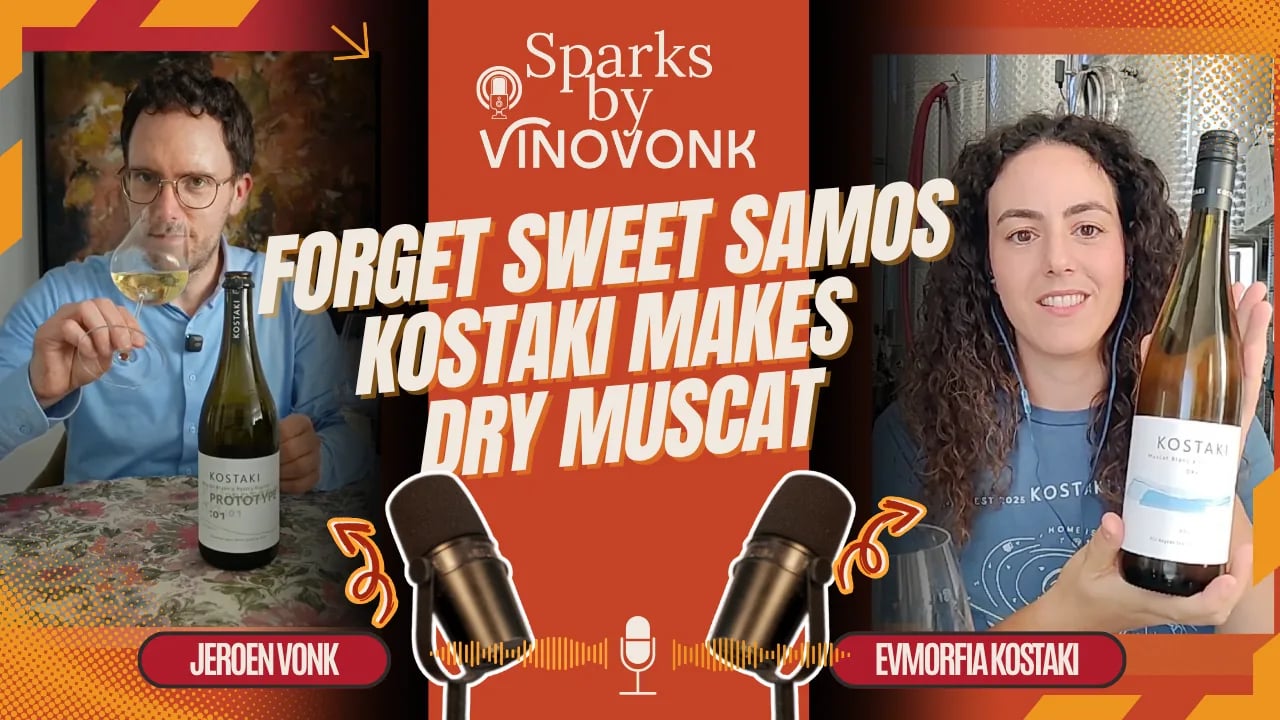
Say Samos to most wine drinkers and they think of sweet dessert wine. When I tell people I am tasting wine from Samos, the first thing they say is “sweet wine”. Evmorfia Kostaki makes dry and sparkling Muscat there, from a vineyard that has been in her family for more than a hundred years. She sent me her wines from Karlovasi, and we tasted some of them together during the recording.
Who is Evmorfia Kostaki
Evmorfia grew up in Karlovasi on the western side of Samos, where the family vineyard has sat on the same terraces for more than a century. She always wanted to work in wine. Unsure whether she was ready for it yet, she read Chemistry in Athens first, a subject she also loves.
She then studied Viticulture and Oenology with Vinifera Euromaster, first in France and then in Italy, with a thesis in California. That is where she met Lorenz Immerfall. Alongside the master’s they both took the WSET Diploma. Outside Greece, Evmorfia worked harvests in Chablis and Champagne.
Lorenz is the other half of Kostaki Winery. He is from Bavaria, studied viticulture and oenology at Geisenheim, and has worked harvests in Germany, New Zealand, Australia, France, Austria, Luxembourg, Portugal, Spain, the USA, Cyprus and England. He has lived on Samos full time for three years. After their theses the two had offers to stay in the US, but they wanted something of their own and chose Samos. They founded the winery in 2023.
The address on the bottles reads Megali Lakka Kondeikon. The winery is five minutes south of Karlovasi.
A vineyard that has been Muscat for as long as anyone can remember
The plot has been planted with Muscat Blanc à Petits Grains for over a hundred years, and it will stay that way. There are roughly 1,400 hectares of Muscat on Samos. A few other grapes grow on the island, but Muscat is by far the largest.
What sets the vineyard apart is how the vines were propagated. Whenever earlier generations needed to replant, they took cuttings from the next terrace. That is massal selection, repeated over decades, and it has left them with plant material that is unique to this spot.
Evmorfia does not want the very intense Muscat aromas in her wines. She puts that partly down to the massal selection and partly to not using enzymes or commercial yeast, which tend to push those aromas. In my glass the Prototype gave pine, lime and a slightly bitter grapefruit peel, and the Dry rosemary and thyme.
Organic since 2000, on an island with more rain than London
The vineyard has been certified organic since 2000, so for well over twenty-five years. According to Evmorfia it is the first organic vineyard on Samos. Keeping that certificate is hard work on an island with more rain than London.
Around 650 to 700 millimetres fall each year. That surprises people, because most of us picture a Greek island as parched. Most of the rain comes between November and April, but the forests and mountains keep the humidity high right through the summer. Walk into the vineyard and you are wet straight away.
They mow the grass and leave it as mulch, and the soil underneath stays damp all summer. The vines suffer little from water stress. Add tight Muscat bunches and thin skins, and no synthetic fungicides, and the risk of fungal disease is high.
They train the vines as gobelet bush vines, with the leaves on top acting as a sunshade. According to Evmorfia, Samos is one of the places in Greece with the most hours of sunshine. Lower down they strip leaves for airflow, and so that the sulphur and copper they spray reach the bunches properly.
The meltemi blows in from the north and cools the vineyard around midday. Together with the humid air, that keeps temperatures a little lower.
Samos combines a lot of rain and humidity with a lot of sun. The island has two mountains of around 1,100 and over 1,400 metres, and forest, vineyard and olive grove alternate across the slopes. Evmorfia calls it the exact opposite of the desert-like climate of Santorini.
Why Muscat gets so little respect
According to Evmorfia, Muscat Blanc à Petits Grains is one of the oldest grapes in the world. She says it travelled with the ancient Greeks, which is why it turns up in their old colonies. From there it spread to Italy, France, Spain, Portugal, Australia and the United States. She calls it the first international grape variety.
Even so, Muscat is undervalued. A pleasant, perfumed Muscat is easy to make, but the grape is hard to grow and hard to make well. That is why hardly anyone has tried to show what it is really capable of. Evmorfia says Kostaki wants to become the benchmark for Muscat.
She compares Muscat with Sauvignon Blanc. Her hunch is that Muscat comes from this part of the world and behaves with restraint here, much as Sauvignon Blanc does in the Loire. Elsewhere, she says, you get full, opulent styles.
You can argue with this. My own pushback is that Loire and Marlborough Sauvignon are both legitimate styles with their own audiences, and calling one of them “the real version” feels a bit territorial. That few producers have properly committed to Muscat is a separate point.
Reductive winemaking, screwcaps and a light bottle
Muscat oxidises quickly and turns bitter when it does. So they work as reductively as they can in the cellar and keep oxygen away from the wine. They use only their own yeast and no enzymes. For now their yeast does not get much beyond about 12% alcohol, she says, so the wines stay low in alcohol.
Every bottle has a screwcap. If you work reductively and then put a cork in, Evmorfia says, you undo the work you have done.
The bottles are brown, UV-protective glass, since Greece gets a lot of UV. They are also light, made of recycled glass weighing 400 to 420 grams. Evmorfia and Lorenz bottle the wine themselves and carry the boxes to tastings, so a one-kilo bottle makes little sense to them. When I took the bottles out of the box I thought they were empty.
The label is an abstract rendering of the view from their tasting room over western Samos, with the layers of the mountain ridges at sunset. I had already seen the Samos landscape in it before she explained.
The Prototype range
Prototype is their experimental line. The first was a sparkling wine made by what Evmorfia calls “basically a traditional method”, but without commercial yeast or sugar. They aged the 2023 base wine in barrel for a year and then added fermenting must, which set off a second fermentation in the bottle. Prototype 01 is 11.5% alcohol.
They called it Prototype because they did not know whether it would work. The winery started in 2023 with all-new equipment, and their own yeast had never been used before.
There were 500 bottles. The Greek distributor took all of them, and none were sold on Samos itself. They are making more this year, and Evmorfia expects to add it to the range under a regular label.
There is more on the way. A flor trial is running in a small tank. Alongside it there is a governo experiment, the half-forgotten Tuscan technique of adding dried grapes from the previous harvest to the fermentation of the new one. Evmorfia describes the result as “trippy”, with dried-fruit flavours in a wine that tastes very dry.
The Master of Wine path
Evmorfia is on the Master of Wine programme. She started in 2020 and was in her fifth year at the time of recording. She has passed the theory and is in stage two, with only the practical still to go. That means a great deal of tasting and studying wines, styles and regions. If she passes, the thesis comes next.
Tasting at MW level has made her a better winemaker, she says, because winemaking comes down to tasting. At Kostaki, she says, you cannot make good wine without tasting properly. That is probably the most useful argument I have heard for a producer to take on the qualification.
If she gets through, she will be the next Greek Master of Wine.
Women in Greek wine
People occasionally point out that most of my guests are men. I want the line-up to be as diverse as possible. There are still plenty of men-only networks in wine, and you come across fewer women. If you look for them, you will find them. In the Netherlands there is a large network of women in wine who support each other.
Evmorfia is a member of Women in Greek Wine, a network for women in Greek wine. During the conversation I called Samos a new renaissance. Evmorfia hopes more winemakers, on Samos and elsewhere, will take Muscat to a higher level.
The tasting
Three bottles were on the table during the recording: the Prototype, the Kostaki Dry and the Early Harvest. These are my first impressions from the conversation.
Prototype. The first nose struck me as a little reductive, the kind of smell that makes you wonder what is going on. Then came forest and pine, followed by lime and lemon. On the palate it is fresh, with a flinty edge, a slightly bitter grapefruit peel and a touch of yeast. Plenty of flavour, yet light, with a long finish. It felt like a walk through a forest next to the beach.
Kostaki Dry. Pale lemon and slightly cloudy. Fining with bentonite came up in the conversation. The nose is complex, with the same forest notes as the Prototype but more floral, plus rosemary, thyme and fruit. On the palate it is elegant and round, with a little tannin like an orange wine that I could feel on my gums. The label is simple, the wine is not.
Early Harvest. A shade paler than the Dry and 9% alcohol. A little less aromatic, and more different from the Dry than I expected. It is slightly sweeter but also higher in acidity, which gives it tension, with your brain going back and forth between sweet and sour. Lots of lime zest.
I do not know the price, and the wines are not yet available in the Netherlands.
Where this is going
Kostaki wants to show that Muscat can do every style, from sparkling and dry to dessert wine and orange wine. According to Evmorfia, you cannot call yourself a Muscat specialist unless you make a lot of different styles. The Prototype range is the experimental side of that.
I have spoken to a few Dutch importers about the wines. So far the answer has been “interesting, let us see”.
The winery is at kostakiwinery.gr and on Instagram as @kostakiwinery. The current range covers Prototype 01, Kostaki Dry, Rosé, Ancestral Method, Early Harvest, Amber and ALO. Evmorfia keeps the names simple on purpose. A sommelier should not have to remember a made-up name, so each name tells you the style.
Full transcript
Open the full transcript (English, ~4,300 words)
This transcript is generated automatically from the audio and has not been edited. Speech recognition makes mistakes, so treat wording as an approximation rather than a verbatim quote. It is here for accessibility and search.
Transcript sourced from the original Riverside export with speaker labels, lightly edited for proper names and wine terminology. Included for accessibility and search indexing.
Jeroen [00:02] Hi, and welcome to a new episode of Sparks by VinoVonk. My name is Jeroen, and I’m guiding you to the world of wine, meeting fascinating people like today, we’re meeting a very special winemaker from Samos in Greece, Evmorfia Kostaki. Very welcome, Kalispera.
Evmorfia [00:20] Kalispera, thank you for having me.
Jeroen [00:22] Thank you very much for making time. You send me all of your wines. You’re making six wines We’re going to taste only three today because well time is limited But you are on the the Greek island of Samos. I’ve been there a couple of times for holidays. I saw a lot of beaches Yeah, I was in Marathokampos and
Evmorfia [00:37] You have been here, wow!
Jeroen [00:45] and I went to the architectural museum and I saw the big statue of Kouros. I still have some pictures and I found them during my research for this conversation. And I thought, okay, I have to come again because I didn’t know they make wine there. But first of all, can you tell me something about yourself?
Evmorfia [00:54] Yeah, so I actually come from Samos, from Karlovasi on the western part. That’s where I grew up. And this is also where we have our vineyards and winery. So I grew up here, I went to school here, and then I moved to Athens to study. I studied the first chemistry. I always wanted to go into wine, but I thought, okay, maybe I’m young, like maybe I’m not sure. So I thought chemistry is a safe solution and something I really love. So I did that first and then I thought, okay, the wine bug does not go away that easily. And I went to study a bit more. I studied Viticulture and Oenology and that’s where I met my partner, Lorenz. So we studied in Italy, first in France, then in Italy. We did our thesis in California. I did it with the university and Lorenz did it with the winery. And at the same time as we started our masters, we started with the WSET, we did the diploma. So it was a really complete course, complete overview of wine, because you saw at one time how it’s made and then the other time what a lot of universities are missing, the actual tasting and learning about the regions and the styles and the grapes and all that. So, yeah, I mean, we had some offers to stay in the US and continue working. over there, but we thought, okay, let’s do something of our own. And we decided to come back to Samos. And here we are now.
Jeroen [02:50] So you’ve been winemaking all over the world? Well, almost. Not in Australia or New Zealand.
Evmorfia [02:54] No, went, I did harvests outside of Greece just in France. I did in Chablis and Champagne. But Lorenz has been all over the world, also in New Zealand and Australia and all over the place. Yeah. Yeah.
Jeroen [03:11] So lot of knowledge all over the world and now you’re on Samos. But the vineyard started in 2000, but did you start a…
Evmorfia [03:19] No, the vineyard. So the vineyard we have has been in the family for many, years, more than 100 years. And it always used to be a vineyard. And that’s what makes it special because our vineyard is massal selection. And basically, when they wanted to replant something, they just took cuttings from the next terrace and planted it in the new one. So the clone we have on the vineyard the vineyard it’s just this very original clone so that makes the wines very special very unique. But I think it’s important to talk a bit about Samos maybe because you have been but most people have no idea what’s happening. So it’s a very green island. I think you saw maybe not as much in Marathokampos but when you go to the north side where also most of the vineyards are, you get a lot of rain. We have more rain than London, which is quite impressive.
Evmorfia [04:29] although it’s mainly in winter. And yeah, everything is green. You have forest, interrupted by vineyard, interrupted by an olive grove, and it’s all like growing together, a very special place. And we have these two massive mountains. So one is 1,400 meters, more than that. And the other is about 1,100. All that makes it a very unique place. It’s not like the desert-like climate of Santorini, let’s say. It’s the exact opposite.
Jeroen [05:02] because Santorini is known for its assyrtiko, a lot of wind there, a special kind of vineyards, little baskets. But how does the climate compare to Santorini?
Evmorfia [05:05] So as I said, we have so much rain, we have about 650-700 millimeters per rain, of rain per year. And because of the forests and the mountains, we have a lot of humidity throughout the summer. So that makes the temperatures a bit lower, combined with the meltemi wind that flows from the north and cools down the vineyards in the midday. And yeah, we also have the the training system of the bush, like the goble, and that is very traditional here and acts as an umbrella basically against the sun because Samos is one of the places in Greece with the most sunshine hours, so you kind of need the sun protection. It’s very oxymoron, at one side you have a lot of rain, on the other side you have a lot of sun, but yeah it’s perfect conditions for grape growing.
Jeroen [06:12] Yeah, but not a lot of rain during the summer because I’ve been there and I never had any rain.
Evmorfia [06:18] Not a single cloud, not rain. The weather from, let’s say, most of the rain falls from November until April. And then maybe you have a little bit before, a little bit after, but in the rainy season it rains. And yeah, the rest of the year, it’s just, you have a lot of humidity, like you go in the vineyard and you’re wet immediately, like the leaves are wet. So it’s very impressive and you like we don’t till the soil, we just cut the grass so we have a thick layer of mulch in our soil and if you just lift it up underneath it’s also wet, like the soil stays wet throughout the summer. So it’s very impressive and the vineyards don’t have a lot of water stress and you see them like they’re not struggling at all but that’s also because of the muscat grape we have. So the Muscat.
Jeroen [07:11] because before we start, what kind of grape varieties you have, you’re making wine now. And I found out you’re also learning more about wine. You’re doing, you are doing the master of wine. Well, journey, course. Could you tell me something about that?
Evmorfia [07:16] It’s very challenging, I have to say, and requires a lot of time and real dedication. So I started in 2020 and now we’re in 2025, it’s been five years. And I am in stage two, and I have passed the theory part. So now I’m just a practical only student, which means I taste, taste, taste, taste, taste some more and study about the wines and styles and regions. And communicate that in the paper, in the exam. yeah, it makes me really a better winemaker because winemaking is about tasting. And our philosophy at Kostaki is also that without tasting properly, you cannot make good wine. yeah, it’s really helped me become better every day.
Jeroen [08:18] So maybe soon you will be the next Greek master of wine.
Evmorfia [08:23] Maybe, hopefully, hopefully soon. Three. So if I pass now, if this year I pass the practical, I will have to do a thesis. And that’s it. If I pass the thesis, which is not as easy as it sounds, then yeah, I will be free, free and a master of wine.
Jeroen [08:25] Maybe, Hopefully soon, because there four stages, on three. I will be following your journey. Now back to the vineyard. What kind of grape varieties do you now have and what kind of grape varieties did you have because the vineyard is in your family for more than 100 years? Could you tell me something about it?
Evmorfia [09:08] So the vineyard was always exclusively muscat. We have Muscat Blanc à Petits Grains, and it’s the variety that you find all over Samos Island. There are about 1,400 hectares of muscat planted on the island. There are a few other grapes, but it’s the vast majority. originally it was, yeah, it has always been muscat and will always be muscat, let’s say. Yeah. And then…
Jeroen [09:38] but you make different kinds of wine from the same grape variety.
Evmorfia [09:46] Yes. So our goal is to become basically the benchmark of Muscat and not a lot of people around the world really focus on this grape, although a lot of people make it. you found it in Greece, you find it in almost all the wineries, they almost all make a Muscat and also abroad you find it in many wine regions in Italy, France and even Spain, Portugal, Australia, the US, it’s the first international grape variety. And it’s one of the most ancient grapes in the world. That’s why it expanded together with the ancient Greeks. They took it with them and you find it in all the ancient colonies. And from there, it spread all over the world. So it’s a variety that’s really loved, but it’s not really currently appreciated because it’s easy to make an OK wine, a very perfumed wine. But to focus on it and see what it can do, not a lot of people have tried to do that. Because, it’s hard. It’s a very hard variety to grow and hard to make it good.
Jeroen [10:58] It’s so… It’s wine friendly, but it’s not labor friendly.
Evmorfia [11:04] Absolutely not. So we’re also organic and Muscat has very thin skins and very tight bunches.
Jeroen [11:08] I saw the label on the bottle and I saw it and I thought, you’re organic certified. That’s a lot of work. And it’s very special.
Evmorfia [11:24] Yes, yes, yes. It is organic certified and this vineyard has been organic since 2000. So it’s the first organic vineyard on Samos and has been continuously organic for, yeah, since then, like 25 years, which is a lot of time and enough to make an impact. But it’s very hard to grow perfect grapes with organic, especially in Samos with so much humidity and with the muscat that has the tight bunches. So for example, we have the bush vine, which has all the leaves on top. that creates the shade, but at the same time we do leaf removal in the bottom to improve the aeration and to improve the contact of the pesticide, basically like sulfur and copper that we use, fungicide. So yeah, it’s a lot more work, but we’re very happy with it. And I mean, we work in the vineyard ourselves. Like we are the ones who are in the vineyard all day. And it’s important for me that I’m not afraid to sit in the grass of my vineyard. So it’s not just marketing, it’s about myself.
Jeroen [12:38] But it’s hard work, but is it also hard working for making a good wine of it?
Evmorfia [12:44] Yeah, Muscat is very easy to oxidize. So you have to be very careful during wine making to not allow oxygen inside because then it becomes bitter. So for me, that’s the biggest challenge to not have something bitter. yeah, so we work very reductively and we love the style actually. And at the same time, we use screw cups. because if you work productively and then you put a cork in it, you just undo everything you’ve done. yeah, we just, all our decisions are the best for our product and ourselves, maybe not necessarily for marketing, but for example, we also use lightweight glass and all the glass is a color like this kind of brown color because it protects from UV. And I mean, we’re in Greece, we have a lot of UV. And but also they’re they are lightweight bottles because we carry them around and we go to tastings and we do all these things and we have to bottle ourselves and we have to carry the boxes. And why choose a bottle that’s one kilo when you can choose something that’s very light? Like there are so many practical things that that we did. Yeah. Making our life easier wherever we can.
Jeroen [13:39] When the bottles arrived at my place, I got them out of the box and I thought, they’re empty. And I looked, no, they’re not empty because they were so light. Yeah. And I liked the labels also, very elegant, but also, maybe it’s my imagination, but…
Evmorfia [14:14] Thank you very much.
Jeroen [14:30] I also see the landscape of Samos in it.
Evmorfia [14:33] Exactly. So it is an abstract view from my tasting room. And our tasting room has a very amazing view all over Western Samos. And that’s basically what you see. then as the sun goes down, see all these different colors and the layers between all the mountain ranges. yeah, the labels perfectly represent that and represent our style. We’re very happy with them.
Jeroen [14:59] Before we’re going to taste the wines, could you tell me something about the different kinds of wine? Because you sent me six wines.
Evmorfia [15:01] A lot of wines. So Muscat is basically the grape that can make all styles possible. You can have sparklings, can have still wines, you can have dessert made with botrytis like in Tokaj. You can have dessert from sundried like on Samos or Mistelle or I don’t know, whatever kind of wine you imagine. Orange wines are now very trendy. Whatever kind of wine you can imagine, you can make with Muscat.
Evmorfia [15:35] And that’s something amazing that this variety can do. And I honestly believe no other grape can do it so successfully. And we cannot claim to be the Muscat masters if we don’t make a lot of different styles. And we want to showcase this variability of Muscat and its ability to make so many things. And yeah, our goal is to change people’s minds. about the variety and hopefully we see many more wineries coming up, not only in Samos but elsewhere that follow this logic that they take Muscat to the next level because it’s a pity that it’s so undermined.
Jeroen [16:15] Yeah, because when I say to people, well, I’m going to taste some wine from Samos, they say, sweet wine. Because they only know Samos making only sweet wines.
Jeroen [16:26] And then they say no, they also make dry wines. Shall we go taste some wines? Yeah, it’s a prototype. then it’s more like a pet-nat or not. and this is the second term of the section. And that’s why it’s called Prototype. It’s very fresh. The first thing I thought, okay, it’s a little bit reductive because you have these kinds of aromas that you think, okay, what is this? And then you have some like forest vibes, red leaves, like pines. But then I got some lime and some lemon. And it’s very fresh and neat, the flintiness, a little bit like a bitter of the grapefruit peel. but it’s very fresh, but the aftertaste is so long. I feel like I’m walking in a forest, but it’s beside of the beach. Very strange things happening in my mind now. Yeah. And it’s a little bit like a little bit yeasty, but a lot of full flavors, but it’s very light at the same time. It’s very nice in balance. Yeah, so this is what made of by the masters of Muscat. And what are the reactions on the island of this wine? What were the reactions of this wine on the island? Yeah, because I love it. Yeah, are you going to make this every year now? Because it’s not a prototype, it’s a success. Yeah, very nice. Shall we go to the next one? And that’s the drive. Yeah, well, sounds very interesting. Fascinating times. Then we go into the, yeah, very nice name, dry. Yeah, but it’s also very simple to pronounce. It’s… Kostaki? Dry, please. the color is light lemon yellow. It’s a little bit cloudy. You don’t find it. Because you clear it with bentonite, I think. stable and the gravity worked for it. Because it’s very complex in the nose. And I thought, okay, what is happening? And again, the same vibes of the forest, but it’s more floral, one. More flowers, but also a lot of rosemary and thyme. And very fruity. Oh, it’s very elegant, complex, but very round and straightforward at the same time. You smell something, you taste it, that’s it, and it stays there. And develops in your mouth and then need a little bit of the tannins of the orange wine. I feel it in my gums a little bit. Oh, it’s very nice. The label is simple, but the wine isn’t simple. You don’t make it simple. it’s going be lovely. Yeah, it reminds me of a conversation I had with a champagne maker. Yeah, and we do this and that and that. And then we’re going to mix and then yeah, then we have a simple wine. Yeah, and sometimes the most magical things happen by accident. Did you sometimes do a blend that you thought, okay, okay, I didn’t want this, but now I want this. Yeah, that was a magical moment then. Let’s try it. And now we do it everywhere. Yeah, that’s very interesting. Could you share some technical details about how you do the fermentation? Because sometimes people ask, okay, what is the temperature they use for the fermentation and how do you do it? But how do you balance that with the pH level of the wine? Perfect, thanks. Shall we go to the last wine? And that’s a very interesting name because the name is Early Harvest. Well, I think it’s you picked the grapes earlier. Yeah, and I don’t know if you can see it, but this is the early harvest. It’s a little bit lighter of color than the dry one because, yeah, I think maybe there’s… and only 9 % alcohol. It’s a little bit less aromatic but also very interesting that you think, okay, what is happening now? Because you think, okay, it will be the same. But it’s not completely different, but there’s a huge difference in it. It’s a little bit sweeter, but also higher in acidity. And in that way, you get a lot of tension in your mouth. Your brain is like, okay, it’s sweet. No, it’s not. It’s sour. No, it’s not. Well, it has another level of complexity. It’s very pleasant also. Yeah, because you have a lot of lime zest. If you think in cocktails, just put an umbrella on it. maybe in the label some, yeah, a little bit of umbrella shape. Yeah. But this is a new sound of Samos, a new renaissance of Samos, you could say it. But how do you see the future of winemaking in Samos? And are other winemakers coming to you? I want to learn about how you make these kinds of wines.
Evmorfia [35:21] Okay, I’m it overheated because it was hit by the sun. Yeah. Okay, we can continue. We should taste some wines. We can start with the prototype. So, yes. So, prototype is are
Jeroen [35:56] Because you’re working in very hard conditions, very wet during the whole year, but besides of the summer, very hot in the summer, but you’re organic certified, so you know how to do it. And a lot of people say, OK, I can’t do organic certification because I have too much humidity. Go to Samos and learn from you, I would say.
Evmorfia [36:22] And what we do with this wine is it’s basically a traditional method, but because we don’t use any commercial yeast in the winery, we aged the base wine of 2023 for one year, we aged it in barrel. And then we blended it fermenting mast in order to initiate a second fermenting bottle. So that’s how it became sparkling. It doesn’t have any extra
Evmorfia [36:52] or yeah, commercial yeast. just has a base wine plus fermenting must put together like this.
Jeroen [36:59] But how do you see the future of Samos in winemaking then?
Evmorfia [37:04] the first fermentation. So here, this is the second fermentation with just 10%. Yeah, it’s a prototype because we didn’t know if it was going to work. We have our own yeast, The winery is new. All the equipment was new when we started in 2023. We didn’t know if it was going to work because we never used any yeast here. It’s just our own. And we know our yeast struggles with, let’s say, achieving 12 and 1 alcohol. That’s why also quite low alcohol because our yeast cannot ferment very high, for now at least. And so yeah, it was an experiment. It worked really well.
Jeroen [37:51] You’re a very passionate winemaker. You’re learning new things. You’re going on study trips. But I found also out that you are one of the women in Greek wine. And your role is a fearless wine warrior, I found out.
Evmorfia [38:11] Yamas. So yeah, as you see, in other wines, we try to not have so much the very intense muscat flavors. And that’s contributed by the massal selection that we have, but also don’t use enzymes, for example, or commercial yeast that can really enhance this flavor. But what I also say is that Muscat Blanc à Petits Grains comes from this area, comes from Samos or comes from somewhere around here. And for example, just like Sauvignon Blanc, it comes from the Loire. And over there it makes these wines very mineral, very elegant, very. And anywhere else in the world, you have these very opulent styles. And it’s the same with Muscat. Like in its origin, where it comes from
Jeroen [39:28] Yeah, I can understand. because in Netherlands you also have a large network of women working in wine and because they support each other. But now they still you see a lot of men only networks doing things in wine. And I thought, OK, why is that? A lot of people complained to me also because I have a lot of guests and they say, you only have men as a guest. Well, I’m not.
Evmorfia [39:44] mineral.
Jeroen [40:05] picking only men. I want to be as diverse as possible. But there aren’t a lot of women in wine. But if you look for it, you can find it. And if you don’t look for it, you don’t find it.
Evmorfia [40:35] Thank you so much.
Jeroen [40:40] looking forward to that. Do you want to share something else about what you do?
Evmorfia [40:47] Actually, this wine we didn’t sell on the island. A very limited production and our distributor in Greece got it all.
Jeroen [41:02] Yeah, and because when people want to buy these wines, they aren’t available yet in the Netherlands. I spoke to some importers and they told me, well, yeah, but they’re a bit new. Let’s see for it. Well, I think go for it because it’s very, very nice. But where can people buy a wine?
Evmorfia [41:15] So eventually, like this year, we created some more sparkling base next to me here. the tank gives me this very nice lighting. And yeah, so we will make some more of this. But I think under a normal label, we will add this on our range.
Jeroen [41:37] I’ll put some links in the show notes also from your Instagram account and other social media.
Jeroen [41:46] Well, thank you very much for your time. I will enjoy these wines and also the other three wines. I will make tasting videos and they will come on my social media. Thank you very much for your time. Hope to see more of your wines in the future because the Vintage 2025 almost ends. Can we have a sneak peek? What do you think? Is it a good vintage?
Evmorfia [42:13] Which from last year. So you have it’s very trippy because you have that has dried flavors, but it tastes very dry. And we see so stay tuned for the next prototypes whenever they get released. Dry. I keep things simple and I want to help the people who help me. Like if you’re a sommelier in a restaurant, I don’t want you to remember a random name. Another random name that someone made up. Like I want you to know like is a dry wine and yeah, every wine represents the names, represent the styles.
Jeroen [43:12] Yeah, looking forward to meeting these kinds of wines from 2025. Evmorfia, thank you very much for your time. This was a new episode of Sparks by VinoVonk. Don’t forget to subscribe in your favorite app, Spotify, YouTube, Apple Podcast, whatever. And see you next time.
Evmorfia sent the bottles herself. I received no payment and the opinions are entirely my own.
Listen and watch
YouTube: youtu.be/0RmF9gbLBgc Spotify: open.spotify.com/episode/6NlkZNW3AYPeE5CMXGt9jM
Subscribe to the In het Glas newsletter for the weekly bottle pick and to hear when the next Sparks lands.
Listen
Watch