

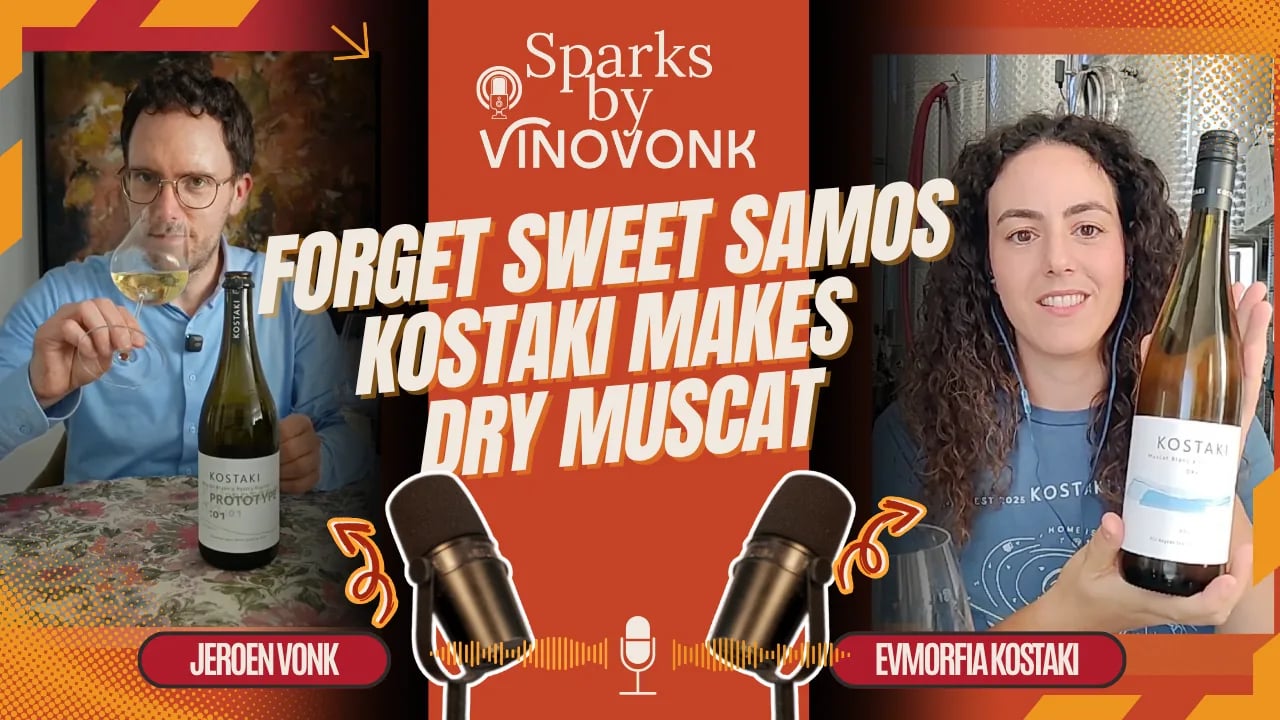
Samos en droge wijn klinkt voor de meeste mensen als een tikfout. Het eiland staat bekend om zoete dessertwijn, en wie ik vertel dat ik wijn van Samos ga proeven, zegt meteen “zoete wijn”. Evmorfia Kostaki maakt er droge en mousserende Muscat, van de wijngaard die al ruim honderd jaar in haar familie is. De flessen die ze vanuit Karlovasi naar mij stuurde, proefden we voor een deel samen tijdens de opname.
Deze aflevering is in het Engels opgenomen. Bekijk op YouTube met automatische ondertiteling, of lees de Engelstalige versie van dit artikel.
Wie is Evmorfia Kostaki
Evmorfia groeide op in Karlovasi, op het westelijke deel van Samos, waar de familiewijngaard al meer dan een eeuw op dezelfde terrassen ligt. Ze wilde altijd al de wijn in. Ze twijfelde of ze al klaar was voor wijn en koos eerst Chemie in Athene, een vak waar ze ook van houdt.
Daarna studeerde ze Wijnbouw en Oenologie bij Vinifera Euromaster, eerst in Frankrijk en daarna in Italië, met een thesis in Californië. Tijdens die studie leerde ze Lorenz Immerfall kennen. Naast de master deden ze allebei het WSET Diploma. Oogsten deed Evmorfia buiten Griekenland in Chablis en Champagne.
Lorenz is de andere helft van Kostaki Winery. Hij komt uit Beieren, studeerde wijnbouw en oenologie in Geisenheim en oogstte in Duitsland, Nieuw-Zeeland, Australië, Frankrijk, Oostenrijk, Luxemburg, Portugal, Spanje, de Verenigde Staten, Cyprus en Engeland. Sinds drie jaar woont hij vast op Samos. Na hun thesis kregen ze aanbiedingen om in de VS te blijven, maar ze wilden iets eigens beginnen en kozen voor Samos. In 2023 richtten ze de wijnmakerij op.
Het adres op de fles is Megali Lakka Kondeikon. De wijnmakerij ligt vijf minuten ten zuiden van Karlovasi.
Een wijngaard die al zo lang Muscat is als iedereen zich kan herinneren
Het perceel staat al ruim honderd jaar vol met Muscat Blanc à Petits Grains, en dat blijft zo. Op heel Samos staat zo’n 1400 hectare Muscat. Er groeien een paar andere druiven, maar Muscat is veruit de grootste.
Bijzonder is de manier waarop de stokken zijn vermeerderd. Als eerdere generaties iets moesten herplanten, namen ze stekken van het volgende terras. Dat is massale selectie, decennialang herhaald, en het levert plantmateriaal op dat uniek is voor deze plek.
Evmorfia wil in haar wijnen niet de heel intense Muscat-aroma’s. Dat komt volgens haar deels door die massale selectie en deels doordat ze geen enzymen of commerciële gist gebruiken, die dat aroma juist versterken. In mijn glas vond ik bij de Prototype dennen, limoen en een bittertje van grapefruitschil, en bij de Dry rozemarijn en tijm.
Biologisch sinds 2000, op een eiland met meer regen dan Londen
De wijngaard is sinds 2000 biologisch gecertificeerd, inmiddels ruim vijfentwintig jaar. Volgens Evmorfia is het de eerste biologische wijngaard van Samos. Dat certificaat houden is lastig op een eiland met meer regen dan Londen.
Er valt ongeveer 650 tot 700 millimeter per jaar. Dat verrast, want bij een Grieks eiland denken de meeste mensen aan droogte. Het grootste deel van die regen valt tussen november en april, maar door de bossen en de bergen blijft de luchtvochtigheid de hele zomer hoog. Loop de wijngaard in en je bent meteen nat.
Ze maaien het gras en laten het liggen als mulch, en daaronder blijft de bodem de hele zomer vochtig. De stokken hebben weinig last van waterstress. Daar komen dichte Muscat-trossen en dunne schillen bij, en synthetische schimmelmiddelen gebruiken ze niet. Dat geeft veel kans op schimmel.
Ze telen de stokken als gobelet, een struikvorm waarbij het blad bovenop als parasol tegen de zon werkt. Samos is volgens Evmorfia een van de plekken in Griekenland met de meeste zonuren. Onderin halen ze blad weg, voor luchtcirculatie en zodat de zwavel en het koper waarmee ze spuiten de trossen beter bereiken.
De meltemi komt uit het noorden en koelt de wijngaard rond het middaguur. Samen met de vochtige lucht houdt dat de temperatuur wat lager.
Samos combineert veel regen en luchtvochtigheid met veel zon. Op het eiland staan twee bergen van circa 1100 en ruim 1400 meter, en bos, wijngaard en olijfgaard wisselen elkaar af. Evmorfia noemt het precies het tegenovergestelde van het woestijnachtige klimaat van Santorini.
Waarom Muscat weinig serieus wordt genomen
Volgens Evmorfia is Muscat Blanc à Petits Grains een van de oudste druiven ter wereld. De druif reisde volgens haar mee met de oude Grieken, en daarom vind je hem in hun oude koloniën. Van daaruit verspreidde hij zich naar Italië, Frankrijk, Spanje, Portugal, Australië en de Verenigde Staten. Ze noemt hem de eerste internationale druif.
Toch wordt Muscat weinig gewaardeerd. Een aangename, geparfumeerde Muscat maak je makkelijk, maar de druif is moeilijk te telen en moeilijk goed te maken. Daarom heeft bijna niemand geprobeerd te laten zien wat er in de druif zit. Kostaki wil volgens Evmorfia de referentie voor Muscat worden.
Ze vergelijkt Muscat met Sauvignon Blanc. Haar gok: Muscat komt uit deze streek en gedraagt zich daar ingehouden, zoals Sauvignon Blanc in de Loire. Elders ter wereld krijg je volgens haar volle, opulente stijlen.
Je kunt daar tegenin gaan. Mijn eigen tegenwerping is dat Sauvignon uit de Loire en uit Marlborough allebei legitieme stijlen zijn met een eigen publiek, en dat het wat territoriaal voelt om er één “de echte” te noemen. Dat weinig producenten zich serieus op Muscat toeleggen, staat daar los van.
Reductief werken, schroefdop en een lichte fles
Muscat oxideert snel en wordt dan bitter. Daarom werken ze in de kelder zo reductief mogelijk en houden ze zuurstof bij de wijn weg. Ze gebruiken alleen eigen gist en geen enzymen. Hun eigen gist komt voorlopig niet veel verder dan zo’n 12% alcohol, zegt ze, dus de wijnen blijven laag in alcohol.
Op elke fles zit een schroefdop. Wie reductief werkt en daarna een kurk gebruikt, maakt volgens Evmorfia ongedaan wat hij heeft opgebouwd.
De flessen zijn van bruin, UV-werend glas, want in Griekenland is veel UV. Ze zijn ook licht, van gerecycled glas van 400 tot 420 gram. Evmorfia en Lorenz bottelen zelf en sjouwen de dozen zelf naar proeverijen, dus waarom een fles van een kilo kiezen. Toen ik de flessen uit de doos haalde dacht ik dat ze leeg waren.
Het etiket is een abstracte weergave van het uitzicht vanuit hun proefruimte over westelijk Samos, met de lagen van de bergruggen bij zonsondergang. Ik zag het landschap van Samos er al in voordat ze het uitlegde.
De Prototype-reeks
Prototype is hun experimentele lijn. De eerste was een mousserende wijn volgens wat Evmorfia “basically een traditionele methode” noemt, maar zonder commerciële gist of suiker. Ze lieten de basiswijn van 2023 een jaar op vat liggen en voegden daarna fermenterende most toe, zodat in de fles een tweede gisting op gang kwam. Prototype 01 heeft 11,5% alcohol.
Ze noemden hem Prototype omdat ze niet wisten of het zou werken. De wijnmakerij begon in 2023 met nieuwe apparatuur en hun eigen gist was nog niet eerder gebruikt.
Er waren 500 flessen. De Griekse distributeur nam ze allemaal af en op Samos zelf is er niets verkocht. Dit jaar maken ze meer, en Evmorfia verwacht hem onder een regulier label aan het assortiment toe te voegen.
Er staat meer klaar. In een klein tankje loopt een proef met flor. Daarnaast loopt een experiment met governo, de half vergeten Toscaanse techniek waarbij je gedroogde druiven van de vorige oogst aan de gisting van de nieuwe toevoegt. Evmorfia noemt het resultaat “trippy”, met smaken van gedroogd fruit in een wijn die heel droog proeft.
Het Master of Wine-traject
Evmorfia volgt het Master of Wine-programma. Ze begon in 2020 en zat bij de opname in jaar vijf. De theorie heeft ze gehaald en ze zit in stage twee, waarin alleen het praktijkdeel nog openstaat. Dat betekent vooral veel proeven en studeren op wijnen, stijlen en regio’s. Haalt ze dat, dan volgt nog de thesis.
Het proeven op MW-niveau maakt haar volgens eigen zeggen een betere wijnmaker, omdat wijnmaken om proeven draait. Bij Kostaki geldt volgens haar: zonder goed proeven geen goede wijn. Dat is misschien wel het beste argument dat ik heb gehoord om als producent de kwalificatie te halen.
Als ze het haalt, wordt ze de volgende Griekse Master of Wine.
Vrouwen in de Griekse wijn
Ik krijg af en toe de opmerking dat ik vooral mannen als gast heb. Ik wil zo divers mogelijk zijn. Het is zo dat er in wijn nog veel netwerken van alleen mannen zijn en dat je minder vrouwen tegenkomt. Wie gericht zoekt, vindt ze wel. In Nederland is er een groot netwerk van vrouwen in de wijn die elkaar steunen.
Evmorfia is lid van Women in Greek Wine, een netwerk voor vrouwen in de Griekse wijn. Ik noemde Samos in het gesprek een nieuwe renaissance. Evmorfia hoopt dat meer wijnmakers, op Samos en elders, Muscat naar een hoger niveau tillen.
De proeverij
We hadden tijdens de opname drie flessen op tafel: de Prototype, de Kostaki Dry en de Early Harvest. Dit zijn mijn eerste indrukken uit het gesprek.
Prototype. De eerste neus vond ik wat reductief, zo’n geur waarbij je je afvraagt wat dit is. Daarna kwamen bos en dennen, en vervolgens limoen en citroen. In de mond fris, met iets vuursteenachtigs, een bittertje van grapefruitschil en een lichte gisttoets. Veel smaak en toch licht, met een lange afdronk. Het voelde als een wandeling door een bos naast het strand.
Kostaki Dry. Licht citroengeel en een tikje troebel. In het gesprek kwam het klaren met bentoniet ter sprake. In de neus complex, met dezelfde bostonen als de Prototype maar bloemiger, met rozemarijn, tijm en fruit. In de mond elegant en rond, met een beetje tannine zoals bij een orange wine, die ik in mijn tandvlees voelde. Het etiket is eenvoudig, de wijn niet.
Early Harvest. Iets lichter van kleur dan de Dry en 9% alcohol. Iets minder aromatisch, en toch verrassend anders dan ik verwachtte. Hij is iets zoeter maar ook hoger in zuur, en dat geeft spanning in de mond, waarbij je brein twijfelt tussen zoet en zuur. Veel limoenschil.
Een prijs ken ik niet, en de wijnen zijn in Nederland nog niet te koop.
Waar dit naartoe gaat
Kostaki wil laten zien dat Muscat alle stijlen aankan, van mousserend en droog tot dessertwijn en orange wine. Volgens Evmorfia kun je jezelf geen Muscat-specialist noemen als je niet veel verschillende stijlen maakt. De Prototype-reeks is de experimentele kant daarvan.
Een paar Nederlandse importeurs heb ik erover gesproken. Het antwoord was tot nu toe “interessant, we kijken even”.
De winery zit op kostakiwinery.gr en op Instagram als @kostakiwinery. Het huidige assortiment bestaat uit Prototype 01, Kostaki Dry, Rosé, Ancestral Method, Early Harvest, Amber en ALO. De namen houdt Evmorfia bewust eenvoudig. Een sommelier hoeft geen verzonnen naam te onthouden, want elke naam zegt welke stijl het is.
Volledig transcript
Open het volledige transcript (Engels, ~4.300 woorden)
Het gesprek is in het Engels opgenomen. Onderstaand transcript is afkomstig van de originele Riverside-export met sprekerslabels, licht geredigeerd op naamspelling en wijntermen. Opgenomen voor toegankelijkheid en zoekmachine-indexering.
Jeroen [00:02] Hi, and welcome to a new episode of Sparks by VinoVonk. My name is Jeroen, and I’m guiding you to the world of wine, meeting fascinating people like today, we’re meeting a very special winemaker from Samos in Greece, Evmorfia Kostaki. Very welcome, Kalispera.
Evmorfia [00:20] Kalispera, thank you for having me.
Jeroen [00:22] Thank you very much for making time. You send me all of your wines. You’re making six wines We’re going to taste only three today because well time is limited But you are on the the Greek island of Samos. I’ve been there a couple of times for holidays. I saw a lot of beaches Yeah, I was in Marathokampos and
Evmorfia [00:37] You have been here, wow!
Jeroen [00:45] and I went to the architectural museum and I saw the big statue of Kouros. I still have some pictures and I found them during my research for this conversation. And I thought, okay, I have to come again because I didn’t know they make wine there. But first of all, can you tell me something about yourself?
Evmorfia [00:54] Yeah, so I actually come from Samos, from Karlovasi on the western part. That’s where I grew up. And this is also where we have our vineyards and winery. So I grew up here, I went to school here, and then I moved to Athens to study. I studied the first chemistry. I always wanted to go into wine, but I thought, okay, maybe I’m young, like maybe I’m not sure. So I thought chemistry is a safe solution and something I really love. So I did that first and then I thought, okay, the wine bug does not go away that easily. And I went to study a bit more. I studied Viticulture and Oenology and that’s where I met my partner, Lorenz. So we studied in Italy, first in France, then in Italy. We did our thesis in California. I did it with the university and Lorenz did it with the winery. And at the same time as we started our masters, we started with the WSET, we did the diploma. So it was a really complete course, complete overview of wine, because you saw at one time how it’s made and then the other time what a lot of universities are missing, the actual tasting and learning about the regions and the styles and the grapes and all that. So, yeah, I mean, we had some offers to stay in the US and continue working. over there, but we thought, okay, let’s do something of our own. And we decided to come back to Samos. And here we are now.
Jeroen [02:50] So you’ve been winemaking all over the world? Well, almost. Not in Australia or New Zealand.
Evmorfia [02:54] No, went, I did harvests outside of Greece just in France. I did in Chablis and Champagne. But Lorenz has been all over the world, also in New Zealand and Australia and all over the place. Yeah. Yeah.
Jeroen [03:11] So lot of knowledge all over the world and now you’re on Samos. But the vineyard started in 2000, but did you start a…
Evmorfia [03:19] No, the vineyard. So the vineyard we have has been in the family for many, years, more than 100 years. And it always used to be a vineyard. And that’s what makes it special because our vineyard is massal selection. And basically, when they wanted to replant something, they just took cuttings from the next terrace and planted it in the new one. So the clone we have on the vineyard the vineyard it’s just this very original clone so that makes the wines very special very unique. But I think it’s important to talk a bit about Samos maybe because you have been but most people have no idea what’s happening. So it’s a very green island. I think you saw maybe not as much in Marathokampos but when you go to the north side where also most of the vineyards are, you get a lot of rain. We have more rain than London, which is quite impressive.
Evmorfia [04:29] although it’s mainly in winter. And yeah, everything is green. You have forest, interrupted by vineyard, interrupted by an olive grove, and it’s all like growing together, a very special place. And we have these two massive mountains. So one is 1,400 meters, more than that. And the other is about 1,100. All that makes it a very unique place. It’s not like the desert-like climate of Santorini, let’s say. It’s the exact opposite.
Jeroen [05:02] because Santorini is known for its assyrtiko, a lot of wind there, a special kind of vineyards, little baskets. But how does the climate compare to Santorini?
Evmorfia [05:05] So as I said, we have so much rain, we have about 650-700 millimeters per rain, of rain per year. And because of the forests and the mountains, we have a lot of humidity throughout the summer. So that makes the temperatures a bit lower, combined with the meltemi wind that flows from the north and cools down the vineyards in the midday. And yeah, we also have the the training system of the bush, like the goble, and that is very traditional here and acts as an umbrella basically against the sun because Samos is one of the places in Greece with the most sunshine hours, so you kind of need the sun protection. It’s very oxymoron, at one side you have a lot of rain, on the other side you have a lot of sun, but yeah it’s perfect conditions for grape growing.
Jeroen [06:12] Yeah, but not a lot of rain during the summer because I’ve been there and I never had any rain.
Evmorfia [06:18] Not a single cloud, not rain. The weather from, let’s say, most of the rain falls from November until April. And then maybe you have a little bit before, a little bit after, but in the rainy season it rains. And yeah, the rest of the year, it’s just, you have a lot of humidity, like you go in the vineyard and you’re wet immediately, like the leaves are wet. So it’s very impressive and you like we don’t till the soil, we just cut the grass so we have a thick layer of mulch in our soil and if you just lift it up underneath it’s also wet, like the soil stays wet throughout the summer. So it’s very impressive and the vineyards don’t have a lot of water stress and you see them like they’re not struggling at all but that’s also because of the muscat grape we have. So the Muscat.
Jeroen [07:11] because before we start, what kind of grape varieties you have, you’re making wine now. And I found out you’re also learning more about wine. You’re doing, you are doing the master of wine. Well, journey, course. Could you tell me something about that?
Evmorfia [07:16] It’s very challenging, I have to say, and requires a lot of time and real dedication. So I started in 2020 and now we’re in 2025, it’s been five years. And I am in stage two, and I have passed the theory part. So now I’m just a practical only student, which means I taste, taste, taste, taste, taste some more and study about the wines and styles and regions. And communicate that in the paper, in the exam. yeah, it makes me really a better winemaker because winemaking is about tasting. And our philosophy at Kostaki is also that without tasting properly, you cannot make good wine. yeah, it’s really helped me become better every day.
Jeroen [08:18] So maybe soon you will be the next Greek master of wine.
Evmorfia [08:23] Maybe, hopefully, hopefully soon. Three. So if I pass now, if this year I pass the practical, I will have to do a thesis. And that’s it. If I pass the thesis, which is not as easy as it sounds, then yeah, I will be free, free and a master of wine.
Jeroen [08:25] Maybe, Hopefully soon, because there four stages, on three. I will be following your journey. Now back to the vineyard. What kind of grape varieties do you now have and what kind of grape varieties did you have because the vineyard is in your family for more than 100 years? Could you tell me something about it?
Evmorfia [09:08] So the vineyard was always exclusively muscat. We have Muscat Blanc à Petits Grains, and it’s the variety that you find all over Samos Island. There are about 1,400 hectares of muscat planted on the island. There are a few other grapes, but it’s the vast majority. originally it was, yeah, it has always been muscat and will always be muscat, let’s say. Yeah. And then…
Jeroen [09:38] but you make different kinds of wine from the same grape variety.
Evmorfia [09:46] Yes. So our goal is to become basically the benchmark of Muscat and not a lot of people around the world really focus on this grape, although a lot of people make it. you found it in Greece, you find it in almost all the wineries, they almost all make a Muscat and also abroad you find it in many wine regions in Italy, France and even Spain, Portugal, Australia, the US, it’s the first international grape variety. And it’s one of the most ancient grapes in the world. That’s why it expanded together with the ancient Greeks. They took it with them and you find it in all the ancient colonies. And from there, it spread all over the world. So it’s a variety that’s really loved, but it’s not really currently appreciated because it’s easy to make an OK wine, a very perfumed wine. But to focus on it and see what it can do, not a lot of people have tried to do that. Because, it’s hard. It’s a very hard variety to grow and hard to make it good.
Jeroen [10:58] It’s so… It’s wine friendly, but it’s not labor friendly.
Evmorfia [11:04] Absolutely not. So we’re also organic and Muscat has very thin skins and very tight bunches.
Jeroen [11:08] I saw the label on the bottle and I saw it and I thought, you’re organic certified. That’s a lot of work. And it’s very special.
Evmorfia [11:24] Yes, yes, yes. It is organic certified and this vineyard has been organic since 2000. So it’s the first organic vineyard on Samos and has been continuously organic for, yeah, since then, like 25 years, which is a lot of time and enough to make an impact. But it’s very hard to grow perfect grapes with organic, especially in Samos with so much humidity and with the muscat that has the tight bunches. So for example, we have the bush vine, which has all the leaves on top. that creates the shade, but at the same time we do leaf removal in the bottom to improve the aeration and to improve the contact of the pesticide, basically like sulfur and copper that we use, fungicide. So yeah, it’s a lot more work, but we’re very happy with it. And I mean, we work in the vineyard ourselves. Like we are the ones who are in the vineyard all day. And it’s important for me that I’m not afraid to sit in the grass of my vineyard. So it’s not just marketing, it’s about myself.
Jeroen [12:38] But it’s hard work, but is it also hard working for making a good wine of it?
Evmorfia [12:44] Yeah, Muscat is very easy to oxidize. So you have to be very careful during wine making to not allow oxygen inside because then it becomes bitter. So for me, that’s the biggest challenge to not have something bitter. yeah, so we work very reductively and we love the style actually. And at the same time, we use screw cups. because if you work productively and then you put a cork in it, you just undo everything you’ve done. yeah, we just, all our decisions are the best for our product and ourselves, maybe not necessarily for marketing, but for example, we also use lightweight glass and all the glass is a color like this kind of brown color because it protects from UV. And I mean, we’re in Greece, we have a lot of UV. And but also they’re they are lightweight bottles because we carry them around and we go to tastings and we do all these things and we have to bottle ourselves and we have to carry the boxes. And why choose a bottle that’s one kilo when you can choose something that’s very light? Like there are so many practical things that that we did. Yeah. Making our life easier wherever we can.
Jeroen [13:39] When the bottles arrived at my place, I got them out of the box and I thought, they’re empty. And I looked, no, they’re not empty because they were so light. Yeah. And I liked the labels also, very elegant, but also, maybe it’s my imagination, but…
Evmorfia [14:14] Thank you very much.
Jeroen [14:30] I also see the landscape of Samos in it.
Evmorfia [14:33] Exactly. So it is an abstract view from my tasting room. And our tasting room has a very amazing view all over Western Samos. And that’s basically what you see. then as the sun goes down, see all these different colors and the layers between all the mountain ranges. yeah, the labels perfectly represent that and represent our style. We’re very happy with them.
Jeroen [14:59] Before we’re going to taste the wines, could you tell me something about the different kinds of wine? Because you sent me six wines.
Evmorfia [15:01] A lot of wines. So Muscat is basically the grape that can make all styles possible. You can have sparklings, can have still wines, you can have dessert made with botrytis like in Tokaj. You can have dessert from sundried like on Samos or Mistelle or I don’t know, whatever kind of wine you imagine. Orange wines are now very trendy. Whatever kind of wine you can imagine, you can make with Muscat.
Evmorfia [15:35] And that’s something amazing that this variety can do. And I honestly believe no other grape can do it so successfully. And we cannot claim to be the Muscat masters if we don’t make a lot of different styles. And we want to showcase this variability of Muscat and its ability to make so many things. And yeah, our goal is to change people’s minds. about the variety and hopefully we see many more wineries coming up, not only in Samos but elsewhere that follow this logic that they take Muscat to the next level because it’s a pity that it’s so undermined.
Jeroen [16:15] Yeah, because when I say to people, well, I’m going to taste some wine from Samos, they say, sweet wine. Because they only know Samos making only sweet wines.
Jeroen [16:26] And then they say no, they also make dry wines. Shall we go taste some wines? Yeah, it’s a prototype. then it’s more like a pet-nat or not. and this is the second term of the section. And that’s why it’s called Prototype. It’s very fresh. The first thing I thought, okay, it’s a little bit reductive because you have these kinds of aromas that you think, okay, what is this? And then you have some like forest vibes, red leaves, like pines. But then I got some lime and some lemon. And it’s very fresh and neat, the flintiness, a little bit like a bitter of the grapefruit peel. but it’s very fresh, but the aftertaste is so long. I feel like I’m walking in a forest, but it’s beside of the beach. Very strange things happening in my mind now. Yeah. And it’s a little bit like a little bit yeasty, but a lot of full flavors, but it’s very light at the same time. It’s very nice in balance. Yeah, so this is what made of by the masters of Muscat. And what are the reactions on the island of this wine? What were the reactions of this wine on the island? Yeah, because I love it. Yeah, are you going to make this every year now? Because it’s not a prototype, it’s a success. Yeah, very nice. Shall we go to the next one? And that’s the drive. Yeah, well, sounds very interesting. Fascinating times. Then we go into the, yeah, very nice name, dry. Yeah, but it’s also very simple to pronounce. It’s… Kostaki? Dry, please. the color is light lemon yellow. It’s a little bit cloudy. You don’t find it. Because you clear it with bentonite, I think. stable and the gravity worked for it. Because it’s very complex in the nose. And I thought, okay, what is happening? And again, the same vibes of the forest, but it’s more floral, one. More flowers, but also a lot of rosemary and thyme. And very fruity. Oh, it’s very elegant, complex, but very round and straightforward at the same time. You smell something, you taste it, that’s it, and it stays there. And develops in your mouth and then need a little bit of the tannins of the orange wine. I feel it in my gums a little bit. Oh, it’s very nice. The label is simple, but the wine isn’t simple. You don’t make it simple. it’s going be lovely. Yeah, it reminds me of a conversation I had with a champagne maker. Yeah, and we do this and that and that. And then we’re going to mix and then yeah, then we have a simple wine. Yeah, and sometimes the most magical things happen by accident. Did you sometimes do a blend that you thought, okay, okay, I didn’t want this, but now I want this. Yeah, that was a magical moment then. Let’s try it. And now we do it everywhere. Yeah, that’s very interesting. Could you share some technical details about how you do the fermentation? Because sometimes people ask, okay, what is the temperature they use for the fermentation and how do you do it? But how do you balance that with the pH level of the wine? Perfect, thanks. Shall we go to the last wine? And that’s a very interesting name because the name is Early Harvest. Well, I think it’s you picked the grapes earlier. Yeah, and I don’t know if you can see it, but this is the early harvest. It’s a little bit lighter of color than the dry one because, yeah, I think maybe there’s… and only 9 % alcohol. It’s a little bit less aromatic but also very interesting that you think, okay, what is happening now? Because you think, okay, it will be the same. But it’s not completely different, but there’s a huge difference in it. It’s a little bit sweeter, but also higher in acidity. And in that way, you get a lot of tension in your mouth. Your brain is like, okay, it’s sweet. No, it’s not. It’s sour. No, it’s not. Well, it has another level of complexity. It’s very pleasant also. Yeah, because you have a lot of lime zest. If you think in cocktails, just put an umbrella on it. maybe in the label some, yeah, a little bit of umbrella shape. Yeah. But this is a new sound of Samos, a new renaissance of Samos, you could say it. But how do you see the future of winemaking in Samos? And are other winemakers coming to you? I want to learn about how you make these kinds of wines.
Evmorfia [35:21] Okay, I’m it overheated because it was hit by the sun. Yeah. Okay, we can continue. We should taste some wines. We can start with the prototype. So, yes. So, prototype is are
Jeroen [35:56] Because you’re working in very hard conditions, very wet during the whole year, but besides of the summer, very hot in the summer, but you’re organic certified, so you know how to do it. And a lot of people say, OK, I can’t do organic certification because I have too much humidity. Go to Samos and learn from you, I would say.
Evmorfia [36:22] And what we do with this wine is it’s basically a traditional method, but because we don’t use any commercial yeast in the winery, we aged the base wine of 2023 for one year, we aged it in barrel. And then we blended it fermenting mast in order to initiate a second fermenting bottle. So that’s how it became sparkling. It doesn’t have any extra
Evmorfia [36:52] or yeah, commercial yeast. just has a base wine plus fermenting must put together like this.
Jeroen [36:59] But how do you see the future of Samos in winemaking then?
Evmorfia [37:04] the first fermentation. So here, this is the second fermentation with just 10%. Yeah, it’s a prototype because we didn’t know if it was going to work. We have our own yeast, The winery is new. All the equipment was new when we started in 2023. We didn’t know if it was going to work because we never used any yeast here. It’s just our own. And we know our yeast struggles with, let’s say, achieving 12 and 1 alcohol. That’s why also quite low alcohol because our yeast cannot ferment very high, for now at least. And so yeah, it was an experiment. It worked really well.
Jeroen [37:51] You’re a very passionate winemaker. You’re learning new things. You’re going on study trips. But I found also out that you are one of the women in Greek wine. And your role is a fearless wine warrior, I found out.
Evmorfia [38:11] Yamas. So yeah, as you see, in other wines, we try to not have so much the very intense muscat flavors. And that’s contributed by the massal selection that we have, but also don’t use enzymes, for example, or commercial yeast that can really enhance this flavor. But what I also say is that Muscat Blanc à Petits Grains comes from this area, comes from Samos or comes from somewhere around here. And for example, just like Sauvignon Blanc, it comes from the Loire. And over there it makes these wines very mineral, very elegant, very. And anywhere else in the world, you have these very opulent styles. And it’s the same with Muscat. Like in its origin, where it comes from
Jeroen [39:28] Yeah, I can understand. because in Netherlands you also have a large network of women working in wine and because they support each other. But now they still you see a lot of men only networks doing things in wine. And I thought, OK, why is that? A lot of people complained to me also because I have a lot of guests and they say, you only have men as a guest. Well, I’m not.
Evmorfia [39:44] mineral.
Jeroen [40:05] picking only men. I want to be as diverse as possible. But there aren’t a lot of women in wine. But if you look for it, you can find it. And if you don’t look for it, you don’t find it.
Evmorfia [40:35] Thank you so much.
Jeroen [40:40] looking forward to that. Do you want to share something else about what you do?
Evmorfia [40:47] Actually, this wine we didn’t sell on the island. A very limited production and our distributor in Greece got it all.
Jeroen [41:02] Yeah, and because when people want to buy these wines, they aren’t available yet in the Netherlands. I spoke to some importers and they told me, well, yeah, but they’re a bit new. Let’s see for it. Well, I think go for it because it’s very, very nice. But where can people buy a wine?
Evmorfia [41:15] So eventually, like this year, we created some more sparkling base next to me here. the tank gives me this very nice lighting. And yeah, so we will make some more of this. But I think under a normal label, we will add this on our range.
Jeroen [41:37] I’ll put some links in the show notes also from your Instagram account and other social media.
Jeroen [41:46] Well, thank you very much for your time. I will enjoy these wines and also the other three wines. I will make tasting videos and they will come on my social media. Thank you very much for your time. Hope to see more of your wines in the future because the Vintage 2025 almost ends. Can we have a sneak peek? What do you think? Is it a good vintage?
Evmorfia [42:13] Which from last year. So you have it’s very trippy because you have that has dried flavors, but it tastes very dry. And we see so stay tuned for the next prototypes whenever they get released. Dry. I keep things simple and I want to help the people who help me. Like if you’re a sommelier in a restaurant, I don’t want you to remember a random name. Another random name that someone made up. Like I want you to know like is a dry wine and yeah, every wine represents the names, represent the styles.
Jeroen [43:12] Yeah, looking forward to meeting these kinds of wines from 2025. Evmorfia, thank you very much for your time. This was a new episode of Sparks by VinoVonk. Don’t forget to subscribe in your favorite app, Spotify, YouTube, Apple Podcast, whatever. And see you next time.
Evmorfia stuurde de flessen zelf op. Ik ontving geen betaling en de oordelen zijn volledig van mijzelf.
Luister en kijk
YouTube: youtu.be/0RmF9gbLBgc Spotify: open.spotify.com/episode/6NlkZNW3AYPeE5CMXGt9jM
Schrijf je in voor de In het Glas-nieuwsbrief voor de wekelijkse flespick en als eerste te horen wanneer de volgende Sparks online komt.
Luister
Bekijk