

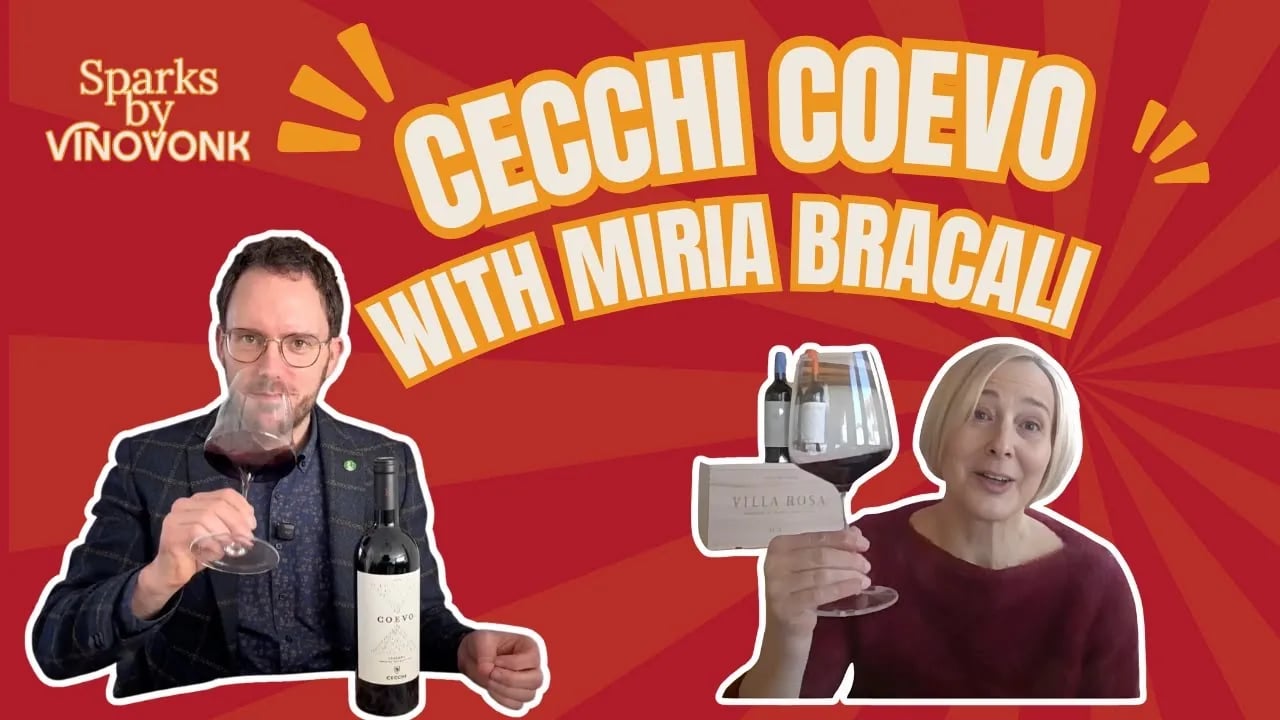
With the 2021 vintage, Cecchi cut Coevo back from four grapes to two: Sangiovese from Chianti Classico and Merlot from Maremma, in equal parts. For this Sparks I talk to Miria Bracali, chief technologist and director of production at Cecchi, while I taste the wine. She explains why Andrea Cecchi wanted Coevo, from its first harvest in 2006, to mark a turning point in the estate’s oenological history.
The bottle was sent to me; I received no payment and the opinions are my own.
Who is Miria Bracali
Miria is chief technologist and director of production at Cecchi, where she has worked for 26 years. She feels she has grown up with the company, working hand in hand with Andrea Cecchi and the team. Cecchi makes 8 to 9 million bottles a year from estates in Chianti Classico, Maremma, Umbria and, newest of all, Montalcino. She describes Coevo as a memory of the house’s tradition and a reference for the present and the future.
Cecchi has no interest in a strong, muscled wine, Miria says; the aim is to keep freshness, elegance and finesse. That idea runs through the whole conversation and explains the choices in the vineyard and the cellar.
What you learn in this episode
- Why Cecchi cut the Coevo blend back from four grapes to two
- How Sangiovese from Chianti Classico and Merlot from Maremma keep each other in check
- Why Miria calls the Val delle Rose Merlot round rather than jammy
- How Cecchi deliberately holds back on tannin extraction
- Why the wine spends almost 14 months in large five-hectolitre barrels
- Where the saline freshness in the wine comes from
- Why Miria would pour Coevo with chocolate after dinner
In the glass
On the nose I found ripe red fruit, plenty of spice and dried herbs, nutmeg above all. There was something woody in there, though the wood never took over. Violets and roses too. On the palate it was round and fruity, the tannins present but restrained. Full-bodied yet light in the mouth and very drinkable, with cinnamon, nutmeg, rosemary, thyme and sage coming back.
According to Miria, the length and the saline freshness come from the high-altitude Sangiovese at Villa Rosa, and part of the freshness from the sea breeze that blows across the Merlot vineyard in Maremma.
Reservations
Going in, I expected Sangiovese and Merlot to clash: the muscle of one against the roundness of the other. Miria’s answer is that her Merlot grows in a high vineyard near the sea and stays fresh as a result. In my glass it worked, but that is one bottle, tasted during a conversation with the maker. Price and availability in the Netherlands did not come up; all I say in the recording is that the wine will be sold internationally.
Frequently asked questions
What does Coevo mean?
Coevo means “contemporary” in Italian, Miria explains. The name carries the idea behind the wine: rooted in Tuscan tradition, with an eye on the future. Since the first harvest in 2006 the blend has been free to change from year to year.
Why did Cecchi move from four grapes to two?
With the 2021, Cecchi narrowed the blend to Sangiovese and Merlot alone, 50 per cent each, with neither given priority. Miria calls the two grapes perhaps the masterpiece of their winemaking, and they stand for the two areas that shaped the family’s history.
Where do the grapes come from?
The Sangiovese comes from the Ribaldoni vineyard at Villa Rosa in Castellina in Chianti, the Merlot from Poggio La Mozza in Val delle Rose in Maremma.
How was Coevo 2021 made?
Picked in the second half of September 2021. In the cellar the skins are kept wet without pushing tannin extraction, followed by malolactic fermentation to keep the acidity in balance. The wine then aged for almost 14 months in five-hectolitre barrels, with the team tasting it every month to decide when it was ready to come out.
Listen on your own podcast platform
Prefer Apple Podcasts, Pocket Casts, Overcast or another app? Search for Sparks by VinoVonk and you will find this episode with Miria Bracali.
Transcript
The full conversation transcript.
Show full transcript
This transcript is generated automatically from the audio and has not been edited. Speech recognition makes mistakes, so treat wording as an approximation rather than a verbatim quote. It is here for accessibility and search.
Hello everyone, I’m Jeroen from VinoVonk Wine Writer and WSET Certified Wine Expert. Today I have a very special guest at Sparks by VinoVonk and in the show I’ll dive into the fascinating world of wine, spirits and innovative drinks. Today my special guest is from one of Tuscany’s most respected winery. It’s Miria Bracali from Cecchi Winery. And we will be exploring the story behind their newest flagship wine from Tuscany.
It’s this wine. I think it’s Coevo, Coevo from 2021, a super Tuscan that represents both tradition and innovation. We’ll be tasting it together and learn about the philosophy that makes this wine so special. Miria Bracali, it’s wonderful to have you here. And thank you very much for your time.
Did I pronounce your name correctly? Yes, yes, I’m Miria. Miria, perfect. And you’re in the great country of Tuscany, Toscana in Italy, making a very famous Chianti Classico, of course, and all different wines. You’re the chief winemaker at Cecchi Winery.
Could you tell me something more about what you do? Yes, hi, it’s a pleasure for me to be here with you and I am the chief technologist and director of production at Cecchi and I’ve been working here since for 26 years. I feel that I can see that I have grown together with the company. and working with hands in hand with Andrea Cecchi and the entire team to follow perhaps a consistent and constant direction in the search of passion. This is my job, this is my passion.
I started with wine many years ago and I’m here now. So you’re the chief winemaker making a lot of different wines, but in average how many bottles per year do you produce? In Cecchi we produce 8-9 million bottles per year. So we have a very important and interesting production. So I’m a little busy every day.
We have some special wines that come from our estate because we have… Estates here in Chianti Classico area in Castellina in Chianti, Villa Cerna and Villa Rosa, where we produced special selection of Chianti Classico. And in Maremma, in Val delle Rose, in the south part of Tuscany, where we produced special selection of different varieties. So Merlot, Cabernet Franc, and… What’s the name of our…
Cabernet Sauvignon? And the Vermentino, it’s a white grape with the production of special selection of Vermentino, the name is Cobalto. We produce this wine in three different bottles. It’s amazing, I love this wine because it is so complex, so concrete, but still concrete and oak together and blend with the… a very expressing complexity of wine.
And then we are in Umbria with Tenuta Alzatura where we produce Sagrantino and Montefalco Rosso, Montefalco Bianco that come from Trebbiano grapes. Very interesting varieties again, because with great potential in aging. So it’s strange for Italian white wine sometimes. We have a new born in the Cecchi family because we have Aminta that is our estate in Montalcino and we are launching in this day, so in this year, the wine of Aminta Brunello and Rosso. So it’s a great time with my team, together with my colleagues, we are involved every day in winemaking.
It’s amazing. Yeah, that sounds perfect and very fascinating. Always growing, making new wines, new opportunities and about talking about new opportunities. You launched this wine, Coevo. And could you tell me something about this wine?
Yes, the first harvest of this wine, Coevo, was 2006. And with this wine, perhaps the fourth generation at the helm of the company, Andrea Cecchi, that is our president and CEO, strongly felt and desired that this wine, with this wine, to give a turning point in Cecchi’s oenological history. So, because Coevo perhaps represents the synthesis of a very deep and important path in the history of Cecchi. Coevo is a memory of our tradition, is a reference for the present, but above all for the future. And it is a real testimony of two milestone territories for the family, Chianti Classico and Maremma.
In fact… We produce this wine from two different areas here in Castellina in Chianti with the Sangiovese that comes from our vineyards Ribaldoni in Villa Rosa and with Merlot that comes from Poggio La Mozza vineyards in Val delle Rose in Maremma. Why we choose two different areas of production? Because they represent the milestone of the Cecchi history. Wines and the philosophy of Coevo with that means in Italian language contemporary means that we can change the blend every year.
But with the 2021 vintage we are tasting now, we have a new chapter of the history of wine because we reduce from four different varietals to two, only two varietals that are perhaps the masterpiece of our wine making. With Sangiovese that binds Cecchi to the terroir because for us Sangiovese is the king of the variety because it’s the basis of all the most important population in Toscana and in Cecchi production too. But with the Sangiovese. from Villa Rosa we had very important change because we have character of freshness, of great elegance, persistence and the of long aging for whoever. So I think that it’s a very interesting harvest and vintage.
Yeah, and so the two grape varieties, Sangiovese and Merlot, from different areas, but what are the percentages of each grape variety? 50%. Exactly the same percent. No more importance one versus the other. The same.
Could you share something about how you make this wine? Yes, all our wines, so all the techniques in winemaking for us are very easy because the most important thing for us is to announce and to maintain the character of the grapes and what the grapes can say because it’s all in this way you can have a very strong personality and individuality of our wines. So, for Coevo, we picked in 2021 in the second part of September, and we in the cellar, we have only easy winemaking process because we maintain wet the skin without pushing the extraction of tannins because we don’t want to have the… a strong and muscled wine. What we try to maintain freshness, very elegant and fineness wine.
So this is very easy, not something strange. Yeah, and after you press it and you did the fermentation, did the wine age on oak or? The wine did malolactic fermentation too, because in this way we can maintain a very well balanced acidity. And then we aged in oak in barrel of five hectoliters, so big barrel, and for almost 14 months. Sometimes depends on the vintage, because you must taste.
every month the wine and the behavior of the aging during the aging. So at the right moment we decided to put out from the oak the wine and then in bottle. Yeah. And now for the most interesting part, of course, shall we taste the wine together? Yes?
because I already poured it in because I don’t want to spill something on myself. But what I immediately had was a nose full of ripe red fruit, but also a lot of spices, lot of herbs, dry herbs, but also a lot of nutmeg and a lot of, a little bit like wood, but it wasn’t very wood. Yes, it doesn’t overwhelm the richness of the fruitiness of the wine. Yeah, it’s full, but it is aromatic, but also lot of like violets, roses, and very complex. Is that also about, because Coevo means contemporary, so it’s modern, is this more like a new sound of Tuscany?
Wow, yes, I think so. Yes, that’s right. Cheers, salut! Oye, salute! It’s very round, very fruity.
The tannins are present, but not too much. Full body, but very lightweight in the mouth, very drinkable. And a lot of spices again, a lot of cinnamon, nutmeg, dry herb like rosemary, thyme. sage also, a lot of blossoms and roses, but it’s very light-footed, light, very drinkable. And so this is the new sound of Tuscany.
But still you managed to have a lot of heritage in it because the history is also inside of this wine. How did you manage to do this? New language, new heritage, new sound. This is obviously contemporary, means the heritage of the Tuscan winemaking. Our roots are here in Castellina in Chianti, so it’s the core of the production of the wine in Tuscany.
But at the same time, we would like to have a look in the future because we are conscious that wine can’t be a stone because wine must be evolved in the future. And so you have to maintain, you have to have a view what… what the meaning of the wine today. So in this sense, we will lose the touchy of oak, an overwhelming oak in the wine, but we would like to preserve the fruitiness, the freshness, because in this way you can enjoy the wine in every moment of your day. So you can enjoy this wine with food.
but why not with chocolate at the end of the dinner or the lunch? So it’s a different vision of perhaps wine. Link to the tradition, but we see to the future too. Yeah, and what do you like the most about this wine? So the persistence, the vertical tasting of the wine, because it comes from the Sangiovese from Villa Rosa, because this is the strong character of Sangiovese, it comes from that elevated area.
So this freshness, stability, saltiness of the wine cuts from there, even if saltiness comes from the Merlot from Maremma, because In Maremma we have the breezy that comes from the sea, so this character of freshness comes from there too. So this is… So the freshness comes also from the sea wind, but the Merlot is also about roundness. But normally I think it will be too much contrasty because you have the powerful muscular from Sangiovese and the roundness of Merlot, but in this way you get a very synergy. Yes, but the blend that comes from Val delle Rose is a special Merlot because the vineyard is very high on sea level and it is influenced by the breeze that comes from the sea.
So it’s not a jammy Merlot, it’s a roundness Merlot but with good flesh. So it’s a good blend with Sangiovese because in other ways it can be not so good blend together. The Sangiovese comes from Chianti Classico and the Merlot comes from a warm area like this style. Yes, I agree. Just a short last question.
What do you see in the future for Cecchi? What can we expect more? Yeah, it’s not so easy because every day is the future for us, so we must think something new, must think something interesting, but perhaps I can see that more and more we are looking forward to winemaking as a matter of interpreting the terroir. This is a very important one. We must be recognized, so we must have very strong individual personality and we strongly believe in what we are doing consistent with our territories, our vines and mother nature are offering.
So we believe that identity will be the most desirable trait in the wines of the future. And we can’t forget that we must talk to the youngsters. So in order to have to create wine culture, it’s very important. You are so important for our wine and wine… of every producer and perhaps again pay attention to why not distribute quality wines with an accessible or very well-priced one.
So this perhaps is one of the most important goals for our winery in the future. Thank you very much for your time and thank you very much for the information. I really enjoyed this wine. Miria Bracali, Chief Winemaker from Cecchi Winery, Salute! This was a new episode of Sparks by VinoVonk.
Join us for the next episode and if you have the chance, go buy this wine. It will be available internationally. Coevo from Cecchi Winery. Thank you very much. Thank you.
Enjoy.
Read also
Related article on this topic →Listen
Watch