

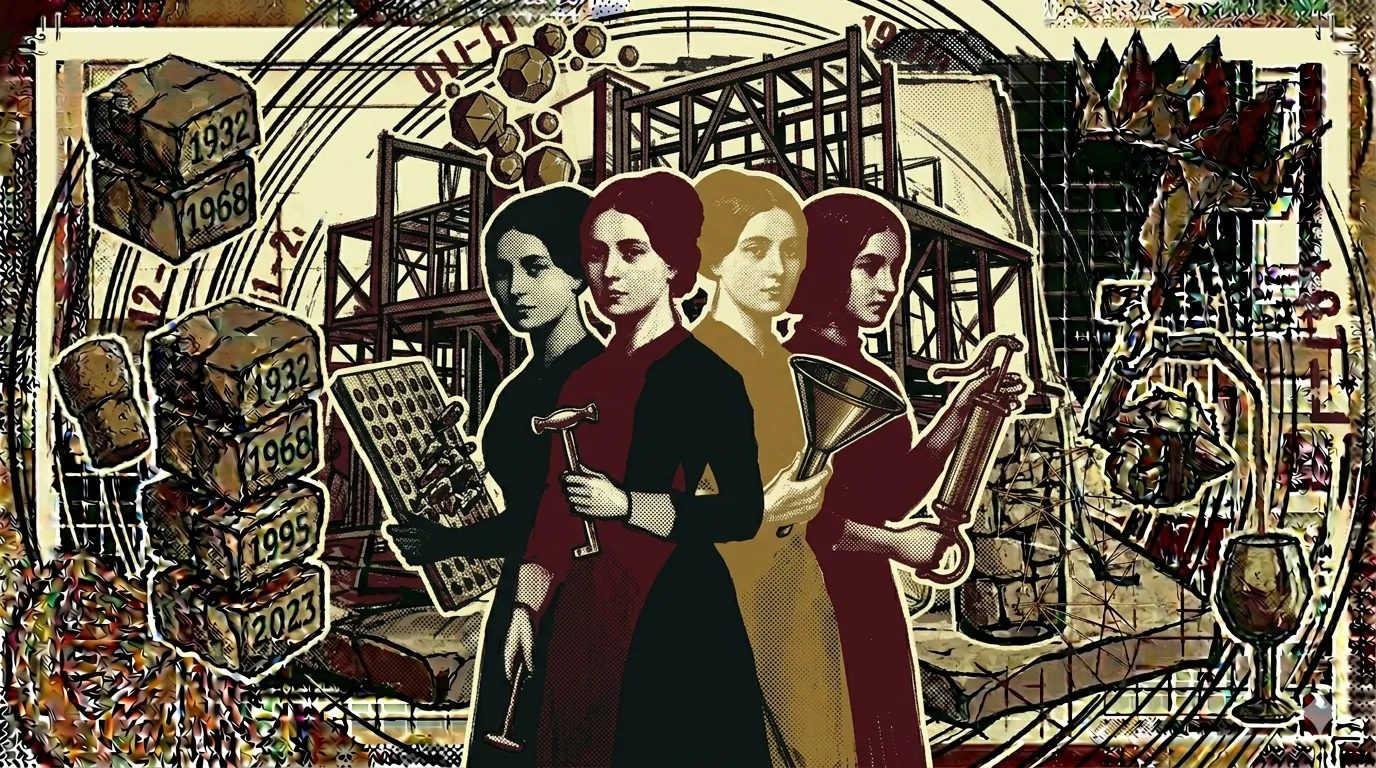
In the nineteenth century, women in French business were rare. In Champagne they not only became visible, they built the industry. The French word “veuve” (widow) appears on multiple Champagne labels, and that is no coincidence. Widow status gave women in that period the unique legal authority to act as independent entrepreneurs. Five of them shaped the modern Champagne widows industry permanently: Clicquot, Pommery, Bollinger, Roederer (through Camille Olry) and Laurent-Perrier (through Mathilde Émile Laurent-Perrier).
Madame Clicquot (1777-1866): inventor of riddling
Barbe-Nicole Ponsardin married François Clicquot in 1798. He died in 1805, aged 30. She was 27. With her father-in-law’s backing, she took over the family business, faced the choice to liquidate or carry on, and chose to carry on. She built Veuve Clicquot into one of the world’s biggest Champagne houses.
Her main technical contribution was the invention of the pupitre in 1816. Together with her cellar master Antoine Müller, she developed a wooden A-frame with holes for bottles, twisted lightly each day so the yeast deposit gathered in the neck. Before that, Champagne was hazy; afterwards it could be served clear. It was a fundamental technological leap that made the modern méthode champenoise possible.
Madame Clicquot was also the first to introduce rosé Champagne by blending red wine into white base wine (1818). Her Yellow Label is today one of the best-selling Champagnes in the world.
Louise Pommery (1819-1890): builder of the crayères
Jeanne Alexandrine Louise Mélin married Alexandre Pommery in 1839. When he died in 1858, she was 39. The business was at the time a mixed wool-and-wine trade; she decided to specialise in Champagne.
Her main achievements:
- Purchase of the Roman crayères (ancient chalk quarries under Reims) in 1868, and transformation into a storage complex of 18 kilometres of tunnels at a constant temperature of 10 degrees Celsius. The Pommery crayères are now a UNESCO World Heritage site.
- Invention of the Brut style in 1874. Until then Champagne was largely sweet. Louise created the first commercial Brut cuvée specifically for the British market, where taste already trended drier. It became a global standard.
- Architectural investment in the neo-Gothic Pommery headquarters, still in use today.
Under her leadership, Pommery became one of the four great Champagne houses of the 19th century.
Lily Bollinger (1899-1977): the cycling ambassador
Elisabeth “Lily” Law de Lauriston-Boubers married Jacques Bollinger in 1923. When he died in 1941 at 47, she led the house through the Second World War and the post-war rebuild. She was 42 when she took the helm and stayed CEO until 1971.
Her contributions:
- International expansion of Bollinger, with personal sales tours by bicycle through the Bollinger vineyards in Aÿ.
- Launch of Bollinger R.D. (Récemment Dégorgé) in 1961: a prestige cuvée with extremely long autolysis and late disgorgement, laying the groundwork for the modern late-disgorgement category.
- Protection of Vieilles Vignes Françaises, the two pre-phylloxera parcels in Aÿ that Bollinger has preserved. The wine made from them is today one of the rarest and most expensive Champagnes in the world.
Lily Bollinger’s famous line: “I drink Champagne when I’m happy and when I’m sad. Sometimes I drink it when I’m alone. When I have company I consider it obligatory. I trifle with it if I’m not in a hurry and drink it when I am. Otherwise I never touch it, unless I’m thirsty.”
Camille Olry-Roederer (1855-1934): rescue after revolution
Camille Olry-Roederer took over Louis Roederer in 1932 at the age of 77, after the death of her husband. The timing was difficult: the Russian Revolution of 1917 had wiped out Roederer’s biggest customer (Cristal was specifically designed for Tsar Alexander II), and the 1929 Great Depression had collapsed global Champagne demand.
Her achievement was the survival of the house through:
- Diversification of export markets away from Russia, towards the US and the UK.
- Strict cost management without compromising the quality of Cristal or the other cuvées.
- Investment in the vineyards by three generations of the Olry family, which is why Roederer today is one of the few houses to own most of its own grape sources.
Roederer remained independent and privately held by the family until today, a direct legacy of Camille’s choices.
Mathilde Émile Laurent-Perrier (1898-1990): rebuilding a house
When Eugène Laurent-Perrier died in 1939 and their son Bernard fell in the war in 1940, Mathilde faced a house that barely existed any more: vineyards destroyed, stocks plundered, staff scattered. She was 42.
Between 1948 and 1985 she rebuilt Laurent-Perrier from scratch. Her main contributions:
- Launch of Cuvée Rosé in 1968, an assemblage rosé that quickly became one of the most iconic rosé Champagnes in the world.
- Cuvée Grand Siècle, a blend of three vintages designed to embody the “great century” of Champagne.
- Rebuild of the vineyards and expansion into one of the ten largest Champagne houses.
Mathilde was 87 when she stepped back, and the house has remained in family ownership (the Nonancourt family).
Why this history matters
Four observations that keep the Champagne widows’ story relevant:
- The modern industry was shaped largely by women. Not as an exception, but as the systematic reality of 19th-century widow status.
- Technical innovation often came from their hands. Riddling, the Brut style, late disgorgement: three key techniques introduced by female leaders.
- Marketing myths often overshadow their work. Dom Pérignon gets credit for inventions he did not make; the widows get less recognition for what they actually did.
- Contemporary parallels exist. Female leaders in modern Champagne (Vitalie Taittinger, Cécile Bonnefond at Veuve Clicquot, Alice Tétienne at Henriot, Charline Drappier at Drappier) build on this tradition.