

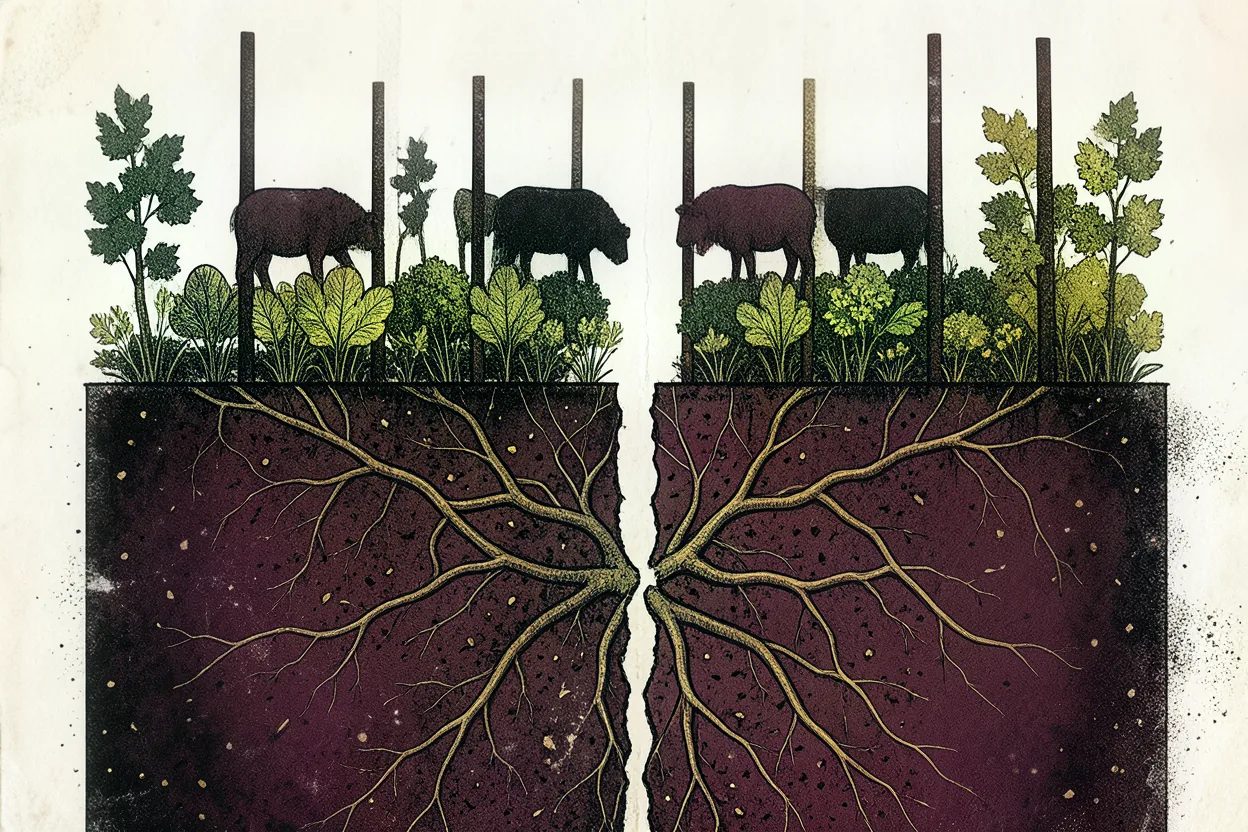
Sheep grazing between the vines in winter. Cover crops you never plough under. Soil treated as an organism you feed, not a substrate you work. That is regenerative viticulture: an approach that does not stop at doing less harm but actively sets out to restore the vineyard. Build soil life, bring back biodiversity, hold water better. Fine words. The question is which of them you can verify and which mostly read well on a label.
Because here is the catch. “Regenerative” is not a legally protected term. Unlike “organic”, anyone can use it, with or without evidence. That makes it at once one of the most interesting and one of the most buyer-beware ideas in wine right now.
What regenerative viticulture actually means
Regenerative farming did not start in wine. It was adapted from arable agriculture, where the idea centres on soil as a carbon reservoir and a living system. The ground beneath our feet holds more carbon than all the plants on Earth combined. How you manage a vineyard, then, touches something larger than the taste in the glass.
In the vineyard it translates into a handful of concrete principles:
Permanent ground cover. No bare soil between the rows but cover crops: grasses, legumes, flowering plants. They feed soil life, break up compaction, and hold water.
No or minimal tillage. Ploughing disturbs the fungal network and releases carbon. Regenerative growers keep the plough parked as much as they can.
Compost and organic inputs instead of synthetic fertiliser, to feed the soil food web.
Animals in the system. Sheep that graze and fertilise, chickens against pests. Grazing replaces mowing and closes the loop.
Biodiversity as a goal, not a by-product. Hedges, insect habitats, flower strips. A vineyard that looks like a monoculture regenerates nothing.
Regenerative versus organic and biodynamic
This matters, because the three get lumped together. The difference lies in what each one puts at the centre.
Organic is first of all a prohibition: no synthetic pesticides, herbicides or fertilisers. It protects the crop from outside inputs. It says little about the soil itself.
Biodynamic adds an active toolkit: preparations, a lunar calendar, the vineyard as a single organism. It overlaps strongly with regenerative in its holistic view, but it leans on a philosophical tradition that sits outside mainstream science.
Regenerative is about an outcome: a demonstrably healthier soil. Not which inputs you do or do not use, but whether organic matter, water retention and soil life actually rise. The strictest regenerative standards therefore build on organic as a floor and then measure whether the soil truly improves.
The carbon promise: what holds up and what does not
This is where you should prick up your ears. Much of regenerative viticulture’s appeal rests on the climate story: healthy soils store carbon, so regenerative farming helps against climate change. True in broad strokes, and routinely overstated in the detail.
What the science does show: regenerative practices improve soil health consistently. More organic matter, better structure, less erosion, more water retention, more biodiversity. There is broad agreement on this.
What the science does not show cleanly: exactly how much carbon gets stored, and how durably. Scientific reviews consistently conclude that regenerative agriculture improves soil metrics but that carbon sequestration varies widely by soil type, climate and implementation. Stored carbon can also be released again once the practice slips. And a hectare of vineyard is not a forest.
So the first critical observation of this guide is plain: be wary of any producer deploying “regenerative” as a ready-made climate certificate. The soil gains are real and well evidenced. The carbon claim is a gradient, not a guarantee.
A second critical observation follows, and it sits less comfortably. Researcher Vicky Corbeels, lead author of a life cycle study on wine sustainability, pointed out to me that a gain in the soil is not the same as a lower footprint per bottle. Regenerative farming often comes with lower yields, and once you run the whole chain through such a life cycle assessment, that same wine can score worse per hectolitre than a conventional one. What the soil gains, a smaller harvest can quietly hand back.
And the footprint hides in places you would not expect. Hand labour instead of machines sounds pure, but if every worker drives to the vineyard in a separate car, that lands in the ledger too. A vineyard that uses biodiversity purely to make better wine also stays a monoculture with a green edge: how natural do you really let nature be? These are uncomfortable questions, and the science has not settled them.
To be fair, those life cycle models have gaps of their own. Their databases capture biodiversity and soil life poorly, so the verdict sometimes lands too harshly on regenerative. It cuts both ways. But yield per hectare and per hectolitre counts, however appealing the wider story. Corbeels puts it plainly: the footprint is visible and improvable, and that is exactly where conventional and regenerative meet.
Certification: ROC, RVF and Ecocert
Because the word is unregulated, the certifications do the real work. Three names come up.
Regenerative Organic Certified (ROC) is the strictest and best known. Launched in 2017 in the US by the Regenerative Organic Alliance, with the Rodale Institute, Patagonia and Dr. Bronner’s among its founders. ROC builds on organic certification by requirement and adds three pillars: soil health, animal welfare and social fairness. It has tiers: bronze, silver, gold.
The Regenerative Viticulture Foundation (RVF) is the wine-specific movement, established in the early 2020s. Not a standalone label in the ROC style, but a knowledge and standards body built for viticulture, now with members across several countries.
Ecocert runs its own regenerative certification, focused on measurable soil improvement: organic matter, structure, water retention, biological activity. Ecocert is also one of the certifying bodies for ROC in Europe.
That brings the third critical observation. Without a verified label, “regenerative” on a bottle means nothing legally. It is exactly the kind of term that lends itself to greenwashing: warm, positive, unmeasurable. The relevant question with any bottle is not whether the word appears on the label, but whether a ROC or Ecocert verification sits behind it. A producer helping to build a checkable standard earns more trust than a marketing department that discovered the word.
Who already does it
You read a movement’s credibility from who commits to it, and with what independent oversight.
Tablas Creek (Paso Robles, California) became the world’s first ROC-certified vineyard in 2020, and the first at gold level in 2022. Organic since 2003 and biodynamic-certified in 2017: regenerative was a logical next step for them, not a marketing leap.
Familia Torres sits at the foundation of a regenerative certification built specifically for viticulture, set up with the Regenerative Viticulture Foundation and verified by Ecocert. Torres ties this to its wider climate work within the IWCA. That they help build a verified certificate matters more than the word itself.
Champagne Telmont became the world’s first Champagne house with ROC status in early January 2026, in a region where very few growers farm organically. Deliberately positioned, with backing from investor Leonardo DiCaprio. For an area that trades on prestige, that is a statement: sustainability as part of luxury, not its opposite.
Should you, as a drinker, look for it?
Regenerative viticulture is not a promise of taste. A regeneratively farmed bottle is not by definition better than a conventional one from the same appellation. What you buy is a way of working, not a guarantee in the glass.
Even so, it is one of the more sensible developments in wine right now, precisely because the soil gains are solid and the best producers submit to oversight. My advice is level-headed: do not get swept up by the word, look at the verification behind it. See ROC, RVF or Ecocert, and there is a checkable standard underneath. See only “regenerative” on its own, and treat it as what it legally is: an unprotected promise. For the generation that views sustainability as a threshold rather than a bonus, that distinction will only grow in weight.
Frequently asked questions
Is regenerative wine the same as organic wine?
No. Organic is a prohibition on synthetic inputs and is legally protected. Regenerative targets a demonstrably healthier soil and is not legally protected. The strictest regenerative labels require organic as a floor and go beyond it.
Does regenerative viticulture really store carbon?
Partly. Regenerative practices improve soil health consistently, but how much carbon is stored durably varies widely by soil, climate and implementation. And carbon in the ground says nothing yet about the footprint per bottle: lower yields can partly cancel out the soil gain once you run the whole chain. Treat sweeping climate claims with healthy scepticism.
How do I spot a credible regenerative wine?
By a verified label, not by the word on the bottle. Look for Regenerative Organic Certified (ROC) or an Ecocert regenerative certification. Without verification, “regenerative” means nothing legally.
Sources
- Scientific source: Corbeels, V., Thomassen, G. and Van Passel, S. (2025), “Cool emerging versus warm established regions: does climate change alter the sustainability focus in wine production?”, Cleaner Food Systems, doi.org/10.1016/j.clfs.2025.100006
- Primary source: Tablas Creek, “Our Story” and regenerative certification, tablascreek.com/story
- Additional: Champagne Telmont, first ROC Champagne (vinetur, Jan 2026), vinetur.com
- Additional: Regenerative Organic Alliance, regenorganic.org; Regenerative Viticulture Foundation, regenerativeviticulture.org; Ecocert regenerative, ecocert.com