

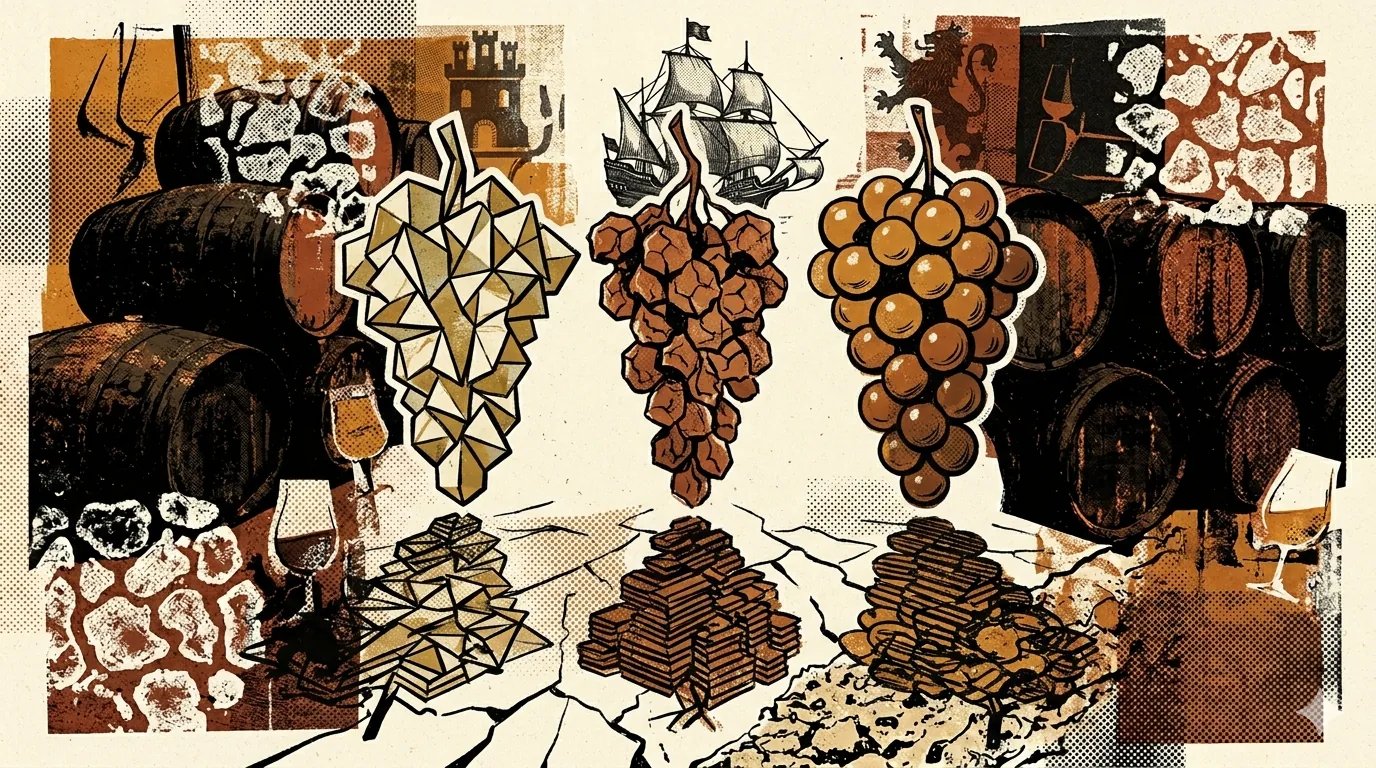
One region, three grapes, three completely different roles. Marco de Jerez officially permits only three sherry grapes: Palomino Fino, Pedro Ximénez and Moscatel. They share the same chalky soil, the same Atlantic wind and the same bodegas, but the result runs from bone-dry fino to syrupy PX aged for forty years.
This guide explains what each grape does, why Palomino is so overwhelmingly dominant, how Pedro Ximénez dries on woven mats in the sun, and where Moscatel finds its aromatic niche. Plus: which grapes vanished after phylloxera and what producers like Equipo Navazos, Luis Pérez and Ramiro Ibáñez are doing today to bring that history back onto the label.
Palomino Fino: 95% of plantings and the neutral backbone
Palomino Fino covers roughly 95% of plantings in DO Jerez-Xérès-Sherry. Almost every fino, manzanilla, amontillado, palo cortado and oloroso you drink starts as pure Palomino. That seems strange for a grape that delivers little aroma on its own. That is exactly the point.
The wine that Palomino yields after primary fermentation tastes flat: low acidity, low fruit, low scent. A blank canvas. Only when the young wine is fortified to the right alcohol level and goes into a half-filled bota under a layer of flor yeast does the work begin. Flor digests glycerol, alcohol and residual sugar, producing acetaldehyde, sotolon and the typical almond, dough and salty notes. An aromatic grape would shout over that signature.
Palomino also fits the albariza soil biologically: the white chalk earth around Jerez de la Frontera, El Puerto de Santa María and Sanlúcar de Barrameda. Albariza retains winter rainfall like a sponge and slows water loss during the hot poniente summers. The grape ripens slowly, with moderate sugars (around 11, 12% potential alcohol) and low acidity. A drawback for table wine; exactly what you want for a wine that will later be fortified to 15% and survive years under flor.
The variety only became dominant after the phylloxera outbreak in Jerez (from 1894 onward). On replanting with American rootstocks, Palomino delivered the highest yield and the most reliable base for the solera system. Most of the rest of the pre-phylloxera mix disappeared.
A final detail: “Palomino Fino” is not the same as “Palomino de Jerez” or the older “Listán”. DNA work confirms that Palomino Fino is the Jerezano selection of the broader Listán family and, for example, the parent of Listán Negro on the Canary Islands. Outside Jerez the same grape often simply goes by Listán Blanco.
Pedro Ximénez: the sun grape from Montilla-Moriles
Pedro Ximénez, abbreviated PX, is the sweet counterpart. Within Marco de Jerez itself PX makes up roughly 1 to 5% of plantings, concentrated in warmer inland parcels around Jerez Superior. Real scale lives in the neighbouring DO Montilla-Moriles, south of Córdoba, where PX accounts for the clear majority of white plantings.
The origin story has been argued for centuries. The romantic version says a Flemish or German soldier named Peter Siemens brought the grape from the Rhine to Andalusia in the sixteenth century (Ximénez = the Spanish corruption). Modern DNA microsatellite analysis offers no support: PX clusters firmly with Mediterranean grape populations, not with German or Hungarian cultivars. An early import from the Canary Islands or a local Andalusian mutation looks more plausible.
What makes PX unique is not the vineyard, but what happens after harvest.
The soleo process: drying grapes under the Andalusian sun
Soleo is the traditional method of concentrating sugars by open-air sun-drying. After picking, the bunches lie on mats woven from esparto grass (a tough Andalusian steppe grass) on a flat field next to the vineyard. They stay there for seven to twenty days, depending on weather and the target sugar level.
By day, water evaporates from the berries under direct sun of 35°C or more. At night, growers cover the mats with canvas against dew and rain. The berry shrinks to a raisin. Sugar content rises from around 12 degrees Baumé at harvest to 28 to 35 degrees Baumé after drying, equivalent to over 450 grams of sugar per litre of must. Only then do the grapes go to the press.
Fermentation starts spontaneously but stalls almost immediately because the yeasts cannot cope with the extreme sugar load. The must is lightly fortified with wine alcohol to block any further fermentation, and then ages for years in the solera. Result: an inky black, syrupy wine with 350 to 450 grams of residual sugar per litre, tasting of dried figs, walnut, coffee, liquorice and aged balsamic vinegar.
PX plays two roles in the bodega. Pure PX sherry (often 12, 15, 20, 30 or 50 years old) is bottled separately. PX also serves as the sweetening component in cream, medium and pale cream blends, and adds colour and sweetness to older oloroso editions sold as “dulce” or “abocado”.
Moscatel: the aromatic underdog
Moscatel, with under 1% of plantings in Marco de Jerez, is the rarest of the three. The variety grown here is specifically Moscatel de Alejandría, otherwise known as Muscat of Alexandria, one of the oldest documented grapes from the Mediterranean basin.
Unlike Palomino, Moscatel is openly aromatic. Fresh Moscatel smells of orange blossom, honeysuckle, jasmine and yellow peach, with an undertone of white musk grape and honey. That perfume survives fortification and years in cask. For that reason Moscatel is rarely used for classic biological aging under flor (the aromas would clash with the flor signature), but it is used for separate sweet sherries and for blends where you want a floral lift.
The grape finds its niche on the Atlantic coast around Chipiona, west of Sanlúcar. Sandy parcels sit there, sometimes right behind the dunes, exposed directly to onshore Atlantic wind. The sand drains fast and holds barely any nutrients, which forces Moscatel into low yields and concentrated aromas. Phylloxera also struggled in sand, so some parcels around Chipiona still stand on original roots.
As with PX, Moscatel grapes often go through a brief soleo, though the drying period runs shorter (three to seven days) and the goal is concentration rather than full raisining. Pure Moscatel sherry comes to market as “Moscatel” sec, or as a sweet version alongside PX in the same age categories (12, 20, 30 years). The style is round, grapey, with white flowers and candied orange peel; lighter than PX, but just as sweet.
Lost grapes: Listán, Mantúo, Vijariego and Cañocazo
Before the phylloxera crisis of 1894 Marco de Jerez held at least eight white grape varieties in serious cultivation. Alongside Palomino and Pedro Ximénez stood Listán de Jerez, Mantúo Castellano, Mantúo de Pilas, Vijariego (also Vejeriega or Bejariego), Cañocazo, Albillo Castellano and Beba.
The so-called “vinos de mantúo” were sweet, often unfortified white wines based on Mantúo Castellano or Mantúo de Pilas, with more aromatic lift and higher acidity than modern sherry. Vijariego and Cañocazo brought structure and freshness to blends. Listán de Jerez was known for slightly more character than today’s Palomino Fino.
After phylloxera the Consejo Regulador took the pragmatic route: replanting on American rootstocks with the varieties that delivered the highest yields and the most predictable flor aging. That meant Palomino Fino, with PX and Moscatel as small satellites. The rest disappeared from production statistics.
Over the past fifteen years a handful of producers have dug that history back up. Equipo Navazos (the collective of Eduardo Ojeda and Jesús Barquín), Luis Pérez and his son Willy Pérez at Bodegas Luis Pérez, and the viticulturist and historian Ramiro Ibáñez of Cota 45 have identified surviving pre-phylloxera plots and replanted Vijariego, Cañocazo and Mantúo in places. Their “vinos de pasto” and “vinos de pago” deliberately step outside the DO rules: unfortified Palomino, single-vineyard bottlings and trials with old varieties, often with a vineyard name on the label instead of a bodega name. Not always usable for DO Jerez; often sold instead under Vino de la Tierra de Cádiz.
Which grape makes which sherry style?
| Style | Grape | Aging |
|---|---|---|
| Fino, Manzanilla | Palomino Fino (100%) | Biological under flor, min. 2 years |
| Amontillado | Palomino Fino | First under flor, then oxidative |
| Palo Cortado | Palomino Fino | Brief flor, then oxidative |
| Oloroso (seco) | Palomino Fino | Fully oxidative, no flor |
| Pedro Ximénez | Pedro Ximénez (100%) | Oxidative, sun-dried grapes |
| Moscatel | Moscatel de Alejandría (100%) | Oxidative, often lightly sun-dried |
| Cream, Medium, Pale Cream | Palomino + PX (and/or Moscatel) | Blend of dry and sweet |
The dry styles are always 100% Palomino. The sweet styles are always 100% PX or 100% Moscatel. The cream-segment blends combine a dry oloroso or fino base with PX or Moscatel as the sweetening component.
If you are starting out with sherry, taste a fino, an amontillado, a dry oloroso and a PX side by side. Four glasses, one grape (Palomino) for the first three, one grape (PX) for the last, and the full spectrum from bone-dry and salty to almost syrupy sits on the table. That is what makes sherry wine: not the dessert category the supermarket shelf shoves it into, but a wine region with three grapes, two aging paths and seven official styles.
Frequently asked questions
Which grape is used most for sherry?
Palomino Fino is by far the most important, accounting for around ninety percent of plantings. Almost every dry style, from fino to oloroso, comes from this neutral white grape. Its strength is that neutrality: it lets flor and oxidation do the work.
Why is Pedro Ximénez so sweet?
Pedro Ximénez is sun-dried on mats after harvest, the soleo process. The water evaporates, the sugars concentrate, and the result is an almost black, syrupy wine with notes of raisin, fig and liquorice. A natural concentration, not added sugar.
Is Moscatel used much in sherry?
Moscatel plays a small, aromatic supporting role. Like PX it is sun-dried, giving a sweet wine with floral, citrus notes. You find it as a standalone bottling or as the sweetening component in cream blends.
Can you make a dry sherry from Pedro Ximénez?
You can, but it is rare. A handful of bodegas vinify PX dry, giving an unusual, spicy white wine. The grape is so tied to sweet styles that most producers reserve it for that.
Sources
- Liem, Peter & Barquín, Jesús. Sherry, Manzanilla & Montilla: A Guide to the Traditional Wines of Andalucía. Manutius Press, 2018.
- Jeffs, Julian. Sherry (5th edition). Mitchell Beazley, 2004.
- Consejo Regulador del Vino y Brandy de Jerez, annual statistical reports on plantings and harvest, www.sherry.wine.
- Consejo Regulador de la Denominación de Origen Montilla-Moriles, www.montillamoriles.es.
- OIV (International Organisation of Vine and Wine), Vitis International Variety Catalogue, www.vivc.de (Palomino Fino, Pedro Ximénez, Muscat of Alexandria).
- Equipo Navazos, project documentation and bottlings via www.equiponavazos.com.