

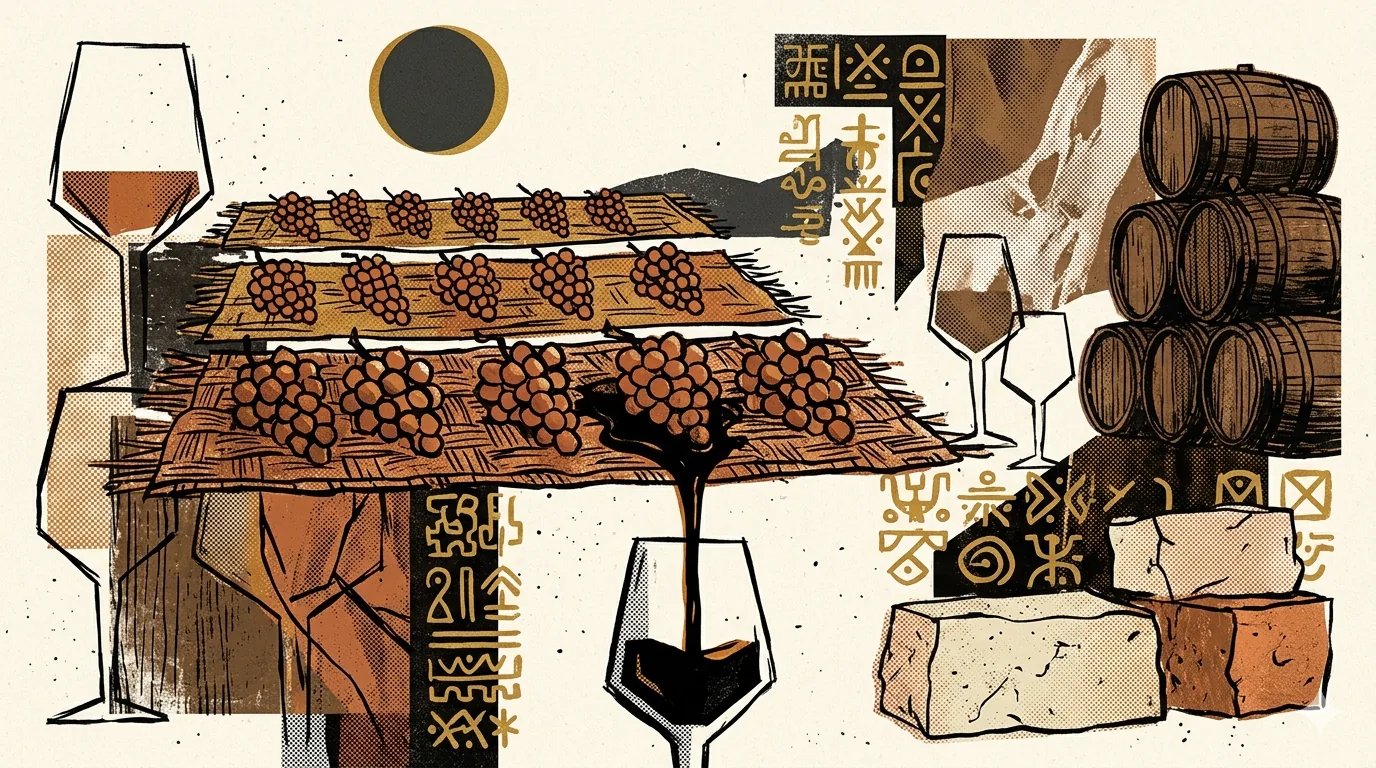
You pour a stream of ebony-black syrup over a scoop of vanilla ice cream. It hesitates, glistens, then slowly sinks in. That is Pedro Ximénez sherry: a wine so thick and dark it looks more like molasses than anything that came out of a glass. And yet it is wine. Real wine, made from one grape, one obsession, and centuries of patience.
The road to 400 grams of sugar
| Step | What happens | Sugar or alcohol at that point |
|---|---|---|
| Harvest in August | The bunches come in as ordinary ripe white grapes | 18 to 22 degrees Brix, roughly 180 to 220 grams of sugar per litre |
| Soleo on esparto mats | Seven to twenty-one days in full sun, ten to twelve when the weather cooperates | The dried fruit can exceed 400 to 500 grams of sugar per kilo |
| Pressing | What leaves the press is no longer juice but a thick, syrupy must | So much sugar that the yeast loses the fight before it starts |
| Fermentation | The yeast cells die before the must can ever run dry | Stops by itself at 15 to 18 percent alcohol |
| Fortification | Neutral wine spirit of 96 percent or higher halts fermentation for good | Final alcohol stays at 15 to 18 percent, residual sugar at 200 to 400 grams per litre |
| Ageing in solera | Most quality bottlings sit ten to twenty years, VORS a minimum of thirty | Evaporation in the cask pushes a thirty-year VORS toward 400 grams per litre |
| As a sweetener in cream | Five to twenty-five percent PX goes into a dry base sherry | Fifteen to twenty percent delivers the fifty grams per litre of a typical cream |
For comparison: a Sauternes sits around 120 to 150 grams of residual sugar per litre.
What is Pedro Ximénez? One grape, one purpose: sweetness
Pedro Ximénez (PX for short) is both a grape variety and a wine style. The grape grows mainly in the Andalusian DO Montilla-Moriles, the chalky inland region just south of Córdoba, and to a lesser extent in the Marco de Jerez where the better-known fino, amontillado and oloroso come from.
Both regions have their own DO regulations, but the goal with PX is identical. Not to make dry white wine, not a crisp aperitif. Just one thing: concentrate as much sugar as possible into a single bottle. PX is a thin-skinned white grape with high sugar at ripeness, ideal for what comes next.
In Montilla-Moriles, PX is the dominant grape. In Jerez it has been more broadly permitted since 2022, and historically large volumes of PX must were shipped from Montilla to Jerez to serve as a sweetener in cream sherries.
The soleo process: drying grapes under the sun
The magic begins not in the cellar but on the ground. After the August harvest the bunches are spread out on esparto mats (woven mats made from Spanish steppe grass) and laid out in full sun for days. This is the soleo or asoleo: sun-drying as a concentration method.
The grapes lie there for seven to twenty-one days, depending on the weather. Under ideal conditions (25 to 35 degrees Celsius, low humidity, clear skies) ten to twelve days is often enough. In trickier weather it takes the full three weeks. Producers turn the bunches by hand and drag them under shelter at night or when rain threatens.
The result: the grapes shrivel into something that looks suspiciously like raisins. Water evaporates, sugars concentrate, and the freshly harvested 18 to 22 degrees Brix (roughly 180 to 220 grams of sugar per litre) climbs to levels that in the dried fruit can exceed 400 to 500 grams of sugar per kilo.
Fermentation and fortification: how the sweetness survives
After the soleo the dried grapes go under the press. What comes out is no longer juice but a thick, syrupy must with extreme sugar concentrations. Here begins the second piece of physics: the yeast cannot win.
Yeast cells convert sugar into alcohol, but above a certain alcohol level (usually around 15 or 16 percent) they die. With a sugar bomb like this as a starting point, fermentation never gets close to “dry”. It stops on its own at 15 to 18 percent alcohol from natural fermentation, leaving a thick mountain of residual sugar.
Then comes fortification: neutral wine spirit at 96 percent or higher is added to halt fermentation definitively and stabilise the wine for the long aging period. Final alcohol stays between 15 and 18 percent, with residual sugar between 200 and 400 grams per litre, sometimes more in very old bottles.
For comparison: a Sauternes sits around 120 to 150 grams of residual sugar. PX plays in another league.
Flavour profile: fig, date, coffee, liquorice
Pour a glass and the first thing you notice is that the glass is no longer transparent. PX has that characteristic ebony-black colour with a slow, viscous flow down the glass. No wine should look like this.
On the nose you get dried fig, date, raisin, molasses and roasted coffee. Often also liquorice, dark chocolate, walnut, a hint of soy sauce. Oxidative aging adds aromas of rancio, old wood and tobacco.
In the mouth it is syrupy without becoming cloying. The high acids that remain despite all the sugar provide balance, and the oxidative characters give the necessary bitter counterforce. A finish that lingers for minutes, with date and bitter cacao as the final layer.
PX is not a wine you drink in half-glasses. A small cordial glass, after the meal, is enough.
Long aging: from solera to vintage
After fortification the wine disappears into a solera system: a tiered aging method where older wine is partly drawn off for bottling and topped up with younger wine from the layer above (the criadera). The effect: the wine in the bottle is a blend of many vintages, and the system itself only gets older over time.
Some PX is bottled after just a few years. Most quality bottlings stay ten to twenty years in the solera. VORS (Vinum Optimum Rarissimum Signatum) guarantees a minimum thirty-year average age, and some soleras contain wine that has been continuously refreshed since the nineteenth century.
During this aging in oak barrels water evaporates (the famous “angel’s share”), so sugar concentration and colour increase further. A thirty-year-old VORS PX can comfortably reach 400 grams of residual sugar per litre.
Alongside solera wines there are also single-cask or vintage PX bottlings, which skip the solera and represent a single barrel or single vintage. These are rare and often collector pieces.
PX in cream sherries: the silent sweetener
Pedro Ximénez has a second life as a blending component. Cream sherry is not a separate sherry style produced as such, but a blend: a dry base sherry (usually oloroso) with PX added as a sweetener.
In practice the blend contains five to twenty-five percent PX, depending on the target sweetness. A typical cream sherry aims for about fifty grams of residual sugar per litre, achieved with fifteen to twenty percent PX.
The rest of the so-called “Pale Cream” and “Medium” categories work along the same lines. Without PX, the cream sherry segment simply would not exist as we know it.
Pairing: ice cream, blue cheese, chocolate
Three pairings are iconic, and none of them are forced.
Vanilla ice cream. The classic. Pour a tablespoon of cold PX over a scoop of vanilla ice cream and serve immediately. The vanilla in the ice cream amplifies the oak-derived vanilla in the wine, the temperature contrast is interesting, and the syrupy texture of the wine merges seamlessly with the cream. A dessert in thirty seconds.
Blue cheese. Stilton, Roquefort, aged Gorgonzola. The salty, sharp blue mould cuts through the sweetness of the PX, and the oxidative bitterness of the wine balances the fattiness of the cheese. A centuries-old combination in both British and Spanish food culture.
Dark chocolate. Especially chocolate at seventy percent or higher. The cacao bitterness and the liquorice notes in the PX find each other effortlessly. Works equally well with chocolate mousse, brownie, or a simple square of dark chocolate beside the glass.
Beyond that: poached pear or plum, walnut tart, foie gras, and (surprisingly) grilled mushrooms. The umami in old PX reaches well beyond the dessert course.
Producers worth knowing
A short orientation. Not exhaustive, but representative.
Toro Albalá Don PX (Montilla-Moriles). Famous for vintage bottlings, with the iconic Don PX 1972 as best-known reference. The range runs from accessible younger vintages to highly collectible old releases.
Bodegas Tradición PX VORS (Jerez). A small, quality-driven bodega with soleras averaging thirty years. Concentrated, complex, with a noticeable rancio edge.
Lustau San Emilio (Jerez). Lustau is a major sherry house and San Emilio is their widely available PX. Twelve years average in solera, an affordable entry point.
Hidalgo-La Gitana Triana (Sanlúcar). The Triana single-cask PX is an interesting alternative to the classic solera approach: one barrel, no blending, distinct character. Twenty years or more of aging.
González Byass Noé VORS (Jerez). The Noé is a thirty-plus VORS from one of the house’s oldest soleras. Dark, concentrated, with spicy complexity.
Price tiers in brief: entry-level (young PX, often Montilla-Moriles), mid-range (fifteen to twenty-five years of solera), premium (VORS, thirty-plus), and highly collectible rare old vintages.
Start with a Lustau San Emilio or an entry-level Don PX to learn the style. Drink it cool but not ice cold (around 13 degrees Celsius), from a small glass, after the meal. An open bottle keeps for three to six months in the fridge given the alcohol and sugar levels.
PX is wine at the very edge of what wine can still be. Not an everyday drinker, but a bottle every wine lover should have in the cellar at least once.
Frequently asked questions
How much sugar is in Pedro Ximénez?
Between 200 and 400 grams of residual sugar per litre, and more in very old bottles. Sauternes sits around 120 to 150 grams, so PX plays in a different division. The concentration comes from the soleo: seven to twenty-one days of sun drying on esparto mats, after which the grapes pass 400 grams of sugar per kilo.
How long does an open bottle of PX keep?
Three to six months in the fridge. The 15 to 18 percent alcohol and the sheer sugar concentration leave the wine almost indifferent to oxidation, which is the opposite of what happens to a fino.
Where should you start with Pedro Ximénez?
With Lustau San Emilio or an entry-level Don PX from Toro Albalá, both widely available. Serve around 13 degrees in a small glass after dinner, and stop at one: this is not a wine you drink by the bottle.
Sources
- Consejo Regulador DO Montilla-Moriles, technical files on the Pedro Ximénez grape and soleo process (https://www.montillamoriles.es)
- Consejo Regulador DO Jerez-Xérès-Sherry, regulations on VOS/VORS classification and cream sherry (https://www.sherry.wine)
- Jefford, A. & Robinson, J., The Oxford Companion to Wine (4th edition, 2015), entries on Pedro Ximénez, Montilla-Moriles, soleo
- Bodegas Toro Albalá, product information on Don PX vintages (https://www.toroalbala.com)
- Bodegas Tradición, technical sheets PX VORS (https://www.bodegastradicion.es)
- Emilio Lustau, product page San Emilio Pedro Ximénez (https://www.lustau.es)