

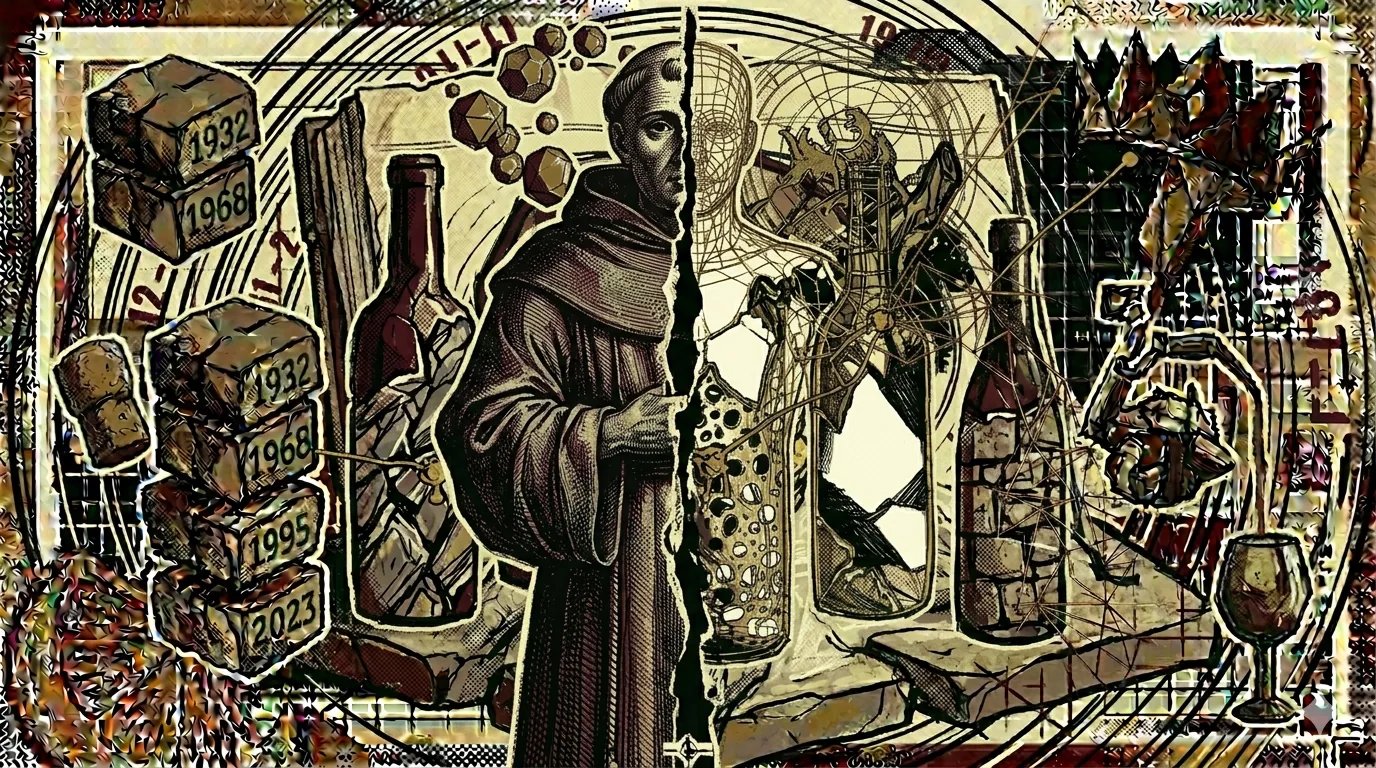
“Come quickly, brothers, I am tasting the stars.” The famous quote from Dom Pérignon at his supposed discovery of Champagne. A poetic scene that appears on bottles, in commercials and in every Champagne presentation. It is also untrue. The monk never said it, and he did not invent Champagne. The Dom Pérignon myth is a marketing story built up in the twentieth century by Moët & Chandon, using scattered historical facts as building blocks.
The myth beside the sources
| What the story says | What actually happened |
|---|---|
| Dom Pérignon invented Champagne | Sparkling wine was already a commercial product in England. Christopher Merret described the technique in 1662, six years before Pérignon became cellar master |
| He was chasing the bubbles | He tried to suppress the spontaneous second fermentation: bottles exploded, and the English called it le vin du diable |
| He developed the cork stopper | Cork had been used for wine since antiquity, and the modern cork shape predates him |
| “Come quickly, I am tasting the stars” | First surfaced in a Moët & Chandon marketing publication late in the nineteenth century, more than 150 years after his death |
| He was no serious winemaker, only a brand name | He spent 47 years as cellar master at Hautvillers, refining blending across parcels, strict selection at harvest, gentle pressing and cooler fermentation |
The source for all of this is Tom Stevenson, who traced the English origin of the method through Royal Society archives.
Who Dom Pérignon really was
Pierre Pérignon (1638-1715) was a Benedictine monk who served as cellar master at the abbey of Hautvillers, a monastery near Épernay in the Vallée de la Marne, from 1668 until his death. He managed the abbey’s vineyards and winery for 47 years.
During that time he was a real and important wine innovator, but not for the reasons the marketing story suggests. His actual contributions:
- Blending grapes from different parcels for more consistent quality. He was among the first to systematically combine the outputs of different vineyards.
- Strict harvest selection. Damaged or overripe fruit was sorted out.
- Gentler pressing to avoid extracting colour from black grapes into the juice, enabling white wine from black grapes.
- Working at cooler cellar temperatures for more controlled fermentation.
All improvements in still wine production. These were techniques that raised the quality of Hautvillers wine, not innovations that created sparkling Champagne.
What he did not do: invent Champagne
Dom Pérignon did not invent Champagne. Sparkling wine was already a commercial product in England decades before he came across it. English scientists, notably Christopher Merret, described in 1662 (six years before Pérignon became cellar master) the technique of adding sugar and yeast to still wine to create a second fermentation in bottle. The document survives in the archives of the Royal Society.
Pérignon preferred still wine, since sparkling wine at the time was a problem, not an achievement. Bottles regularly exploded (the English called it “le vin du diable”, devil’s wine) from uncontrollable pressure. Pérignon tried to suppress spontaneous secondary fermentation, not promote it.
He also did not develop the cork stopper, although this is regularly claimed. Cork had been used for wine since antiquity; the modern cork shape predates Pérignon.
“I am tasting the stars”: the fictional quote
The famous quote first surfaced in a Moët & Chandon marketing publication in the late 19th century, well over 150 years after Pérignon’s death. No 17th- or 18th-century source confirms it. The line is a deliberate poetic invention to build the monk’s mythic status.
For anyone wanting to verify: historian Tom Stevenson documents this in detail in his “Christie’s World Encyclopedia of Champagne and Sparkling Wine” (1998), where he also traces the English origin of méthode champenoise through Royal Society archives.
How the myth was built
Three historical movements built the myth:
1. Moët & Chandon’s acquisition of Hautvillers (1823). The house took over the old abbey, dismantled the vineyards (already neglected by then) and turned the site into a prestigious marketing anchor. The graves of Pérignon and his colleague Frère Jean Oudart were placed there with monumental tombstones.
2. The Dom Pérignon cuvée (1936). When Moët decided to launch a prestige cuvée as a statement above their ordinary vintage, they chose the monk as the namesake. The first edition was vintage 1921. The cuvée became a commercial success and reinforced the myth with every bottle.
3. Twentieth-century popularisation. Books, films, advertising and wine literature treated the “inventor monk” as fact. Through repetition the story became truth in public perception.
Why this matters
Three reasons the reality behind the myth still matters:
-
Champagne is a collective invention, not an individual one. It was built by hundreds of farmers, monks, scientists and merchants over more than a century, in England and France. Pérignon was a major link, not the origin.
-
The still-wine legacy is undersold. Pérignon’s actual contributions to still white wine (blending, gentle pressing, press-fraction separation) are foundational for modern Champagne production. That is the legacy worth honouring.
-
Marketing myths can be revised. Anyone who knows the real history can better distinguish between wine quality and wine marketing.
The English perspective
For anyone wanting to explore further: Christopher Merret’s 1662 paper to the Royal Society documents how English wine merchants were already systematically creating second fermentation in bottle by adding sugar to still wine imported from France. The English were also the first to develop strong glass (Sir Kenelm Digby’s “verre Anglais” around 1632) that could withstand the pressure of a second fermentation.
In other words: both the process and the bottle technology that made Champagne possible largely originated in England. The French contribution was the systematisation and perfection in the century that followed, and the creation of a recognisable regional style.
Hautvillers today
The abbey still stands, restored by Moët, and is a major marketing site for the house. Pérignon’s grave is a pilgrimage spot for Champagne lovers. It is a beautiful place with historical value, but anyone visiting deserves to know the real story behind the symbolism.
Frequently asked questions
Did Dom Pérignon invent Champagne?
No. Christopher Merret described the second fermentation in bottle to the Royal Society in 1662, six years before Pierre Pérignon became cellar master at Hautvillers. Pérignon spent his career trying to suppress that spontaneous second fermentation, since exploding bottles were a problem in his day rather than an achievement.
Did he ever say “I am tasting the stars”?
The line first appears in a Moët & Chandon marketing publication late in the nineteenth century, more than 150 years after his death. No seventeenth or eighteenth century source contains it.
So what did Dom Pérignon actually do?
He ran the Hautvillers cellar for 47 years and improved the still wine on four counts: blending across parcels for consistent quality, strict selection at harvest, gentle pressing so black grapes gave white juice, and fermenting at lower temperatures. Those techniques are still in every modern Champagne.