

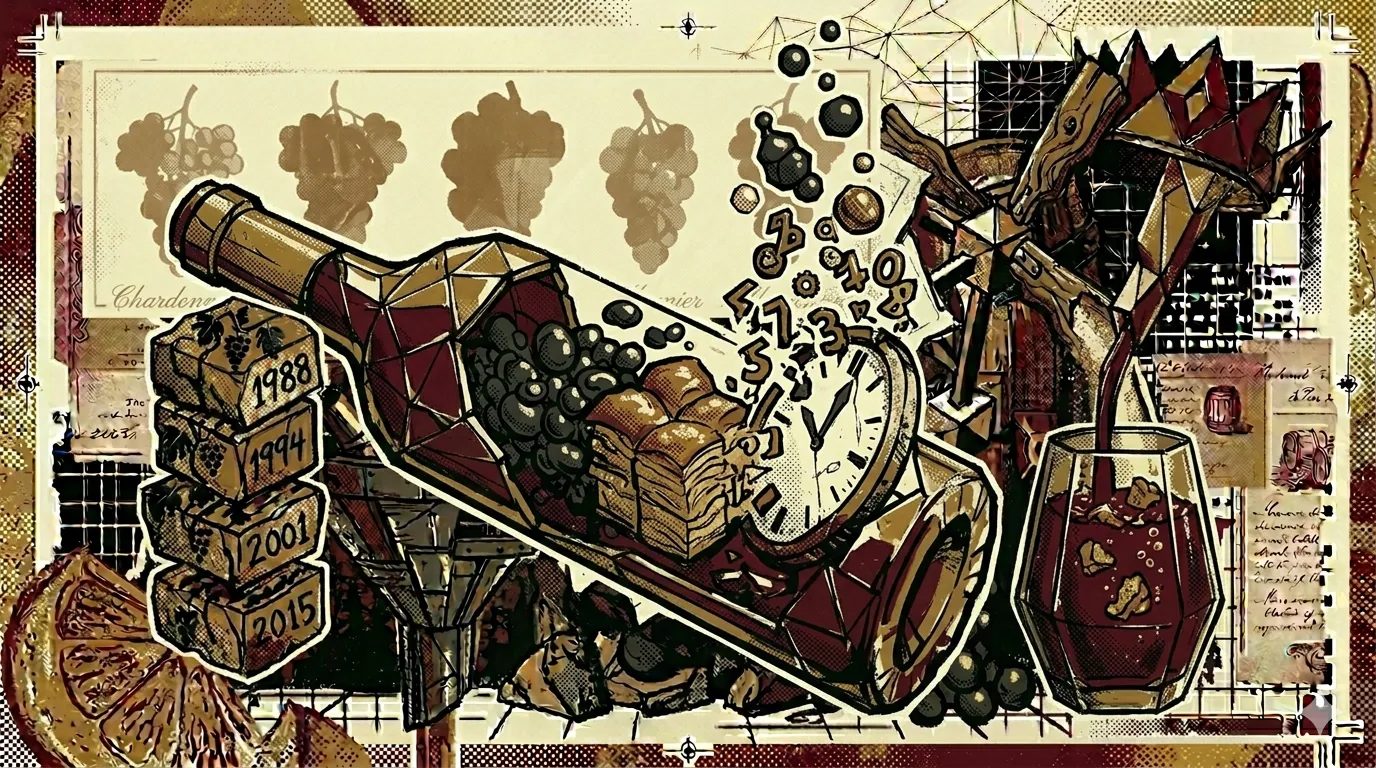
The bread-and-almond character of Champagne does not come from a barrel or a wood. It comes from dead yeast. Champagne autolysis is the process in which yeast cells slowly break themselves down after the second fermentation in the bottle, producing texture, brioche aromas and a mousse that grows finer over time. Lying long on the lees trades freshness for complexity.
What happens inside the bottle
After the second fermentation a deposit of dead yeast cells remains in the horizontal bottle. Those cells are not inert. Endogenous enzymes, mainly glucanases and proteases, break down the cell wall from the inside out. The cell wall has three main components: beta-glucans, mannoproteins and a small chitin fraction. As that structure falls apart, the contents leak into the wine: mannoproteins, peptides, free amino acids, nucleotides and lipids.
That leak is autolysis. The pace is slow, tied to the cellar temperature of around ten to twelve degrees Celsius in the Reims crayères. At that speed autolysis is a process of years, not months.
Mannoproteins do the heavy lifting
Mannoproteins are the main payoff. They raise the colloidal material in the wine, which translates to a rounder mouthfeel and the so-called crémeux character. They stabilise the mousse and keep the foam alive longer. They bind tartrate ions, which lowers the risk of wine-stone crystals. And they soften phenolic bitterness, which matters most in Pinot Noir-heavy blends.
Amino acids and peptides add the aroma layer. They serve as precursors for slow Strecker degradation and very limited Maillard-style reactions that produce brioche, toast and roasted nuts. The low pH and low temperature make those reactions slow, but over years they build a recognisable signature.
What the AOC requires
The Champagne cahier des charges sets firm minima for lees ageing:
- Non-vintage (Brut Sans Année): minimum 15 months between tirage and shipment, of which at least 12 months on the lees.
- Vintage (Millésimé): minimum 36 months between tirage and shipment, in practice entirely sur lattes.
Those are floors. The law guards against undercooked wines, but real quality lives above the floor.
Source: INAO cahier des charges Champagne, Comité Champagne.
What prestige cuvées do
For top cuvées, autolysis is a time investment that runs into years:
- Krug Grande Cuvée: typically six to eight years on the lees.
- Krug Vintage and Clos du Mesnil: ten years or more.
- Bollinger R.D. (Récemment Dégorgé): eight to fifteen years or longer, with late disgorgement to keep both autolytic texture and freshness.
- Salon Le Mesnil: around ten years on the lees plus extra post-disgorgement rest.
- Dom Pérignon: usually about eight to nine years for the standard release.
- Cristal: six years or more.
The gap between an NV with eighteen months on the lees and a vintage with eight years is not a marketing story. They are two different drinks built from the same grape.
How it tastes: short versus long
Short on the lees (15 to 30 months)
- Tighter mouthfeel, acid up front, linear.
- Primary fruit: citrus, green apple, white blossom.
- Light bread or dough notes, subtle.
- Mousse can be coarser, less persistent.
Long on the lees (5 to 10+ years)
- Much richer, softer, acid better integrated.
- Creamy, almost oily texture.
- Brioche, toast, hazelnut, cream, dried fruit, sometimes honey.
- Tertiary complexity above primary fruit.
- Mousse finer, more persistent, with a delicate bead.
The role of the reductive environment
The bottle sits under five to six bar of pressure and contains almost no oxygen after sealing. The yeast that was still alive consumed the last traces of oxygen during the second fermentation. That creates a reductive environment in which oxidative aromas stay suppressed. A Champagne on its lees does not develop the sherry-like notes a wine would gain in an open vessel. Instead bread, pastry and nut aromas form slowly, without browning.
If you wonder why old Champagne is still pale gold and not amber, this is why.
What this means for your cellar
Three rules that help with buying and ageing:
- An NV with 36 months on the lees sits well above the AOC minimum and tastes that way. Producers usually list it on the tech sheet.
- A vintage that prints the disgorgement date on the label gives you a handle on the post-disgorgement window. Six months to three years after disgorgement is usually a sweet spot.
- R.D.-style cuvées (late disgorgement) develop quickly after opening. They are ready to drink, not to age further.