

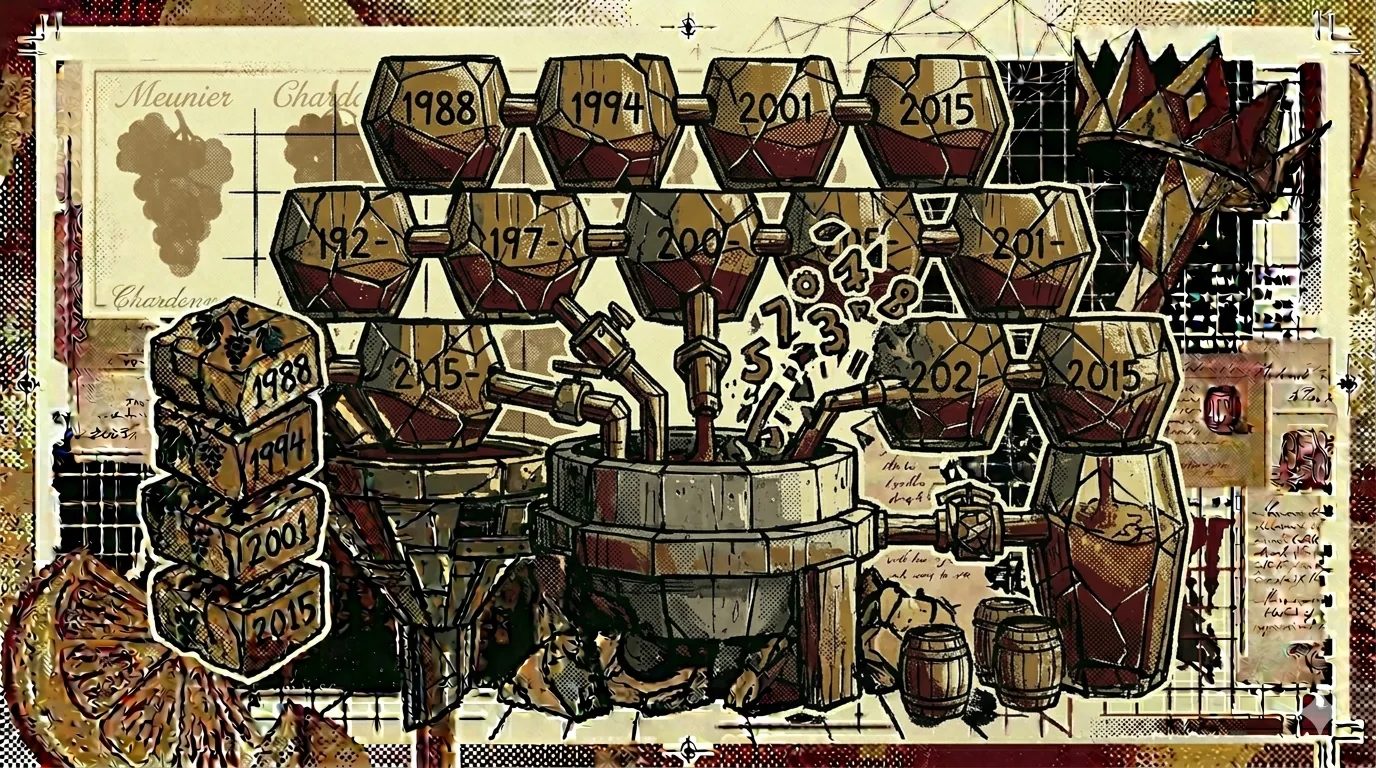
A Champagne house does not sell wine; it sells consistency. A bottle of Veuve Clicquot Yellow Label, Moët Brut Impérial or Pol Roger Réserve should taste the same in 2026 as in 2018 and in 2030. That seems impossible, since harvest in cold years differs from harvest in warm. The answer to that impossibility is champagne blending, and its heart is reserve wine: older wines a house keeps to steer every new base blend.
What blending actually is
After the first alcoholic fermentation (usually followed by malolactic), every house holds dozens to hundreds of still base wines (vins clairs) from the current harvest year. Each one is a combination of one variety, one parcel or village, and one press fraction (cuvée or taille). A house like Krug works each year with more than 250 individual base wines.
The cellar master and team taste through every base wine and build an assemblage: a blend of base wines plus reserve wines that defines the final taste of the cuvée. For non-vintage a significant percentage of reserve wine joins in; for vintage at most a few percent, since 85 percent must come from the stated year.
Blending happens each spring, about six months after harvest. The result then goes into bottle for the second fermentation (tirage).
Reserve wines: the collective memory
A reserve wine is a still base wine from earlier years, kept to use in future blends. How a house stores and uses its reserve wines is one of the most distinctive quality markers. Three systems exist:
Classical reserve wines in tank or vat. The most common approach. Wines from the last three to five harvests are kept separately, usually in inert stainless steel or large oak vats. Each new assemblage receives a share from that pool. Charles Heidsieck, Pol Roger and Roederer are references for careful cask management.
Magnum reserve wine. The Bollinger system used for Special Cuvée: reserves are kept in magnums under crown cap, which produces a mini-fermentation and long autolysis that adds extra texture. Bollinger draws on up to five vintages of magnums for every Special Cuvée.
Solera system (perpétuelle). A perpetual chain in which each year a fraction of the oldest vat is drawn for blending and topped up with the new harvest. Anselme Selosse, Laherte Frères, Tarlant and a few other growers work this way, modelled on Sherry. Selosse’s oldest perpétuelle runs from 1986; every bottle in theory contains traces of every year since.
How Krug and Roederer use blending
Krug Grande Cuvée is the textbook example of blending as an art. The cuvée usually contains 120 to 250 individual base wines, drawn from six to ten different vintages. The youngest base is the “edition” of the current year (since 2011 the edition number sits on the bottle). Krug does not present Grande Cuvée as less than a vintage; it is a different philosophy that puts blending skill at the centre.
Louis Roederer works through deliberate parcel-by-parcel vinification. Each village-and-parcel blend is kept apart. For Brut Premier (the standard NV), Roederer blends around 80 base wines from six to seven vintages.
Bollinger Special Cuvée draws on a magnum reserve that is itself a mini-Champagne, plus around 60 percent wine from the current year.
What reserve wines add to the wine
Three things only reserve wines can deliver:
- Roundness and texture. Still base wines lose some sharp primary fruit after a few years and gain roundness, texture and softer palate weight. That softness blends into a new assemblage and offsets the angularity of young base wines.
- Aromatic complexity. Older base wines develop light tertiary notes (dried fruit, nuts, brioche) that young wines do not yet have. In a blend that builds a deeper aromatic layer.
- Style continuity. By adding reserve wines each year, the house style stays recognisable despite variation in harvest quality. A cold year gets more reserve from warmer years, and the other way around.
Vintage: blending without reserve wines
For vintage cuvées, blending works differently. No or almost no reserve wines, because at least 85 percent must come from the stated year, and in practice all serious vintages work at 100 percent. The assemblage then happens within a single harvest: cellar masters taste through the base wines of that year and build a blend that expresses that one summer.
For the philosophical differences, see also our article on vintage versus non-vintage Champagne.
What blending cannot do
Blending with reserve wines can absorb a mediocre year and keep a house style intact. But it is no solution for poor base wine. If a house chooses high yields and underripe grapes, reserve wines only stack more mediocre wine. The technique is a tool, not a miracle.
That also explains why top growers usually use less reserve wine than big houses. Their base wine is strong enough to stand without a heavy buffer, and their style favours expressing the current year over preserving an unchanging signature.