

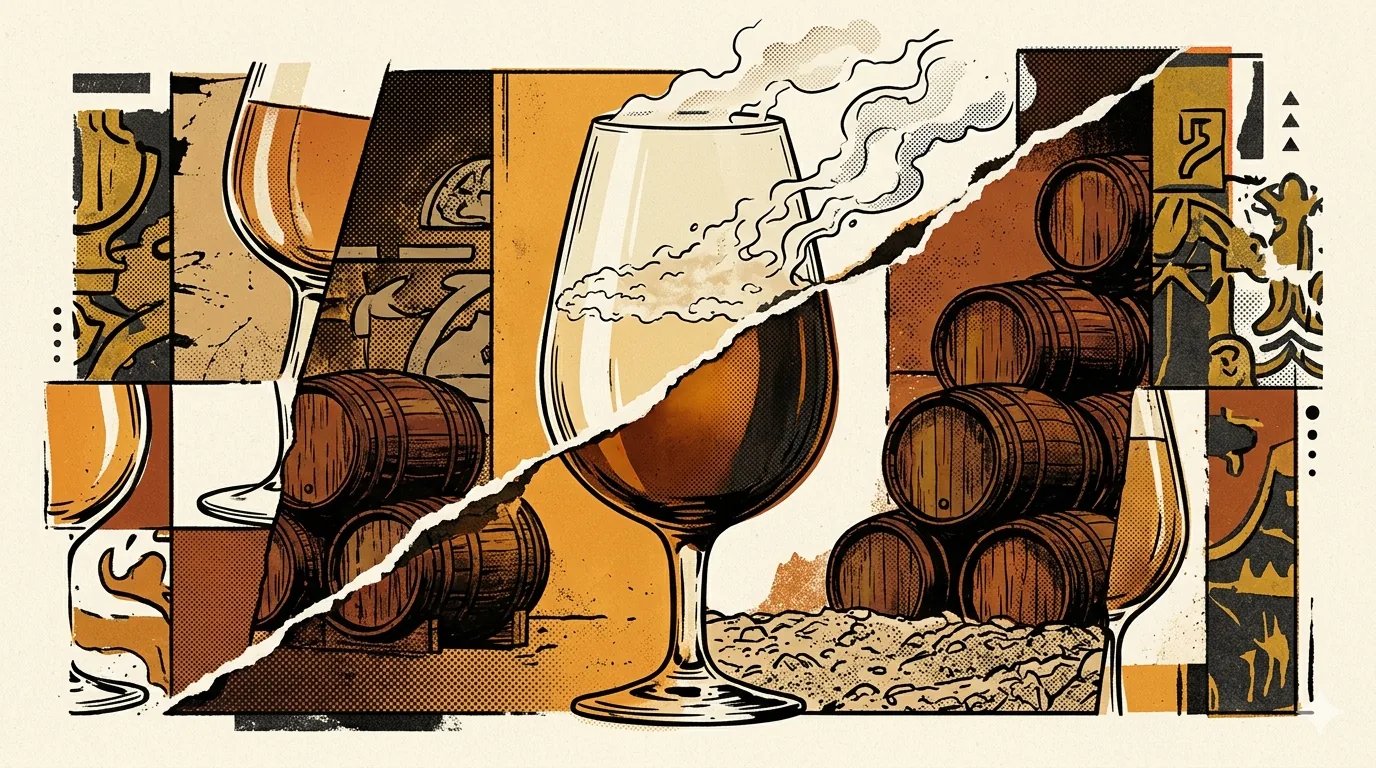
Pour a glass of amontillado sherry and you are looking at two lives in one wine. The first life sits dormant under a white yeast veil for years, picking up almond, salt and chalk while the flor protects the wine from oxygen. The second life happens after that veil dies, when oxidative aging slowly layers in hazelnut, leather and dried fruit. The colour lands somewhere between honey and amber, and the nose smells like a memory filling itself in.
The two lives side by side
| Phase | What happens in the cask | What you find of it in the glass later |
|---|---|---|
| First life, as fino | The wine lies under the velo de flor, which eats glycerol, residual sugar and part of the alcohol | The saline, chalky base layer and the almond note an oloroso never has |
| Transition, the natural route | In older casks of a fino solera the food runs out, the veil thins, breaks up and sinks to the bottom | Usually gives the most complex wines, because the flor lived long enough to do its full work |
| Transition, the deliberate route | The capataz refortifies from around 15 to 17 percent or higher, and the veil dies within days | Hands the cellar control over the moment of change, and the cask moves to its own criadera |
| Second life, oxidative | Oxygen reaches the wine directly, on average ten to twenty years or longer in solera | Hazelnut, caramel, dried fruit and leather, stacked on top of the saline foundation |
| What comes out | Neither fino nor oloroso, but a hybrid between 17 and 22 percent alcohol | Amber to deep amber in colour, dry by nature, with a finish that runs for many seconds |
What is Amontillado? Two lives in one glass
Amontillado is a fortified wine from Marco de Jerez, the triangle between Jerez de la Frontera, Sanlucar de Barrameda and El Puerto de Santa Maria in Andalusia. The grape is palomino fino, vinified dry and fortified with grape spirit. What makes amontillado unique is not a single aging method but the combination of two consecutive methods inside the same cask.
In the first phase the wine sits as fino under a living yeast layer called velo de flor. That veil covers the surface, blocks oxygen, and consumes glycerol, residual sugar and part of the alcohol. The result is pale, dry, salty wine with marked almond character.
In the second phase the flor disappears. From that moment oxygen reaches the wine directly. The colour darkens, and the aromatics build toward roasted hazelnut, caramel and dried fruit. What remains is no longer a fino and not yet an oloroso, but a hybrid carrying the minerality of the first life and the depth of the second.
The name itself points to Montilla, a town south of Cordoba where a comparable style existed in the eighteenth century. Amontillado literally means “in the style of Montilla”. Today it is a legally protected category within DO Jerez-Xerez-Sherry.
How does Amontillado happen? The death of the flor
An amontillado is never started as an amontillado. It begins life as a fino. Only when the flor disappears does the cask flip into amontillado. That transition takes two paths.
The natural path. Flor is a living colony and needs nutrients: glycerol, small amounts of alcohol, oxygen. In older fino-solera casks those nutrients run out. The yeast layer thins, breaks open, drops to the bottom. The wine that surfaces is suddenly unprotected. From that day on its oxidative life begins, and at some point the capataz declares the cask has crossed into amontillado.
The deliberate path. A capataz, the cellar master, can also intervene. He tastes a fino, hears what the cask is becoming, and re-fortifies from around 15 percent to 17 percent alcohol or higher. Above that threshold flor cannot survive. The yeast layer dies within days. The wine is moved to a separate amontillado criadera and starts its oxidative phase.
Both paths are legitimate. The natural path tends to give the most complex wines because the flor lived long enough to deposit its full biological signature. The deliberate path gives the capataz control over when and how a cask transitions. In practice both happen side by side inside the same bodega.
Once the flor is gone, the wine enters the solera y criadera system. A stack of casks where wine is moved annually from the youngest row (criadera) down to the oldest row (solera). What ends up in the bottle is a blend of many vintages, with the oldest fraction as the spine. For amontillado that means the oxidative character builds over an average of ten to twenty years or longer.
Flavour profile: hazelnut, chalk and oxidative depth
A good amontillado is a layered glass. The biological phase leaves a salty, chalky undertone. The oxidative phase puts warm, darker notes on top. It is not the sum of two separate styles but a gradual continuum.
Colour. Amber, sometimes copper, sometimes already pushing toward dark amber. The older the wine, the closer to mahogany. Never as dark as oloroso, never as pale as fino.
Nose. Roasted hazelnut leads. Underneath, almond skin, chalk, iodine, sea salt. Older bottlings show caramel, leather, dried fig, black tea, old furniture wood. Sometimes a touch of furfural, the bread-like aroma that emerges from extended cask aging.
Palate. Dry. The salinity from the flor phase lingers on the tongue while the oxidative layer brings deep, almost silvery umami. Alcohol usually sits between 17 and 22 percent, but rarely tastes hot thanks to the long aging. A serious amontillado has a finish that runs for many seconds: nuts, salt and a faint walnut-skin bitterness.
A common mistake is confusing amontillado with a sweet sherry. A real, classical amontillado is dry. What is sold as “medium amontillado” or “amontillado dulce” is a blended product, usually with Pedro Ximenez added. Those are commercial categories, not classical amontillado.
Amontillado Viejo, VOS and VORS
The Consejo Regulador in Jerez certifies older amontillados in two guaranteed age categories. The mark appears on the label only after chemical and sensory analysis by the regulator.
VOS stands for Vinum Optimum Signatum or Very Old Sherry. Minimum twenty years average age in the solera. On English labels often shown as “20 Years Old”.
VORS stands for Vinum Optimum Rare Signatum or Very Old Rare Sherry. Minimum thirty years average age. These are the bodega flagships, often produced in runs of only a few hundred bottles per year.
There is also Amontillado Viejo, sometimes used for wines between ten and twenty years old, plus the official VOS 12 anos and VOS 15 anos designations for younger guaranteed ages. A bottle carrying a VOS or VORS seal is always a serious commitment, in cost and in glass time.
Producers worth knowing
The Jerez triangle counts a few dozen active bodegas. For amontillado these names keep returning on sommelier lists and at sherry tastings.
Valdespino in Jerez makes Tio Diego Amontillado, an accessible entry point of around twelve years old, and the iconic Coliseo VORS, one of the oldest and most concentrated amontillados still in production. Valdespino is one of the few houses still bottling single-vineyard finos and amontillados from the Macharnudo vineyard.
Lustau in Jerez runs the Almacenista series, where Lustau bottles under the names of small private cellars without their own commercial license. The Almacenista amontillados often have very specific character and are a strong way to learn the stylistic range.
Bodegas Tradicion produces some of the most respected VORS amontillados available today. Their Amontillado VORS averages over thirty years and gets compared by critics to grand old white Burgundies for sheer complexity.
Hidalgo-La Gitana in Sanlucar bottles Amontillado Napoleon, an approachable and still authentic amontillado in old-school style, with a clear biological past on the nose.
Gonzalez Byass in Jerez makes Del Duque VORS, one of the most decorated amontillados in the world. A wine that shows what thirty years in solera deliver: dense hazelnut, dark caramel, a saline thread that never leaves.
Other names that belong on a serious sherry list: Equipo Navazos with the La Bota bottlings, Fernando de Castilla, Emilio Hidalgo and Bodegas Yuste with Aurora.
Pairing: mushrooms, aged cheese and umami
Amontillado is the most versatile sherry at the table. Its dry, salty base suits savoury food, while the oxidative depth carries dishes with roasted, aged or umami-heavy character. Serve at around twelve degrees Celsius in a white wine glass or a copita.
Classic combinations:
- Aged hard cheeses: old Manchego, two-year-plus Comte, parmigiano reggiano
- Mushrooms in any form: porcini risotto, ceps on toast, roasted shiitake
- Game birds with depth: roast partridge, quail with chestnut, roast pigeon
- Iberico ham, especially the fattier cuts
- Clear consomme and miso soup, both share the same umami axis as the wine
- Chicken tagine with almond and dried apricot
- Smoked almonds or roasted walnuts as a simple snack
What does not work: very sweet desserts, fresh green salads, shellfish with citrus dressing. The wine is too powerful and too oxidative for any of those.
The cultural cliche: Poe and the cask
For many non-sherry drinkers Amontillado is mostly a name from The Cask of Amontillado, the short story Edgar Allan Poe published in November 1846 in Godey’s Lady’s Book. A revenge tale in which the narrator, Montresor, lures his rival Fortunato into the catacombs with the promise of a rare cask of amontillado, gets him drunk, and walls him in alive.
The story locked the name Amontillado into English-language culture, but it works mainly as gothic horror. Poe was no sherry expert. The pull of the story relies on the fact that a cask of amontillado in 1846 was rare and expensive enough that a gentleman like Fortunato would abandon his judgement for a sip. That part is accurate: amontillado was a prestige wine in the mid-nineteenth century.
If you have not read it, the story takes about half an hour. After which you can open a bottle, with significantly fewer consequences.
Frequently asked questions
What is amontillado?
Amontillado is a sherry that starts as a fino under flor, then ages oxidatively once the flor fades. That gives it fino’s fresh origin plus oloroso’s nutty depth. It is naturally dry, amber-coloured and smells of hazelnut and tobacco. It pairs well with broth, poultry and aged cheese.
Is amontillado sweet or dry?
Dry. A classic amontillado carries no residual sugar, since the palomino ferments right out before the distillate goes in. Anything sold as “medium amontillado” or “amontillado dulce” is a blend with a sweetening component, usually Pedro Ximénez, and that is a commercial style rather than an amontillado.
What do VOS and VORS mean on a bottle of amontillado?
Guaranteed average age in the solera, certified by the Consejo Regulador after both chemical and sensory analysis. VOS means at least twenty years, VORS at least thirty. There are also VOS 12 años and VOS 15 años designations for younger guaranteed ages.
Sources
- Consejo Regulador de las Denominaciones de Origen Jerez-Xerez-Sherry, Manzanilla-Sanlucar de Barrameda y Vinagre de Jerez. Reglamento. sherry.wine/sherry-region/regulatory-council
- Jefford, A. (2017). The New France. London: Mitchell Beazley. (Chapter on sherry and the flor phase.)
- Liem, P. & Barquin, J. (2012). Sherry, Manzanilla & Montilla: A Guide to the Traditional Wines of Andalucia. Manutius Press.
- Gonzalez Gordon, M. (1972, reprinted 1990). Sherry: The Noble Wine. London: Cassell.
- Suarez-Lepe, J.A. & Morata, A. (2012). “New trends in yeast selection for winemaking.” Trends in Food Science & Technology, 23(1), 39-50.
- Poe, E.A. (1846). “The Cask of Amontillado.” Godey’s Lady’s Book, November 1846.
- Bodegas Tradicion. Technical bottling notes Amontillado VORS 30 anos. bodegastradicion.es
- Lustau. Almacenista programme documentation. lustau.es
- Valdespino. Product documentation Tio Diego and Coliseo VORS. grupoestevez.com
- Gonzalez Byass. Del Duque VORS technical sheet. gonzalezbyass.com