

1979 Kalos Stergianos 2022: The Retsina From the Hills
Pale gold, dry and herbal. The 1979 Kalos Stergianos 2022 is a retsina with the character of mountain forest rather than the sea.

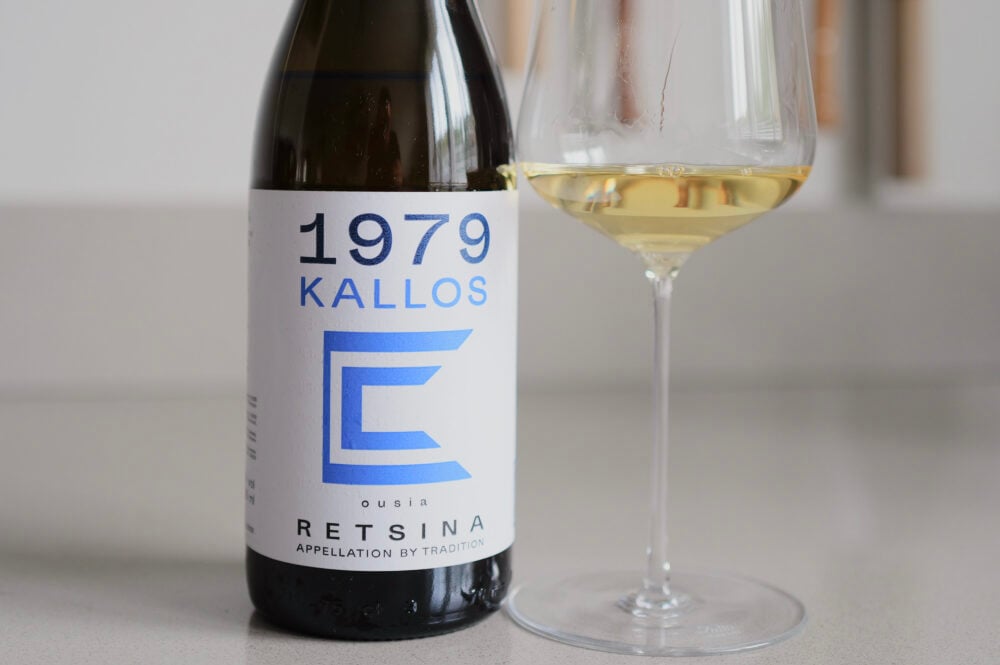
Dried rosemary and white pepper. That’s the first impression out of the glass, from exactly the same grape, the same fermentation, and the same winemaker as the Thalassino.
What changes is the forest. The Thalassino takes its resin from pines on the Aegean coast. The Stergianos takes resin from the Megara plateau, some distance from the sea, on rockier soil and at higher elevation. The wine that comes out tastes like an entirely different place. No iodine, no shellfish, but Mediterranean scrubland, dry herbs, mineral dust.
This is what Eleni Kechri calls “forest terroir” in practice. Two wines from the same tank, separated only by which forest produced their resin, and the difference reads instantly in the glass.
- Producer
- 1979 Wines
- Wine
- Kalos Stergianos 2022
- Region
- Emathia, Northern Greece
- Grape
- Assyrtiko
- Vineyard
- Gerakona, Kilkis, 350m
- Resin
- Pinus halepensis, Megara plateau
- Harvest
- Sustainable, no sulphuric acid
- Alcohol
- ~12.5%
- Price (GR)
- approx. €16
Available in Germany, Belgium, the UK and Canada. Dutch distribution coming soon. More: 1979.gr/en.
Tasting Note
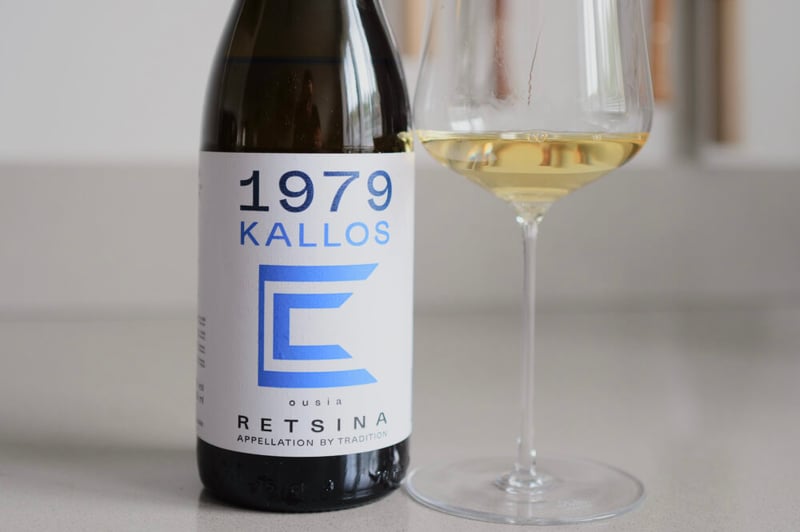
Appearance
Pale gold, similar to the Thalassino, with a clean bright rim. A touch more golden at the centre.
Nose
More immediately herbal than the Thalassino. Dried rosemary and white pepper come forward first, followed by lemon thyme and a faint lavender thread that feels distinctly Mediterranean scrubland rather than coastline. There’s still citrus from the Assyrtiko, but here it reads as dried lemon peel rather than fresh zest. The mineral quality is earthier: chalk and dry stone rather than iodine and sea spray. The pine is integrated and resinous in a more traditional sense: a clean, spiced warmth rather than a lifted coastal freshness.
Palate
The attack is slightly softer than the Thalassino, with acidity still high but marginally less sharp on the front palate. The mid-palate has real presence; there’s grip and structure here that suggest this wine will age well. The texture is rounder, more generous, and the herbal character carries through with consistency to a finish that lingers with dried herb and mineral warmth. No harshness, no astringency, just clean length.
Quality
The Stergianos demonstrates the retsina concept from a different angle than the Thalassino. Where that wine dazzles with coastal freshness, this one persuades through elegance. It’s the more contemplative of the two 2022s, and arguably the one that will develop most interestingly with a few more years in bottle.
Why the Same Base Wine Tastes Different
The base wine, the fermentation, and the winemaking choices are identical to those of the Thalassino. Eleni harvests both together, begins fermentation in the same tank, and only separates them after the first clarification, when they’re transferred to different barrels with their respective resins. From that point on the wines evolve differently. Not because anything beyond the resin itself was added, but because the resin profiles are genuinely distinct.
The Megara plateau is further from the sea than Halkidiki’s coastline. Not dramatically, nowhere in Greece is truly far from water, but far enough to matter. The pines there grow in rockier, more mineral soil at higher elevation. The resin they produce has a different balance of terpenes: less of the light, iodine-forward fraction that gives Thalassino its coastal character, and more of the drier, herbal, phenolic notes that translate into the wine as rosemary and white pepper.
This is the argument for forest terroir. Not that one forest is better than the other, but that they produce genuinely different things, and those differences are worth preserving rather than blending away.
Food Pairing
The Stergianos’s rounder texture and herbal character make it a more versatile food wine than the Thalassino. Eleni describes it as a wine for white meat and butter-based sauces: roast chicken with tarragon, pork tenderloin with a cream and mustard reduction, veal escalope with sage butter. I’d add: a young, semi-hard sheep’s cheese (aged Manchego or a mild pecorino), rabbit with herbs, or a simple pasta with aged goat’s cheese and lemon.
The structure also makes it a candidate for the table throughout a meal rather than just an aperitif. This wine holds its own alongside a main course in a way more delicate whites sometimes can’t.
Serve at 9–11°C. Like the Thalassino, it rewards time in the glass. Open 20 minutes before serving or decant briefly.
The Verdict
The Stergianos 2022 is the wine that most fully converted me to the idea of forest terroir. Not because it’s more spectacular than the Thalassino, it isn’t, in the way a dramatic coastal landscape is spectacular, but because it’s quietly persuasive. It tastes like a specific hillside in Attica. It has a sense of place that comes from a forest rather than a vineyard. That’s genuinely new territory in serious wine.
At €16 in Greece, it represents serious value for what is, in both the technical and conceptual sense, a unique wine.
Part of a three-bottle tasting with Eleni Kechri of 1979 Wines on Sparks by VinoVonk.
Frequently asked questions
Where does the resin in the Stergianos come from?
From the Megara plateau, away from the sea, on stonier soil at greater altitude. That gives dried rosemary, white pepper, Mediterranean scrubland and mineral dust, without the iodine and sea air of the coastal bottling.
How does it differ from the Thalassino?
Only in the forest the resin comes from. Grape, fermentation and winemaker are identical: Assyrtiko from Emathia, made by Eleni Kechri. The Thalassino draws its resin from coastal pines in Halkidiki and tastes of the sea; the Stergianos tastes of the land behind it.
What does the 1979 Kalos Stergianos cost?
Around 16 euros, the same as the Thalassino. The aged Kalos 2020 from the same range costs about 25. Prices at the time of publication.
Sources
- 1979 Wines (officieel, Eleni Kechri): 1979wines.com
- Wines of Greece: retsina tradition: winesofgreece.org
More on Wine Review
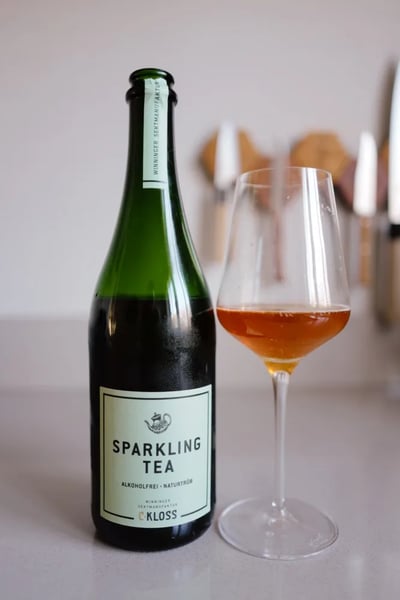
C. Kloss Sparkling Tea Weiss: Fermented Celery
Non-alcoholic sparkling tea Weiss from C. Kloss: linden blossom, nettle and fermented celery. Dry, 2.7 g sugar per 100 ml, €14.99 at Amavine.
Read on →
Barbadillo Sábalo: Organic Palomino Without Flor
Organic Palomino Sábalo from Barbadillo: no flor, salt from albariza soil. Chamomile, apple, sea. €17.95 at Granada Wijnen, with discount code.
Read on →
Tua Rita Lodano Rosso 2024: Petit Verdot Leads
A €50.95 Super Tuscan built on 60 percent Petit Verdot and 18 months of barrique. Why I chill it, decant it and never drink it without food.
Read on →