

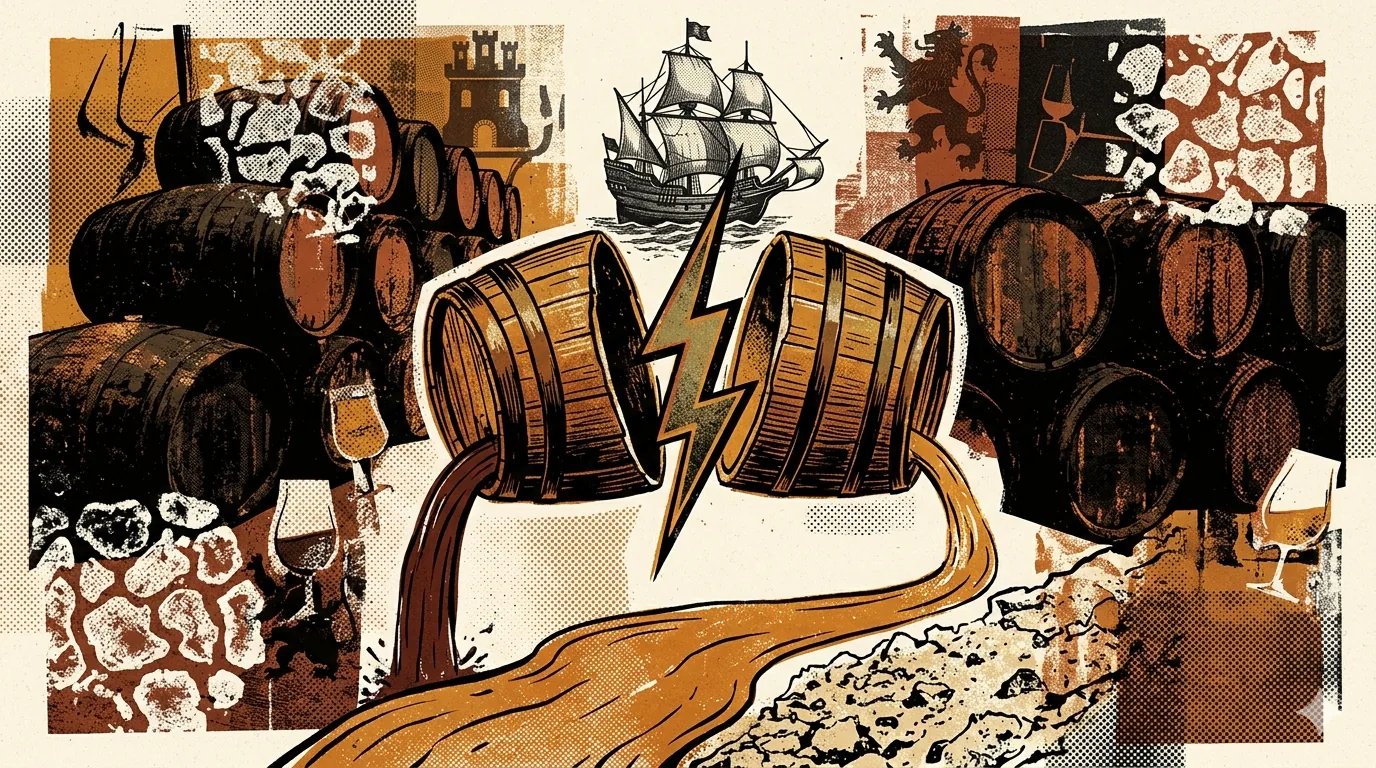
In a bodega in Jerez, a capataz stands beside a row of 600-litre American oak butts, venencia in hand. He tastes a base wine of around 11.5%, then makes the call: this barrel goes to Fino under flor, the next becomes Oloroso. Then the spirit comes in. That moment, that one calibrated push of grape distillate after fermentation, is exactly why sherry is sherry. To answer why is sherry fortified, you need three layers at once: a 16th-century British shipping route, the life cycle of a yeast film, and an EU rule that says fortifying a wine doesn’t make it less of a wine.
Short version: sherry receives a targeted alcohol addition after fermentation, aiming for a precise ABV that decides whether the surface yeast survives or dies. No ABV target, no sherry style. And yet this is still wine, made from Palomino grapes, fermented dry, then adjusted.
Three fortified wines, three moments
| Wine | When the spirit goes in | What happens to the sugar | Where the wine ends up |
|---|---|---|---|
| Sherry | Only after the Palomino has fermented completely dry | No residual sugar in the base; sweet styles are built later by blending in PX or Moscatel | 15 to 15.5 percent for flor, 17 to 18 percent against it, climbing to 20 or 22 in very old stocks |
| Port | Mid-fermentation, once roughly half the sugars have converted | The yeast dies instantly from the alcohol shock, so unfermented sugar stays in the wine | Around 19 to 20 percent, with 80 to 120 grams of residual sugar per litre |
| Madeira | At varying moments, depending on whether the style is to end up dry or sweet | Depends on the moment chosen, much as with port | Then months of warming to 45 to 50 degrees Celsius via estufagem or canteiro, which builds the caramelised note |
All three remain wine under the EU definition, because the spirit itself is also made from grapes.
What is fortification? Mitad y mitad in practice
Fortification means adding grape spirit to a finished wine to raise its alcohol level. In Jerez this happens through a traditional method called mitad y mitad, which translates as “half and half”. The cellarmaster blends a neutral grape distillate of around 95-96% ABV with mature sherry from the bodega in equal parts. The result is an intermediate liquid of roughly 50% alcohol, which is then introduced gradually into the young base wine.
The indirect route is not folklore. A raw shot of 96% ethanol creates a local alcohol spike inside the bota, and that spike damages aroma precursors and disturbs microbial balance. By diluting with sherry first, the alcohol integrates more smoothly and the Palomino fruit stays intact. The addition is often done in stages, with several days of rest between phases, so the cellarmaster can dial in exactly where the wine lands.
The base wine before fortification typically sits between 11 and 12.5% ABV, fermented dry, no residual sugar. From there it’s arithmetic: how much mitad y mitad to reach 15.0%, or to reach 17%? That choice is the difference between biological ageing under a yeast veil and oxidative ageing in contact with oxygen.
Two paths: 15% for flor, 17% against flor
Sherry has two fundamental ageing routes, and the ABV target decides which path a barrel takes. For Fino and Manzanilla, the cellarmaster brings the wine to 15.0-15.5% ABV. At that level, Saccharomyces cerevisiae beticus, the yeast that forms the famous flor layer, survives. Flor grows as a white film on top of the wine, consumes alcohol and glycerol, and produces acetaldehyde. That gives Fino its almond note and saline edge.
For Oloroso the bar is higher. The wine is brought to 17-18% ABV. At that concentration, flor cannot survive, and without the protective veil, oxygen has free access. The wine ages oxidatively, developing walnut, leather, dried fig and a deep mahogany colour. Through water loss via evaporation in the warm Andalusian air, ABV in the bota keeps creeping up, sometimes reaching 20-22% in very old stocks.
Amontillado is the hybrid that shows how clever this system really is. An Amontillado starts as Fino at 15%, ages for years under flor, and is then re-fortified to 17%+. The flor dies off, oxidative ageing takes over. You taste the two phases side by side in one glass: the saline, yeasty attack of the biological years, and the nutty depth of the years that followed.
This is why fortification in Jerez is not a matter of taste, but of architecture. The ABV target designs the style before the first month of ageing is over.
Why was sherry ever fortified? The British market and the sea
The fortified sherry we know today was born from logistics. By the 16th century Jerez was already a respected wine region, but its wine was shipped largely as ordinary dry wine. The problem: long sea voyages to northern Europe and the West Indies destroyed the wine. Heat in the hold, motion, unstable microflora. Many barrels arrived sour or spoiled.
The solution came from practice. By adding distillate before shipment, ABV climbed well above the threshold at which spoilage organisms can live. The wine survived the crossing, and as a bonus, the extra alcohol improved the ageing profile. What started as a preservation trick became a stylistic foundation.
The British market accelerated the process. Sir Francis Drake raided Cádiz in 1587 and brought a large haul of “sack” back to England, an early name for wine from Jerez. Shakespeare gave Falstaff his ode to “sherris-sack” in Henry IV, Part 2. Through the 17th and 18th centuries England became the largest export market, and British trading houses settled in Jerez. Names like Sandeman, Williams & Humbert and Osborne still carry that history.
That British demand was a feedback loop. The English wanted stable, sturdy wine that aged well in cooler cellars. Producers in Jerez fortified more deliberately. By 1800, the mitad y mitad system and the split between Fino and Oloroso looked roughly the way it does now.
What does fortification do chemically? Preservation and oxidation
Ethanol is a biocide. Above 15% ABV, most lactic acid bacteria, acetic acid bacteria and wild yeasts are no longer viable. Brettanomyces, the yeast that gives red wine its barnyard notes, rarely survives above 14.5%. For Jerez that means the wine is microbially stable the moment fortification is locked in. No unwanted re-fermentation, no creeping acetification, no surprise renovation in the bota.
Fortification also rewires oxidation dynamics. In Oloroso at 17%+, the wine is open to oxygen without converting to acetic acid. The ethanol concentration suppresses bacterial oxidation while chemical oxidation of phenolics and aroma compounds keeps running. The result is controlled ageing, where nutty aldehydes and sotolon-like compounds steal the show.
In Fino, fortification does the opposite. The 15% level inhibits spoilage organisms but leaves flor alone. That yeast layer consumes oxygen above the wine, keeping the wine reduced. That’s why Fino stays pale, sharp and fresh. One cellar policy, two opposing outcomes, steered by a single decimal.
A third chemical layer involves glycerol. Under flor much of the glycerol disappears, which gives Fino its light, almost lean mouthfeel. In Oloroso glycerol stays intact and combines with esters and aldehydes to build a rounder texture.
Sherry vs port vs madeira: three roads to fortified wine
Three classic fortified wines, three different methods. The difference is when you add the spirit and what stays in the wine after.
For port, fortification happens mid-fermentation. Portuguese producers add a 77% grape distillate (aguardente) into the must once roughly half the sugars have been converted. The yeast dies instantly from the alcohol shock, and the unfermented sugar stays in the wine. That is why port is sweet: 80 to 120 grams of residual sugar per litre, with a final ABV of around 19-20%. This intervention is called mutage.
For madeira, something similar happens, plus a heat treatment. The wine is fortified at different moments depending on whether the style ends up dry or sweet, then it goes through estufagem or canteiro: months of warming up to 45-50°C that develop the typical caramelised, tangy madeira note. The distillate preserves, the heat transforms.
For sherry, the timing difference is the key point. The Palomino grape ferments fully dry, all the way to 0 grams of residual sugar. Only then does the distillate come in. So a natural sherry is always dry at the base. Sweet sherry styles like Pedro Ximénez or Cream are made by adding sweet components or special grapes (PX, Moscatel) to the dry base wine later.
Three methods, three philosophies. Port stops the yeast, sherry lets the yeast finish. Madeira adds heat as a fourth dimension. But all three remain wine under EU definitions, because the spirit itself comes from grapes too.
Is fortified wine still wine? The Vino de Pasto debate
Here it gets philosophically interesting. Under EU Regulation 1308/2013 (Annex VII, Part II), “wine” is any product made by complete or partial alcoholic fermentation of fresh grapes or grape must. Fortified wine sits in a separate sub-category: vino de licor in Spanish, “liqueur wine” in English legal parlance. But it remains wine. The instinct that sherry is somehow “half wine, half spirit” is a misreading. It is wine with a measured shot of grape spirit added, and grape spirit is distilled wine.
In 2022 the Consejo Regulador in Jerez took it one step further. A regulation change made it possible to release unfortified wines under the Jerez DO, provided they are made from Palomino grown on specific pagos and vinified without added distillate. This category is called Vino de Pasto. ABV stays natural, around 11-13%, and the wine may or may not age under flor. Some producers use it to express terroir in a Burgundian register, foregrounding the salty, chalky albariza soils.
That move sparked debate immediately. Purists argue sherry is fortified by definition. Others point out that pre-fortification wines from Jerez before the 17th century were also unfortified, and that Vino de Pasto is in fact a return to older practice. The regulator chose pluralism: Fino, Oloroso, Amontillado, Palo Cortado, PX, Moscatel and now Vino de Pasto, all under the same roof.
The lesson: fortification is not a requirement to be called wine, and since 2022 it is no longer a requirement to be called Jerez. What it remains is the technique that gave sherry as the world knows it its architecture. Without fortification there is no flor, no Oloroso, no four centuries of British trade romance.
So when you open the next bottle of Fino, you are not drinking “wine with a splash of spirit”. You are drinking wine that, through one calibrated intervention, made the choice between two biochemical paths. That is not a deficit. That is precision.
Frequently asked questions
To what strength is sherry fortified?
It depends on the style, and the number decides the style. Fino and Manzanilla go to 15.0 to 15.5%, where flor survives; Oloroso goes to 17 to 18%, where flor dies off and oxygen takes over. The base wine before fortification sits between 11 and 12.5%.
Is sherry wine or spirit?
Wine. EU Regulation 1308/2013 files fortified wine under the category vino de licor, and the distillate that goes in is itself made from grapes. What is added is wine spirit, not grain alcohol.
Is there such a thing as unfortified sherry?
Since 2022, yes. The Consejo Regulador admitted Vino de Pasto: Palomino from specific pagos, no added distillate, around 11 to 13% alcohol, with or without flor. Purists refuse to call it sherry, though the Jerez wines made before the 17th century were not fortified either.
Sources
- Wikipedia, Sherry
- Wikipedia, Fortified wine
- Wine Scholar Guild, Regional Spotlight: Sherry
- Foods & Wines from Spain, Amontillado: Sherry’s renowned dual-aged style
- Foods & Wines from Spain, The enigmatic expressions of Palo Cortado
- Sherry Notes, Vino de Pasto: Unfortified Terroir Wines from Jerez
- SevenFifty Daily, Understanding Sherry’s New Regulations
- EU Regulation 1308/2013, Annex VII, Part II: wine categories
- Folger Shakespeare Library, Henry IV, Part 2, Act 4 Scene 2: “sherris-sack”
- PMC / FEMS Yeast Research, Saccharomyces cerevisiae beticus and flor formation