

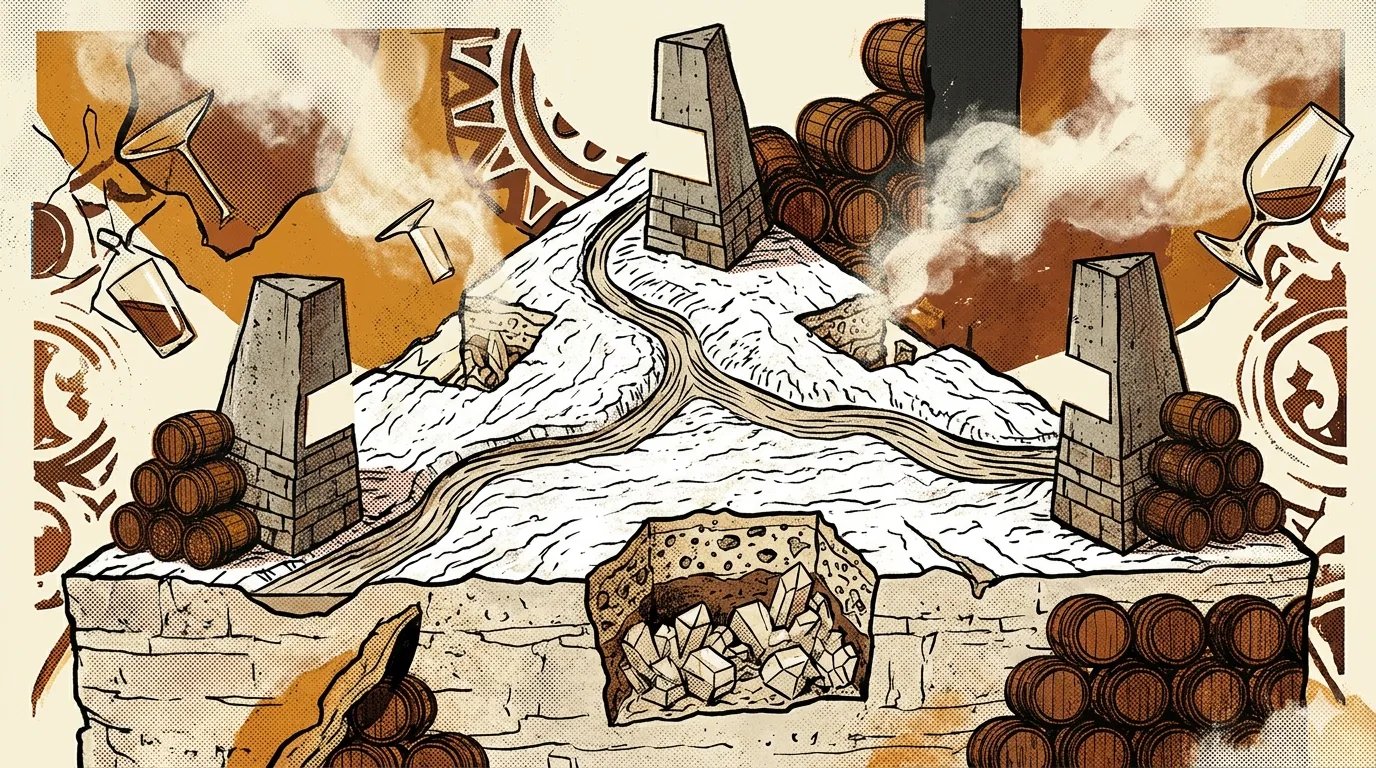
In Sanlúcar the wind smells of salt and yeast. A hundred kilometres inland, in the Cádiz countryside, white chalk crunches under your shoes like broken porcelain. Between those two points sits the sherry triangle: a small corner of Andalucía that is one of the most precisely demarcated wine regions on earth. Three towns, one DOP, around 7,000 hectares of vineyard, and a soil nobody else has. This is where sherry comes from, and why it cannot exist anywhere else.
The three towns side by side
| Town | Setting and climate | What that does to the flor | Style that comes from it |
|---|---|---|---|
| Jerez de la Frontera | Slightly inland, on rolling hills between 50 and 100 metres, warmer and drier than the coast | The yeast film runs through four seasons and thins out in summer | Powerful fino, complex amontillado and most of the region’s oloroso |
| Sanlúcar de Barrameda | At the mouth of the Guadalquivir, right on the Atlantic, cool and humid | The flor stays thick and active all year, with no seasonal cycle | Manzanilla, which may legally come from nowhere else |
| El Puerto de Santa María | On the bay of Cádiz, halfway between the other two, with a climate the locals call “suave” | Steady conditions, so the yeast film develops evenly | Fino del Puerto, broader on the palate and rounder in its salinity than Jerez fino |
The three sit roughly twenty kilometres apart. That is the whole difference.
Three towns, three identities: Jerez, Sanlúcar and El Puerto
The classic sherry triangle is formed by three port towns in the province of Cádiz, in the deep southwest of Spain. They sit roughly twenty kilometres apart and all face the Atlantic Ocean, but each has its own climate, its own bodega culture and its own sherry style.
Jerez de la Frontera
Jerez is the capital. The largest town in the region, the administrative seat of the Consejo Regulador, and the place where the great houses built their cathedral-like bodegas. The town sits slightly inland on gently rolling hills, with vineyards on average 50 to 100 metres above sea level. The climate is therefore a touch warmer and drier than at the coast.
Jerez gives sherry its name (Jerez-Xérès-Sherry, in three languages at once) and supplies the structural backbone of the region: powerful finos, complex amontillados and most olorosos come from Jerez bodegas.
Sanlúcar de Barrameda
Sanlúcar sits at the mouth of the Guadalquivir, exactly where the river meets the Atlantic. That location is not a detail. The cool ocean air and constantly high humidity make Sanlúcar the only town on earth where manzanilla is allowed to age. Not because regulation demands it for show, but because the flor, the white yeast veil that grows on the wine, stays thick and active here all year round.
Manzanilla soleras in Sanlúcar typically have eight to nine criadera levels, sometimes up to fifteen. Four to six sacas per year is normal. That rhythm only exists because the microclimate carries it.
El Puerto de Santa María
El Puerto sits halfway between Jerez and Sanlúcar, on the bay of Cádiz. The local climate is described as “suave”: gentle, mild, consistent year-round. That makes El Puerto particularly well suited to fino. The flor enjoys steady conditions and develops evenly. Fino del Puerto is a recognised sub-style within the sherry spectrum, with a slightly broader palate and a touch more saline roundness than Jerez fino.
Marco de Jerez: what the DOP actually defines
The DO Jerez-Xérès-Sherry was established in 1935 under the 1933 Wine Statute. It is therefore the oldest Denominación de Origen in Spain and one of the first protected geographical indications in Europe.
The official zone is called Marco de Jerez and covers ten municipalities:
- Jerez de la Frontera
- Sanlúcar de Barrameda
- El Puerto de Santa María
- Chipiona
- Rota
- Trebujena
- Chiclana de la Frontera
- Puerto Real
- Lebrija (province of Sevilla)
- (extension via adjoining qualified parcels)
Together those areas hold about 7,000 hectares of vineyard registered with the Consejo Regulador as suitable for sherry production. Not every hectare is equal. Within the production zone there is a second, stricter tier: Jerez Superior.
Jerez Superior is the premium zone. Only plots planted on pure albariza soil qualify. In practice those plots cluster around Jerez, El Puerto and Sanlúcar, in the famous pagos such as Macharnudo, Carrascal, Balbaína, Añina and Miraflores. If you want to make sherry from Jerez Superior fruit, you cannot fall back on sandy coastal plots or clay further inland. The geography is hard.
Albariza: the white chalk soil
Albariza is the reason sherry exists the way it does. The name comes from the Spanish “albo”, white, and that is no marketing flourish. In full sun the soil reflects so much light you have to squint. It looks almost unnatural.
Geologically, albariza is a marine deposit from the Tertiary, formed in a shallow sea during the Oligocene and Miocene. It is built from chalky marl, the compacted skeletons of billions of microscopic diatoms and calcareous algae. The calcium carbonate content runs from roughly 30 to 80 percent depending on the subtype. The top categories Tosca cerrada and Barajuela reach 60 to 80 percent; other layers sit lower.
Three properties make albariza unique for viticulture:
- Water retention. The soil holds up to 30 percent of its own weight in water. During the wet winter (October to March) it saturates, and through the dry summer it slowly releases that water back to the roots. This is why dry-farming through a three-month drought works here.
- Reflective white surface. Albariza throws sunlight back onto the underside of the leaves and onto the bunches. More photosynthesis, more ripening.
- Drainage. During heavy storms the excess drains away rather than pooling around the roots.
Three types: tosca cerrada, barajuela, lentejuela
Albariza is not a monolith. Geologists and growers distinguish three main types within the region, each with its own character.
Tosca cerrada is the most widespread. About 80 percent of current Marco de Jerez vineyards sit on this type. It is hard, compact, with a slightly grey tint and the highest chalk content. Tosca cerrada is traditionally considered the highest quality and yields the structural, mineral-driven base wines that anchor classic finos and amontillados.
Barajuela is layered. The soil shows clear horizontal bands of white chalk, sometimes broken by ochre layers containing oxidised iron and clay. The diatom content is highest here and the limestone level sits around 60 to 70 percent. Wines from barajuela carry a recognisable depth and a faintly saline tongue.
Lentejuela (also called antehojuela) is loose, crumbly and highly porous. It behaves like a sponge. During wet seasons it soaks up water quickly and releases it gradually. Lentejuela is gentle on the vine and produces less plant stress. Research links this soil type to base wines that feed specific flor yeast strains, and therefore to the most expressive manzanillas and finos.
Kinship with Champagne chalk
To put it functionally: albariza is to sherry what craie is to Champagne. Both are marine deposits (Champagne from the Cretaceous, albariza from the Tertiary), both are largely calcium carbonate, both retain water through dry summers and both reflect light. Both give their wines a recognisable saline mineral signature.
The difference sits in the topsoil. Champagne chalk often has only a few centimetres of topsoil above it and demands constant fertilisation. Albariza carries a thicker, better developed upper layer that holds more organic matter. Functionally the two soils do the same job; geologically they are cousins from different generations.
Climate: poniente, levante and the influence of the Atlantic
The climate in Marco de Jerez is Mediterranean with a heavy Atlantic correction. On paper: roughly 3,000 hours of sunshine per year, more than 300 sunny days, and around 600 millimetres of rainfall that falls almost entirely between October and March. In between it is dry, sometimes for months on end.
What truly shapes the climate here are two winds. They have names, and they have a direct effect on the yeast on the wine.
The poniente comes from the west, off the Atlantic Ocean. It is a cool, humid wind that freshens the entire coast. The poniente lifts humidity inside the bodegas to around 70 percent or higher. That is exactly what the flor, the white yeast veil (Saccharomyces beticus and relatives), needs to form and maintain itself on the wine. No poniente, no biological ageing. No biological ageing, no fino or manzanilla.
The levante comes from the east, out of the interior and the Alborán Sea. It is a dry, hot wind that tears across land and evaporates any moisture along the way. By the time the levante reaches Jerez it is desiccating and aggressive. A long levante period can thin the flor, weaken it or in extreme cases kill it. Sherry makers therefore follow the wind closely: bodegas use damp sand floors and directional ventilation to buffer the levante.
The Guadalquivir estuary amplifies the effect around Sanlúcar. The river feeds in cool water and the bay works as a natural air conditioner. That is why Sanlúcar runs systematically cooler and more humid than Jerez, even though it sits only twenty kilometres away. And that, in turn, is why manzanilla can exist only there.
What this terroir does for sherry
The combination is not coincidence. Albariza holds water through the dry summer. The Atlantic and the poniente keep humidity high enough for flor. The levante delivers occasional stress and oxidation. The bodegas themselves, built tall like cathedrals, with whitewashed walls and sand floors kept damp, translate the outside climate into the indoor environment.
The result is a family of sherry styles that cannot be made at this scale anywhere else:
- Fino and manzanilla age biologically under thick flor. Saline, dry, yeasty, fresh. Manzanilla emerges only in Sanlúcar.
- Amontillado begins biologically and ends oxidatively, once the flor dies or is killed by added alcohol. Nutty, complex, dry.
- Oloroso ages directly oxidatively, with no flor. Full, dark, walnut and dried fruit.
- Palo cortado is the outlier that sits between amontillado and oloroso.
- Pedro Ximénez is made from sun-dried grapes, often brought in from Montilla-Moriles, and aged oxidatively into a near-syrupy sweet sherry.
Sherry is wine. Not a spirit, not a liqueur, not a by-product of something else. It is wine made from Palomino Fino (and to a lesser extent Pedro Ximénez and Moscatel), grown on white chalk, aged under Atlantic wind, and transformed by one of the most fascinating microbiological processes in viticulture. Understand the sherry triangle, and you understand why a fino tastes the way it does. And why it can taste that way nowhere else.
Frequently asked questions
Which towns make up the sherry triangle?
Jerez de la Frontera, Sanlúcar de Barrameda and El Puerto de Santa María, roughly twenty kilometres apart in the province of Cádiz. The official production zone, Marco de Jerez, is larger and covers ten municipalities with around 7,000 hectares of vineyard between them.
Why can manzanilla only come from Sanlúcar?
Because the flor stays thick and active there all year. Sanlúcar sits at the mouth of the Guadalquivir, where cool ocean air and constantly high humidity feed the yeast veil. That is why manzanilla soleras there run eight to nine criadera levels and four to six sacas a year, a rhythm no other town can sustain.
What is albariza and why does the soil matter so much?
A white, chalky marl from the Oligocene and Miocene, built from diatom skeletons, running 30 to 80 percent calcium carbonate. It holds up to 30 percent of its own weight in water and releases it back to the roots through the dry summer, which is what makes unirrigated viticulture possible. Its white surface also bounces light back onto the bunches. Only parcels on pure albariza may carry the Jerez Superior designation.
Sources
- Consejo Regulador del Vino de Jerez. Sherry Region & Regulation. https://www.sherry.wine/sherry-region/consejo-regulador
- Sherry.wine. Production zone & municipalities. https://www.sherry.wine/
- Cellar Tours. A Comprehensive Guide to Sherry: From Grape to Glass. https://www.cellartours.com/blog/spain/a-comprehensive-guide-to-sherry-from-grape-to-glass
- Sherry Notes (Ruben Luyten). Albariza, flor and Marco de Jerez background articles. https://www.sherrynotes.com/
- Jancis Robinson. Oxford Companion to Wine: Jerez, albariza, flor entries. https://www.jancisrobinson.com/ocw/
- Wikipedia. Sherry & History of Sherry (cross-checked dataset). https://en.wikipedia.org/wiki/Sherry
- Spanish Wine Lover. Jerez redefines itself: end of compulsory fortification and new DO. https://spanishwinelover.com/jerez-redefines-itself-end-of-compulsory-fortification-and-new-do